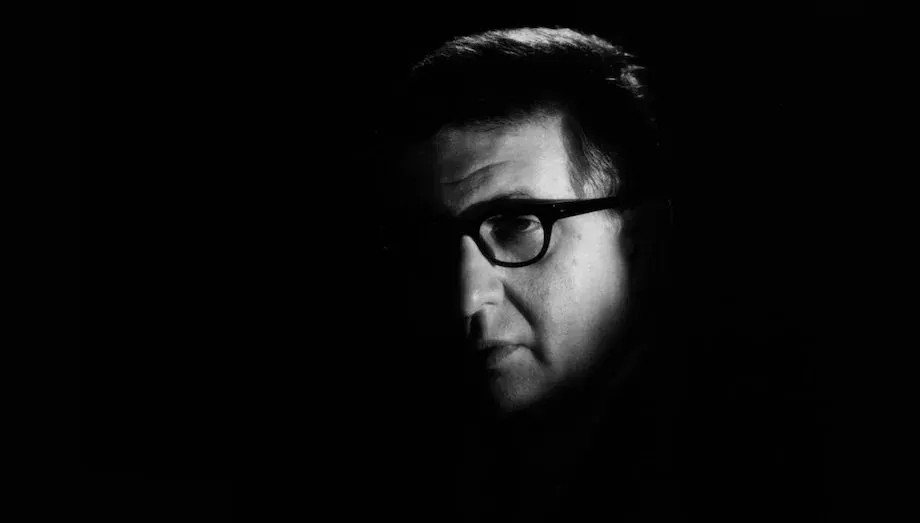

“I always think that film music expresses what the actor can’t show or tell.”
—Bernard Herrmann, interviewed by Ted Gilling, Sight and Sound, 1971–72“I feel that music on the screen can seek out and intensify the inner thoughts of the characters… It can propel narrative forward or slow it down. It often lifts mere dialogue into the realm of poetry,”So wrote Bernard Herrmann for a 1972 London recording
“My feelings and yearnings are those of a composer of the 19th century. I am completely out of step with the present.”
-Bernard Herrmann in a letter to his wife“He depends on music and often photographs a scene knowing that music will complete it.”—Bernard Herrmann, interviewed by Ted Gilling, Sight and Sound, vol. 41, no. 1 (1971/72), pp. 36–39; by Cinescores. “He” refers explicitly to Hitchcock in the preceding sentence.
On music as Hitchcock’s weapon of suspense:
“I think that Hitchcock’s films depend enormously on music to build his nutcracker of suspense, and to impose on him a kind of pop culture is to deprive him of one of the greatest weapons in his arsenal.”—From the same Ted Gilling interview. This is the full sentence as reproduced in the transcript. Herrmann was discussing the end of their collaboration and his objection to the pressure for pop-oriented music.
On Hitchcock adapting his editing to the score:
“Hitchcock, for example, is very anxious for you to tell him when you see a rough cut where you plan to use music, because if you’re using music, he’ll cut it differently.”—From the same interview. This gives you a specific account of how the collaboration worked: the planned music could affect Hitchcock’s editing, rather than simply being added to a finished sequence.
On their break—sharper and more confrontational:
“Because … he only finishes a picture 60 percent. I have to finish it for him.”—Bernard Herrmann, interviewed by Royal S. Brown in August 1975. The ellipsis appears in the published transcript; The interview first appeared in High Fidelity in September 1976 and was revised for Brown’s Overtones and Undertones (1994). The Bernard Herrmann Society reproduces it with a note explaining that the original recording was consulted to restore deletions and some of Herrmann’s original wording.
In the Gilling interview, Herrmann also recalls Hitchcock saying, about Vertigo: Alfred Hitchcock, as recalled by Bernard Herrmann.
“If we’re going to have music, we won’t have one word of dialogue; we’ll just have the camera and you.”Composer Miklos Rozsa reportedly said:
“Herrmann was a Gulliver among the film music Lilliputians.”“The thing about Herrmann was that he was a forceful personality and that force in his personality found its voice in those hammering, repetitive themes of his, which you can’t get out of your ear. – Composer John Williams
Before the Image, a Voice- Bernard Herrmann and the music beneath the surface
I often feel that Bernard Herrmann’s music reaches a character’s inner life before the film has found the words for it. It doesn’t merely accompany danger or alert us to the fact that danger is near; it draws us into and lets us also feel their dread, longing, obsession, or loneliness. Before we know its name, we know the sound.
A shower curtain opens, and violins turn into an assault. A woman emerges through a ghostly green light, and the orchestra swells with an obsessive love so desperate that it can no longer distinguish a person from a beautiful phantasm. A taxi moves through Manhattan steam, and the music offers two versions of the city: one is seductive, the other already burning.
These are not merely memorable musical textures or the voices of films like Psycho, Vertigo, and Taxi Driver. They are part of what those films mean. Bernard Herrmann could make an orchestra reveal something that a character would never admit, or that a director preferred to leave unresolved. His music did not always tell us what was happening, but it did tell us what happening felt like, from somewhere dangerously far inside.
Bernard Herrmann’s biographer Steven C. Smith, the author of A Heart at Fire’s Center: The Life and Music of Bernard Herrmann, finds much of Herrmann’s genius in his ability to evoke psychological nuance, and in the way he brought together just the right instruments to give each film its own emotional undercurrents and draw us closer to the characters’ fear and desires.
You may know Bernard Herrmann’s music whether you realize it or not. Think of the dark snarling brass that opens Citizen Kane, the spiraling arpeggiated phrases of Vertigo, or the headlong rush of North by Northwest. Those strings that slash the air in Psycho, the saxophone drifting through Taxi Driver, and, of course, each belongs so completely to its film that it is hard to imagine the images without it in the realm of modern cinema.
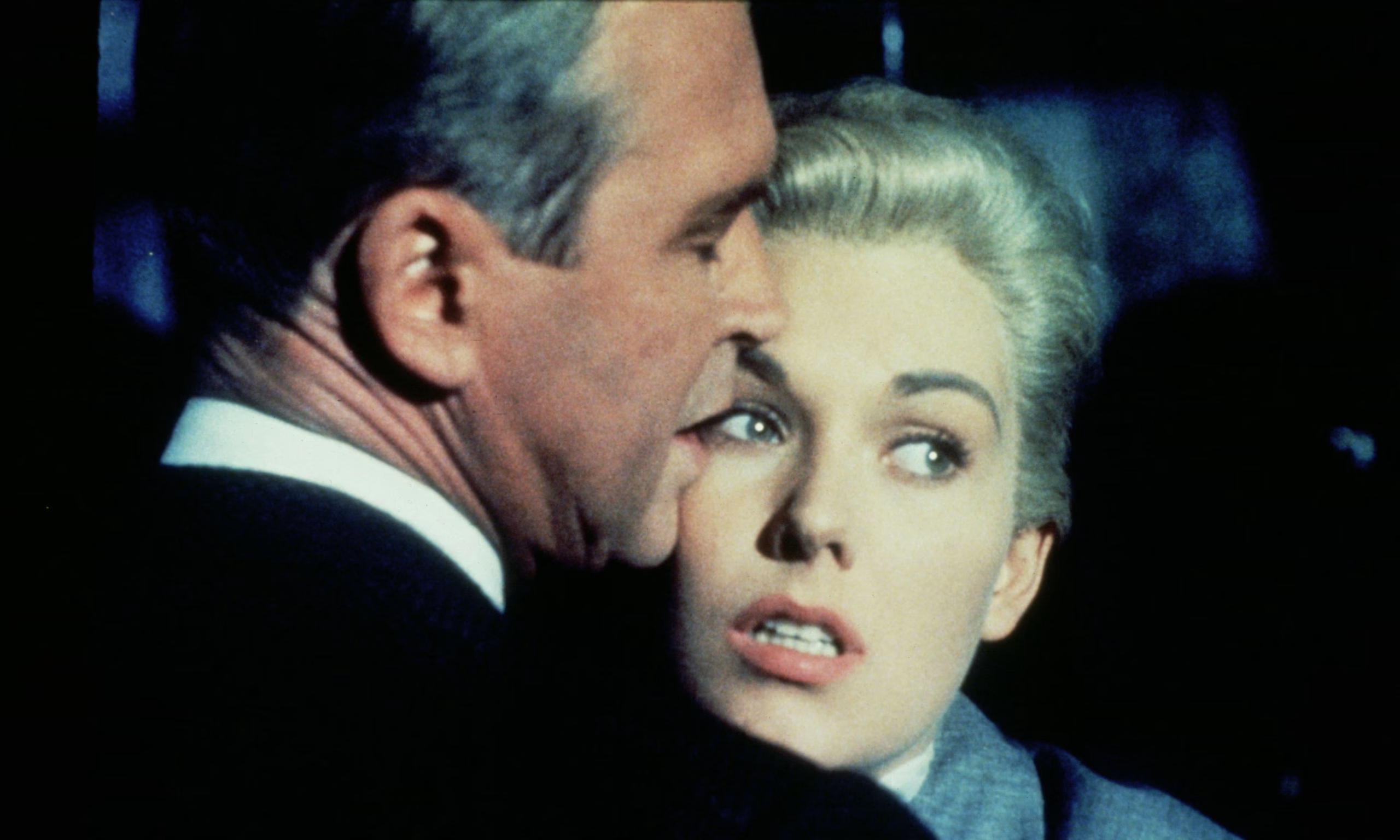


Yet there is much more to Herrmann than menace. He could give The Magnificent Ambersons a tenuous elegance, then summon the enormous forces that seem to shake the ground beneath Mysterious Island. Across that range, you can still hear his signature: short phrases that won’t let go, chords that seem suspended in midair, and moments when the music opens unexpectedly into longing. Listen to brass voices plunging in Cape Fear or the sinister whistling theme from Twisted Nerve. The music leaves us unsettled, waiting for a resolution that never quite arrives.
The title The Sound of Suspense fits him, but suspense is only the beginning. Herrmann also understood solitude, tenderness, grief, and the peculiar terror of wanting something that could save you in the end or finally bring you relief, while the threat that you might never attain it feels all too real.
But his music could just as readily open its arms to romance, catch the exhilaration of an adventure, or give us the wonder of stepping into a world we had never imagined. He had room for the whole sweep of feelings, from the smallest private hope to the grandest leap into the unknown. Maybe beneath the famous shocks lies a composer of longing: for lost childhoods (Citizen Kane), unreachable lovers (the heartbreaking separation between Lucy Muir and the ghostly sea captain in The Ghost and Mrs. Muir), vanished worlds (The Magnificent Ambersons – the family’s privileged world gives way to industrial change. His soundtrack captures the loss of an entire social order, not simply one person’s happiness) Herrmann’s score belongs to that story of decline and displacement, and human contact that arrives too late (Taxi Driver, On Dangerous Ground) or at a price. His reputation for terror can overshadow the yearningly romantic side of his music, particularly in North by Northwest and The Ghost and Mrs. Muir. All of it belongs to the emotional territory of his work. He could also make room for love fulfilled, horizons opening, and the sheer joy of being swept into something larger than ourselves.
Bernard Herrmann might have preferred to be celebrated for his opera Wuthering Heights, his symphonies, his cantata Moby Dick, and his other concert works. Yet, according to fellow film composer John Williams, Herrmann’s greatest ambition was to earn recognition as a conductor. Whatever recognition he hoped for, the movies became the place where his imagination left its deepest mark. He helped change not just how films sounded, but what they could say through music, and generations of composers have been listening ever since. That was “his great skill—his understanding of the psychology of the character,” fellow film composer Howard Shore said. Herrmann could hear what was happening beneath a character’s words and actions, then give it musical expression. His scores brought us closer to the fears, desires, and contradictions driving the people on screen.
Herrmann’s music could stir a feeling, resist it, or give it an unexpected gravity. The psychology was in the encounter—not only in the person, but in what happened when that person met the world.


A Life Tuned to Drama
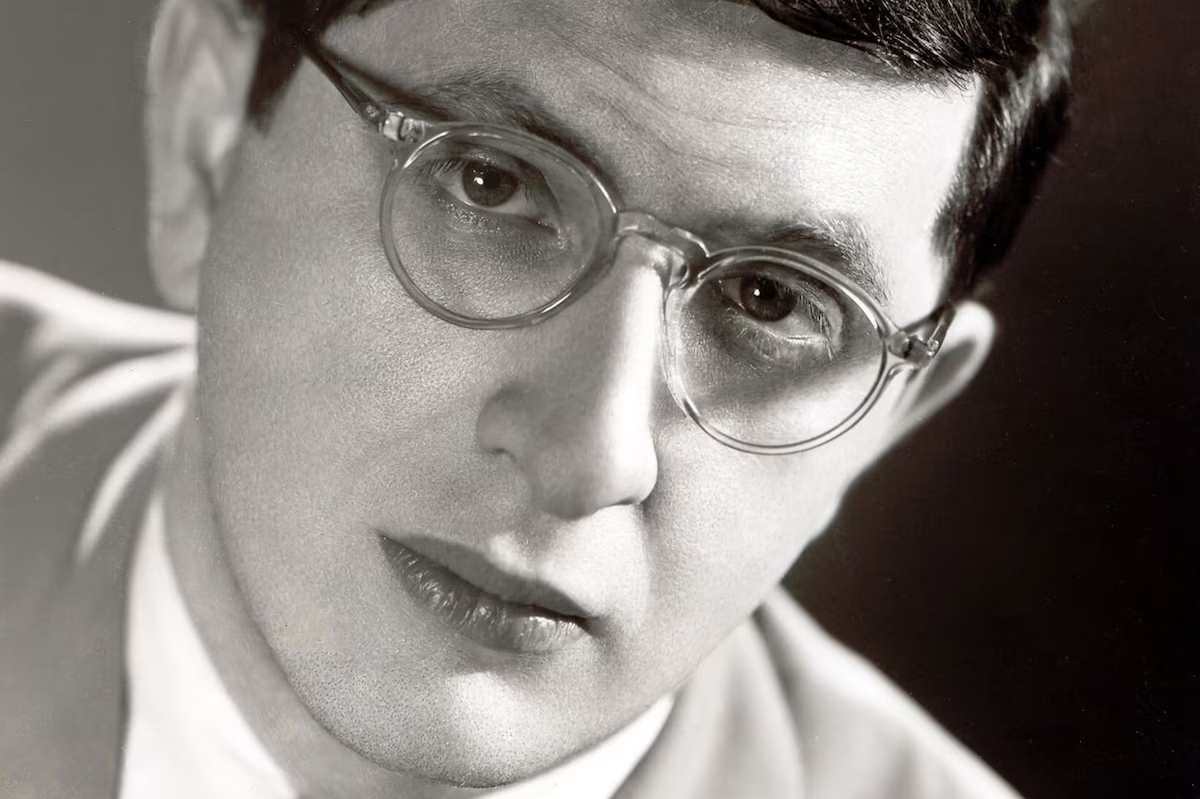
Bernard Herrmann was born in New York City on June 29, 1911, to Jewish parents who had come from Russia. He proved to be a musical prodigy early: with a flair for violin and piano, he soon revealed a talent for composition.
I like to picture his musical beginnings through the things his father brought within reach: evenings at the opera, the sweep of a symphony, and a violin he could tuck beneath his own chin. His father encouraged that early fascination, giving him an instrument at age five and the lessons to begin finding his way into the music for himself.


As a young man, Herrmann discovered Hector Berlioz’s treatise on instrumentation, a book that helped persuade him to become a composer. I find that an especially telling beginning for someone who would become so sensitive to the expressive character of individual instruments and draw so much feeling from the combinations he chose for each film.
In January 1929, at seventeen, he completed his first work for large orchestra, The Forest: A Tone Poem, and by his early twenties was gathering musicians together for his own New Chamber Orchestra. At age 20, he studied at New York University and Juilliard, formed the New Chamber Orchestra of New York, and wrote his first dramatic score at age 22. In 1934, the aspiring composer, an active member of Aaron Copland’s circle, joined the Columbia Broadcasting System (CBS) as a staff conductor. Herrmann did not begin as someone waiting for Hollywood to give him an identity.
But the career that made Herrmann famous wasn’t quite the one he wanted most. For all his success as an influential film composer, his first love was still conducting. You might expect it to be the other way around, a conductor wishing he had more time to write music of his own. Herrmann wanted more time leading an orchestra, performing other composers’ work. Writing his own music mattered to him, but so did the chance to share music he loved with an audience. One of the twentieth century’s most distinctive musical voices found a particular sense of purpose in giving voice to other composers’ work.


John Williams put it this way, “Benny was what you’d expect him to be. Powerful and willful. He put his idiosyncratic spin on everything he did. His lasting contribution is not only his film music, but as a single-minded artist who kept his seriousness intact. His music, yes. Everybody knows the Alfred Hitchcock scores. What’s behind that is a strong character that is unyielding. He was a unique man.”


Before the Camera: Herrmann on Radio
Before Herrmann gave suspense a cinematic voice, he learned how to make it inhabit the imagination. Radio’s unseen world offered no face to study, no landscape to photograph, no reassuring evidence of what stood beyond a door. Music could supply those missing dimensions or make their absence disturbing. Before Hollywood, there was the orchestra and then the radio. Herrmann joined CBS in 1934 as a staff arranger and conductor. In 1934, he began writing for radio with In the Modern Manner, a series of poetry settings. By 1937, his experimental compositions for The Columbia Workshop were giving him room to explore what music could do when the audience had only sound to guide its imagination.
For a time, radio gave Herrmann a regular opportunity to conduct concert music alongside his work for film. His weekly CBS series, Invitation to Music, brought orchestral performances into listeners’ homes.
Radio gave Herrmann steady work and taught him how to make music count in a story. At CBS, he wrote and arranged music for broadcasts, conducted orchestral performances—including those on his weekly series, Invitation to Music—and eventually became chief conductor of the network’s symphony orchestra. A radio score had to work quickly, setting the scene, bridging a transition, moving the story along, or suggesting a change in mood before a listener lost the thread. Herrmann learned how much a few seconds could convey.


Herrmann wanted to write music, conduct, explore, and champion other musical voices by introducing people to composers they might never have heard otherwise.
“He was really a traditionalist,” composer John Williams said. “He was suspicious of modernity. But he was also an advocate for neglected composers.”
At CBS, he had the chance to do all of this. He used his broadcasts to share unfamiliar pieces of music and neglected music that rarely got played. That curiosity came through when you met him, too. David Raksin, a composer I’ve admired for years, who wrote the music for Preminger’s 1944 noir classic Laura and Vincente Minnelli’s 1952 melodrama The Bad and the Beautiful, along with the evocative television theme for Ben Casey, remembered meeting Herrmann at CBS in 1935 and being amazed by how much obscure music he knew. Even then, Herrmann wasn’t just interested in discovering music for himself. He wanted other people to hear it.


In 1938, Herrmann’s work took a decisive turn when he became the composer for Orson Welles’s The Mercury Theatre on the Air. Their collaboration developed in a world of voices, microphones, and precisely timed musical entrances. Welles produced and performed, while Herrmann helped give the literary adaptations an atmosphere that listeners had to complete for themselves. Their work together depended on a world of voices. The broadcast also shows how closely Welles and Herrmann thought about sound and dramatic timing.
Through their radio collaborations, they tackled Dracula, Heart of Darkness, The Magnificent Ambersons, The Thirty-Nine Steps, and A Tale of Two Cities. Herrmann helped give dramatic shape to stories and bring whole worlds into being through sound. These were places and characters listeners couldn’t see, but voices they would come to know, and dangers that felt close enough to touch. It was an extraordinary education in musical storytelling: how the music had to make its presence felt quickly, how quickly it could establish the mood and bring a place to mind, how much a few notes could suggest, and how a shift in the music could change everything.
Writing in Cineaste, David Sterritt reviewed Steven C. Smith’s Hitchcock and Herrmann: The Friendship and Film Scores That Changed Cinema; he talks about how their temperaments were not designed for a quiet afternoon. Working together wasn’t always peaceful. Producer John Houseman remembered “the snapping of batons and the hurling of scripts and scores into the air” during the Welles years. The commotion didn’t cause artistic paralysis. When their collaboration moved from radio into motion pictures, Welles and Herrmann still managed to do great work together; Houseman recalled that the two men came to understand each other perfectly.


Photograph of a rehearsal of CBS Radio’s The Mercury Theatre on the Air, printed in many US newspapers following the broadcast of “The War of the Worlds.” Subjects include Orson Welles, with arms upraised; Bernard Herrmann, conducting the CBS Radio orchestra; actor Ray Collins at the CBS microphone; Richard Wilson (white shirt) beside him; William Alland to Wilson’s left; and Arthur Anderson.
Then, in October 1938, came The War of the Worlds. Welles and his Mercury company turned H. G. Wells’s science-fiction novel into a radio drama, using simulated news reports to make the story sound as though it were happening live. Herrmann conducted the studio musicians appearing as the fictional Ramón Raquello and His Orchestra, who played the part of a dance orchestra in what seemed to be an ordinary evening broadcast. He helped give the literary adaptation an atmosphere that listeners had to complete for themselves. The broadcast made newspaper headlines, brought Welles wider attention, and helped pave his way to Hollywood. Its unnerving effect depended largely on the imitation of ordinary broadcasting, dance music interrupted by reports of an increasingly extraordinary emergency, rather than on an orchestra continuously announcing catastrophe. The distinction is revealing: suspense could arise from the disruption of familiar sound, not merely from the addition of frightening music.
The broadcast on October 30, 1938, scared some listeners into calling the police and newspapers, and there were scattered reports of people fleeing their homes, because Martians were invading, and they were starting with New Jersey. But the nationwide panic was largely a newspaper production, played up by a press that was keen to show how irresponsible its radio rival could be. The Martians were fictional; the competition for advertising wasn’t. That night would later become the basis for the 1975 television dramatization The Night That Panicked America. By then, the panic itself had become as much a part of the story as the fictional invasion.


Herrmann had composed, arranged, and conducted more music for Welles’ Mercury Theatre radio plays. Radio was not simply a training ground he abandoned upon reaching Hollywood. It remained a substantial part of his working life, encompassing not just The Mercury Theatre on the Air, but The Campbell Playhouse, Suspense, Crime Classics, and his collaborations with Norman Corwin.
In the 1940s, he continued to regularly conduct concerts for CBS Radio, introducing American audiences to important works and championing challenging composers such as Charles Ives.
One of their most haunting radio collaborations was The Hitch-Hiker, first broadcast on The Orson Welles Show on November 17, 1941. Written by Lucille Fletcher, then Herrmann’s wife, it follows a motorist who repeatedly encounters the same mysterious figure along a cross-country journey. Welles supplies the increasingly desperate voice; Herrmann’s score makes the road feel less like a route of escape than a passage through a fear that keeps arriving ahead of its haunted traveler. The landscape changes, but the apparition returns. Here is an early, concentrated example of the territory Herrmann would explore so memorably in film: physical movement that cannot free a character from psychological captivity. The play returned on several radio programs, retaining his music; biographer Steven C. Smith described it as one of the composer’s most chilling scores. The story found another unnerving life on The Twilight Zone in 1960, with Inger Stevens taking the wheel as the gradually unraveling Nan in Rod Serling’s adaptation of Fletcher’s play.


Radio also gave Herrmann room to move beyond pursuit and dread. In Norman Corwin’s Whitman (1944), his music joined Charles Laughton’s reading to give Walt Whitman’s poetry a fresh resonance for a nation at war.
Whitman’s democratic vision gave the broadcast a way to speak to its own moment through an older American voice. For Herrmann, it shows another side of his dramatic instincts. He could draw us into a mind closing around the isolation of an obsession, but he could also make room for something more expansive: a sense of fellowship and responsibility for one another. Radio let him address not just the solitary listener, but people listening together.
That sense of shared responsibility took on a larger scale in Corwin’s On a Note of Triumph, broadcast on May 8, 1945, to mark victory in Europe. Narrated by Martin Gabel, the hour-long production celebrated the victory, but also asked what the living owed the dead and one another. Herrmann’s score moved between relief, remembrance, and the responsibilities that lay ahead. As the Library of Congress account makes clear, his music and Corwin’s words helped turn a victory broadcast into a question for its enormous audience: what should people do with the peace they had won and the kind of world that should follow?
These broadcasts show how much more there was to Herrmann than a gift for terror. In radio, he moved from ghost stories and literary adaptations to historical crime, poetry, and national occasions. He also learned to make a little music go a long way: without an image to help. A musical entrance had to establish its purpose without a camera doing half the work. So a few notes had to tell listeners where they were or unsettle their sense of it. Long before the shower in Psycho or the haunted obsessive circles of Vertigo, he was finding ways to make an unseen world felt. The music could tell you something had changed before the voice at the microphone explained what it was or anyone said a word.


From Radio to Citizen Kane: The Trouble Beneath the Surface—The Sound of a Life Already Lost
In 1939, at Orson Welles’s insistence, RKO hired Herrmann. Welles had a lasting influence on Herrmann, who often singled him out as the director who best understood what music could bring to a film.
He explains that Orson Welles “dealt with characters, with people’s emotions and attitudes. While Hitchcock deals very rarely with character portrayal, or has little or no interest in people’s emotions… his interest in music is only in relationship to how the suspense can be heightened… one has to create a landscape for each film, whether it be the rainy night of PSYCHO or the turbulence of a picture such as VERTIGO, as CITIZEN KANE, a picture of people within a specific time and how they felt against external events, I mean of attitudes, of hatred, love, revenge.” – Roger Hall, Soundtrack Magazine, 2002
The composer’s first feature-film assignment was the sled movie that was Citizen Kane. Some careers begin with an apprenticeship. Herrmann’s began with Xanadu. Charles Foster Kane’s vast fictional estate in the film: a castle-like mansion in Florida, surrounded by sprawling grounds and filled with the art and objects he has collected. It is where he dies at the beginning of the film.
While sweeping romantic scores were the fashion, Herrmann brought the compact, elliptical language of radio to Citizen Kane. He described the result as a “jigsaw,” fitting together waltzes, polkas, jazz and opera rather than letting one grand musical statement carry the film.


Orson Welles’s Citizen Kane (1941) gave Herrmann an unusually rich first canvas: a story assembled from fragments, memories, contradictions, and the testimony of people who had known a man without necessarily understanding him. Herrmann responded with music that could move between public spectacle and private emptiness. His experience in radio helped him write brief, sharply purposeful cues rather than assuming that every passage needed an extended musical explanation.
Welles brought the same ambition to movies that had already made him a force on the airwaves. When he went to RKO to make Citizen Kane, many of his Mercury collaborators came with him, including, of course, Herrmann. Performers who were familiar to radio listeners, known by their distinctive voices, were now appearing on screen, and Herrmann was writing his first film score. When Welles moved into filmmaking, Herrmann brought this understanding of dramatic timing with him. It was the start of a new direction for him, and the film career he’s best known for today.
The music brought together techniques that would become signatures of his work: recurring themes, or leitmotifs, that draw us back to a character or narrative thread, and brief musical cues that carry us from one scene to the next.
The score also revealed his affinity for ostinatos—short, repeated phrases of just a few notes that create momentum, tension, or a sense of something quietly taking hold. Those insistent little patterns would return throughout his career.
Perhaps the clearest hint of what Herrmann would later bring to Taxi Driver comes in the opening of Citizen Kane, where a distinct theme matters less than the brooding textures that leave us sensing something is wrong before we know why.
At the beginning, the music leads us toward Kane’s estate as though entering a mausoleum whose owner has not quite finished dying. Composer David Raksin described it as an introduction to Kane’s “grandiose and morbid world.” The score makes the vastness feel airless. Here is wealth that has accumulated until it resembles a type of burial.
What strikes me about Herrmann’s score is how dark it sounds from the beginning. As the camera takes us toward Xanadu, low woodwinds and brass give the place a heavy, brooding atmosphere. This isn’t the grand entrance we might expect for a man of Kane’s wealth and importance. The music makes his estate feel remote and unwelcoming, a place already weighed down by its past. Herrmann’s fondness for the lower voices of the orchestra is there from his very first film.
But the score doesn’t stay in that darkness. It moves through waltzes, lively dances, songs, and opera as the film moves between different periods of Kane’s life. Herrmann also brought something practical from radio: the confidence to use a brief musical passage, make his point, and stop. He didn’t need to keep the orchestra playing beneath every scene. A few seconds could carry us into another time or suggest a feeling that the dialogue left unspoken.


Herrmann could also find the drama in an ordinary moment. He demonstrates that dramatic insight in one particular scene that doesn’t need to announce itself solemnly. The breakfast montage traces a marriage coming apart through a series of encounters across a table. The music helps us feel the passing years and the growing distance between two people, turning a familiar domestic routine into an account of emotional estrangement and something quietly painful. Both the montage and the opera sequence show Herrmann’s keen sense of how music can shape a scene’s dramatic impact.
The breakfast-table sequence is a lovely example of how much music could tell us, as we watch Kane and his first wife, Emily, grow apart over this series of breakfasts, while Herrmann writes variations on the same waltz. At first it has an easy grace. As their exchanges become colder, the music loses that warmth, too. Years of marriage pass in just a few minutes, and we hear the distance growing between them as clearly as we see it. The music helps make those separate mornings feel like one continuous unraveling.


Then there is Susan Alexander’s disastrous debut on the opera stage, where she was given a piece far beyond what her modest voice could comfortably manage. Herrmann wrote an aria for the invented opera Salammbô. The orchestra sounds imposing; Susan sounds overwhelmed. That imbalance is the point. We’re hearing the difference between what Kane insists she can be and what she can actually do, and how exposed she is when his ambition puts her in front of an audience.
According to Raksin, he set the vocal line high enough to make her performance sound strained. The music does not simply accompany Susan’s failure; it makes us hear the effort of trying to fulfill Kane’s ambitions. What he wants becomes something she has to endure.
Running through these changes are recurring musical ideas associated with Kane’s power and with Rosebud. The Rosebud music is heard near the beginning, with the delicate sound of the vibraphone, and returns in different forms before we understand its significance. By the end, it connects the mystery surrounding Kane to something much more private: the childhood he lost. For all the score’s variety, Herrmann keeps bringing us back to the difference between the public figure everyone remembers and the person none of them quite knew.
Herrmann earned an Oscar nomination for Citizen Kane, but it was his other score that year that took home the award: William Dieterle’s The Devil and Daniel Webster (1941), also released as All That Money Can Buy. Its story of a bargain with the devil gave him room to play with layers of recorded violin music and eerie sounds that made us truly sense the devil’s presence. Herrmann’s score has a diabolical charm, as though the fiddle knows something about the bargain that we don’t.
Set in 1840s New Hampshire, The Devil and Daniel Webster follows Jabez Stone (James Craig), a struggling farmer, poor but a good man living a simple life with his wife (Anne Shirley) and his Ma (Jane Darwell), who trades his soul to Mr. Scratch (Walter Huston) for seven years of prosperity. Soon things get better; he’s even charmed by the enchanting Belle (Simone Simon), but after seven years, the bargain comes due and Scratch returns to collect. Jabez sees that he is doomed, but Daniel Webster (Edward Arnold) steps in to defend him in a trial. Herrmann’s score brings the story’s rustic charm and supernatural menace together with remarkable inventiveness. For the fiddle sequence, based on The Ballad of Springfield Mountain, he creates effects that no single player could achieve. He layered multiple recordings of the fiddler, allowing plucked harmonics and bowed passages to sound simultaneously. The result is a striking example of his gift for making music part of the storytelling. For all the remarkable scores still to come, this would remain his only Oscar win.
In general, where have you had the greatest opportunities to experiment?
“CITIZEN KANE was completely different from any other film ever made, and the score, like the film, works like a jigsaw. For William Dieterle’s THE DEVIL AND DANIEL WEBSTER, I used a mixture of the rustic barnyard style of music and a very advanced electronic kind of music. When the devil plays at the barn dance, we superimposed for the first time four violin tracks on top of each other. That wasn’t repeated for the commercial recording because you have to see the visual to get the impact of it. And we had another effect which we got from recording the sound of singing telephone wires at 4 a.m. It was always used whenever the devil (Walter Huston) appears.” – interview with Ted Gilling, 1971


Agnes Moorehead as Fanny Minafer, whose thwarted hopes and aching loneliness haunt Orson Welles’s The Magnificent Ambersons (1942).
Herrmann’s next collaboration with Welles, The Magnificent Ambersons (1942), had a far more troubled fate. As RKO famously cut and butchered the film, his music suffered alongside it: roughly thirty minutes of his original fifty-eight-minute score were removed, and music by Roy Webb was added, including music for the replacement ending. What we hear is neither Herrmann’s complete score nor entirely his work. Herrmann was willing to let the studio retain his surviving music, but he refused to take sole credit for a soundtrack that no longer reflected his original vision and intentions. In June 1942, he insisted that his name be removed from the film. His contribution was not entirely erased, but it was definitely obscured: you can still hear a substantial portion of his music in the released version, even though you’ll find no acknowledgment of him in the credits.
Those two scores Kane and Daniel Webster– announced a visionary film composer and a formidable personality who was not always easy to work with. Even in these two early scores, you can hear how far his imagination could travel, from a haunted mansion to the devil himself. Yet both seem to ask the same unsettling question: what do we agree to when we want something too much?


The Concert Hall Within: Herrmann’s Classical Voice
Herrmann’s musical language and classical background influenced his film scores through his command of orchestral color, his combination of the tension between Romantic expressiveness and modernist unease, music that feels tense, unsettled, or dissonant, and his ability to give small musical ideas a larger dramatic shape in his film scores.
He did not simply bring a concert-hall sound to Hollywood: he adapted those resources to the timing and psychological demands of a scene. His concert and screen music also fed into one another: material from his early Sinfonietta for Strings, an early concert work, written for strings in the mid-1930s, not for a film, reappeared in Psycho, while his film work and his opera Wuthering Heights (with a libretto by his first wife, the radio dramatist Lucille Fletcher) shared musical ideas.
Herrmann brought more than his radio experience to the movies. He still brought the musical imagination of a composer and conductor who loved the sweep of Romantic orchestral writing and was curious about the new sounds composers were exploring around him, the new musical experimentation of his own century. In the early 1930s, he joined Aaron Copland’s Young Composers Group, formed the New Chamber Orchestra, and conducted works by his contemporaries, including Charles Ives. Hollywood didn’t draw him away from that world; the music he loved, wrote, studied, and conducted remained part of the intellectual and emotional life that his scores emerged from in each of his films.
That background helped make orchestration a form of dramatic thought. Composers such as Berlioz, Debussy, Ravel, and Delius had shown him different examples of how instrumental color could shape musical expression, influencing Herrmann’s approach to the orchestra.
For Herrmann, choosing which instrument played a phrase mattered as much as the phrase itself. What he carried into film was not simply a preference for sumptuous sound, but an understanding that a musical idea changes according to the voice that delivers it. The same melody could sound fragile or vulnerable in one instrument and threatening in another. A particular combination of instrumental sounds could make a landscape shimmer, or a room feel suddenly claustrophobic, or even a moment of tenderness feel strangely exposed. The orchestral instrumentation was not merely the way to transport his music. It was his way of choosing what sounds were part of the meaning.
His classical inheritance also contained a productive tension. There was room in Herrmann’s music for both warmth and unease. He could write a melody full of longing, then surround it with sounds that made it difficult to relax into its beauty. He could write with the yearning breadth associated with Romantic music while drawing on a more unsettled modernist language. The relationship between those impulses helps explain why beauty in his scores so often fails to bring reassurance or a comfortability. A lyrical passage may offer the promise of emotional release, while its surroundings make that promise difficult to trust. The music can reach toward fulfillment without allowing us to forget what stands in its way. Herrmann did not have to choose between intimacy and disturbance; he could let each sharpen our awareness of the other. That is part of what makes his scores so affecting: a tender passage doesn’t always mean we are safe, and a beautiful one doesn’t necessarily bring comfort. We may hear the hope of love or happiness while sensing how easily it could slip away. In that way, he was the perfect composer for Hitchcock. He could make us feel the safety and the threat at the same time.
Sometimes, the connection between his concert work and his film music was quite literal. Years before Psycho, he wrote Sinfonietta for Strings, a concert piece that explored tense, unsettled sounds; he would revisit it in 1960 for Hitchcock’s seminal psychological thriller, including the three-note figure associated with Norman Bates. This wasn’t simply a matter of putting an old composition to new use. It’s that the expressive musical language he developed outside cinema could take on a new dramatic role within it.
The significance is that music he had first written to stand on its own now helped tell a story. What had once been an uneasy sound in the concert hall became part of the fear we feel watching Psycho. An abstract musical disturbance became attached to a particular mind, a particular room, a particular terrible discovery.
The exchange moved in the other direction as well. His work on Jane Eyre helped inspire his opera Wuthering Heights, composed between 1943 and 1951, and the opera incorporated material associated with several of his early film scores. Rather than treating concert composition and film scoring as separate worlds, Herrmann allowed ideas to travel between them. Both offered room for the subjects that repeatedly drew him: longing, isolation, the persistence of memory, and emotional attachments that become impossible to give over.
His achievement, then, was not to make every film behave like a symphony. It was to make the resources of his deeply rooted musical imagination responsive to the conversation with the screen. A concert work can establish its own span of time; a film score has to negotiate those images, voices, pauses, and cuts.
Herrmann brought those orchestral instincts to film with a keen ear for what each scene needed. The classical composer was always present, but not simply to lend a film more seriousness. He understood how a few notes, a change in harmony, or the distinctive color and character of a particular instrument could shift the emotional weight of a scene.
That combination of musical knowledge and dramatic responsiveness is the foundation of his unmistakable voice. If you want to understand his style more closely, all you have to do is listen not only to his melodies, but to the sounds he chose, the resolutions he withheld, and the small phrases he refused to let go of.


The Shape of an Unquiet Mind: Herrmann’s Musical Language
Many of your best film scores blend both manic rhythms and moody, elegiac sequences, frequently in the minor key. Have you deliberately sought out this kind of material?
“No, I don’t seek it out – they seek me out. In California, they like to pigeonhole you. From the time I began working for Hitchcock, they decided I was a big suspense man. On other occasions, I’ve had fantasies or bittersweet romantic stories. I think I’d enjoy writing a good comedy score, but I’ve never had the luck to be offered such films. The nearest I got to it was Hitchcock’s THE TROUBLE WITH HARRY, and perhaps NORTH BY NORTHWEST. I have no particular theories about keys or modes I work in. The stories are nostalgic or wistful or full of inner contemplation. Mancini gets the cheerful ones. So that’s how it is.” —From Cinescores – Bernard Herrmann: The Colour of the Music
Ted Gilling interview 1971/72
Herrmann was a neo-romantic composer, a modernist with a romantic soul. Herrmann’s music had deep roots in Romanticism, but he was never confined by tradition. He often worked with short musical phrases, developing them through repetition and variation, and used unusual harmonies to give familiar chords an unexpected edge.
Instead of letting a melody stretch out at length, he often took a short musical phrase and explored what it could do, returning to it through different incarnations. His unusual chords could give a scene its emotional character, then reappear later to connect it with another moment in the film. He certainly wrote themes for characters and ideas, but his music often made its point through a few carefully chosen phrases rather than a long, sweeping statement. There was nothing small about the effect, though. His use of repeating patterns anticipated aspects of minimalism, and he also experimented with atonality and twelve-tone techniques. Audiences drawn in by the story were hearing some of the most adventurous musical ideas of the time, whether they realized it or not.
“Film music must apply what an actor cannot say. The music must really convey what the word cannot do. If you’re dealing with an emotional subject this is the complete purpose of a film score. But if you’re dealing with a picture by Hitchcock or anyone film by someone of enormous skill and taste, a film is only made of segments that are put together and artificially linked by dissolves or cuts, or montages, and the many ways that a film can be made. It is the function of music to cement these pieces into one design that the audience feels that their sequence is inevitable. Now, it is one of the paradoxes of cinema music that music correctly used can be of very poor quality and be effective, or be music of magnificent quality and also serve its purpose.” – commentary by Herrmann included on the final track of the 1993 Milan CD, Bernard Herrmann Film Music
Herrmann’s music often seems to begin even before there’s dialogue, to reach us before words do, catching a feeling before we quite know how to explain it. What makes it recognizable isn’t one particular quality; he brings together his choice of instruments, harmony, and rhythm that work together to draw us into the emotional life of a scene. A short phrase repeats, but the music around it grows darker. A chord hangs on, keeping us waiting for it to settle. A tender passage can wind up becoming inseparable; something about it leaves us feeling uneasy.
His musical voice brings together the emotional intensity of Romantic music and the restless edge of modernist music, so beauty and disquiet can occupy the same space. He lets us feel the full emotional force of the moment, without pretending it’s simple. Instrumental color was at the heart of that voice. For Herrmann, the orchestration was the finishing coat of paint applied to an already completed canvas. He orchestrated his own scores because the choice of instruments belonged to the act of composing in itself; he heard each phrase with a particular instrumental sound already in mind. A musical phrase could hold one feeling in the low warmth of a bass clarinet and a different feeling in the slender sound of a violin.
It’s the combination of voices, how high or low the register of an instrument, how sounds blended or stood apart from each other; all of this helped shape the feeling of the music. Herrmann often built his ensembles around the particular needs of a story, choosing as he went along which instruments belonged to that particular drama. He might leave out a whole family of instruments or bring together an unusual concentration of another, choosing what we hear, shaping the sound as carefully as a director decides what belongs within the boundaries of a frame.
Within the depth of his music, his work lets us hear what lies on the surface and sense what stirs beneath it. Low woodwinds and heavy brass can suggest something gathering beneath the stillness. A harp or a high, exposed melodic line can let in a fragile brightness, even as the darkness remains surrounding it. Herrmann understood the nuances of musical thought, often letting groups of instruments stand apart, answering one another or troubling one another, adding tension between them. We hear one sound as close and vulnerable, another as distant and unyielding. These unusual combinations have a dramatic purpose. These unusual combinations were rarely chosen for their novelty alone. They give each story its own atmosphere: how heavy the air feels, how warm or cold the space, how much room there is to breathe.
Harmony gives those rooms their uncertain foundations. Hermann could use recognizable chords, at the same time denying us any comfort of hearing them find their way home. He might set contrasting harmonies against one another, move between them without warning, or hold back the resolution we’re waiting to hear.
The effect is not always harsh. Sometimes the music is beautiful precisely because it seems suspended: a promise left hanging there, a longing that can’t quite settle. At other moments, clashing harmonies make the music feel unstable from within. We may recognize the individual sounds, yet we distrust or feel uneasy about what happens between them. The suspense comes as much from waiting for that arrival as from any sudden dissonance or a clash of notes that breaks the calm.


Gothic Hearts: Jane Eyre, Hangover Square, and The Ghost and Mrs. Muir
Herrmann’s early work makes it impossible to reduce him to a specialist in murder.
In Robert Stevenson’s Jane Eyre, completed in 1943 and released widely in 1944, Herrmann surrounds the romance between Joan Fontaine’s resilient Jane and Orson Welles’s brooding Rochester with a lush Gothic sound, full of darkness, secrets, old wounds, unspoken longing, and unease. When Rochester arrives on horseback, the ominous orchestral colors make his entrance feel less like an introduction than a warning. Before we know his story, we can already hear that something weighs on him.
In Jane Eyre, Herrmann makes the orchestra sound as though it has entered a house where every room remembers something its inhabitants refuse to say. Low woodwinds gather beneath the music like darkness seeping beneath a door; muted brass, high woodwinds, and the glimmer of celesta, a small piano whose delicate hammers strike metal bars rather than strings. It produces an angelic bell-like sound that is bright and shimmering, but softer than a glockenspiel. This treatment gives that darkness changing edges. Thornfield is not merely a setting that lends to an atmosphere; it actually becomes an audible pressure, a place where sensitivity must find its way through secrecy. The music can make us hesitate before a door has opened, as though the orchestra has already sensed what waits on the other side.
Against that weight, the oboe, the instrument Herrmann uses to give Jane her own musical voice, offers something more solitary and personal kind of expression. Its wistful sound, sometimes joined by the harp, does not need to overwhelm the orchestra to establish a presence or force us to listen. It’s not a theme that suggests helplessness or an easy reassurance either, that Jane will be safe in the end, yet there’s an inner life that says I refuse to disappear. Where the darker instrumental colors make the surrounding world feel heavy with withheld knowledge, the oboe gives that feeling a narrow passage through it. There is vulnerability in it, but also resolve: a sense of someone holding on to herself. She’ll remain quiet without surrendering her desire to be heard.


When the strings open into fuller, more romantic writing, Jane’s private feelings seem to reach beyond her, becoming more urgent and harder to, and incapable of, sweeping the shadows aside. But the shadows do not simply fall away. Herrmann lets longing and unease share the same musical space, so that the hope of love comes with the danger of trusting it. Even as the melody opens out, we can still hear the darkness around it. It feels less like sunlight entering a room than a fire being lit inside it: there is warmth at last, but beyond its glow, it remains uncertain.
This is what gives the score its emotional force. The Gothic unease and the romantic expression are not separate elements attached to separate scenes. They exert pressure on one another. Beauty becomes more vulnerable because we have heard the darkness surrounding it; the darkness becomes more troubling because there is the possibility of love for it to endanger. Herrmann gives Jane’s inner life a voice in the orchestra, her longing held back at first, then laid bare, and finally opening out. The music lets us hear both the strength of her feelings and the courage it takes for her to trust someone when she has learned to expect secrets.
John Brahm’s Hangover Square (1945) brought the relationship between music and disturbed psychology into the plot itself. Its central figure, a composer played by Laird Cregar, suffers murderous blackouts while struggling to complete a piano concerto. Herrmann wrote the substantial concerto movement performed in the climax, where the music continues amid a catastrophic fire.


In Hangover Square, Herrmann gives the piano a voice that seems capable of turning against the hands that summon its music. Its notes strike hard, leap abruptly, clash with one another, and carry dissonant aggression. Around it, harsh strings surge and ominous muted horns make the orchestra feel less like support than a growing threat. He also becomes fixated on Netta Longdon, an ambitious singer played by Linda Darnell, who encourages his attention to persuade him to write songs for her
The piano, which usually demands control, discipline, and cultivated expression, becomes a source of instability. Phrases unfold like an attack, pull back, and return rather than flowing smoothly. We hear someone who can control the music with extraordinary precision but cannot control the impulses beneath it. Laird Cregar’s performance of the tormented George Harvey Bone gives that struggle a volatile physical presence, moving between exquisite restraint and anguish that seems ready to tear through it.
That contradiction gives Laird Cregar’s portrayal an unsettling musical depth. Herrmann does not confine him to the sounds of menace. The score also has room for soaring strings and lonely melancholy, allowing the character’s aspiration and vulnerability to remain audible within the violence. Beauty is not an alibi for what Bone does, but it prevents the music from reducing him to a single monstrous gesture. We hear the possibility of an expressive life alongside the forces that threaten to destroy it. The same musical world can contain the wish to create something lasting and the compulsion to destroy what stands in its way.


The Concerto Macabre brings those competing forces into a single musical statement. Written in a dark, Lisztian vein, it is not simply a spectacular concert piece inserted into the film’s conclusion. Its musical ideas are threaded through the surrounding score, so that the final performance gathers sounds we have already encountered in fragments. What seemed scattered across acts of violence and moments of unrest now acquires the shape of a finished composition. When you hear it this way, the concerto is a terrible act of recognition: the character’s artistic achievement and his destructive inner life force have been speaking related musical languages all along.
Fire completes that connection. Herrmann draws the music associated with the film’s fires from a fast-moving section of the concerto, binding destruction to the work Bone is trying to complete. In the final performance, as flames spread and the others flee, the music no longer seems safely enclosed within a concert. The room becomes an extension of its violence. Bone returns to the keyboard, and the piano’s persistence begins to sound like a refusal to acknowledge anything beyond the next phrase. Creation continues, but it can no longer be separated from self-destruction.


At the end, the orchestra falls away, and the piano remains alone. And that withdrawal is more disturbing than another overwhelming climax would be. The instrument that has struggled against the surrounding musical forces is left without an answering voice, continuing inside a world that is disappearing around it, burning down around it. So Herrmann lets the concerto end not in the public triumph we might expect from its structure, but in a solitude that feels absolute. The final sound, then, is an achievement stripped of any future in which anyone might hear it: music completed at the very moment its imagined life beyond the composer is consumed.
The result is not simply a thriller with an impressive musical finale. Artistic creation and destruction become inseparable. The concerto is the character’s achievement, his refuge, and the thing he cannot abandon even when his survival demands it. The familiar romantic image of the artist consumed by his work becomes horribly literal.
Then comes Joseph L. Mankiewicz’s The Ghost and Mrs. Muir (1947), one of Herrmann’s own favorite scores. A widow, played by Gene Tierney, whose luminous stillness moves into a seaside house inhabited by the ghost of a sea captain, played by Rex Harrison. Their impossible relationship gives Herrmann room for a tenderness that audiences who know only Psycho may find startling.


In The Ghost and Mrs. Muir, Herrmann makes the sea sound like something the heart remembers before the mind can name it. The orchestral movement gathers, rises, and falls, passing between restlessness and repose. These are not merely waves supplied as musical scenery. Their recurring motion gives the film an emotional horizon: like the waves themselves, something always approaching, always withdrawing, never entirely possessed. The more turbulent passages bring the sea’s force close; the delicate writing of “The Spring Sea” and “Nocturne” lets that same immensity become intimate, as though the distance beyond the windows has entered the room and begun to breathe and wash over it. It’s a love song from the sea, a love letter to two people whose separate tides have brought them to the same shore.
The haunting belongs to this changing atmosphere. Herrmann avoids the familiar musical gestures that would announce a ghost as an intrusion to be feared. Instead, the dreamlike quality of the score allows the mystery of the house and the presence of the sea to flow into one another. The unseen can feel less like an interruption of ordinary life than a deepening of it. Music makes room for a companionship the visible world cannot quite allow for: a presence that cannot be held, yet can alter the emotional light of everything around it.
In the quieter passages, tenderness seems to arrive without disturbing the silence it emerges from. Herrmann’s scores “Poetry” and “Nocturne” suggest an intimacy that does not need a grand declaration; their delicacy allows feeling to hover at the edge of speech. The romance is powerful because the music does not continually insist on its power. It can remain suspended, almost private, giving the impression of something understood between two people before either has found the courage, or the ability, to say it. When the score becomes more expansive, that earlier restraint gives the release its weight. What opens is not simply a melody, but the emotional space the characters have been unable to occupy together.
But this beauty is not untouched by disappointment. When Lucy discovers the deception of her living suitor, Herrmann gives sorrow its own musical presence. The contrast complicates the film’s division between the real and the spectral: what can be touched is not necessarily what can be trusted. Heard in that light, the score’s dreamlike warmth becomes more than an accompaniment to an impossible romance. It expresses the painful possibility that the most sustaining attachment may be the one ordinary life cannot fulfill.
In the score’s final passages—“The Passing Years,” “The Late Sea,” and “Forever”—we hear time passing, but also a longing that does not fade with it. That longing has become the story’s central poetry. The sea goes on as Lucy’s life draws toward its end, and Herrmann brings the two together in the music. The returning sounds of the sea suggest that what she feels has endured through the years. Where Jane Eyre makes love find its way through secrecy, The Ghost and Mrs. Muir lets it wait beyond a lifetime. The tenderness of the ending feels less like a victory over death than the quiet closing of the distance between two people, a distance we have been hearing in the music all along.
The sea seems to hold something of Lucy’s life in its restlessness and calm. Its movement offers a musical language for time, separation, and emotional persistence. It’s a passage in which stormy water gives way to peace, and the score turns from the force of the waves toward Mrs. Muir’s solitude. For Lucy, there is no sudden threat, only the ache of being alone. Herrmann makes absence sufficiently powerful.
And the film music was becoming impossible to overlook. Jane Eyre and The Ghost and Mrs. Muir revealed his extraordinary feeling for longing, secrecy, and emotional lives that could not be spoken aloud. In these scores, music did not simply accompany a romance or a mystery; it seemed to inhabit the characters’ unexpressed thoughts. That growing body of work helped us hear what he would later bring to his collaboration with Alfred Hitchcock.
If Hitchcock could make even the strangest situations and most unlikely events feel so plausible that we scarcely thought to question them, Herrmann would give that same world Hitchcock created a musical logic of its own. The director knew how to unsettle the world before our eyes. The composer would make us feel that we could no longer trust it.
When Hitchcock Let the Music Speak
Long before they worked together, Hitchcock and Herrmann had each made a name for himself, in Hollywood and beyond. Both brought years of experience and a style unmistakably their own. Hitchcock began directing with the unfinished Number Thirteen in 1922, followed by his first completed feature, The Pleasure Garden, in 1925. Through his early work in silent cinema, he developed a remarkable fluency in the language of images.
Hitchcock knew how to make the camera do the talking. Nothing in the frame was too small to matter; even the slightest detail had a part in what he wanted us to see. A room’s arrangement, a carefully chosen angle, a single movement of the lens could reveal what a writer might need pages to explain. His images did more than show us a situation; they quietly taught us how to read it. Yet the soundtracks of his early British talkies did not always offer the same richness. Music was often used sparingly, leaving the images to carry much of the film’s atmosphere alone. But if the camera could say so much, what was left for music to tell us?
In Hollywood, music would become a larger presence in Hitchcock’s films. He arrived in 1939 under contract to David O. Selznick, expecting to make his American debut with a film about the Titanic. Instead, his first Hollywood film became Rebecca (1940), adapted from Daphne du Maurier’s novel. Hitchcock would later resist calling it his own. “It’s not a Hitchcock picture,” he told François Truffaut, finding its story old-fashioned and missing that touch of humor he liked to bring to darker material.
Franz Waxman’s sweeping orchestral score gave Rebecca a musical presence rich enough to hold its romance, its secrets, and its lingering sense of dread. The music did more than leave room for Hitchcock’s images; it deepened their shadows and gave emotional weight to what remained unseen.
Hitchcock barely had time to settle into Hollywood before his second American production arrived. Released in 1940, the same year as Rebecca, Foreign Correspondent paired him with producer Walter Wanger and moved him from the haunted rooms of Manderley into the treacherous world of international espionage. Alfred Newman supplied the score, bringing romance and excitement to a thriller whose tangled loyalties and gathering dangers gave Hitchcock plenty to work with.
Where Rebecca wrapped its suspense in a Gothic romance, Foreign Correspondent offered something closer to the adventurous, outward-moving Hitchcock thriller that American audiences would come to know so well. Its wartime intrigue and elaborate plot twists hint at an early rehearsal for North by Northwest, with Newman’s music giving the danger and romance a sweep that anticipates the larger musical world Hitchcock would later explore with Herrmann.
Newman’s music captured both the danger and the romance, giving the adventure the soaring mood Hitchcock had in mind.
By then, a decade of memorable scores from Hollywood’s leading composers had shown how much music could bring to a film. Alongside direction, cinematography, and editing, a score could literally shape the experience of a film; it could guide our attention, give a scene more emotional weight, and make the visible world feel larger than the frame. Hitchcock kept asking where music belonged, and whether a film needed it at all.
Lifeboat (1944) brought that question into unusually sharp focus. With the characters stranded at sea, Hitchcock resisted the idea of an orchestral accompaniment: where, in the middle of the ocean, was this orchestra supposed to be? According to an often-repeated anecdote, composer Hugo Friedhofer had a ready answer: “The same place the cameras came from!” It was a neat puncture of the director’s logic. The camera needed no invitation into the boat; why should the orchestra? Hitchcock held onto his approach, and in the finished film, orchestral music was heard only during the opening credits and a brief closing passage, leaving the drama itself unscored.
The question was never simply whether Hitchcock’s films needed music. It was what he wanted the music to do, and how much room he was prepared to give it. Waxman and Newman had already brought their own voices to his films; Lifeboat showed how deliberately he could choose to do without an orchestral accompaniment. Herrmann would enter a world in which music already mattered, but its place was still open to argument.
The richness Waxman brought to Rebecca would take a different form in Hitchcock’s work with Herrmann. Earlier composers had given their own strong personalities and distinctive voices to Hitchcock’s films, but Herrmann’s music seemed to find its way beneath their beautifully ordered surfaces, into the psychological unease stirring below.
Hitchcock was happy to give himself a small part on screen in his cheeky cameos. Working with someone who had equally firm ideas was something else altogether. Herrmann had ideas of his own, but Hitchcock still decided whether to use them. Psycho is a good example: Hitchcock initially wanted the shower scene without music. Herrmann wrote a cue anyway, played it for him, but Hitchcock still had to approve of the music before it went into the film, and we all know the rest is history. Things went differently with Torn Curtain: Hitchcock rejected Herrmann’s score, and their working relationship ended. Their partnership showed what could happen when a composer challenged the director’s judgment: sometimes the film gained something extraordinary; sometimes the two men reached a breaking point. Their partnership showed how much Hitchcock could gain from a composer willing to challenge him and how difficult it could be when neither man would give way.


Hitchcock Finds His Musical Alter Ego
Herrmann’s first collaboration with Alfred Hitchcock was not a tale of obsessive romance or a savage knife in a pristine bathroom. It was The Trouble with Harry (1955), a comedy in which a corpse proves inconvenient to the inhabitants of a picturesque New England community.
In his review of Smith’s book, Sterritt notes that the production made Hitchcock nervous because the dark comedy needed music to reassure audiences that the film’s tone was spot on and that it was okay to be amused, that it could be a world in which death could be funny. Hitchcock was delighted when he heard what Herrmann had written. Smith presents it as the moment Hitchcock found his musical alter ego.
That phrase gets at what made the partnership special: each genius brought something of his own. Hitchcock decided what we saw, when we saw it, and what he kept from us. Herrmann’s music could find the unease beneath it all. He often worked with short, repeated musical patterns called ostinatos, unexpected combinations of instruments, and a careful balance between holding back, a difficult musical exercise which was a finely controlled exchange of restraint and the force of letting loose. These patterns could sound less like a tune progressing toward a destination than a thought refusing to leave the mind.
Hitchcock’s American films had already benefited from composers who understood how quickly elegance could give way to unease. Miklós Rózsa, Franz Waxman, and Dimitri Tiomkin each brought a distinct musical personality to his world, where safety was never quite assured, and suspicion was rarely far away. With Herrmann, though, there was something more intimate at work. His music seemed to know what Hitchcock was withholding: the desire beneath the composure, the dread beneath the ordinary exchange, the moment when a civilized surface might splinter. From the amused morbidity of The Trouble with Harry to the rejected score for Torn Curtain, Herrmann gave Hitchcock’s “benign malevolence” a musical counterpart, sometimes sharing the director’s sly enjoyment of our discomfort, sometimes uncovering an emotional wound beneath the joke.
Before any of that could happen, Herrmann needed a change of scene. When the CBS Symphony Orchestra disbanded in 1951, it marked a turning point in his New York life. He and his wife, Lucy, packed up and headed for California, where his film career was already beginning to take shape.
By 1955, Hitchcock was finishing To Catch a Thief at Paramount and getting ready for a different kind of trouble. His next film, The Trouble with Harry, traded glamorous suspense for a comedy about a corpse and the surprisingly tricky business of keeping it buried. Harry himself had little say in the matter. The living just couldn’t seem to leave him alone.
Lyn Murray, still finishing the music for To Catch a Thief, recommended his friend Bernard Herrmann for the job. Hitchcock and Herrmann had crossed paths years earlier but had never worked together. Now they had their chance, and Herrmann welcomed the idea of trying his hand at comedy. Much of his film work at Twentieth Century Fox had dealt with heavier dramatic subjects. A new studio and a lighter story promised a refreshing change, even if it lasted only for one picture.
The change wasn’t quite the breath of fresh air Herrmann had hoped for. He was used to the Fox orchestra, whose players had spent years working together with remarkable precision. Paramount’s musicians did not exactly meet his expectations, and he didn’t keep his disappointment to himself. Arguments followed as he took issue with performances he considered inadequate and unprofessional. The comedy might be light, but Herrmann wasn’t about to lighten up. Working for Hitchcock was no reason to expect any less of the orchestra.
At the end of the first session, Paramount’s senior music editor approached Murray, who had recommended Herrmann for the job. His opinion of the composer was blunt: “He may be a friend of yours, but he’s still a prick.”
Whatever difficulties Herrmann caused in the recording studio, Hitchcock was delighted with the music he produced for The Trouble with Harry. He would regard it as his favorite score of their collaborations. Its lyricism made room for both sides of the film: the quiet sweetness of rural life and the director’s amused interest in a corpse that refused to stay out of everyone’s way. Herrmann did not have to choose between innocence and the macabre. His music allowed them to inhabit the same landscape.
Their musical understanding soon grew into a friendship beyond work. They were different personalities, Hitchcock reserved and anxious, given to dark moods and sudden anger. Herrmann was outspoken and temperamental, but they found comfort in each other’s company. Bernard and his wife Lucy became welcome guests at the Hitchcocks’ home, where they shared meals that Alma prepared, then swapped stories. (Smith’s interview) Away from the studio, their friendship had a quieter rhythm: conversation, hospitality, and the pleasure of spending time with someone who understood the work and who didn’t always find it easy to accommodate other people.
That understanding made its way into the films, too. Herrmann’s music could reach beneath Hitchcock’s carefully arranged images, expressing desires and fears the characters could barely admit to themselves. It did more than accompany the action or tell us how to feel. It gave what we saw an inner life. As the partnership developed, image and music could seem to emerge from the same unsettling thought.
Herrmann’s music could seem perfectly at home in a Hitchcock film without having been written for it in the first place. Despite those stormy recording sessions, The Trouble with Harry began a remarkable artistic partnership. For its gently macabre world, Herrmann used material he had written for the CBS radio series Crime Classics alongside new music. He didn’t always welcome suggestions that he was repeating himself, but sometimes an earlier idea was just what a new story needed. And he was far from the only composer to find another use for a good idea.
Alfred Newman, too, returned to earlier material, carrying the stirring theme from Vigil in the Night into Hell and High Water (1954). Returning to a melody could be less a matter of repeating himself than of discovering what else it had to say. Herrmann’s music could find a new home beyond film, too. Themes from Jane Eyre resurfaced in his opera Wuthering Heights, completed in 1951. A musical idea didn’t necessarily finish its life with the closing credits. Sometimes another story was waiting for it.
For their second film together, Hitchcock returned to a story he knew well: The Man Who Knew Too Much. He was fond of his 1934 British version, though he later called it “the work of a talented amateur.” The remake gave him another crack at it, this time with Paramount’s resources behind him and years of experience to draw on.


The 1956 film starring James Stewart as Dr. Ben McKenna and Doris Day as his wife gave the story a richer visual style. Robert Burks’s Technicolor cinematography brought its settings to vivid life, while George Tomasini’s editing let suspense gather through small, carefully timed shifts in our attention. The central situation remained familiar, including its most unsettling musical idea: an assassin would fire during a concert, counting on a cymbal crash to cover the shot. There was still the connection between music and violence. The piece was the Storm Clouds Cantata, written by Arthur Benjamin for Hitchcock’s original film. This time, Herrmann himself stood at the conductor’s podium.
For the concert sequence, Hitchcock returned to London’s Royal Albert Hall, with the London Symphony Orchestra and the Covent Garden Chorus giving the scene its full musical weight. Herrmann had the chance to write a new cantata, but chose to keep Benjamin’s. He admired the music and felt it already did what the scene needed. His contribution here wasn’t about putting his own stamp on everything. It was about knowing when another composer had already found the right answer. To help finish off the longer sequence, Paramount commissioned Benjamin to supply an additional minute and twenty seconds of music.
Herrmann’s part in the Albert Hall sequence wasn’t confined to the soundtrack. He appeared on screen, too, conducting the London Symphony Orchestra and the Covent Garden Chorus in Benjamin’s cantata. In white tie and tails, Hitchcock’s composer became part of the scene itself: a conductor carrying on with the concert while an assassin waited for his cue. The performance he led was also the mechanism of suspense, each bar bringing the assassin closer to the moment to fire.
Working with the London Symphony Orchestra seemed to bring out a different side of Herrmann. His Hollywood stories and astonishing knowledge of music reportedly charmed the players, a far cry from the arguments at Paramount. By the end of filming, they had given him a book about the orchestra’s history, with an affectionate twist on the film’s title written inside: “To Bernard Herrmann, The Man Who Knows So Much.”
Herrmann’s admiration for Benjamin went beyond keeping his music in the film. He also secured an extra £100 for the composer on top of the agreed payment. The concert sequence put Herrmann in the spotlight, but he was happy to let another composer’s music take center stage.
For their next film together, Hitchcock and Herrmann moved from the elaborate suspense of The Man Who Knew Too Much to the quieter unease of The Wrong Man 1956. This time, there was no international conspiracy, just a mistake the authorities came to treat as fact. Based on a real case, the film follows Christopher Emmanuel “Manny” Balestrero, played by Henry Fonda, a musician at New York’s Stork Club, whose everyday life unravels when he is accused of a robbery he did not commit. The film’s restrained, almost documentary style makes his ordeal all the more unsettling: nothing needs to look extraordinary for something terrible to happen.


Manny isn’t the only one who suffers. As the accusation turns the family’s life upside down, his wife, Rose (Vera Miles), finds it harder and harder to cope. Hitchcock offers little of the relief we might expect from a more adventurous thriller. The machinery of suspicion keeps moving, while the people caught up in it have to struggle to make themselves heard.
Herrmann’s music belongs to that claustrophobic world. Brooding orchestral writing and uneasy jazz touches give the film a sound both intimate and threatening. Rather than making Manny’s ordeal grander, the score draws us closer to its fear and exhaustion. It’s hard not to hear echoes of Taxi Driver 1976, Herrmann’s final score, in those contrasting musical colors: another vision of New York in which the city’s outward life and a troubled inner world become difficult to separate.
Herrmann brought an imagination of his own to Hitchcock’s films. His music could reveal feelings the images only hinted at, taking a scene somewhere its action or dialogue alone might not suggest. He understood the director’s vision, but he didn’t simply follow it. He brought something Hitchcock might not have found without him.
That was what made the partnership work. Hitchcock could give Herrmann room without giving up control of the film. He just had to trust that the music might reveal something he hadn’t imagined yet.
At their best, they made the most of that trust: Herrmann’s music could give the images more depth, make them less straightforward, or unsettle a scene that would otherwise seem perfectly innocent.
Then, between 1958 and 1960, came three films that demonstrated how radically different the sound of suspense could be.
The Music of Return: Bernard Herrmann and the Sound of Obsession
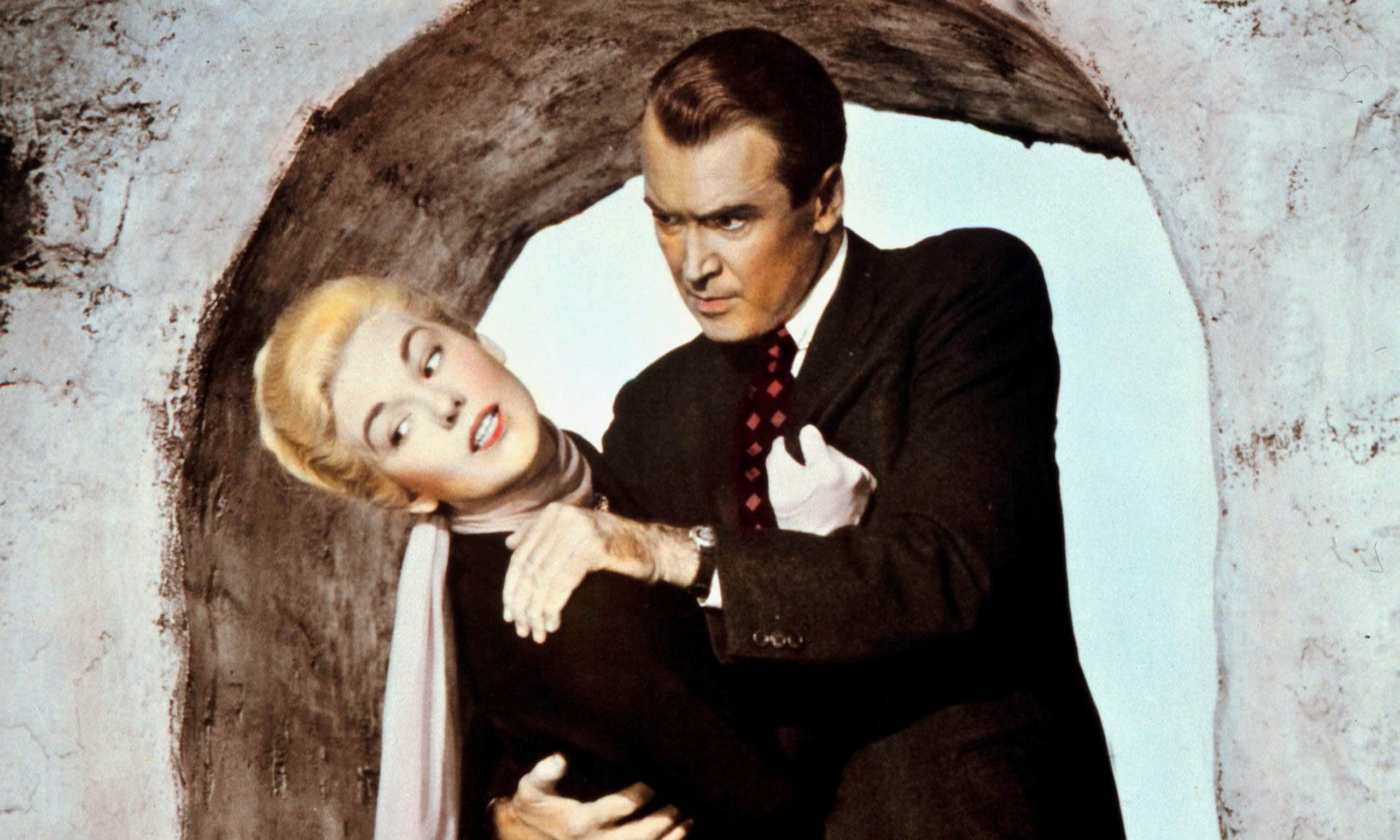
Herrmann’s music does not merely underline emotion in Hitchcock; it gives us a sense of how obsession moves through time. In Vertigo, recurring musical phrases and suspended harmonies in motion that never quite settle make Scottie’s desire feel as though it’s circling back on itself rather than moving forward. The score does not simply tell us that he is haunted; it makes us live through a pattern of repetition, longing, waiting, and return. Herrmann often built suspense from something smaller than a melody: a few notes, a rhythmic figure, a brief musical idea that returned until it seemed to acquire a will of its own. Rather than allowing every phrase to unfold toward a destination, he could make it circle, insist, and begin again. These recurring patterns, often sustained beneath his music, give it its peculiar combination of movement and captivity.


We hear activity, sometimes tremendous activity, but not necessarily release. In Vertigo, ascending and descending figures turn the music into an audible spiral; in Psycho, short, driving patterns make Marion’s journey feel pursued by a thought she cannot outrun. Repetition becomes a way of entering the character’s mind: not a description of obsession from a safe distance, but an experience of its unrelenting persistence.
The technique makes it go a long way, but it’s never merely mechanical. Herrmann could shift a fragment of melody or musical idea higher into the score or give it a deeper voice, pass it between instrumental groups, turn its shape upside down, or change the harmonies around it.
The notes might remain recognizable while their emotional surroundings changed, as though the same troubling thought had returned in a different light. These small transformations let the tension build without the music having to turn into a grand new theme. They also give the music a practical flexibility: a short phrase can be extended, interrupted, or reshaped to meet the changing rhythm of a scene. All those years working in radio had clearly paid off. But in film, that responsiveness became more than a way of making the music fit. It became a language for the mind’s refusal to move on.
There is something unsettling about the way Herrmann makes the familiar feel strange. Usually, hearing a phrase again gives us something to hold on to. Here, each return can leave us feeling a little more trapped, as though we have come all this way only to find ourselves back where we started. His recurring phrases do not always warn of danger somewhere ahead. Sometimes they suggest it has been with us all along. The images change, conversations unfold, and the miles pass, yet one small, restless thought keeps turning.
Herrmann’s ability to make a little go a long way also shaped the soundtrack as a whole; it went beyond a repeated motif to the way he put the score together. When he wrote in short, concentrated passages, he was letting the contrast between them carry a scene forward. A melody moving higher or lower, a sudden drop in volume, or a different instrumental voice could shift the mood without the need for a lengthy new theme to introduce itself. His music could follow a scene’s changing pace and still get straight to the feeling at its heart. He did not have to give everything away at once. A small gesture, a brief phrase, could leave us sensing that something was wrong and when it returned, it might reveal just how far that unease had spread. Holding something back did not make the emotion any less powerful. It brought it into sharper focus.
But knowing when to hold back did not mean Herrmann’s music could not sing. Herrmann’s music could be expansive, yearning, and intensely lyrical, with melodies that still offered us no relief.
The lushness and the harsher edges of his writing belong to the same musical world; he could move between them as the story demanded. A beautiful line might let us hear what a character longs for, while the harmonies around it leave us unsure whether to trust that longing. Even the gentlest moments can feel exposed, and passion can begin to feel oppressive and close in on us. In Herrmann’s music world, beauty is no guarantee of innocence.
What brings all these choices together is a feeling for the mind at work; what finally unites these choices is psychology. Herrmann could follow what was happening on screen, but his music often reaches further, toward the feelings that make a person act in the first place. A theme does not have to tell us only that someone has arrived; it can change how we understand them. Deepen or complicate our ability to know that person. We begin to hear what their words leave unsaid, what their actions only partly disclose. The music does not simply tell us what to think about a character. It lets us feel how a fear takes hold, how a desire keeps pulling, and how difficult it can be to tell the two apart.
This is the voice Herrmann brought from radio into cinema: attentive to the smallest musical phrase, particular about the instruments; the body of sound that would give it life, and unwilling to confuse emotional clarity with emotional simplicity. His scores could be unmistakably his without all sounding alike, imposing the same kind of atmosphere on each story. What remained constant was the way he listened, for what a situation kept hidden, for what a person could not let go of. He found a different world of sound in which those feelings could speak.


Vertigo: Love Going Around in Circles
With Vertigo (1958), the partnership entered its most intimate and disturbing territory. Adapted from Pierre Boileau and Thomas Narcejac’s D’entre les morts, the film turns a mystery into a study of desire that cannot accept loss. James Stewart is obsessed with a woman, loses her, and attempts to reconstruct her image in another woman. The plot turns looking into possession and remembrance into a kind of violence. This is where Bernard Herrmann gives that process its emotional continuity.
James Stewart plays the retired detective whose vulnerability hardens into a need for control, while Kim Novak gives Madeleine Elster an elusive, almost dreamlike composure and Judy Barton a more exposed, anxious presence. Scottie’s insistence on remaking Judy in Madeleine’s image is, for me, repellent rather than romantic: he becomes so attached to an imagined woman that he cannot accept the person in front of him. The film’s affinities with the Tristan legend—the medieval tale of the doomed, forbidden love between the knight Tristan and the princess Isolde—lie in that entanglement of love and death: the beloved becomes an image to pursue, even when the pursuit threatens to destroy both people. For Hitchcock and Herrmann, the story offered a world that brought desire and fear so close together that you can’t tell the difference.


Stewart is John “Scottie” Ferguson, a former police detective haunted by a fellow officer’s fatal fall and his own fear of heights. An old college acquaintance, Gavin Elster, asks him to follow his wife, Madeleine (Kim Novak), claiming that she has fallen under the influence of her dead great-grandmother, Carlotta Valdes. At first, Scottie simply watches her, trying to understand her strange visits to places connected with Carlotta’s life. But his interest soon becomes personal. The mystery gives him a reason to follow her; his growing attachment keeps him there. The mystery gives him a reason to follow her; desire makes it impossible to stop. At Mission San Juan Bautista, Madeleine runs into the bell tower. Scottie follows, but his fear of heights stops him from reaching the top. Her apparent death leaves him facing another unbearable loss he was powerless to prevent. He suffers a breakdown and spends time in a sanatorium. When he returns to the streets of San Francisco, he revisits the places associated with Madeleine, hoping to find some trace of her, searching for the woman he has lost.
When he encounters Judy Barton, resemblance becomes the beginning of another obsession. He does not simply want to know this woman. He wants to alter her until she restores the one he remembers. Clothes, hair, and makeup become instruments of re-creation and his way of bringing Madeleine back. Judy’s willingness to submit gives the relationship its particular sadness: to be loved as herself, she agrees to disappear into someone else.
But the resemblance is not accidental. Judy was the woman Scottie followed, hired by Gavin Elster to impersonate his wife, Madeleine. The real Madeleine was a different woman, whom Scottie had never known. Elster planned to murder her and use Judy’s performance to make her death look like suicide. At the bell tower, Judy ran to the top, where Elster was waiting with his wife’s body, which he threw from the tower. Scottie’s fear of heights had made him useful to the plot: unable to reach the top, he could witness the fall without discovering that the woman he had followed was still alive. The deception worked by exploiting the very fear Scottie had already blamed himself for.
When Scottie recognizes Judy’s necklace from Carlotta’s portrait, he realizes the woman standing before him is the one he’s been trying to recreate: Madeleine. He takes her back to the mission and forces her to climb the tower, this time following her past the point where his abject fear had stopped him. But overcoming his fear does nothing to undo what has happened and release either of them from the past. What he calls love has become a need to possess and control, until the woman herself matters less than the image he wants her to become.
Judy falls to her death, and Scottie loses her a second time. The woman he thought he had lost was there all along, but his obsession to make her into Madeleine has destroyed any chance of them ever being together. His fixation has not only destroyed their chance of a future together; it has consumed his judgment, allowing him to mistake cruelty for devotion.
In Vertigo (1958), Hitchcock often steps back and lets Herrmann’s music tell us what the images alone cannot. Obsessive love runs through the score, with echoes of Wagner’s “Liebestod” from Tristan und Isolde. Roger Ebert captured its pull in the phrase “a haunting, unsettled yearning.”
That sense of unease begins with the suite’s opening two-note phrase, which recalls the foghorns on either side of San Francisco’s Golden Gate Bridge. We hear the actual horns when Kim Novak’s character visits the bay, bringing a sound from the city into the film’s musical world. For the fear of heights that grips James Stewart’s character, Herrmann uses a disorienting chord and startling harp passages that seem to throw the music itself off balance, a suggestion of the shock he would later achieve with the strings in Psycho.
Vertigo was not celebrated on its first release as it would be later. Its reputation grew over time, and it is among the most admired films in cinema, but it is hard to separate Hitchcock’s contribution from Herrmann’s. Working with cinematographer Robert Burks, Hitchcock makes Scottie’s obsession visible, turning a living woman into an image that seems always just beyond his reach. Burks was one of Hitchcock’s principal collaborators, photographing 12 of his films, from Strangers on a Train (1951) to Marnie (1964). Along the way came the watchful tension of Rear Window (1954), the sunlit glamour of To Catch a Thief (1955), the bleak realism of The Wrong Man (1956), the stylish adventure of North by Northwest (1959), and the gathering avian terror of The Birds (1963).
Herrmann’s music makes us feel the happiness he finds impossible to resist, even as the story shows how destructive that hope becomes. What begins as a longing for love turns into a fixation that distorts his clarity, until controlling another person seems to him like loving her.
As in The Ghost and Mrs. Muir, Herrmann writes music for a love that seems unwilling to accept the tenuous boundary of death. But in Vertigo, that longing does not bring any comfort beyond loss.
The music can rise to an almost overwhelming intensity, yet we are never quite sure whether we are hearing love or a refusal to let go. Its beauty does not soften that uncertainty. It draws us deeper into a longing so consuming that desire and possession become difficult to separate.
There is something exposed and vulnerable in this score. Herrmann’s music lets us feel the pull of Scottie’s desire without letting us forget how destructive it becomes. Together, he and Hitchcock make a film in which beauty is neither an escape from suffering nor a guarantee of redemption. It is part of what draws us in.
The music circles back on itself, hesitates, longs, and rises again. In the “Scène d’amour,” the echoes of Wagner’s Tristan und Isolde are clear, but Herrmann is doing more than borrowing. As music critic and author Alex Ross of The New Yorker points out in his article The Rest is Noise published in The New York Times on October 6, 1996, “The main melodic contour is his own; the harmony is still his idiosyncratic construction.” The melody and harmonies remain recognizably his. The echoes of Wagner bring the past into the music, much as the past keeps returning in Scottie’s life. That is also what Scottie is trying, disastrously, to do: make the past recur.
The score’s beauty is therefore inseparable from its danger. It allows us to feel the emotional force of an obsession without asking us to accept what he does. When Judy reappears transformed into the image Scottie demands, the swelling music makes the moment feel as though he has recovered the woman he lost. But the fulfillment is poisoned. What satisfies him comes at the expense of her identity. He sees Madeleine again, while Judy has to set herself aside in order to be loved. He is responding to an illusion, and she is disappearing into it.
This is where Herrmann underscoring of the narrative does more than give the scene a romantic glow. His music does not simply tell us that this is a love scene. It makes desire so persuasive and compelling that we might almost understand how someone might mistake one for the other.
Although Herrmann wrote the score for Vertigo, he did not conduct the recording heard in the film. A musicians’ strike forced the sessions overseas, where Muir Mathieson led the orchestras in London and Vienna. Not being able to conduct the music himself was a bitter disappointment to Herrmann, but the recording still carries the force of what he had written.
That same year, North by Northwest brought Herrmann back to Hitchcock and to a very different kind of movement, that barely stops to catch its breath. It is a world away from “Walking Distance,” The Twilight Zone episode about a man (Gig Young); there, the score lingers over the wish to go back home, longing to return to his childhood. Here, the story keeps Cary Grant relentlessly moving before he has much chance to work out what is happening to him and where he is going.


North by Northwest: Suspense with Its Foot on the Accelerator
If Vertigo is a spiral, North by Northwest (1959) is a headlong dash. Hitchcock sends Cary Grant’s Roger O. Thornhill, a New York advertising executive, into a nightmare of mistaken identity, espionage, spies, pursuit, and a romance with Eve Kendall (Eva Marie Saint) he cannot quite trust. It begins with something ordinary: he wants to send a message to his mother. But a small misunderstanding, an ordinary interruption, becomes an extraordinary predicament, and each attempt to explain himself only makes things worse and seems to carry him farther into danger. He barely has time to work out his predicament before the situation changes again, taking him farther from the ordinary life he wants to get back to.
Herrmann opens not with a solemn announcement of danger but with the rush and driving energy of a fandango. Rather than give the busy city scenes a predictable generic musical pulse, Herrmann sends the film racing ahead. The music’s restless force establishes the adventure’s momentum and sets the pace before Thornhill even knows he is being pursued.
The fandango does more than simply hurry the film along. Its rhythm keeps shifting beneath the melody, making the music feel slightly off balance even as it races ahead, as though the ground were changing beneath someone’s otherwise steady stride. Sharp bursts from the brass cut through the orchestral rush, adding a sense of urgency. The music sounds bold and assured, yet never quite settled, capturing the contrast between a world moving confidently forward and a man struggling to find his footing within it. Herrmann makes the chase feel like a dance whose steps Thornhill must learn while already in the midst of performing them. The music has the brilliance of a public spectacle and the instability of a private ordeal.
Against that relentless drive, the love theme offers a moment of quiet; it opens a more delicate space to rest. Oboe and clarinet pass a lyrical melody between them while the strings allow the score to catch its breath without entirely relaxing. It sounds like a conversation growing more intimate: one voice begins a phrase, another responds, and something warmer gathers around them. But that intimacy does not promise safety. In a story of hidden identities and uncertain loyalties, the melody offers only temporary shelter, like a room made of sound, with the chase still just outside the door.


Then, in the crop-duster sequence, the music withdraws. For much of the encounter, Herrmann denies us the orchestral movement that has made danger exhilarating. The empty landscape has no musical reassurance. Without music to signal danger, we have to watch what the approaching plane does to discover what it is after. Distance becomes something we have to witness and endure. When the music returns at the crash, its renewed force feels almost like the world recovering its pulse after holding its breath. The contrast reveals how much the earlier score has been doing: not merely intensifying the danger, but giving it a rhythm we can follow.


At Mount Rushmore, that rhythm takes on a dangerous edge. Herrmann brings back fragments of the fandango, adds pounding percussion, and shifts the sound from one group of instruments to another as the escape unfolds. The dance has reached a point where a wrong step is no longer funny. Its energy seems to run through hands struggling to find a grip and bodies hanging above the drop, suspended above vast and threatening empty space. Against the monument’s enormous stillness, the music’s motion becomes more urgent, and the orchestra keeps insisting on the need for the characters to keep moving.
The final transition releases all that tension in a single, swift cut. As Thornhill pulls Eve from the ledge and into their train berth, the love theme returns, finally finding the sense of arrival that has been missing til now. The music connects the two moments so naturally that rescue becomes an embrace, and a desperate grip becomes a loving hold. After a film spending all this time making motion feel dangerous, Herrmann finally lets its movement carry the lovers somewhere they can remain.


The music is forceful, restless, and also exhilarating, giving the adventure a rhythm that seems always to be pushing ahead. The score understands the film’s peculiar balance. Roger Thornhill’s predicament is frightening, but his bewilderment is also comical at times; the adventure is dangerous, but the film enjoys its own velocity. Herrmann keeps the musical energy moving without weighing it down. The danger matters, but so does the pleasure of watching an impeccably composed man lose control of his circumstances. Hitchcock and Herrmann make panic entertaining without entirely removing its threat. That momentum changes through rhythmic instability, romantic delicacy, the absence of music, and the final chase.
Herrmann’s role began before he wrote a note: he introduced Ernest Lehman to Hitchcock. The two first worked on an adaptation of The Wreck of the Mary Deare, but set it aside to develop North by Northwest. Lehman’s screenplay takes familiar Hitchcock ingredients- mistaken identity, compromised safety, and pursuit and turns them into something mischievous and expansive. Herrmann’s music matches that spirit; together, visual poetry and his music turn pursuit into an adventure whose improbability is part of its delightful allure, giving it both sweep and a startling sense of play.
Film scholar Neil Sinyard groups Vertigo, North by Northwest, and Psycho as the partnership’s golden period. If you take all these films together, they push back on the notion that there’s a single Hitchcock-Herrmann formula. One score aches, one races, and one literally cuts.

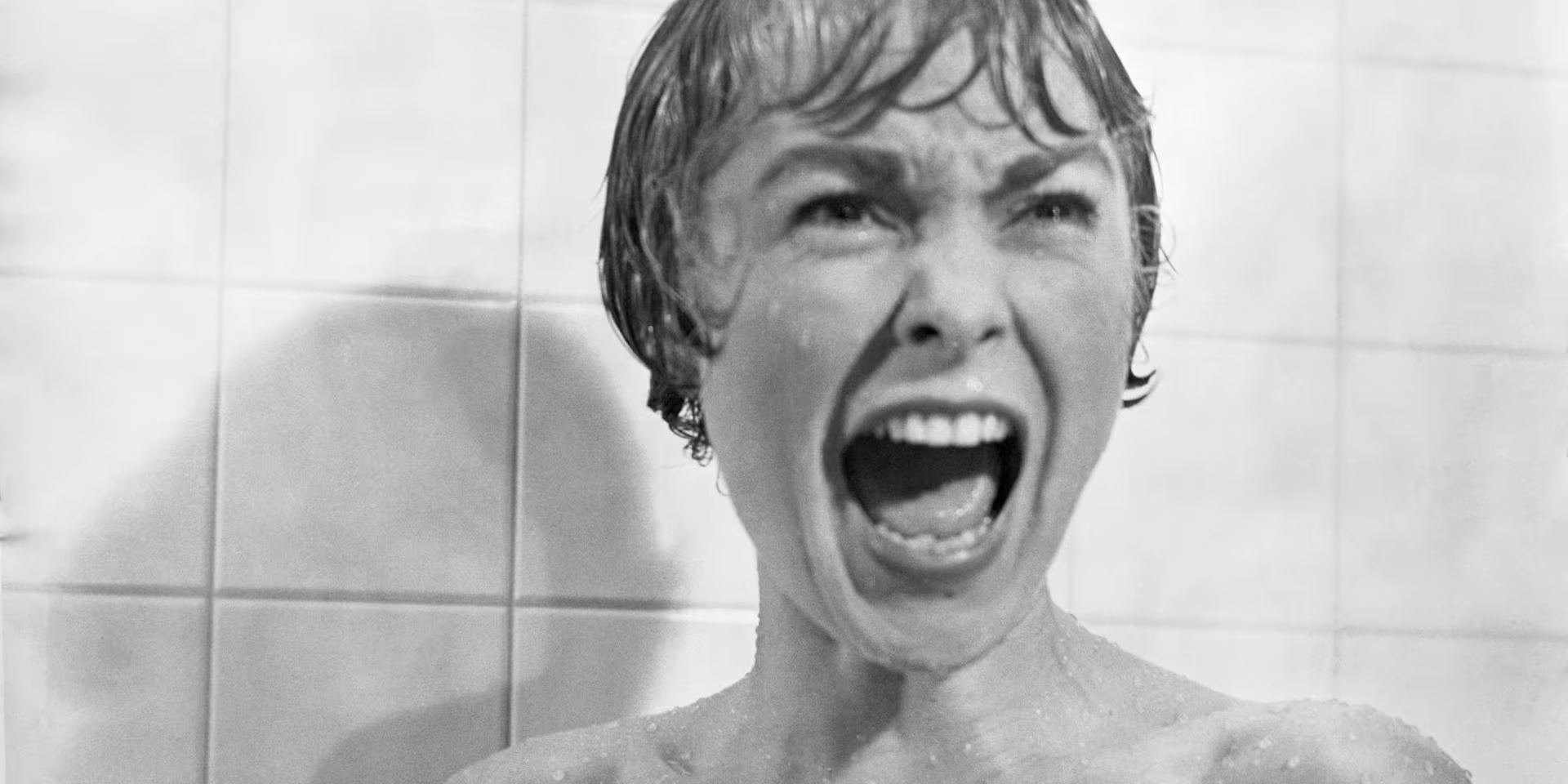
Psycho: The Orchestra Becomes the Wound-A Knife Made of Strings
Among Psycho’s most indelible elements, and perhaps its most evocative hallmarks, are the shrieking violins during the shower scene, giving the murder a piercing, almost bodily force: their abrupt attacks meet Hitchcock’s swift cuts, making it difficult to separate the violence of the image from the violence of the sound, which contrast sharply with the eerie silence of Norman’s final stare, leaving audiences haunted by both sound and stillness. The orchestra seems to acquire an edge. We do not merely watch the knife descend; we feel the music tearing through the scene’s fragile enclosure. Yet that eruption is only one expression of the film’s unease.
The director’s meticulous attention to visual storytelling, embodied by his innovative use of John L. Russell’s cinematography and editing, created an atmosphere of unrelenting tension. This is particularly evident in the iconic shower scene, where Hitchcock’s precise framing and Bernard Herrmann’s musical thought that pierces the silence combine to produce one of cinema’s most memorable sequences. Herrmann’s screeching violin motif during Marian’s murder mimics stabbing motions, visually represented by Hitchcock’s quick frenzy of slashes of the butcher knife, which became synonymous with suspense.
The shower scene’s staccato strings heightened primal fear. With Bernard Herrmann’s piercing score, Hitchcock creates a sequence of unparalleled, visceral impact.
As Lila (Vera Miles) approaches the Bates house, Herrmann’s music shifts; the strings deepen the unease. The film cuts between her approach and her view of the house looming closer, while rising and falling musical lines gradually draw together. High violins descend in long, drawn-out notes, while a restless, more rhythmic figure climbs through the lower strings of the cellos, as though the music of the violas and second violins were closing in around her. The two lines finally meet as she reaches the front door, bringing them together without offering any reassurance. Images and music make each step toward the door feel more threatening.
Later, as Lila explores Norman’s childhood bedroom in the Bates house, the cue, his toys, accompanies her discovery of a room still filled with childhood souvenirs. Herrmann’s slow, descending string phrases have a somber, almost sorrowful, mournful tone. The music suggests sadness beneath the room’s preserved innocence, while a persistent pulse keeps that sadness underneath and keeps the unease alive. The sadness never becomes comforting; something menacing keeps moving about. Slow phrases drift downward, their fragile sound suggesting a childhood that has never quite loosened its hold, turning the room’s reminders of innocence into signs of a life held unnaturally in place, unsettling in its stillness.
Even in its quieter moments, Herrmann’s darker, more subdued string writing lets dread seep into the scene. The music suggests something troubled beneath the carefully arranged images, while pauses suggest an inward disturbance suspended, leaving that unease hanging, with nothing to explain it or ease it away.
Hitchcock gives terror a visible shape through framing and editing; Herrmann makes the texture of quiet feel unbearable. Together, they create a world in which an ordinary room, a shadowed figure, or a moment of waiting can make it feel menacing long before anything terrible happens.


In 1960, Psycho took Hitchcock into a harsher, more intimate world of terror. Not everyone welcomed the change. Some critics thought the material was beneath him, but audiences eagerly embraced its shock value. And that discomfort was part of the point. He wanted to make something deliberately uncomfortable that was essential to the film’s impact. After the elegance and adventure of North by Northwest, Hitchcock offered something far less unexpected and reassuring, a film that brought terror disturbingly close.
Paramount had reservations about the material, but Hitchcock went ahead. He chose black and white, which kept costs down and gave the film its stark look and dramatic atmosphere. After the sweeping color and movement of North by Northwest, Psycho offered a starker visual world with more closed-in spaces. That starkness makes its ordinary settings- a roadside motel, an office, a pristine white bathroom feel even more unsettling when unspeakable horror enters them.
The film was based on Robert Bloch’s novel, whose dark humor and disturbing story appealed to Hitchcock. Bloch took inspiration from the 1957 reports about Ed Gein, the Wisconsin murderer and grave robber. Bloch stressed that he knew little about Gein’s life when writing the book: the story grew from the unsettling possibility that someone could live among unsuspecting neighbors while hiding monstrous acts, rather than from a detailed reconstruction of the crimes.
What fascinated him was the contrast between an apparently ordinary small-town resident and the horrors concealed behind that familiar exterior, in which such terrible atrocities were being committed.
He later explained: “I based my story on the situation, rather than on any person, living or dead, involved in the Gein Affair; indeed, I knew very little of the details concerning that case and virtually nothing about Gein himself at the time?”—Robert Bloch, quoted by the University of Wyoming’s American Heritage Center
There are also similarities between Norman’s attachment to his mother and Gein’s relationship with his own. Both remained under their mothers’ influence after their deaths. An especially disturbing parallel lay in their fixation on domineering mothers, whose influence persisted after death. There are similarities between Norman’s attachment to his mother and Gein’s relationship with his own.
In Norman’s case, that attachment takes the form of keeping her body and assuming her identity. Norman’s preservation of his mother and his taking of her identity echo the desire for transformation associated with Gein: not simply a wish to mourn his mother, but to recreate her. Yet Bloch maintained that he had developed Norman without knowing the full details of Gein’s life, making the resemblance an unsettling convergence rather than a straightforward act of borrowing. Although Gein’s crimes inspired the novel, Norman was not simply a fictional version of him.
Joseph Stefano shaped that premise from the book for the screen, making an important change by opening with Marion Crane rather than Norman Bates and giving more time to her story, so we become more invested in her escape and expect to stay with her before she is slaughtered unexpectedly at the very top of the film. That was a radical departure from Hollywood convention: killing off the heroine so early on, especially with an established star like Janet Leigh in the role. Her murder suddenly takes away the person we thought the film centered around. Bloch provided the underlying nightmare story, Stefano reshaped its dramatic structure for the screen, and Hitchcock decided how and when its revelations reached through the screen.
The opening music moves with the urgency of someone fleeing, yet offers none of the freedom of escape. Short, repeated figures—ostinatos—rotate through the strings, their insistence sharpened by rhythmic displacement and uneasy intervals. The music keeps moving without seeming to arrive. It is a road that folds back into a corridor, a thought that changes its wording but cannot change its conclusion. During Marion’s journey, that repetition gives anxiety a physical momentum: the wheels turn, the miles accumulate, the windshield wipers mark time against the glass like a metronome, but the pressure travels with her. Herrmann makes motion sound like confinement.
Hitchcock made Psycho on a modest budget, drawing heavily on the crew from his television series. But when he saw the rough cut, he began to doubt the picture. He considered cutting it down to an hour as part of his long-running television series, rather than releasing it in theaters. Herrmann saw possibilities and believed the music could make a difference. While Hitchcock was away, he worked on the score, including music for the shower scene, which the director agreed to on one condition: he had wanted to leave it unscored. What Hitchcock had imagined without music, Herrmann heard differently.
Working within the film’s modest budget, Herrmann wrote for strings alone. He later explained that he wanted to complement the black-and-white photography of the film with a black-and-white score. Hitchcock had asked him to leave the shower sequence to play without music, but Herrmann wrote a cue anyway, confident enough in their working relationship to try a different approach.
And when Hitchcock heard the new score, he agreed to use it. The shrieking violins simultaneously intensified Marion’s screams, while their sharp, repeated strokes echoed the action of the knife movement against Janet Leigh’s vulnerable body, left exposed when the curtain was drawn back during the shower scene. According to one published account, Herrmann reminded him: “But Hitch, I thought you didn’t want any music during the shower sequence?” Hitchcock replied, “Improper suggestion, my boy, improper suggestion.”
In the shower, the restraint tears open. The high strings strike in harsh, dissonant attacks, and the instrument most readily associated with lyricism becomes capable of something almost bodily. These are not long melodic lines but abrupt wounds in the air. Each attack has an edge; each repetition denies the ear time to recover. The sound seems to occupy both sides of the violence at once—the knife’s descending force and the Marion’s cries—until it becomes difficult to separate what we hear from what we imagine has happened to the body. Herrmann does not merely accompany the cutting. He makes the orchestra feel cut loose from its own civilized manners.
The cue’s brilliance lies partly in that ambiguity. Is the orchestra the attacker, the wound, the scream, or the spectator’s nervous system? It seems to become all four.
Herrmann often treats music as an extension of a character’s inward life. The famous string-only score for Psycho is not merely economical or startling. For Psycho, he restricted the orchestra to strings, describing the choice as part of that “black-and-white sound,” as he intended to complement the film’s black-and-white photography. But within that restricted palette, he found an extraordinary range of shadow.
In Psycho, when Herrmann strips the orchestra down to strings, he makes their familiar warmth feel suddenly untrustworthy. There is no brass to give danger a heroic outline, no woodwind color to open a window onto another world. The sound is close, dry, and airless: violins, violas, cellos, and basses inhabiting the same narrow emotional chamber. He used mutes, which are small devices fitted onto the bridges of string instruments to change their sound, dampen some of the instruments’ resonance, making the tone less bright and more subdued, not simply quieter.
They veil much of the playing, taking the bloom from the strings without taking away their intensity. What remains can feel like feeling itself under restraint; fear speaking through clenched teeth.
The limitation became an expressive advantage: an orchestra associated with warmth and lyrical elegance could also sound brittle, agitated, and merciless. Its restricted sound palette transforms the film’s world into a nervous, enclosed auditory space. The stabbing violins during the shower murder matter, but the more revealing question is how the score establishes fragility, anxiety, and psychic confinement even before that scene.
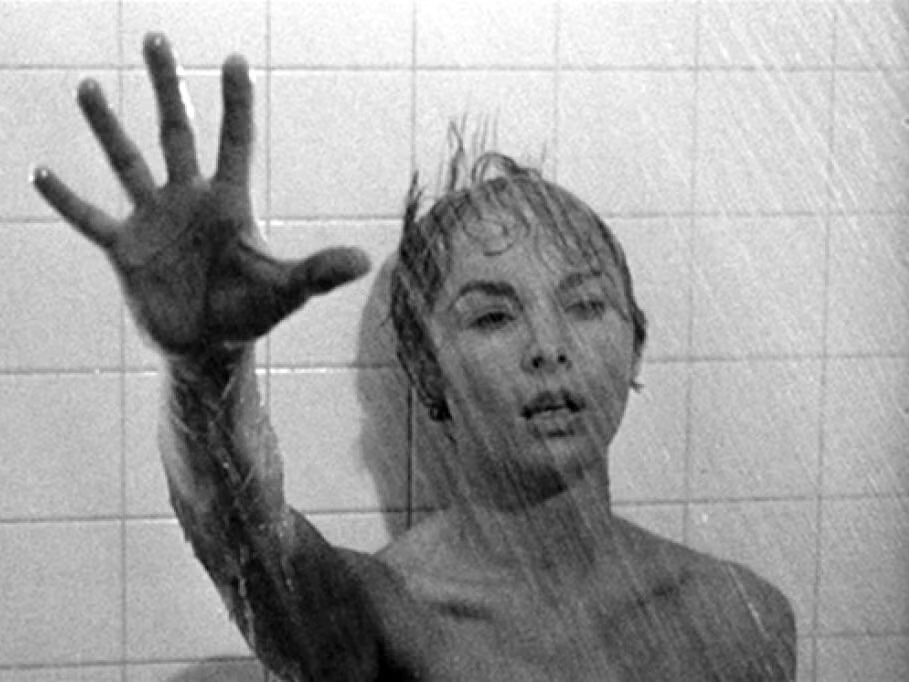

Herrmann’s music also knows how to withdraw into a colder register. Violence is not always loud; sometimes it is the dreadful sense that an ordinary conversation has taken place beside something steeped in secrets and what is concealed. Psycho depends on that contrast between nervous motion, suspended unease, and sudden rupture.
The score’s power depends on more than that famous eruption. In other parts of the film, its smaller recurring figures and subdued colors keep dread alive without bringing it fully into view. The contrast is what makes the violence so devastating: a musical world that has been holding itself tightly together suddenly loses the ability to contain its own sound. In Psycho, the strings do not simply tell us that something terrible is near. They give terror an actual texture, first the chill of something suppressed, then the unbearable sharpness of its release.
Were there any other unusual combinations of instruments which you were the first to use?
I think the most important was in PSYCHO, because it was the return to pure ice water. It was written for a purely string orchestra. The strange thing was the number of colleagues and informed members of the public who have written me letters asking what instruments I used. They couldn’t recognize the sound of a string orchestra – the same kind of orchestra that plays the music of Mozart and Haydn. Is the composer, in a sense, an actor with a greater range of ‘voices off’?
I always think that film music expresses what the actor can’t show or tell. For example, when Janet Leigh is driving her car in PSYCHO, all we see is a pleasant young girl driving in the rain with the windscreen wipers going back and forth. From what you see, she might have been going to the supermarket or visiting a friend, but it’s the music that tells you that she has embarked on a very dangerous, horrifying experience. – Interview with Ted Gillin 1971
Herrmann’s score for Psycho became an influential landmark of film music, its distinctive string writing creating a sense of tension and ambiguity. Yet its musical language, and some of its most memorable passages, had roots in his earlier work. The theme heard in “The Madhouse” grew out of his 1935 Sinfonietta for Strings and also appeared in the closing section of his Moby Dick cantata. Years after Psycho, he returned to it in his final film score, for Martin Scorsese’s Taxi Driver. A thread connecting his concert music with his work for the screen runs through all four works.
Psycho’s extraordinary popular success gave Hitchcock reason to value Herrmann’s contribution, and he reportedly credited the music with “thirty-three and a third of Psycho’s success was due to Bernard Herrmann’s music”. His appreciation went beyond words: he also doubled the composer’s fee. On this occasion, Herrmann’s decision to go against his instructions had strengthened the film. But it also showed how differently the two men could judge what a scene needed. When a similar disagreement arose over Torn Curtain six years later, Hitchcock would reject the score; a quiet distance was beginning to open, and ultimately their partnership would come to an end.
After Psycho, three years passed before Hitchcock’s next film, The Birds, reached the screen. Universal became his filmmaking base, while his financial arrangements with its parent company, MCA, gave him a substantial stake in the business. During this period, he also developed an adaptation of Winston Graham’s Marnie, hoping it would bring Grace Kelly back to the screen. Her return was announced in 1962, but she later withdrew amid objections in Monaco and complications surrounding the production. Meanwhile, Hitchcock was already working on The Birds, returning to Daphne du Maurier, whose Rebecca had provided the story for his first American film. This time, the threat came from familiar, innocuous creatures that suddenly became an inexplicable collective force, turning on people with no clear explanation for their attacks, unless you consider the wide interpretation that not only is nature striking back, but, in my view, it comes in the form of women’s agency as soon as Melanie Daniels steps off that boat.
The adaptation moved far from du Maurier’s original, keeping its basic premise but introducing new characters and relationships. It also became a showcase for elaborate special effects, with the spectacle of the attacks sometimes overshadowing the human drama. In the leading role, Hitchcock introduced Tippi Hedren, a newcomer who had very little acting experience. The film’s reception raised fresh questions about his approach: for some viewers, leaving the threat unexplained and unresolved made it more frightening, and it sustained the terror; for other people, the characters seemed to lack depth, and the story did not quite hold together.
Herrmann’s contribution was a departure from Psycho. Rather than write a conventional musical score, he helped shape Hitchcock’s idea for a soundtrack dominated by bird cries. His role centered on arranging those sounds, shifting the collaboration’s focus from melody and instrumental color to the use of noise. Herrmann did not simply make the murder more frightening. He gave it a sonic identity that would outlive the scene.
Alfred Hitchcock’s Psycho (1960) We All Go a Little Mad Sometimes
But first we’ll step back a bit in time…
The Ache Beneath the Everyday: Herrmann’s Drama and Noir
On Dangerous Ground: a connection after isolation and loss.


Away from fantasy and Hitchcockian suspense films, Herrmann’s music in the 1950s often found room for tenderness. In On Dangerous Ground 1951, Robert Ryan’s embittered policeman, Jim Wilson, finds an unexpected connection with Mary Malden, who is blind and caring for her emotionally disturbed brother, played by Ida Lupino, who gave the role its tenderness without sentimentality.
Herrmann gives Jim’s solitude mournful trumpet and strings that give voice to his loneliness, while Mary’s viola d’amore theme brings a gentler sound into his harsh world. That tenderness carries more weight because Herrmann sets it against such a harsh orchestral sound. In the violent passages, a steel plate adds a metallic bite to the percussion, while “The Death Hunt” sends eight horns racing against the orchestra in restless, repeated figures. The music seems barely able to catch its breath. Beside that force, the solo viola d’amore sounds intimate and exposed, offering a moment of stillness without losing the sadness beneath it. Much of the score’s power comes from this contrast: Herrmann can make the orchestra feel brutal and relentless, then draw it back until a single instrument seems to speak privately.
Eventually, it blossoms into romantic music when he returns to her, suggesting that their relationship offers the possibility of peace and affection after violence and loss.
“I remember I did a score for ON DANGEROUS GROUND (1950), which John Houseman produced and Nicholas Ray directed. Robert Ryan starred with Ida Lupino, who played a blind girl. In it I used a viola d’amore because I felt that the instrument has a veiled quality. It’s a very good film; it’s still occasionally shown, and I’m always very partial to it because I always felt that the color of the music was like her character. I wouldn’t say that it was a piece you should hear in the concert hall, but with the film, it really worked.”-interview with Ted Gilling
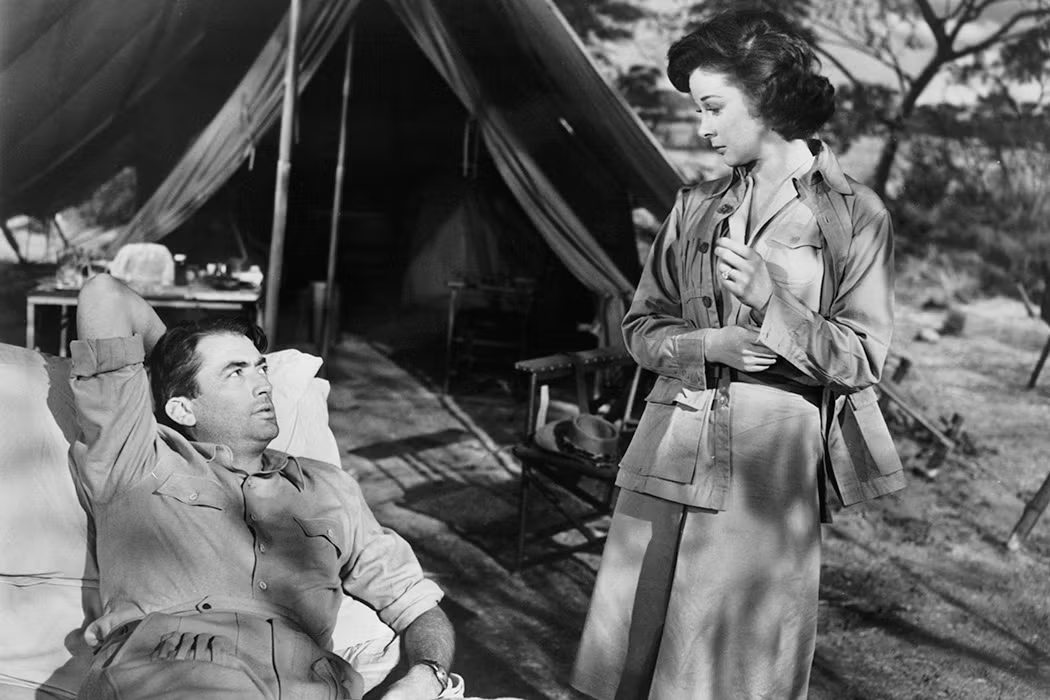

Gregory Peck as Harry Street and Susan Hayward as Helen in The Snows of Kilimanjaro (1952), directed by Henry King.
That gentler side also runs through The Man in the Gray Flannel Suit (1956), where contrasting love themes reflect the two women in its protagonist’s life. Lyrical romantic passages offer moments of warmth, but conflict and remorse keep breaking through. In The Snows of Kilimanjaro (1952), romance is similarly bound up with memory and regret: the music seems to reach toward something that can no longer quite be recovered. The Hemingway adaptation gave Herrmann another way to express longing and became a major project in his early-1950s career.
That emotional range also had a darker side. The espionage thriller Five Fingers (1952) brought secrecy, distrust, and fear into the picture, while A Hatful of Rain (1957) placed his music within a troubled family drama. In Blue Denim (1959), he explored the uncertainties of young love. Together, these scores reveal a composer whose interests were not limited to fear. His music also spoke to loneliness, strained relationships, and the tentative hope of finding comfort in another person.
In The Wrong Man (1956), Herrmann brought that concern for ordinary people under strain into his work with Hitchcock, where Henry Fonda plays Manny Balestrero, the nightclub bass player wrongly accused of robbery, and the double bass becomes a link between the man and the music surrounding him. Herrmann leaves out the usual string section, building the score around woodwinds, brass, harp, percussion, and that solitary bass. Its low, persistent notes and muted trumpets make familiar surroundings feel increasingly cold and threatening.
But the music is definitely not concerned with suspense alone. As the accusation unsettles Manny’s home life and his wife Rose begins to break down, the score makes room for grief as well as fear. Gentler passages offer glimpses of the family’s affection, while the closing oboe melody brings a tenderness that feels worn down rather than reassuring. Here, Herrmann’s restraint gives the drama its weight: the music suggests not a spectacular nightmare, but the quiet devastation of an ordinary life coming apart.
He also brought his dramatic instincts to Tender Is the Night (1962), writing the orchestral score, though the title song was composed by Sammy Fain, with lyrics by Paul Francis Webster.
Inventing Other Worlds, Other Fears: Science Fiction and Fantasy
In Robert Wise’s The Day the Earth Stood Still (1951), Herrmann faced a different challenge: how should an encounter with something genuinely alien sound? His answer was to bring together two theremins, electric instruments, keyboards, brass, and percussion. The theremins, with their eerie alien voice, became one of the defining sounds of 1950s science fiction. were more than a strange added effect: their eerie, unfamiliar voice became part of the music’s character and the score’s broader design. Repeated phrases and ominous low-register threatening sounds create the feeling that something otherworldly has entered the everyday world and all the conventional rules have been interrupted. The music does not merely announce a flying saucer. It makes that ordinary familiar environment feel suddenly and completely unreliable.


“The film with the most experimental, avant-garde techniques was the picture I did for Robert Wise, THE DAY THE EARTH STOOD STILL (1951). At that time, we had no electronic sound, but the score had many electronic features which haven’t become antiquated at all: electric violin, electric bass, two high and low electric theremins, four pianos, four harps and a very strange section of about 30-odd brass. Alfred Newman said the only thing we needed was an electric hot water bottle, which he supplied.” – Herrmann’s interview with Ted Gillin 1971
Composer André Previn recalled an encounter with Herrmann’s temper during the recording of Robert Wise’s The Day the Earth Stood Still (1951). Visiting the scoring stage, he found an unusual collection of electronic instruments making what he called “the most unearthly noise.” It was a cold day, so he fetched an electric blanket from the prop department and brought it back as a joke. Herrmann was not amused. “He didn’t think it was in the least funny,” Previn remembered. “He started screaming at me and berating me.” Herrmann had taken the joke as criticism, although Previn said he liked the music very much. A joke could quickly go wrong if Herrmann thought his work was being treated lightly or altogether dismissed.
Years later, Brian De Palma had a similarly uncomfortable encounter while showing Herrmann a rough cut of Sisters 1973. He had added passages from the composer’s Hitchcock scores to suggest the mood he wanted. Herrmann was not flattered. “Turn it off, turn it off, turn it off,” he reportedly shouted, finding the familiar music a distraction rather than a helpful guide.
Herrmann brought the same inventiveness to underwater adventure. For Beneath the 12-Mile Reef (1953), he used nine harps, creating an unusually luminous instrumental environment for its submerged sequences. Rather than rely on a standard Hollywood orchestra, he chose instruments that could bring this unfamiliar world to life.
Herrmann did not think music should be judged by where it was heard. A concert hall did not give it more distinction, and a cinema did not make it less worthy. He brought the same seriousness to film, television, radio, opera, and concert work, resisting the label “film composer” when it implied that his work belonged in a lesser category of musician. What mattered to him was not whether he was writing a symphony or a soundtrack, but whether the music worked.
His work on films featuring Ray Harryhausen’s fantastical genius showcased that conviction and put that belief into practice. It’s that same principle that animates the fantasy films associated with Harryhausen’s stop-motion artistry: Harryhausen’s fantasies gave Herrmann room to explore the impossible. These adventures gave Herrmann another kind of imaginative freedom: alongside the very different worlds of Orson Welles and Alfred Hitchcock, he could now give musical life to inexplicable worlds. He scored Nathan Juran’s The 7th Voyage of Sinbad (1958), Cy Endfield’s Mysterious Island (1961), and Don Chaffey’s Jason and the Argonauts (1963) (a joy that never leaves me). During the same period, he also wrote the music for Henry Levin’s Journey to the Center of the Earth (1959), another chance to create sounds for a world beyond everyday experience.


The suite from Mysterious Island (1961), based on Jules Verne’s sequel to 20,000 Leagues Under the Sea, opens with a roar. Herrmann’s enormous orchestra—eight horns, four tubas, and expanded woodwind and percussion sections—matches the scale of an adventure that sends escaped Civil War prisoners by balloon to an island of monstrous creatures. The opening “Prelude” and “The Balloon” plunge us into their storm-tossed escape, with the music carrying both the danger and the exhilaration of a flight into the unknown.
Next comes Jason and the Argonauts (1963), one of Harryhausen’s most celebrated films and one of my favorite childhood memories. For this voyage in search of the Golden Fleece, Herrmann leaves the strings back on the shore, reaching instead for an expanded ensemble of brass, woodwinds, and percussion. The music has sharp edges and a bronze gleam, which is a fitting sound for a world where ancient legends stir into life.
In Jason and the Argonauts (1963), Herrmann makes the orchestra sound as though it belongs to a world of bronze giants, dangerous seas, and watchful gods. By leaving out the usual string section and drawing upon massed brass, woodwinds, harps, and percussion, the atmosphere becomes charged with mythology. The opening comes crashing into life, its cymbals and bold brass announcing an adventure with strength and salt air in its lungs. Yet there is wonder beneath the force: around Olympus, harps and bright, ringing percussion suggest a realm suspended above human struggle, glittering and remote.
Nowhere can you see that connection more strikingly than in the appearance of Talos, Harryhausen’s towering sentinel. Herrmann’s slow-moving brass chords give this titan a voice, their immense weight making each movement feel both laborious and unstoppable.
For Talos, the enormous bronze guardian, Herrmann gives four tubas a pounding, four-note figure, reinforced by timpani. The music seems to carry the creature’s weight before we can quite believe that metal has begun to move. As Talos lifts and shakes the ship, those repeated blows grow almost unbearably heavy. The Harpies inhabit the opposite end of this musical world: shrill piccolos, darting woodwinds, and stabbing harp figures turn their flight into a marvelous flurry of purple-blue claws and beating wings. Herrmann does more than accompany Harryhausen’s creatures; he gives each one its own musical body.
By the extraordinary skeleton battle, that sense of weight has become something dry, brittle, and horribly nimble. Chattering woodwinds, castanets, and wood blocks make the dead seem to rattle those ancient bones into motion, while the rhythms keep the fight in nervous suspension. There is a grim playfulness here, as though the orchestra has discovered how to dance without flesh. Across the score, Herrmann moves between grandeur and grotesquerie, the macabre and mordant and without losing the excitement of the voyage: his music lets us feel both the terror of these impossible encounters and the sheer pleasure of seeing them come alive.
These films gave Herrmann creatures lovingly assembled and animated frame by frame, strange landscapes, and impossible journeys on which to exercise his imagination. Each acquired a musical life of its own.


Herrmann’s fantasy adventures took a memorable turn with The 7th Voyage of Sinbad (1958), the first of four films he scored for producer Charles H. Schneer and once again effects artist ‘the wizard of dynamation’ Ray Harryhausen. Harryhausen brought three Sinbad films to life, but this was the only one with a Herrmann score. The composer wanted, in his words, “to envelop the entire movie in a shroud of mystical innocence,” and the music moves easily between enchantment and danger. Herrmann moves from the overture’s lush romance to the haunting lament that introduces Sinbad’s mysterious ship. But he saves one of his most inventive touches for the skeleton duel, where a panicked xylophone scherzo makes the encounter playfully macabre.
Where Hitchcock’s films drew him toward hidden desires and the unease beneath everyday life, these adventures brought their wonders out into the open. His music never stood outside the fantasy with a knowing smile. It made us feel the weight of a giant’s footsteps, enjoy an army of skeletons in battle, see dragons inhabit the same world as humans, and experience the wonder of something unfamiliar and the danger waiting just beyond it. His music took those fantasies seriously, without explaining them away. He entered these worlds without hesitation, giving their creatures weight and movement, and making their dangers and wonders feel real.
It’s tempting to call Herrmann’s excursion into this part of his work an escape or a break from the psychological intensity of Herrmann’s work with Hitchcock, but the two have more in common than they first appear. Whether bringing a mythical creature to life or entering an obsessive mind, he used sound to make the extraordinary feel substantial. His music made it feel real, something we could inhabit, not just watch from a distance.
In 1959, Herrmann returned to CBS for Rod Serling’s new television series, The Twilight Zone. Writing for television did not mean thinking smaller. His opening and closing themes gave the first season a brooding atmosphere, drawing us into uncertainty rather than signaling the strange with a musical wink. The more familiar theme that replaced them was sharper and more instantly recognizable. Herrmann’s music suggested something quieter: the feeling that an ordinary life was beginning to slip into unfamiliar territory.
That feeling found a particularly moving expression in “Walking Distance.” Gig Young plays Martin Sloan, an exhausted advertising executive who longs to recover the security of his childhood. Herrmann’s music gives that longing a vulnerability without making its fulfillment seem simple. It felt more melancholy and inevitable. As in The Ghost and Mrs. Muir and Vertigo, the past exerts an almost irresistible pull, but the desire to return carries its own sadness. Here, the uncanny is not primarily a source of terror. It opens a wound in someone who wants the world to be the way it used to be.


Cape Fear: Menace – Scoring intimidation
Herrmann’s music for J. Lee Thompson’s Cape Fear (1962) provides a useful bridge between Hitchcock and his later work. Robert Mitchum’s extraordinarily brutal exercise in toxic masculinity in the form of Max Cady brings intimidation into the everyday world, threatening a lawyer, Gregory Peck, and his family. Herrmann’s score gives that threat an oppressive musical presence.
Cape Fear is undisguised: Max Cady does not need to conceal his identity or convince the Bowdens that he is harmless. They know who he is and have good reason to fear him. The suspense doesn’t come from discovering he’s a threat, but from knowing he is there and the struggle to stop him.
Unlike the yearning that entangles us in Vertigo, this music can feel brutally declarative. Danger is no longer an interpretation waiting to be confirmed. It has arrived and intends to stay. It feels inevitable.
Herrmann was not entering entirely new territory, but the music carried tremendous dramatic weight. Its threatening four-note figure, powerful brass, and restless strings gave it a presence that outlasted the original film.
When Martin Scorsese made his 1991 remake, he had Elmer Bernstein adapt Herrmann’s music rather than replace it, simply fitting the old recording to new images; it was a measure of how much of the film’s menace lived in the score and persuasive evidence of its lasting power. The familiar themes remained, but Bernstein reshaped how and where they were heard to suit Scorsese’s telling. This was more than a tribute: the grip of Herrmann’s music still had enough power to form the foundations of a newly constructed nightmare, and proved capable of surviving a new cast, a new director, and a different filmmaking era.
In Cape Fear (1962), Herrmann gives Max Cady’s menace a shape before it needs an explanation. That menace is an actual sound that feels bigger than Cady himself. The descending four-note horn phrase does not hurry toward us; it arrives with the force of something already certain of its power. The horns strike with blunt force and a brutal certainty while the strings shift uneasily beneath it in wavering, unsettling patterns.
Around that declaration, the strings create a different kind of unease. Their wavering movement and chromatic lines prevent the surrounding sound from settling, as though the surface of ordinary life has begun to tremble under a pressure it cannot quite name.
Each downward step of the horns seems to reduce the distance between threat and possession. Menace is no longer confined to the figure who brings it. It spreads into anticipation, into the pause before an encounter, into the nervous effort to decide whether a familiar place is still safe. The assault of the brass gives the threat a clear presence; the strings make it seem to spread out, making it difficult to locate its boundaries. It is less a warning than an assertion—a musical presence that has entered the room and sees no reason to leave. Where another score might make danger flicker at the edge of perception, Herrmann gives it a broad, unmistakable outline. Even when Cady is out of sight, the music suggests that he has reached into places where his victims should feel safe. Its power comes not just from how loudly it plays, but from its persistence: a small musical idea- those few notes keep returning, making every moment of reassurance seem temporary.
There is a disturbing fluidity beneath that heavy brass. The string writing seems to ripple and shift, lending the score a hypnotic movement that fits the film’s waterside setting. When you hear it against the recurring threat, that movement offers no release; it can feel like a current carrying the characters toward a confrontation they cannot avoid. Herrmann makes fear both an impact and an atmosphere. The brass bears down, but the unease continues between its appearances, leaving the impression that danger has withdrawn from view without actually leaving.
The orchestra’s limited range of instruments intensifies that closed-in feeling. Herrmann uses strings, four flute players doubling on other instruments in the flute family, and eight horns, leaving out the wider variety of other woodwinds and percussion. Yet the limitation does not make the sound seem small. It makes its colors feel inescapably related, as though each shift reveals another side of the same unease. The lower tones gather beneath the brighter ones, while the higher voices bring movement but little room to breathe. The music changes its expression, but the tension stays with us.
When Sam approaches Cady, muted horns, violin trills, and movement in the lower instruments turn the confrontation into something we hear gathering before it fully unfolds. The music seems to narrow the space between the men. It does not need to announce a violent act to make the possibility of violence bodily: the tremor above and the darker motion below leave us caught between restlessness and heaviness. An ordinary exchange takes on the tension of a door held shut with someone’s hand already pushing against the other side.
That pressure also reaches into the landscape. The muted horns accompanying the Cape Fear River sign make the destination sound ominous before the later confrontation takes place there. The river becomes more than a location; it is a place where the score has been directing its disturbance. Across the music, descending patterns, restless strings, and dark instrumental colors make motion feel less like escape than a gradual tightening of the available world. Herrmann’s terror here is not just the shock of something breaking through. It is the recognition that the threat has been making itself at home.
Suspense Comes Home on Television: The Alfred Hitchcock Hour
Alongside Lyn Murray, whose deeply moving work on the series deserves far more recognition, Herrmann wrote original scores for seventeen episodes of The Alfred Hitchcock Hour, not for the earlier, half-hour Alfred Hitchcock Presents. Hitchcock himself directed none of those seventeen episodes. This was Herrmann working within Hitchcock’s television world, with producer Norman Lloyd as an important collaborator.


Herrmann’s suspense did not need a cinema screen to fill a room or the expanse of the big screen to make the walls feel a little closer. It could enter the living room, settle beside the television, and make an ordinary house feel suddenly less secure. Between 1963 and 1965, he wrote original scores for The Alfred Hitchcock Hour, bringing his dramatic instincts to stories whose dangers had to unfold within a single broadcast. These were not miniature repetitions of Psycho. Each week brought different characters, settings, and emotional troubles, giving him room to move between psychological unease, grotesque humor, and outright terror. As a young child, I would sit down to watch an episode and find myself listening as closely as I watched. The story held me, but the music had its own hold, shaping what I felt before I quite knew why. I couldn’t have said where one ended and the other began. Even now, when I remember a scene, the music is still there, part of the way I first lived through it. There is something quietly unsettling about hearing Herrmann so at home in all of them. Music from those scores also found its way into other episodes of the show, carrying his presence beyond the seventeen he wrote for.
The two Hitchcock series had a different relationship with music. The earlier, half-hour Alfred Hitchcock Presents drew on stock music, while the hour-long series, which began in 1962, made room for scores written for its stories. Herrmann’s first was “A Home Away from Home,” which opened the second season in September 1963. He also rearranged the familiar opening theme, Charles Gounod’s Funeral March of a Marionette, giving its mischievous tread a darker, bassoon-colored character. The tune wasn’t his, but in his hands it seemed quite at home: playful enough to invite us in, peculiar enough to make us know what to expect from the show and hesitate at the door.
Herrmann was working within Hitchcock’s television world here, rather than on another film with Hitchcock behind the camera. An important collaborator was Norman Lloyd, who produced the series and sometimes stepped behind the camera himself, a familiar face from their days in Orson Welles’s circle. Even though Hitchcock wasn’t involved in directing, that hardly makes the work feel less personal or less his own. It brings the wider collaboration -the writers, directors, performers, and musicians who helped give Hitchcock’s television world a life of its own and a particular kind of television experience.
The scale was smaller, but the imagination was not. Herrmann worked with chamber-sized ensembles, letting the character of the instruments, rather than the weight of a full orchestra, set the mood and give the episode its unique atmosphere. Muted trumpets, harps, and returning musical phrases could hint at things a larger ensemble might overwhelm. As the Herrmann Society’s account notes, each episode’s score grew from a theme or motif of its own. In an anthology, that restraint became a virtue: a few sounds could give a new story its identity of its own before we knew who to trust.
One essential example of his contribution to the show is the macabre “The Jar,” broadcast on February 14, 1964, directed by Norman Lloyd and adapted by James Bridges from Ray Bradbury’s story. A rural man brings home a sideshow jar containing something sufficiently mysterious to fascinate his neighbors and disturb his wife. I’ve spent decades peering into that cloudy glass, trying to decipher its contents, and the grotesque thing lurks inside still eludes me. Whatever is inside remains just beyond recognition, though never beyond suggestion. The object becomes a source of attention and status: people who might otherwise dismiss him now gather to speculate about his curious find. Herrmann’s score belongs to that uneasy borderland where curiosity is comic until it becomes appalling. The episode’s power comes partly from what cannot be settled by looking, making it a natural setting for a composer so adept at giving uncertainty an emotional presence.
Another Bradbury adaptation, “The Life Work of Juan Diaz,” broadcast on October 26, 1964, shows how easily Herrmann’s music could reach beyond the familiar machinery of a conventional thriller. Also directed by Lloyd, it follows a poor Mexican family, a dying husband, and the unsettling question of what might become of the body after death. Poverty and exploitation give the story’s horror a painfully human setting, but the family’s struggle to survive is what holds the story together. Herrmann’s forceful opening builds around its ominous four-note phrase. Here, the suspense leaves room for compassion. Beneath the disturbing, macabre possibilities is a family trying to survive, and the story never loses sight of what that struggle costs them.


Dana Wynter in The Alfred Hitchcock Hour’s episode An Unlocked Window, 1965.
“An Unlocked Window” is one of my favorite episodes in the series. Between the performances, the almost unbearably taut atmosphere, its concentrated terror, and the way it is filmed, it feels as though it could have held its own as a full-length feature. Broadcast on February 15, 1965, it was directed by Joseph M. Newman and adapted by Bridges from a story by Ethel Lina White.
It places private nurses, Dana Wynter is one of them, in an isolated house while a murderer is believed to be targeting women in their profession. Louise Latham plays housekeeper Maude Isles, who is stewed throughout the episode. Every precaution seems to offer reassurance only long enough for doubt to creep back in. Doors can be locked, rooms checked, but one overlooked opening is enough to make the whole house feel vulnerable and exposed. With its closed-in setting and sustained uncertainty, the episode is a perfect example of why Herrmann has such a significant place in television suspense. Herrmann’s music belongs to that unease. It does more than warn us when something is wrong; it makes waiting itself feel dangerous. His original score is among the recordings released from his work on the series.


“Where the Woodbine Twineth” moves me in a way few other episodes in the series do. There is something eerily beautiful about its tone, a tenderness that makes the uncanny feel more troubling, not less. Margaret Leighton gives a tour de force performance as Nell Snyder, a woman who takes in her orphaned niece, Eva, hoping to give her a home but struggling to understand the imaginary companions who seem so real to the child; Nell has spent much of her life caring for others, putting her own hopes aside, and Leighton lets us feel both her longing to love this little girl and the rigidity that keeps getting in the way. Herrmann’s music feels at home in that uneasy space between affection and fear. What moves me is how closely the two feelings sit together: the wish to shelter a child, and the dread of a world she can enter but you cannot. After the immediate danger of “An Unlocked Window,” this is a quieter kind of haunting, with sorrow never far beneath its strange beauty.
Broadcast on January 11, 1965, the episode takes a different route to unease and lets it gather around what the adults cannot see. A child’s imaginary friend might ordinarily seem like something to be gently humored, but here imagination offers little comfort to anyone outside it. It moves toward very disturbing territory. Herrmann’s music in this episode belongs to that uncertain border between the familiar that isn’t going to remain familiar and the unseen which isn’t necessarily harmless, a place he returned to in his ghost stories and psychological dramas. His original score is also included among the soundtrack releases, giving us a chance to listen more closely to what the music carries beneath the story. Where “An Unlocked Window” makes us fear what might get into the house, this episode suggests that Eva can see a world the adults cannot, and the outcome is devastating.
Herrmann score for this particular episode of The Alfred Hitchcock Hour, and its melodic meditations, is a large part of why I love it so much. The woodwinds carry a haunting little waltz, its gentle sway suggesting a childhood tune remembered in a house that has grown strangely quiet. To my ear, there is something tender but unsettled in it, as though the melody knows its way into a child’s private world but cannot promise to bring us safely back. Herrmann does not have to force the eeriness. He lets it gather within the sweetness, until the tune feels less like reassurance than an invitation to listen more closely.
And then there is Margaret Leighton, an actress I adore, as Nell, the aunt trying to make sense of her orphaned niece Eva’s increasingly disquieting behavior. Leighton gives the episode an anguished human center, and I find that Herrmann’s music makes her unease more poignant: its delicate movement seems to belong to a world Nell can overhear but cannot enter. That is what stays with me—the distance between the melody’s almost comforting familiarity and the feeling that something has slipped beyond ordinary understanding. It is beautiful without being safe, and all the more haunting for refusing to separate the two.
Together, these episodes show how much room Herrmann found within the series. “The Jar” feeds our curiosity about something grotesque; “The Life Work of Juan Diaz” finds sorrow in a family’s struggle with poverty and death; “An Unlocked Window” makes every precaution feel queasy and inadequate; and “Where the Woodbine Twineth” opens onto an unseen world a child can enter while the adults are left with the loss and unsettles the boundary between imagination and menace. What strikes me is how naturally his music moves among them. Television gave him no single character to follow, no box office protagonist to underscore, but intimate new lives and new troubles to enter each week. That range feels less like a departure from his film work than another way of hearing how much he could bring to a story. His last original score for the series was “Death Scene,” which aired in March 1965, before his partnership with Hitchcock broke apart over Torn Curtain.
These scores deserve more than a passing mention among his film credits. Their smaller ensembles let us hear how much Herrmann could suggest with a few carefully chosen sounds: an atmosphere taking shape, an emotional fault line, a musical phrase that carries more every time you hear it. On television, as much as in his finest film work, he found suspense in the distance between what people wanted and what they were willing to do to get it. His television scores capture the malice, vanity, and self-interest, the bittersweet, the tragic, and the innocence, giving their psychological detail or cruel ironies as much musical attention as their moments of reflection or violence.
https://thelastdrivein.com/2023/05/18/its-the-pictures-that-got-small-good-evening-leading-ladies-of-the-alfred-hitchcock-hour-part-3/
From the Open Range to the Twilight Zone Years
Herrmann’s imagination was never confined to the movie screen. He’s credited with 108 episodes of Have Gun—Will Travel, which aired from 1957-1963, a Western built around Richard Boone’s cultivated gunfighter, Paladin. Herrmann composed the pilot score and its brief but commanding musical calling card, with its own unmistakable authority. His music also became part of the CBS library, finding its way into other episodes and series. Even if you didn’t know his name, you were surely getting to know his sound.
Herrmann entered Rod Serling’s The Twilight Zone in 1959 at the urging of CBS music director Lud Gluskin, bringing his gift for unease to the pilot, ‘Where Is Everybody?’, and composing the series’ original opening and closing themes.
Rod Serling’s The Twilight Zone gave Herrmann’s colorful imagination another kind of room to wander around. Herrmann wrote the first-season theme and seven original episode scores, bringing his gift for intimacy to stories in which an ordinary life could suddenly be overtaken by something inexplicable.
His theme was not the familiar, sharply repeating tune later associated with the series; that was Marius Constant’s, but a slower, more shadowy invitation to cross the threshold into that twinkling abyss.
In “Where Is Everybody?” Earl Holliman wanders through a deserted town, finding signs of everyday life, a lit-up movie theater with a film rolling in the projection booth, coffee perking, telephones ringing, but there’s no one there to engage with. Herrmann builds much of the score from a three-note figure, turning a tiny musical idea into an atmosphere of loneliness and mounting panic. In one of my favorite episodes, “Walking Distance,” a worn-out executive, Gig Young, steps back into his own childhood, where everything is familiar, and his presence is the one thing that doesn’t belong. Here the music opens into lyrical strings, harps, and vibraphone, giving his longing a warmth that makes the impossibility of staying even more painful. Herrmann could make an empty street frightening, but he could also make a familiar one break your heart.


Gig Young as Martin Sloan, a weary man searching for the summer of his youth, in “Walking Distance” (1959), written by Rod Serling and directed by Robert Stevens for The Twilight Zone.
“The Lonely” places a prisoner, Jack Warden, on a remote asteroid, where an android woman, Jean Marsh, becomes his companion. Herrmann gives this unlikely love story lyrical passages within an unusual ensemble of brass, Hammond organ, harps, and vibraphone: the setting may be literally alien, but the need for human affection is not. And one of the show’s most iconic, chilling offerings, “Eye of the Beholder,” turns our need for acceptance into a story about an agonized, bandaged woman and all the faces in shadow, awaiting the results of treatment intended to make her look “normal.” Sparse harp and vibraphone patterns and ominous low brass hold us inside her uncertainty, making the hospital feel less like a refuge than a place where the idea of difference itself is under examination and judgment, and conformity is not a choice but a demand imposed from above in this meditation on authoritarian rule.
In “Little Girl Lost,” a child disappears into another dimension while her parents can still hear her calling. Herrmann’s shifting harp textures, flutes, and percussion give the unseen space an elusive musical presence; the terror comes from hearing someone you love and being unable to reach her, in an expanse just beyond their bedroom wall. In another iconic episode, “Living Doll” brings the nightmare even closer within the home, into a household where Chucky’s got nothing over Talky Tina, who turns against an abusive stepfather, Telly Savalas. With only bass clarinet, two harps, and celeste, Herrmann sets a sinister low voice against a delicate, mechanical waltz. The music makes a child’s simple plaything sound both perfectly innocent and horribly purposefully menacing.


The Birds, Marnie, Torn Curtain and the Partnership’s Breaking Point
For The Birds, Hitchcock returned to Daphne du Maurier, transforming her story into a film in which the familiar world turns inexplicably hostile. Its unsettling premise and elaborate effects for the time made the attacks a spectacle, while its refusal to explain them left the terror not only more uncanny but unresolved.
The Birds (1963) shows a different side of Herrmann’s work with Hitchcock. He served as sound consultant rather than writing an orchestral score. Instead of a conventional score, the film uses bird cries and wing sounds, electronically created by Oskar Sala and Remi Gassmann using the electro-acoustic Mixtur-Trautonium, that occupy the space we might expect to be guided by traditional music and give the attacks their disturbing sound.
After the stabbing strings of Psycho, The Birds offers a different kind of exposure. Hitchcock removes the conventional orchestral score, leaving cries, wingbeats, ordinary sounds, and calculated stretches of quiet to carry the tension. We still listen for a cue, but now it might be no more than a flutter or a sudden break in the quiet. There is no sustained musical voice to give fear a familiar shape, no lyrical passage to make the surrounding world briefly hospitable.
The absence does not empty the film. It leaves it open to invasion. Even when nothing is happening, we find ourselves listening for what might come next. It gives the quiet a premonition that something assaultive is about to begin. Sounds that might ordinarily belong to the background begin to command the foreground, as though nature has stopped accepting its place outside the human story. Nature gives voice to its fury through the birds.
From the opening titles, the birds seem to take over the soundtrack. Their raspy, echoing cries gather, subside, and break out again; the flutter of wings makes the air feel crowded before the story has even begun. These sounds have none of the familiar patterns of a melody. They seem restless, unable to settle down. Where an orchestra might organize danger into clear musical phrases, this soundscape makes it feel as though it could come from anywhere. There is no single musical line to follow, no familiar cadence to suggest the danger will pass.
The electronic treatment makes even familiar bird sounds feel strange, and the environment unstable. Sala and Gassmann’s work with the Mixtur-Trautonium helped turn bird noise into something both recognizable and estranged: cries that sound like living creatures, but not quite like the winged creatures we know. It is not just that the birds sound louder.


The everyday world has become harder to read; the language has become difficult to interpret. A bird call no longer tells us that everything is going on as usual; a wingbeat no longer means something harmless passing overhead. The sounds still belong to nature, but nature no longer feels reassuring. What was ordinary and everyday becomes alien and threatening.
Quiet becomes equally unsettling. Hitchcock sets the attacks against calculated silences and sparse music heard within the scenes, rather than against a continuous dramatic score. The contrast makes the intervals between outbreaks feel exposed. A pause cannot be trusted as relief; it may be only the space where it sets up another attack, preparing itself.
The soundtrack gets us listening for more than we can actually hear, until even the quiet and stillness feel crowded, full of things that might happen. Fear no longer comes just from hearing the threat. It also comes from trying to work out what the silence means.
Herrmann’s contribution belongs to the shaping of this unfamiliar relationship between sound and suspense. Hitchcock said he asked him to supervise the whole soundtrack; Herrmann later described a more limited role, working with Gassmann to make sure the effects matched what Hitchcock wanted. He was also clear that he did not consider the result an electronic musical score. His presence in the soundtrack does not make the bird into a disguised symphony. Instead, he brought his sense of what a scene needed to a type of shared experiment, where noise and timing, the ebb and flow of silence, took on work that melody and orchestral color had done in their earlier films.
What winds up happening is terror without an accompanying musical voice to explain it. In Psycho, the strings give violence an edge we can hear and still remember. In The Birds, the threat seems to have escaped the boundaries of accompaniment altogether. It’s literally a wide-open sky. It occupies the air, interrupts the ordinary, and makes silence temporary. The soundtrack does not stand beside the hostile world and describe it. It makes us feel that we are listening from inside it. The absence of a familiar score becomes part of the insecurity. The birds do not arrive with a reassuringly recognizable villain’s theme. Sound itself seems to have become hostile.
Marnie (1964) returns to openly expressive orchestral music. Herrmann returns to a more expansive musical role. Its story of theft, trauma, compulsive behavior, sexual assault, and a deeply troubling marriage that Mark forces through coercion and blackmail calls for music that looks beyond Marnie’s actions to the fragility behind them.
Herrmann’s score gives voice to her turbulent emotions, while Hitchcock’s use of color, especially the sudden floods of red, makes her distress visible as well. The connection between her distress and the film’s use of color is evident whenever something triggers memories of her deep-rooted childhood trauma.


Hitchcock cast Tippi Hedren again, determined to establish her as a leading actress despite doubts about her experience. Herrmann thought she was the wrong choice for both The Birds and Marnie, giving the two men another point of disagreement as their working relationship grew more strained. Whatever the film’s dramatic weaknesses, Herrmann’s score gave it a rich emotional life. Its sweeping, intensely romantic music, whose rapturous passages could also reveal vulnerability and pain. The score remains one of the film’s compelling elements.
In Marnie, Herrmann makes beauty sound as though it is struggling to survive inside a frightened mind. The opening moves from the restless, unquiet musical phrases associated with Marnie’s terror of red into her expansive, lyrical theme.
Trembling motion gives way to a melody that seems to reach beyond the boundaries of her guarded life. Yet the two expressions belong to the same woman. The music does not separate the wound from the longing; it lets us hear how closely they inhabit one another. Longing becomes the sound of a freedom even though the thought of being free frightens her.


The strings give that longing room to unfold, while horns and woodwinds deepen and darken its emotional color. Herrmann uses no percussion, but the music does not need an external blow to make distress feel physical. The trembling strings of the “red” motif and their sudden leap into the high violins make panic seem to rise from inside the music. Against those seizures, between the bursts of fear, Marnie’s theme opens like a window that cannot stay open for long. Its recurring beauty suggests an emotional life still present beneath the evasions; we hear the feelings she keeps hidden, a part of her that fear has not silenced.
During the fox hunt, that inner conflict becomes impossible to slow down. There’s a relentless momentum. Hunting-horn calls in a lilting three-beat rhythm set against Marnie’s theme, which grows more urgent as she flees. The music makes the gallop feel like an attempt to outrun something that is already traveling inside her. The theme that once offered a sense of lyrical release now seems driven toward its own breaking point. When Forio is fatally injured, her escape reaches its limit. Speed cannot take her beyond the past, and the horse that gave her moments of freedom cannot save her from it.
Later, when her theme returns, it’s much quieter, and hearing it this way gives it a different meaning at the end. It no longer has to reach the same sweeping emotional heights. After the turmoil of her recovered memory, the calmer melody suggests that she might begin to live with what she can finally understand. Herrmann does not make us forget the earlier fear. He allows the familiar melody to occupy a less troubled space, as though Marnie might finally begin to face the memories she has spent so long trying to keep out. Like her mind has been a locked room, that now she might actually begin to inhabit.
The pressure to reach younger audiences and sell records was beginning to affect what Hitchcock and Herrmann were being asked to do. With Marnie, it took a specific form: the studio wanted a song that could become a hit soundtrack album as a promotional hook, whether or not the film needed one or not.
When Hitchcock’s Marnie disappointed at the box office, Universal Studio executives pointed to Herrmann’s traditional score as part of the problem. The musical voice that had helped define Hitchcock’s films was now being treated as a liability. Herrmann took the changing tastes personally, and deeply embittered, and his resentment often spilled into conversation. “You couldn’t spend an evening with Benny without his spending half of it in a terrible diatribe against one of the young musicians who’d gotten a job,” actor and producer John Houseman told Herrmann biographer Steven C. Smith in 1984.
Hitchcock’s position at Universal placed him between artistic commitments and commercial expectations, and those competing demands reached into the music itself. The studio wanted a marketable song for Marnie, one that could generate a profit beyond the film through its recording interests. Hitchcock continued to insist on Herrmann as his composer. For executives seeking a more contemporary commercial sound, Herrmann’s established musical language did little to put the powers that be at ease.
Hitchcock passed the request to Herrmann, who argued that a song would not serve the film. And Herrmann resisted. He regarded the demand for a song as an intrusion on the film’s musical needs and urged Hitchcock to defend his own artistic judgment rather than submit to the studio’s wishes.
Hitchcock backed him on this occasion, but the disagreement revealed a growing strain. Hitchcock faced pressure to keep his films commercially successful, while Herrmann remained firm about writing the music he thought each picture needed.
He was still asking Herrmann for a more contemporary, commercially appealing score. They were no longer simply discussing what the film needed, but what might help it sell.
Herrmann questioned whether the push for a hit song that would draw a younger audience suited the films Hitchcock was making. He argued that Hitchcock wasn’t making films for children and that music should answer to the drama, not try to conform to a marketable formula. Each expected something the other was becoming less willing to give: Hitchcock wanted Herrmann to follow his direction, while Herrmann believed that doing his job sometimes meant telling Hitchcock that a musical choice would weaken the impact and was wrong for the film.
Marnie’s poor performance intensified that pressure, leaving their partnership more vulnerable despite the strength of the score. They could still produce remarkable work together, but agreeing on what a film needed was becoming harder.
Hitchcock’s success and financial security did not mean he could stop worrying about the box office. After Marnie’s disappointing reception, the pressure to deliver another hit grew stronger, and the music became part of that concern. David Sterritt’s account for Turner Classic Movies describes Hitchcock’s insecurity after Marnie and notes that he telegraphed Herrmann, asking for a more “pop” score for Torn Curtain.
In a November 4, 1965, telegram to the composer, Hitchcock wrote: “I am particularly concerned with the need to break away from the old-fashioned cued-in type of music that we have been using for so long.” ‘I am particularly concerned with the need to break away from the old-fashioned cued-in type of music that we have been using for so long.”
It would be too simple to turn this into a fable about Herrmann defending art while Hitchcock gave in to commercial pressure. According to Steve Vertlieb’s account, Lew Wasserman also pressed Hitchcock to choose a younger composer with a more commercial approach.
From Vertlieb’s “Herrmann and Hitchcock: The Torn Curtain,” originally published in Midnight Marquee in 2002 and reproduced by the Bernard Herrmann Society. Vertlieb writes: “Lew Wasserman, the head of Universal and its corporate parent MCA, was adamant in his instruction to Hitchcock that a younger, more economically savvy composer be assigned to his new film, Torn Curtain.”
Herrmann had little patience for that kind of pressure. With the grudge in place, recalling an exchange with Wasserman, he said: “He said, ‘Well, come around when you get hungry.’ I said, ‘I’ll tell you something. When I get hungry, I go to Chasen’s.’” The reply captures his defiance, but Herrmann did not blame the studio alone. As he later told Royal S. Brown ( August 1975 interview with Herrmann, subsequently published in High Fidelity and revised for Brown’s Overtones and Undertones 1994), Hitchcock himself wanted pop stuff, and Herrmann was not interested in writing it.


Hitchcock and Herrmann, who was now living in England, were finding it harder to talk to each other. Discussions about the score passed through Peggy Robertson and telegrams, adding distance to a relationship already under strain. Their disagreement over the music became inseparable from the loss of trust between them.
Hitchcock wanted a more contemporary sound and was looking for a different musical approach to Torn Curtain and worried that Herrmann was beginning to repeat himself. Herrmann saw Hitchcock’s growing willingness to accommodate corporate demands as problematic; it was harder to sustain mutual confidence, and the negotiation increasingly blurred the lines between artistic expectations, commercial pressures, and personal disappointments.
Herrmann felt that Torn Curtain needed music to give its quieter performances and slower scenes more tension and emotional weight. He later said that the score had to make the characters believable as people rather than ludicrous television characters. While Hitchcock wanted a different musical sound, Herrmann was concerned with making the drama more convincing. He saw a need for dramatic counterpoint: music that would bring urgency and conviction to what appeared on the screen.
Their disagreement came into focus in the extended farmhouse struggle, where Paul Newman as Professor Michael Armstrong fights an enemy agent. Hitchcock wanted the scene to play without music, but Herrmann wrote a cue anyway. He had challenged a similar request for the shower murder in Psycho, which, as you know, had remarkable iconic results. This time, though, going against Hitchcock’s wishes did not lead to another breakthrough. It exposed how much their partnership had changed and became another point of conflict. It offered a particularly revealing test of their opposing ideas about suspense.


Paul Newman as Michael Armstrong and Julie Andrews as Sarah Sherman in Torn Curtain (1966), directed by Hitchcock.
The documentary Music for the Movies: Bernard Herrmann (1992) offers a chance to hear part of the farmhouse struggle with Herrmann’s rejected music. Compared with the released version, the difference is striking; it reveals two different approaches to the violence. Without music, we hear the physical effort of the struggle, the movements, the pauses, and how long it takes to kill Gromek. When Herrmann’s stark, brutal music enters, it gives the violence a different weight and rhythm. It does more than add tension and intensify its shocks. It changes how we experience the scene.
Herrmann began recording his score on the Goldwyn soundstage in late March 1966. After the main-title music, the musicians reportedly broke into applause. But their enthusiasm could not bridge the rift with Hitchcock. When the director arrived with his assistant Peggy Robertson, Herrmann asked him to listen to what they had recorded. Hitchcock heard exactly the kind of music he had said he did not want. Herrmann urged him to let the day’s session continue before deciding, since the orchestra and stage were already paid for. Instead, Hitchcock stopped the session and canceled the rest of the session.
The confrontation wound up ending Herrmann’s work on the film and brought their collaboration to a breaking point. Horn player Alan Robinson later recalled a bitter telephone exchange: Hitchcock accused Herrmann of betraying him, while Herrmann accused the director of surrendering his artistic principles to commercial pressure. By then, they were arguing about more than music. It exposed the collapse in their bond that allowed them to challenge and disagree with one another and yet still work together. On Psycho, Herrmann had gone against Hitchcock’s wishes and won him over. On Torn Curtain, Hitchcock was no longer willing to give him that freedom. The rupture exposed how differently they saw their roles: Hitchcock expected the final say on the music, while Herrmann believed that doing what was right for a film sometimes meant challenging its director.
Torn Curtain was released later that year with a new score by British composer John Addison. That settled the question of the music, but it did not manage to repair Hitchcock and Herrmann’s partnership. That was already lost. The film also failed to deliver the renewed success Hitchcock had hoped for. A different composer could give it a different sound, but changing the music was not enough to turn the film’s success around.
The Torn Curtain DVD offers a glimpse of what might have been, restoring Herrmann’s rejected music to several scenes in its bonus features. His opening theme promises a film of greater force and intensity, while his underscoring lends the drama a weight that John Addison’s lighter, more contemporary approach never seems to be able to satisfy.
For Herrmann, losing the partnership meant losing both a friend and an important part of his working life. It also came at a difficult time, as changing musical tastes and commercial demands were making it harder for him to find his place in Hollywood. Hitchcock’s reported reply to a later question at the University of Southern California puts their disagreement plainly. Asked whether he would work with Herrmann again, he said, “Yes”—then added, “if he’ll do as he’s told.”
Herrmann deeply missed his friendship with Hitchcock and asked mutual friends and colleagues to help bring them back together. But those efforts led nowhere. What began as a disagreement over Torn Curtain had become a break he could not mend. During this difficult period, his health also began to decline.
Yet the rupture did not stop him from doing remarkable work. Within two months of the Torn Curtain confrontation, Herrmann was composing the score for François Truffaut’s Fahrenheit 451, an adaptation of Ray Bradbury’s dystopian novel and Truffaut’s first English-language film. Its unsettling vision of a society that is hostile towards books and burns them drew music of lyrical warmth and haunting intensity from Herrmann. The score offered a new setting for the emotional depth that had distinguished his work with Hitchcock into a different world, finding room for a deeply felt, romantic longing in a story of people being denied that expression. He was capable of giving an imagined world an intimate human presence.
Although Herrmann composed the score for François Truffaut’s Fahrenheit 451 that same year, opportunities in Hollywood were becoming scarce. “Benny was so unappreciated here,” composer John Williams later recalled. “He couldn’t find work.” Herrmann continued composing for European filmmakers, but his long partnership with Hitchcock had come to an end.
By then, a younger generation of filmmakers had come to love Herrmann’s music. Those who admired the films his music had helped shape included Brian De Palma and Martin Scorsese. He also revisited his earlier scores in recordings that gave people a chance to hear the music on its own. Among them was Music from the Great Movie Thrillers, recorded in December 1968, which brought together music from five of his Hitchcock films. Maybe their partnership had ended, but Herrmann continued to give that music a life beyond the screen and their broken friendship.
On a visit to Los Angeles with his new wife, Norma, Herrmann stopped by Hitchcock’s office, hoping to introduce her. According to the account, Hitchcock refused to see them, and Herrmann left angry, another attempt to mend their friendship having gone nowhere. They could still revisit and celebrate the music they had made together, but finding a way back to each other wasn’t going to happen.


Oskar Werner as Guy Montag and Cyril Cusack as the Captain aboard the red firetruck in François Truffaut’s Fahrenheit 451 (1966).
After Hitchcock: Fahrenheit 451 and New Collaborations
Truffaut: Fire, Memory, and RevengeOn Truffaut choosing Herrmann for Fahrenheit 451 —François Truffaut, as recalled by Bernard Herrmann – Interview with Ted Gilling, Sight and Sound, vol. 41 no. 1, 1971/72.
How did Truffaut approach the function of the music scores for FAHRENHEIT 451 and THE BRIDE WORE BLACK?
“I originally asked him why he wanted me for the Fahrenheit music when he knew avant-garde composers like Boulez and Stockhausen. He said, ‘Because they’ll give me music of the twentieth century. You’ll give me the twenty-first.’ It sounds like a glib remark, but it wasn’t. I felt that the music of the next century would revert to a great lyrical simplicity and that it wouldn’t have any truck with all this mechanistic stuff. Their lives would be full of it from morning to night. Their lives would be scrutinized. In their music they would want something of simple nudity, of great elegance and simplicity. So I said, ‘If I do your picture, that’s the kind of score I want to write – strings, harps and a few percussion instruments. I’m not interested in all this whoopee stuff that goes on being called the music of the future. I think that’s the music of the past.”
In his quote, it sounds like Herrmann is turning the usual idea of futuristic music upside down on its head. He’s saying the future will call for simplicity, not more machine-like complexity. When he says “I think that’s the music of the past,” the word “that” refers to the experimental, mechanistic music being promoted as the sound of the future, not to the lyrical music he wants to write. The conventional expectation was that a film about the future should have music that sounds technologically advanced, strange, or aggressively experimental. That is why he asks Truffaut about Boulez and Stockhausen. Herrmann’s objection is that people in the future will already be surrounded by machinery, technology, and surveillance. They won’t necessarily want their music to give them more of the same.
They may long for something emotionally direct, elegant, and uncluttered. That is what he means by “a great lyrical simplicity” and “simple nudity”—which is music stripped of unnecessary dressing, not music lacking depth. His conclusion is that the supposedly futuristic style was already becoming outdated. In his mind, the genuinely forward-looking choice is a return to lyrical expression. Not the future sounding like machines, but a future that may make us long for something that doesn’t. It puts me in mind of how effective the score to Norman Jewison’s Rollerball 1975 is. Rollerball’s soundtrack, conducted by André Previn, relies heavily on existing classical works, including Bach and Shostakovich. A particularly relevant example is the Adagio attributed to Albinoni, which expresses Jonathan’s hopeless love for his estranged wife. You can read that lyrical passage as doing something close to what Herrmann describes: finding a human emotional language within a futuristic setting rather than making the music sound technologically advanced.
Herrmann imagined the future differently. In a world already crowded with machines and watched at every turn, he thought people might want music that gave them something their daily lives could not: elegance, emotional directness, room to actually breathe and not be aggressively spied on. What others called futuristic already sounded dated to him.
There was still plenty of room for Herrmann’s music after Hitchcock. François Truffaut, who had long admired Hitchcock’s films, brought him in for Fahrenheit 451 (1966) and The Bride Wore Black (1968). David Raksin later pointed to these collaborations as part of the rediscovery of Herrmann among young filmmakers. But Truffaut gave him more to do than recreate a familiar sound. Herrmann’s sensitivity to longing, anxiety, and obsession found a different home in these cinematic offerings: a melancholy fable; a revenge thriller touched by sadness; and a futuristic warning that becomes a defense of ordinary human feeling in a future world without books – both of which still found room for warmth and human emotion.
In Fahrenheit 451, based on Ray Bradbury’s novel, a society flamethrows books into an inferno and treats independent thought as a threat. Herrmann used strings, harps, and tuned percussion, creating a soundscape capable of both nervous energy and lyrical warmth.
That choice is revealing. The instruments do not merely illustrate an unfamiliar society; they suggest what it has failed to extinguish. Strings can give feeling a sustained human emotional fullness, while the harps and tuned percussion introduce sounds that seem to glimmer at its edges. When you hear them together, they can suggest thoughts that haven’t been spoken yet, things briefly remembered, an inner life that has learned to make itself small without entirely disappearing.
A dystopian score doesn’t have to merely sing oppression; it can suggest what oppression endangers. Here, music offers an emotional counterpart to the fragile survival of our memories and imagination.


In The Bride Wore Black (1968), Jeanne Moreau, poised, mesmerizing, and quietly menacing, plays Julie, a widow who tracks down the five men responsible for her husband’s death on their wedding day. Her performance reminds me why she has continually astonished me with the depth and range of her work. Moreau gives her a calm, determined presence, while Herrmann’s dark, insistent music makes that determination feel like an obsession she cannot escape. Its moments of sadness also leave room for the grief behind her carefully planned revenge.


Oskar Werner as Guy Montag and Cyril Cusack as his commanding officer, Captain Beatty, in François Truffaut’s Fahrenheit 451 (1966), where firemen burn books and obedience begins to give way to doubt.
Fahrenheit 451: The sound of what might be lost
In Fahrenheit 451, based on Ray Bradbury’s novel, a society destroys the remnants of human imagination and treats independent thought as something to be feared. Herrmann’s response was not to make the future sound insistently mechanical. He imagined that people living under relentless scrutiny might need music of lyrical simplicity rather than another expression of the authoritarian machinery surrounding them. He chose strings, harps, and percussion, including xylophone, marimba, glockenspiel, and vibraphone, without brass or woodwinds. The limitation created a distinctive emotional world of nervous movement, but also of delicacy and wonder.
Yet Herrmann never lets that beauty obscure the danger. The firemen’s recurring music pits insistent string figures against chattering xylophone, driving their work forward with relentless precision and aggressive momentum. Their actions become a fixed sequence: the sound seemingly converting human action into a procedure: search, discover, confiscate, burn. Repetition becomes the musical pattern of an institution carrying out its duties without questioning its purpose. Set against the score’s more delicate passages, that rhythmic insistence and rigid momentum make the destruction feel particularly cruel and inhuman. The music’s machinery of obedience has a pulse; the things it destroys have a voice, and we can hear what it threatens into silence.


The burning of the book woman’s library brings these contrasting elements painfully close. Urgent music accompanies the threat and destruction, while the harp provides a quieter, more fragile contrast. Rather than turning her death into an uncomplicated spectacle of sacrifice, it also conveys sadness, loss, dignity, and grief, which remains audible within the violence. Fire consumes everything, but the score directed our attention toward something less easily pictured. As the books burn, the music draws beyond the objects themselves, giving careful attention to what they contain: thought, ideas, experiences, feelings, and personal discoveries held within them. What disappears is not just paper, but a connection between the people who wrote those books and those of us who read them. What is lost are the encounters between minds. To convey that loss through music is a feat of artistic integrity and dramatic alchemy: Herrmann makes us hear not just the burning of books, but the silencing of the voices within them.
Herrmann’s music works against the coldness of the world on screen, bringing the anxiety created by Herrmann’s orchestration and the unstable tempos to its controlled surface. Rather than simply reinforcing that restraint, the score helps us to feel the disturbance beneath that surface and the hunger for something beyond it; those feelings this society tries to suppress: fear, longing, and the desire for a fully realized life.
That is what makes their collaboration more than an extension of Herrmann’s suspense writing. His familiar ability to reveal an inward unrest now serves a society that discourages inwardness itself. The music’s agitation gives oppression its pressure point; its lyricism gives resistance a reason to exist. One of the most powerful aspects of this cinematic journey is that we are not asked only to fear the world of Fahrenheit 451. We are allowed to hear what would make it worth changing.
The Bride Wore Black: Memory turned into a mission
On The Bride Wore Black
“THE BRIDE WORE BLACK is Truffaut’s homage to Hitchcock, with only one touch that wasn’t Hitchcockian – the use of lovers’ quarrels… Hitchcock has always been a great observer of the pursuit of lovers, but he rarely goes into their quarrels. I feel that it’s a remarkable picture, but it has been mucked around in both English and French versions.”
The Bride Wore Black, with Jeanne Moreau as a widow pursuing the men responsible for her husband’s death, brings Herrmann back to obsession and death-haunted attachment, but its emotional movement is different. His score also makes pointed use of Mendelssohn’s Wedding March, connecting the solemn promise of marriage to the revenge that follows its destruction. Jeanne Moreau’s Julie Kohler pursues the men for the rupture of what should have opened a shared future, instead becoming the one event and the tragic loss that shapes the rest of her life.
The film follows her acts of revenge while gradually revealing the loss that drives them. Memory does not simply accompany her journey. It determines its destination.
Herrmann’s use of Mendelssohn’s music makes that broken future audible. Music associated with a public promise of happiness returns in disturbing variations, darkened by what followed the ceremony. What makes its return so affecting is how it’s not just used as an ironic flourish; it is in the way it allows the wedding to persist inside the revenge she carries out, so that that one event keeps reentering the present. We hear not only what Julie is doing, but the moment she cannot leave behind. The music remembers the life that should have begun, even as her actions take her further from any hope of recovering it.


But neither the film nor its score should be reduced to a Hitchcock imitation. The most memorable qualities lie in its lyrical moods and poetic flights rather than in anything especially Hitchcockian. Moreau moves through the film like an avenging angel, with the motivating obsession revealed only gradually. A useful way to approach the music is to look at it not simply as a device for announcing the next murder, but as part of the film’s strange suspension between elegance and cruelty. Julie’s purpose is terrible, yet the movement toward it can retain the grace of a melancholy morbid ritual.
The surviving film hasn’t left Herrmann’s original intentions untouched. Truffaut replaced one passage with an excerpt from a Vivaldi mandolin concerto, heard as a piece of embroidery falls from a window after a killing. In place of Herrmann’s heavier, Mahler-like writing, Truffaut chose something lighter and airier. ( music critic and biographer Benjamin Ivry) The change suggests two ways of approaching the moment’s difference in emphasis: one gives the aftermath more emotional weight, while the other lets it pass more lightly. It’s not like one artist understood the scene and the other didn’t. Neither choice has to be wrong for the difference to matter. Even in a close collaboration, this is evidence that a composer and director may hear the same scene’s emotional balance differently.
Quartet Records’ complete rerecording gives us a fuller sense of Herrmann’s original written score and the release soundtrack, which is made clearer by its restoration. Working from his fully orchestrated manuscript, the recording presents more than fifty minutes of music compared with roughly thirty-five minutes we heard in the film. The notes that come with the recording point to a richer mix of themes, closely matched to the dramatic action. When it’s heard this way, the music suggests more than a return to a familiar, established suspense formula. Herrmann had planned a musical narrative with something more varied than the final film alone reveals.
Two forms of survival:
The connection between these films is not genre. It is the persistence of something that cannot be extinguished or made silent: a remembered text, a dead husband, the reason for everything that follows. But in each film, that persistence leads somewhere different. In Fahrenheit 451, memory offers the possibility of a future; in The Bride Wore Black, it binds the future to an irreparable past. One film asks what people must preserve in order to remain human. The other asks what happens when preservation becomes an absolute demand for repayment for what is lost.
Herrmann had a feel for this kind of emotional complexity. His music could give remembrance warmth without making it harmless, and obsession compelling without making it admirable. Working with Truffaut gave those qualities a different outlet, rather than simply replacing his partnership with Hitchcock. Their collaboration still allowed for tension between two artistic visions: the director could reshape the composer’s music, while the music could reveal emotional depths beyond what the director had envisioned. The films remain remarkable even if they reject a completely perfect agreement between image and music; they do not always say precisely the same thing. Neither is the source of the films’ value, or the value in the artists’ different instincts, but rather what Herrmann and Truffaut each bring that neither could have achieved alone.
Herrmann had a feel for this kind of emotional complexity. His music could give remembrance warmth without making it harmless, and make obsession compelling without making it admirable. Working with Truffaut gave those qualities a different outlet, rather than simply replacing his partnership with Hitchcock. Their collaboration left room for differences: Truffaut could reshape what Herrmann offered, while Herrmann’s music could reveal feelings beyond what Truffaut had envisioned. Image and music do not always say precisely the same thing, but that is part of what makes these films remarkable. They owe their richness to the relationship of two distinct imaginations, not to perfect agreement between them.
The Bride Wore Black 1968: Jeanne Moreau… Goddess of the Hunt


A Whistle in the Dark: Herrmann’s Other Suspense Scores
Herrmann’s later work in suspense was not confined to filmmakers consciously extending Hitchcock’s legacy. Hywel Bennett plays Martin Durnley with a chilling reserve, who also adopts the identity of “Georgie” in Twisted Nerve (1968). On the surface, Martin is soft-spoken and polite; he’s a psychopath who is able to give a performance of genuine tenderness. So much so that it makes him harder to recognize as a threat. Herrmann’s score deepens that effect by adding a level of unease and a tone that almost sounds impish and playful. But as the film progresses, it becomes increasingly disturbing to hear it any other way.
British cinema in the seventies had a knack for psychological horror, finding plenty to haunt us without looking much further than the human mind. For Roy Boulting’s Twisted Nerve (1968), starring Bennett and Hayley Mills, Herrmann supplied an eerie whistled theme whose apparent lightness makes it especially unsettling. Its threat does not announce itself with orchestral force; it arrives as something someone might casually whistle. Decades later, Quentin Tarantino reused the theme in Kill Bill: Vol. 1 (2003), where Daryl Hannah’s Elle Driver, the assassin code-named California Mountain Snake, whistles it as she approaches the hospital room of the comatose Beatrix Kiddo (Uma Thurman), the Bride, intending to kill her. In that setting, the tune’s almost playful quality makes the murderous purpose beneath it more chilling. It was not music written for Tarantino, but an existing Herrmann theme given a new dramatic life.
There are other British thrillers that gave Herrmann further opportunities to make an unexpected instrumental sound carry psychological menace. In The Night Digger (1971), also known as The Road Builder, he used a harmonica to evoke the disturbed young handyman, while warmer passages offered a contrasting emotional tone.
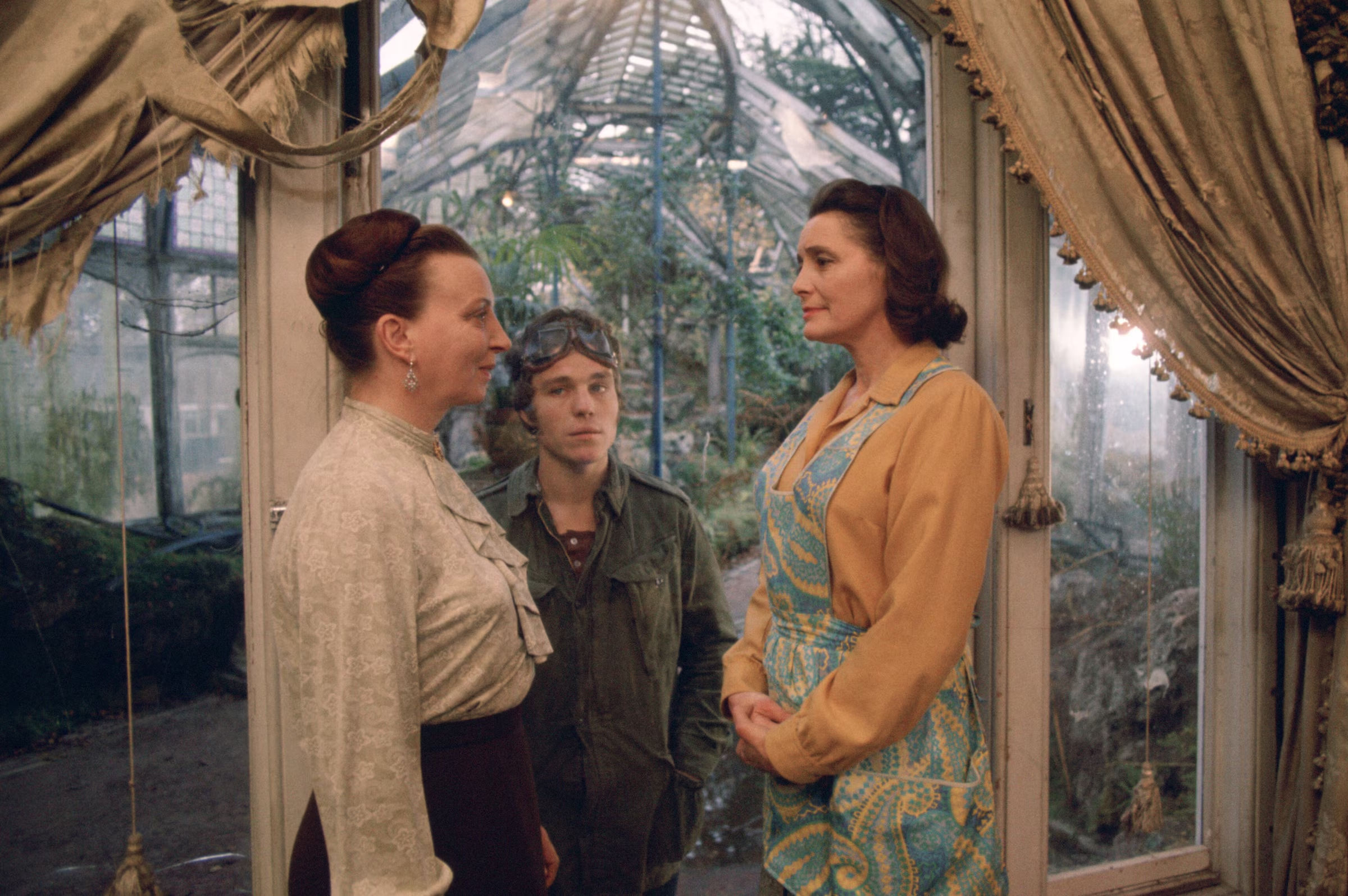


In Alastair Reid’s The Night Digger (1971), Patricia Neal plays Maura Prince, a lonely woman caring for her domineering mother (Pamela Brown) who falls in love with a young handyman, unaware that he is a serial killer. She forms an attachment to a young handyman who possesses a chilling blankness, played by Nicholas Clay, who offers the promise of escape without safety. There’s more than shades of Night Must Fall. Both stories bring a young man with a murderous secret into a household dominated by an older woman, while a younger woman’s attraction to him complicates the danger. He doesn’t need an affectionate or gentle touch to exert a pull on Maura; his physical presence and unsettling self-possession do that work. The resemblance applies to both the 1937 film, starring Rosalind Russell, Dame May Witty, and Robert Montgomery as Danny, and its 1964 remake.
Herrmann’s score gives that uneasy awakening both magnetism and menace. A harmonica associated with the young killer sounds above the strings like a solitary voice that doesn’t quite belong to the world around it; the warmer viola d’amore lends the love music a bruised intimacy. These gentler sounds have their violent counterparts in shrill strings, harp glissandi, and slashing orchestral phrases. When you place it against Maura’s longing, the music can suggest a life cautiously reopening, with something dangerous already crossing the threshold. Herrmann does not make tenderness the opposite of terror: he lets the two inhabit the same room.
For Endless Night, the Agatha Christie adaptation, he experimented with a Moog synthesizer, finding another unsettling voice for his orchestra. These scores belong alongside Twisted Nerve as examples of his continuing search for sounds that could make troubled inner lives easy to hear.


Endless Night (1972), Sidney Gilliat’s take on Christie’s novel, reunited Hayley Mills and Hywel Bennett as a wealthy young woman and the man she hopes to build an idyllic life with; Britt Ekland, George Sanders, and Per Oscarsson are among the supporting cast. Herrmann gives their dream an uneasy musical life. The strings can sound full of longing, but the Moog synthesizer introduces an alien presence, as though something in the picture has slipped out of alignment. That’s what makes the score’s beauty never entirely secure: romantic passages open themselves to harsh interruptions, and the promise of happiness seems to carry its own warning. Unlike the instantly recognizable whistle of Twisted Nerve, this music lingers in the uncertainty of whether we are hearing a love story or the slow disclosure of something sinister concealed underneath.


Hywel Bennett as Michael Rogers, a dreamer with more than romance on his mind, in Sidney Gilliat’s Endless Night (1972).

Margot Kidder as Danielle Breton/Dominique Blanchion and Lisle Wilson as Phillip Woode in the prelude to the chilling birthday-cake scene from Brian De Palma’s Sisters (1973).
De Palma and the Return of the Unquiet Mind
Brian De Palma understood how much Herrmann could say beneath the dialogue. “ I set up a lot of sequences just for him to play. He was the master of giving a whole emotional subtext to the characters. That is what makes the film work” — Brian De Palma
When seeking a composer for Sisters, his thriller starring Margot Kidder, who is both mesmerizing and unnerving as Danielle Breton and her twin, Dominique, in 1972, Brian De Palma approached Bernard Herrmann, whom he had apparently assumed was dead. As K. J. Donnelly and Steven Rawle (Partners in Suspense: Critical Essays on Bernard Herrmann and Alfred Hitchcock, published by Manchester University Press in 2017) recount, De Palma and his editor, Paul Hirsch, arranged a screening, with music from Marnie playing beneath the dialogue to suggest the atmosphere he wanted. He had used the love theme from Marnie only as temporary music. But this didn’t have the intended effect. Herrmann was appalled. It interfered with his ability to imagine new music. Thumping his cane against the floor, he demanded that they stop the film: “How can I think about anything new with that playing?” Nor was he persuaded by De Palma’s wish to begin without title music. “You are not Hitchcock!” he told him icily. “He can make his movies as slow as he wants in the beginning!” Hitchcock’s audience, he explained, would wait; De Palma’s might go home to their televisions.
Though De Palma wanted something of the sound Herrmann had created for Hitchcock, Herrmann wasn’t going to repeat himself on request. Admiring his work was one thing; telling him how to do it was another. The younger filmmakers who sought him out also had to reckon with his insistence on doing things his own way, which seemed to make for an uncomfortable first meeting.


Brian De Palma’s Sisters (1972) and Obsession (1976) both have Hitchcock running through them. In Sisters, it’s the voyeurism, fractured identities, and disturbed inner world that lead to murder. Obsession comes closer to Vertigo, with its grief and the dangerous desire to recreate a lost woman. With Herrmann writing the music, you can hear the connection to his past collaboration as well as see it.
The story of Sisters involves a reporter, Grace Collier (Jennifer Salt), who witnesses a murder involving a woman haunted by her separated twin. For Sisters, Herrmann brought electronic sounds, including a Moog synthesizer, into the score’s menace. He was still willing to try unfamiliar sounds when a film called for them, rather than simply fall back on the style of writing he was known for. In Obsession, he used orchestral voices to give the music a haunting beauty.
In Sisters, Herrmann makes the horror felt before we know where it’s coming from. The opening music bears down on the images: a blunt, repeating horn figure, echoing chimes, and the downward cries of the Moog. At times, it sounds caught between a lament and an electronic unraveling. Nothing feels settled or safely human. There’s something of a cruel childhood taunt in the repetition, only heavier and harder to shake off. The music doesn’t just warn that something terrible is coming. It makes you feel that something has already gone badly wrong.


Its menace becomes more disturbing because Herrmann does not sustain one unbroken assault. Bells and vibraphone give the birthday-cake music a delicate, almost innocent character; in other places, strings, dark woodwinds, and electronics gather around the violence with a weight that makes the sudden rupture feel catastrophic. Small gestures of pleasure and affection become precarious. The score can seem to embrace a moment and then turn upon it, allowing sweetness to remain something accessible even as its surroundings become monstrous. The Moog is crucial to that instability: its strange voice does not simply modernize the orchestra but makes familiar instruments sound as though they belong to a world whose boundaries can no longer be trusted.
Herrmann also gives the film’s fractured identities a musical counterpart, setting ascending and descending string lines against one another. If you listen to this shifting sound world, you might notice how they can suggest lives pulling in opposite directions while remaining bound together.
Herrmann also gives the film’s voyeurism a musical unease. In the opening Peeping Toms sequence, a short phrase repeats over a drone, suggesting an attention that cannot quite pull itself away. The scene may turn out to be a television prank, but the music makes the watching feel troubling before we understand what we are seeing.
The music moves beyond the immediate shock of murder toward something more intimate: attachment that cannot release its hold, and fascination made inseparable from dread. De Palma’s debt to Hitchcock is unmistakable, but Herrmann is not merely supplying a remembered sound. He gives Sisters its own feverish emotional climate, in which even the gentlest passage seems vulnerable to an intrusion it cannot keep out.
In the summer of 1975, Herrmann wrote one of his most richly romantic scores for Brian De Palma’s Obsession. Its echoes of Vertigo brought him back to familiar ground. Brian De Palma’s Obsession (1976) follows a wealthy New Orleans businessman haunted by the loss of his wife and daughter. Years later, in Florence, he meets a woman who looks uncannily like his late wife, and falls for what seems like a second chance at a lost love. Cliff Robertson and Geneviève Bujold star, with John Lithgow as his friend and business partner. The story of love, loss, and betrayal gave him room to explore those feelings with his new collaboration. His music gives the film a painful and powerful sense of longing, making its haunted attachments its own life rather than reminding us of Hitchcock.
The two films bring out different sides of Herrmann. Sisters can sound fractured and invasive, while Obsession gives psychological danger a strange, almost ceremonial beauty. He could still give us both the shock and the lament.


Cliff Robertson as Michael Courtland, a man haunted by loss and the promise of a second chance, in Brian De Palma’s Obsession (1976).
Herrmann said during his August 1975 interview with Royal S. Brown, while in New York supervising the dubbing of the film’s music tracks. Brown had asked whether his music was inspired by the film itself. Herrmann replied that he wrote Obsession as though the film had swept him into its own dream.
“Well, cinema music is the cinema. That’s part of making the picture, not something that’s put in later. I mean, I wrote this score…. I was just telling Brian [De Palma] today: I really can’t tell you; I don’t remember writing it; I was so carried away with the picture.”
He then explained that he would write at four in the morning, that the music came very quickly, and that he identified with the female character’s feelings. He said he completed the score in a month. “I don’t remember writing it,” which describes how emotionally absorbed he felt in the process.
Film-music critic Craig Lysy describes Obsession as “Herrmann’s cinematic requiem,” referring primarily to the score as a farewell to the composer. He was referring to the fact that Herrmann died six months after finishing it, while distribution problems had left the film unreleased.
Later that year, Martin Scorsese, a longtime admirer of Herrmann’s work, invited him to score Taxi Driver, starring Robert De Niro. Herrmann worked on the music from October through December, creating a brooding score whose jazz-inflected sound offered a different direction from the romantic expansiveness of Obsession. The contrast between the two projects reveals the range of his late work: one turns toward longing and emotional remembrance, while the other enters a more troubled, inward world that reaches out to a hostile, unstable one.
He also scored writer-director Larry Cohen’s It’s Alive (1974), a horror film about a murderous mutant infant. That assignment might seem far removed from the prestige of Welles or the elegance of Hitchcock and Truffaut. There is something familiar, though, in his willingness to take a film’s emotional problem seriously, whatever its premise. David Raksin remembered Herrmann’s pleasure that the new generation wanted to hear from him.


Director Larry Cohen, writer-director of such films as Q: THE WINGED SERPENT, GOD TOLD ME TOO and THE STUFF, also became a close friend of the composer during his later years.
In an interview, Cohen recalled Herrmann’s difficult relationships with Hitchcock and the studios, offering a more personal perspective on the man behind the music. Herrmann was intended to score Larry Cohen’s God Told Me To (1976), having already composed the music for Cohen’s It’s Alive (1974). His sudden death prevented that collaboration. Frank Cordell ultimately wrote the score, and the film was dedicated to Herrmann.
“Bennie told me that when Hitchcock came to England to make FRENZY, somebody from Universal called him up and said, “Hitch is in town, would you be interested in writing the music for FRENZY?” And Bennie said, characteristically, “If Hitch wants me, why doesn’t Hitch call me?” and that was the end of it. Somebody tried to be an intermediary, and I’m sure probably called him with Hitch’s permission, but he didn’t want to hear from that guy; he wanted Hitch to call him himself. That’s the way he was, so nothing came of it. He would have been willing to go back to work for Hitch if Hitch had called him.”
“After the Hitchcock break-up, Bennie moved to England with his wife, and they got a nice house in Regents Park. They’d picked up a stray dog on Ventura Blvd., which they’d named Alpy and took with him, and Bennie would walk the dog every morning at 5 a.m. in Regents Park, and he got work. It wasn’t the kind of work he’d gotten before, but he did British films, a Hayley Mills picture and a couple of other films, and then, by and by, what happened was that young guys would start writing him letters asking if he would help them, and he did SISTERS for Brian De Palma, and he came back to do THE EXORCIST. He went to New York. I’d made IT’S ALIVE, and I prevailed upon the people at Warner’s who knew him to see if he would possibly be available to do the score for me, and they said he’s not available because he’s doing THE EXORCIST. He flew to New York to meet with Friedkin, who showed him the picture. Afterward, Friedkin said to him, according to Bennie, “I want you to write me a better score than you wrote for CITIZEN KANE.” And then Bennie said, “Then why didn’t you make a better picture than CITIZEN KANE?” That was the end of that relationship. Bennie returned to England.” -Larry Cohen
Friedkin eventually commissioned Lalo Schifrin, only to reject his score. The finished film instead combined existing works by composers including Krzysztof Penderecki and Mike Oldfield with additional music by Jack Nitzsche; Oldfield’s “Tubular Bells” became its most recognizable musical element.


The City After Dark: Nocturne for the Damned: Bernard Herrmann and Noir’s Inner City
Taxi Driver: The Last Night Music: The Lonely Hours Before Violence
Martin Scorsese’s Taxi Driver (1976) brought Herrmann back to New York and gave him one final, profoundly unsettled protagonist.
In Martin Scorsese’s neo-noir masterpiece, Herrmann gives Robert De Niro’s Travis Bickle a musical life that moves between the desolate blues of aching solitude and gathering fury. His final film score does not simply accompany the cab through New York’s sleepless streets; it makes the journey feel captive to the troubled outsider behind the wheel. Low brass and percussion establish a heavy, threatening undertow, while a sobbing alto saxophone rises above it with an almost unbearable ease. The contrast is the score’s wound: a voice full of longing and existential questions surrounded by sounds that seem to be preparing for violence.
Taxi Driver unfolds in a city that seems to have misplaced the dawn. De Niro gives Travis the terrible stillness of a man rehearsing an eruption, and every encounter confirms a private suspicion. Through Chapman’s camera, New York becomes the Minotaur’s labyrinth; it is both a maze and a prison built to contain a monster within the rain-slick streets washed in neon and passing faces, its lights promising anonymous escape without offering comfort. Herrmann’s music moves through it all like a longing that cannot find its object: the saxophone reaches for intimacy, and the orchestra answers with dread.
Travis Bickle (Robert DeNiro) drives through the city at night, watching people without finding a way to join them. His loneliness develops into judgment, and his judgment into a violent fantasy of purification. Herrmann’s score moves between threatening orchestral intensity and a lyrical jazz voice, making the city feel at once alluring and diseased. The music is the poetry of quickening; it is the alchemy of unease.
Herrmann’s music holds to a low, brooding pulse, but there’s a richness to it. Against the brass wearing away at the silence, the saxophone returns now and then, suggesting Travis’s desire to reach beyond himself, his fascination with studying other people, and the sexual longing tangled up in it.
Scorsese gives anger a landscape and makes the sense of alienation a mesmerizing visual language. Working with De Niro and screenwriter Paul Schrader, he brings the Western’s solitary avenger out of the open country and into the cramped interior of a New York cab. The obsessive pursuit that drives the story comes from a troubling new antihero in Travis, whose desire to set things right becomes impossible to separate from his appetite for violence. The film’s cinematic beauty offers no shelter from its brutality; it draws us closer to a slow-burning fuse who mistakes his own unraveling for a mission to salvage something decent from the human wreckage he sees around him.


In his diary, Travis longs for a “real rain” to “come and wash all this scum off the streets.” Herrmann’s music gives those private words a second, more unsettling voice. It follows the turns of Travis’s thoughts without simply agreeing with them; Herrmann’s score runs alongside Travis’s ruminations, the saxophone and brass giving us a restlessness that his measured delivery can’t disguise. The score exposes the disturbance beneath that composure, with the lonely saxophone and threatening brass suggesting different sides of his inner life.
Herrmann initially objected to doing the film, but after Scorsese’s persistence and after reading the script, he was persuaded to join the project. His music turns the city into something Travis cannot shut out. The score takes shape in the counterpoint between the brass and a contrasting saxophone theme. The music shifts from one mood to the other as Travis’s grip on himself begins to fray. Harps as “gritty little harp figures as hard as shards of steel” (Robert Barnett, MusicWeb 1998 review), and clarinets and bassoons wander through these two strands, joined by sounds from the city itself, the rattle of percussion or the soundtrack of decadence spilling out from the porn palaces, while the brass gathers into something heavier and more threatening. The result is a city heard through overloaded nerves, every sound pressing closer until atmosphere becomes agitation.
The saxophone, played by Ronnie Lang, offers something more intimate than a conventional love theme. Its languid phrases can suggest the companionship Travis wants but cannot manage to sustain, the imagined closeness (especially with Betsy) that makes his actual isolation harder to bear. Against the strings, it gives the passing city a fleeting softness, as though beyond the windshield there might still be a place for him. But the music never allows that possibility to settle. The brass returns with grinding weight, and the percussion gives his restless movement a coercive pulse. What sounds briefly like invitation becomes withdrawal; longing turns back on itself. Herrmann lets us hear the distance between Travis’s wanting human contact and knowing how to actually reach another person. Herrmann’s saxophone theme, associated with Betsy (Cybill Sheppard), offers a romantic warmth repeatedly interrupted by darker, threatening orchestral elements. You can hear that contrast as the distance between the companionship Travis imagines and his inability to sustain it. That division keeps the score from becoming merely an attractive nocturnal jazz accompaniment. Its beauty is unstable, and even its moments of ease seem to drift toward the violence Travis mistakes for purpose.
The sax does not cure the violence in the surrounding music, and the harsher passages do not erase the loneliness that precedes them. Both belong to Travis, without making his loneliness an excuse for what he does. When the climactic shooting arrives, the violence itself unfolds without score; the orchestra returns afterward, its snarling brass and pounding percussion sounding like the delayed release of pressure that has been accumulating throughout the film. The music then takes on the weight of a funeral procession, refusing the easy exhilaration of a victorious finish. In the end, the film settles back into an uneasy normality, as though the bloodshed has somehow been absorbed into the life of the city. This later coda from the immediate aftermath leaves room for the final musical sting, which punctures the apparent calm and suggests that something remains deeply wrong with Travis.
Herrmann died in December 1975, shortly after completing the recording, leaving Taxi Driver as his last finished film score. Its force doesn’t rest on treating it as a farewell. The music belongs completely to this film: to the cab’s restless movement, to the seduction of the city at night, and Travis’s belief that keeping moving might offer a way out. The saxophone seems to open a door; the orchestra keeps returning him to the same enclosed space. He can cross the city endlessly and still find himself in the same place.
Bernard Herrmann’s music gives noir’s urban spaces an unstable psychological dimension, especially in his earlier Hangover Square and Taxi Driver, where musical ambition, masculine frustration, erotic fixation, and violence converge.
The lyrical passages are crucial. Without them, Travis might seem merely monstrous. With them, we hear the dream of intimacy that his behavior cannot sustain. The seemingly innocent outsider at first glance does not excuse him. It reveals the distance between what he wants and what he is becoming. Film critic David Thomson calls the score a “lament for impossible love,” and that’s a useful way to hear it: not simply as the sound of New York nightlife, but as the beautiful, inadequate promise of belonging. Composer David Raksin described the main-title music as a powerful evocation of “New York as hell” (Camera Three: Bernard Herrmann). These responses are not contradictory. Herrmann’s city can lure and condemn in the same breath. It would be sentimental to hear every note as an anticipation of his death. The score doesn’t have such a mythology. Its power lies in the way it lets beauty and danger share the same space, without asking one to make sense of the other.
Despite feeling unwell, Herrmann insisted on completing the recording sessions for Taxi Driver on December 23, 1975. He died in his sleep that night; he was sixty-four. Released the following year and dedicated to his memory, the film became the final chapter of a screen career that had begun with Citizen Kane. Between those two portraits of profoundly isolated men, Herrmann had made music a way of hearing what a character could neither explain nor escape. Scorsese dedicated the film to him, closing with an acknowledgment of the composer’s contribution: Our gratitude and respect. The dedication felt like a fitting goodbye to an artist who, even at the end, was still finding new things for music to say.


Beyond the Final Frame: What stays in the ear
What Herrmann Changed
Herrmann was much more than the man behind the knife-edge strings of Psycho, and the most revealing accounts of his life and music give us room to hear that. Steven C. Smith, biographer, documentary producer, and the author of A Heart at Fire’s Center: The Life and Music of Bernard Herrmann, tells us about a man whose prickly exterior could hide real sensitivity and vulnerability. Sterritt, reviewing Smith’s later study of Hitchcock, brings us closer to the music itself: the unexpected and unusual combinations of instruments, the little phrases that keep circling back, and the tension between suppression and sonic force, the feeling that something held tightly in check might suddenly break loose. Schwartz, in his assessment of Herrmann’s work, makes a larger point: this wasn’t a composer who simply added atmosphere to a great film. His music could help make it great in the first place. Taken together, those perspectives bring us back to what made Herrmann so extraordinary: he didn’t just tell us what a scene was feeling. He let us hear what it couldn’t quite say.
He understood that a score could disagree with an image. A beautiful passage could expose a delusion rather than champion or celebrate a troubled romance. A repeated musical phrase could reveal captivity during a narrative journey. An unfamiliar instrument could make a familiar situation seem to belong to another world. And silence could deny us the comfort of an explanation.
Herrmann’s music didn’t stay in the shadows of suspense cinema. It found its way onto the stage, into pop songs, and into the imaginations of composers who came after him. Stephen Sondheim pointed to Hangover Square as an important spark behind the musical world of Sweeney Todd. George Martin carried something of Psycho’s cutting strings into the Beatles’ “Eleanor Rigby.” And Danny Elfman has returned again and again to Herrmann as a guiding influence. His legacy wasn’t just a sound others admired; it was a language they could make their own.
What these artists inherited was not simply a collection of effects. It was permission to treat musical color and psychological insight as inseparable, to let the arrangement itself tell the story.
Herrmann’s great scores do not stand outside their characters, pointing out danger. They enter the room, settle into the furniture, and begin thinking their thoughts.
That is why the shower still shocks, the green-lit apparition still aches, and the taxi still seems to be carrying something more volatile than a passenger in the moody, misty, dimly lit noir streets.
The sound of suspense, in Herrmann’s hands, is the sound of an inner life becoming impossible to contain.


My thanks to the Classic Movie Blog Association for hosting the 2026 Fall Blogathon, Cinema Couture: The Art of Illusion—it’s a wonderful occasion to explore how movies dress their dreams. I can’t wait to visit all the other wonderful entries!
Sources listing:
* Steven C. Smith — A Heart at Fire’s Center: The Life and Music of Bernard Herrmann, University of California Press. -François Truffaut, as remembered by Bernard Herrmann
— Hitchcock and Herrmann: The Friendship and Film Scores That Changed Cinema, Oxford University Press.
—‘Hitchcock & Herrmann’: Author Steven C. Smith on His Book About the Greatest Director/Composer Collaboration in Hollywood History, and Why the Two Legends Finally Fell Out – by Chris Willman
* David Sterritt — Review of Smith’s Hitchcock and Herrmann, Cineaste, Summer 2026.
* Composer David Raksin — Camera Three: Bernard Herrmann, CBS television tribute 1976; transcript published on the Bernard Herrmann Society website.
* Lloyd Schwartz — “Composer Bernard Herrmann Showcases His Range on ‘PostClassical Ensemble,’” NPR’s Fresh Air, May 4, 2021; transcript republished by High Plains Public Radio.
* David Thomson — Previously attributed to The New Biographical Dictionary of Film, but the quotation and its source remain unverified.
*Royal S. Brown, film-music scholar and critic, and professor emeritus at the City University of New York.
— “Herrmann, Hitchcock, and the Music of the Irrational,” Cinema Journal, vol. 21, no. 2, 1982, pp. 14–49. This examines Herrmann’s collaboration with Hitchcock and the harmonic language of their films.
— Overtones and Undertones: Reading Film Music, University of California Press, 1994. It includes substantial discussion of Herrmann’s music and interviews with the composer.
— August 1975 interview with Herrmann appeared in High Fidelity in September 1976. A revised version appeared in Overtones and Undertones in 1994 and is reproduced on the Bernard Herrmann Society website. Discussing Obsession, Herrmann said, referring to composing the score for Brian De Palma’s Obsession.
*K. J. Donnelly and Steven Rawle (Partners in Suspense: Critical Essays on Bernard Herrmann and Alfred Hitchcock, published by Manchester University Press in 2017)
*Claudia Gorbman —Herrmann’s music for Hangover Square, in her book Unheard Melodies: Narrative Film Music (1987), published by the British Film Institute and Indiana University Press.
*University of California, Santa Barbara — Its collection of Bernard Herrmann’s papers and archival materials.
*Bernard Herrmann Society — Its online archive of essays, interviews, and other material.
*Cinephilia & Beyond’s “‘Obsession’: When De Palma Stepped Out of Hitchcock’s Shadow” reproduces this statement by De Palma:
*Neil Sinyard’s film scholar essay “Hitchcock vs Herrmann: The Story Behind the Break-up of Cinema’s Greatest Director–Composer Partnership” reproduces Truffaut’s written account
*Brian De Palma — Quoted in Cinephilia & Beyond, “‘Obsession’: When De Palma Stepped Out of Hitchcock’s Shadow,” compiled by Bill Fentum
*François Truffaut — Quoted in Neil Sinyard’s online essay, “Hitchcock vs Herrmann.”
*David Raksin – composer -David Raksin Remembers His Colleagues: Bernard Herrmann
*Larry Cohen was talking about working with Herrmann on It’s Alive (1974). The source is an interview, rather than an essay Cohen wrote: “Larry Cohen Talks about Bernard Herrmann,” by Dennis Fischer, originally published in Soundtrack! magazine, vol. 11, no. 43, in 1992, and later reproduced online by Cinescores.
*An Interview with Bernard Herrmann by Ted Gilling, article The Colour of Music ?, Sight and Sound 41, No. 1 (1971/72), pp. 36-39
*Publisher: British Film Institute (BFI)
*An Interview with Bernard Herrmann by Ted Gilling?Sight and Sound 41, No. 1. (1971/72) pp. 36-39—Publisher: British Film Institute (BFI)
*Larry Cohen on Bernard Herrmann (1972)
Originally published in Soundtrack Magazine Vol.11 / No.43 / 1992
Text reproduced by kind permission of the editor, Luc Van de Ven
https://cinescores.dudaone.com/director-larry-cohen-talks-about-bernard-herrmann
*Roger Hall. Originally published in Soundtrack Magazine Vol.21/No.81, 2002. Text reproduced by kind permission of the editor, Luc Van de Ven, and Roger Hall
*Steve Vertlieb – essay “Herrmann and Hitchcock – The Torn Curtain,” dated 2002 on the Bernard Herrmann Society website.
*John Williams -composer- interviews source needed
*David Thomson -The New Biographical Dictionary of Film


