

THE QUEEN OF SPADES 1949

“The Dead Shall Give Up Their Secrets!”
The Queen of Spades (1949) is an obscure British psychological thriller. Associate Producer Jack Clayton was on board for this film, directed by Thorold Dickinson (Gaslight, 1940), who came onto the project at the last minute. Adapted to the screen by Rodney Ackland and Arthur Boys from the 1834 novella written by Alexander Pushkin. The story could have easily been dreamt up by Aleksei Tolstoy, Ivan Chekhov (The Drop of Water sequence in Black Sabbath), Nikolai Gogol, or even Oscar Wilde.
It also brings to mind Edgar Allan Poe’s short story “Never Bet the Devil Your Head: A Moral Tale.” Which of course was brought to life by Federico Fellini in the segment of Spirits of the Dead 1968 called Toby Dammit, featuring the work of divine actor Terence Stamp.


It’s clear that Russians are very good at telling Ghost stories and notorious for telling tales about selling your soul to the Devil!
The Queen of Spades stars Anton Walbrook, Edith Evans, and Yvonne Mitchell. Also in the supporting cast is Ronald Howard, son of Leslie Howard, who bears a striking resemblance to his father. Andrei is of a noble background, a soldier as well, and Herman Suvorin’s only friend. He is truly in love with Lizaveta (Yvonne Mitchell). The evil Suvorin even steals a few of Andrei’s poetic words to use in one of his love letters to lure Lizaveta.
An ambitious officer, Herman Suvorin, becomes obsessed with learning the secret card combination that once made an elderly countess fabulously rich, a secret she supposedly bought with her soul. To get it, he worms his way into the household through her young companion, Lisaveta, only to drive the old woman to her death and find himself haunted, literally and figuratively, by what he’s done.
The film is a lost masterpiece of British Gothic cinema, with its arresting visuals, the elegant but uncanny set design, and the way mirrors, shadows, and sound are used to keep pace with Walbrook’s unraveling.


The evocative music scored by Georges Auric (Beauty and the Beast (1946), The Innocents (1961), and Wages of Fear 1953, just to mention a very few!) is as heart-wrenching as it is heroic, drawing out the exquisite melody and chord changes to reach the soul and twist it into knots while it lingers.
What can I say about the gorgeous cinematography by Otto Heller? The odd camera angles are reminiscent of the great German Expressionist movement, something from Fritz Lang, or the use of light and darkly dreamy angles like those of Carl Theodor Dreyer.
Even without any sound, the story would have emerged from the screen as a powerful cautionary tale, rife with grotesque and compelling characters.


The film is an arresting fairytale, that’s dreamy, and haunting in its imagery, and perhaps, as visually stunning as I dare say Jean Cocteau’s La Belle et la Bete 1946 or Julian Duvivier’s Flesh and Fantasy 1943, and the collaborative efforts of Alberto Cavalcanti, Charles Crichton, Basil Dearden, and Robert Hamer’s Dead of Night 1945.


There are frames so masterfully conjured in shadow that you might even think you’re watching Film Noir or an obscure Val Lewton production. Either way, The Queen of Spades defies any single label; it is a wonderful fusion of many compelling elements.
You know, a lesser director would simply sit back and let Walbrook carry everything, but Dickinson matches his intensity by filling the frame with signs of fracture; reflections that don’t feel trustworthy, hallways that seem to lengthen under the pressure of paranoia, and images that keep you guessing whether the Countess is a victim or a supernatural predator.
Dickinson’s direction emphasizes a brooding, Gothic atmosphere through chiaroscuro lighting in opulent Russian interiors and Expressionistic use of shadows to convey psychological turmoil. There are unsettling close-ups of Walbrook’s intense gaze
It has a melancholy, fairy-tale logic of its own, drawing on mystery, crime, noir, and supernatural horror from that golden age when the way a film looked mattered as much as what anyone said or did.
Dickinson films all of this with a rich, brooding flair. The interiors feel like gilded mausoleums: heavy drapes, ornate mirrors, and those deep pools of black shadow that look ready to swallow the characters whole. Light and darkness battle it out in every frame, faces half-carved by candlelight, staircases that vanish into ink, cards gleaming like tiny white tombstones on the imagined color of green baize. There are close-ups of Walbrook’s gaze so intense they almost feel like a challenge to us: are you really sure this is all in HIS head?
The world around him is just as expressive. Otto Heller’s camera turns the Russian aristocracy into a kind of living ghost story, with costumes and sets that feel slightly heightened, slightly unreal, like a memory of the 19th century rather than a documentary reconstruction. Georges Auric’s music threads through it all like a nervous pulse, amplifying the sense that fate is already written, and every choice these characters make is just another step toward it.
What I love is how the film stands at a crossroads: you can feel the influence of German Expressionism in those tilted shadows and uncanny compositions, but there’s also the fatalism and moral rot of film noir seeping through the cracks. It’s Gothic horror dressed in cards and uniforms, already nudging its way toward the more modern obsessions of psychological thrillers, what happens inside a mind when greed, fear, obsession, and desire all start playing their own rigged game.
The Queen of Spades (1949), treated as a major work of British Gothic cinema, gains an even stronger atmospheric charge when you factor in Thorold Dickinson’s background as an editor, his earlier work on the original Gaslight, and the circumstances that brought him onto the film at very short notice, reshaping both script and tone.
Anton Walbrook’s career and temperament; his origins as Adolf Wohlbrück in Vienna; his pre-war success in German cinema and theatre; his flight from Nazi Germany; his reinvention in Britain; and how that history of exile and doubleness feeds into his performance as Herman Suvorin in this film. All of that should feel integrated, a context that enriches the reading of the film, not little biographical footnotes.
Thorold Dickinson leans hard into a brooding, Gothic mood. He floods those St. Petersburg interiors with chiaroscuro light, corridors carved out of shadow, letting faces emerge from the dark as if the shadows are thinking for themselves, surfacing as if summoned rather than simply lit.
The camera keeps circling back to Walbrook’s eyes in unnervingly tight close-ups, so that a single glance can feel like a threat or a crack in his sanity.


The world around him is just as expressive. The cinematography feels like guilty opulence under siege: The rooms are crowded with heavy fabrics, ornate furniture, and elaborate uniforms and gowns that don’t just signal 19th-century Russian aristocracy, they make the whole society feel overdecorated and airless, as if the characters are being slowly smothered by their own luxury.
Otto Heller’s work is explicitly, metaphorically visual with his use of towering shadows, inky pools of darkness, expressionist angles, creating St. Petersburg as a maze of pitchblack and candleflame, faces carved out of shadow like reliefs, the gambling den as a kind of infernal chapel where light and smoke conspire to turn men into specters, and the part of the film’s preoccupation with fate and damnation.
And the way Messel and Kellner’s sets and Heller’s lens make the Welwyn stages feel like a haunted city rather than a modest British studio. The Gothic textures, the baroque interiors, the way mirrors and high angles warp scale and sanity, all circle back to the film’s preoccupation with fate and damnation.
Kellner and Oliver Messel are the production designers; the BFI has a whole piece on his Queen of Spades model work and describes those “rococo flourishes, faded grandeur, flickering candles, mercurial mirrors and architectural pieces capable of throwing the most ominous of shadows.” William Kellner, credited as art director, is specifically praised in a recent Film Experience piece for stuffing the frames with baroque excess.
The Queen of Spades absolutely leans into that slightly baroque and lush mood, mirroring the film’s own sense of ornate decay, while threading through a few precise, cutting images that keep it feeling overstuffed.
The film’s language is rich, tactile, and atmospheric, and the metaphors are layered, curling around the texture of the images, the velvet blacks, hard glints on brass, the gleam of cards, and the pallor of anxious faces, punctuated every so often by a short, almost brutal line that states the psychological or supernatural truth of what we’re seeing.
That duality lets you honor the film’s rococo visual world while keeping your prose disciplined: the baroque tone sits in the sensory detail and rhythm, and the “sting” arrives in those sudden, cool observations that cut through the gloom.
The Queen of Spades is shot as if the entire film were taking place inside a guilty conscience, dressed up in velvet and gilt to keep the truth from showing. Light doesn’t simply illuminate these rooms; it seems to trespass into them, sliding over brocade and brass, catching on the trembling edges of playing cards and the brittle planes of severe faces. The blacks are deep and inky, the kind of darkness that doesn’t just sit in the background but presses forward, swallowing doorways, staircases, and corners until the characters look less like they’re inhabiting a space than being slowly absorbed by it. Candle flames and lamps carve out small, feverish islands of visibility, and within those islands, every crease in the wallpaper and every glint from a picture frame feels complicit in the story’s sense of doom. The camera glides through this environment like an accomplice who already knows the ending, drifting past heavy draperies and ornate furniture with the calm assurance of fate, occasionally settling into compositions so tight and airless that even the grandest rooms feel like traps waiting to spring.
Faces in this film don’t simply appear; they emerge from the gloom in stages, features picked off one by one by slashes of light that seem less interested in revealing identity than exposing motive. Anton Walbrook’s profile, in particular, is treated almost like an architectural element chiseled out of shadow, his eyes catching just enough glimmer to suggest the restless, calculating machinery behind them. The cinematography repeatedly turns him into a figure at war with his own surroundings: one moment, he’s swallowed by the house’s baroque clutter, a man miniaturized by portraits, pillars, and candelabra; the next, the frame clamps down so tightly on his face that the world recedes and all that remains is obsession, flickering in a narrow band of light. There is a sense that each shot is a negotiation between opulence and suffocation, the décor flaunting its richness even as the framing and lighting insist that nothing in this world, no mirror, no staircase, no deck of cards, is safe or neutral. Every visual choice feels like a bet placed against the characters’ better judgment.
What makes the images so unnerving is the way the supernatural never quite announces itself; it seeps in through the textures.
Reflections linger a second too long in those mirrors, suggesting presences that might just be tricks of the light, until we begin to doubt our own eyes along with the characters’. The house behaves like a silent conspirator: staircases vanish into shadow that looks thick enough to touch, doorways become black gaps that seem to promise either revelation or annihilation, and the countess’s rooms feel embalmed under layers of fabric and ornament, like a mausoleum that never admitted it was one. When the uncanny finally steps fully into the frame, it doesn’t arrive as an interruption, but as an inevitability, something the images have been patiently preparing us for since the first candle guttered against the dark.
The overall aesthetic of the costumes in The Queen of Spades feels like an extension of the sets—ornate, faintly unreal, and just a little too sumptuous for comfort. Designer Oliver Messel, better known as a star theatre and production designer, brought his unapologetically anti-naturalistic, “enemy of everything utilitarian” sensibility to the film, dressing characters in layers of brocade, lace, and elaborate trim that make the aristocratic world look both intoxicating and airless.
His inspirations reportedly ran to the pioneering English architect, designer, and artist who introduced Italian Renaissance classicism to English architecture. Inigo Jones, who started as a designer of theatrical masques and sets, also Fragonard, Boucher, and other masters of elegant artificiality, and you can see that in the exaggerated silhouettes, the froth of ruffles and silk, the way collars, cuffs, and headpieces frame faces as if they were portraits being composed for our inspection.


The Countess’s gowns, especially, are like movable shrines— baroque horrors, treasure boxes, guilded nightmares, heavy, rustling constructions that announce her before she even speaks, while Lisaveta’s simpler dresses emphasize how she’s visually of this world but not really allowed to own it.
As far as the men’s uniforms and evening clothes go, they have a sharp, almost rigid formality that contrasts with Suvorin’s inner disarray; he’s buttoned and braided within an inch of his life, yet always looks slightly ill at ease inside Messel’s meticulously tailored elegance. All together, the costume design contributes to that sense of a rococo society drifting toward nightmare: everything is beautiful, everything is heightened, and every ribbon and epaulet feels like one more thread in a web these characters won’t easily escape.
The 1949 film follows the basic spine of Pushkin’s story quite faithfully, but it thickens and reorients the material in ways that make it far more of a Gothic character study and melodrama than the relatively lean, ironic tale on the page.
Pushkin gives you a compact narrative about Herman Suvorin, an outsider obsessed with discovering the secret card-winning formula from an old countess, and the devastating consequences of his cold, calculating ambition; the film keeps that core, but elaborates on the character’s relationships, heightens the supernatural aura, and leans heavily into visual and atmospheric excess that Pushkin only suggests in a few of his clean strokes of the pen.
Plot-wise, the main events are recognizably Pushkin: the legend of the three cards, Suvorin’s manipulation of the young woman connected to the countess, the fatal confrontation, the ghostly visitation, and the final, ironic twist at the gaming table all remain intact. Where the film diverges is in its emphasis and tone; it slows down and luxuriates in spaces, rituals, scheming, and psychological beats that the story moves through with brisk, almost cruel efficiency, turning what a sharp moral fable it is, into something closer to a richly upholstered nightmare about obsession, class, and fatalism.
The Pushkin source, the rewiring of the story by Arthur Boys and Rodney Ackland, the producer Anatole de Grunwald, the late replacement of Ackland by director Dickinson after quarrels with both de Grunwald and Walbrook, and the way Dickinson’s experience on Gaslight inflects the film’s fascination with manipulation, paranoia, obsession, and moral rot.
Otto Heller’s inky black-and-white cinematography, the baroque sets, and the way the film has come to be regarded as a neglected gem or gothic masterpiece of late?40s British cinema, rather than just a handsome literary adaptation.
Walbrook’s performance, which can be seen against his earlier turns in The Life and Death of Colonel Blimp and The Red Shoes, becomes a pivot: another portrait of a driven, haunted man, but here shaded with greed, desperation, and a kind of spiritual homelessness.

Set in 19th-century St. Petersburg, the story follows Captain Herman Suvorin, an obsessive gambler who becomes fixated on learning a secret three-card formula from an elderly Countess who made a deal with the devil himself.
Anton Walkbrook is enigmatic, oozing a mania of greed and obsession, playing the bitter, venomous Capt. Herman Suvorin, an army engineer, was so poisoned by his resentments toward the ruling aristocracy that he wanted to gain his own wealth and punish those around him who had benefited by their birthright and title. Suvorin is under the influence of the supernatural as he manipulates the Countess’s young ward, Lizaveta, to gain access to the Countess’s secrets. Suvorin does not want to take life as it comes; he wants to “Grab life by the throat and force it to give him what he wants!”
Walbrook’s Suvorin is a man forever teetering between reason and delirium. One moment he’s the cool rationalist, sneering at superstition; the next, his eyes catch the light in a way that makes you wonder what, exactly, he’s seeing in the shadows. If the film didn’t point to Suvorin’s entanglement with fear, superstition, and a tremendous ego, you might believe you see a flicker of him haunted by guilt, or has he really opened a door that should have stayed bolted? Is he being hunted by the Devil, or simply losing himself to madness?
The film never quite lets you off the hook; every logical explanation seems to leave just enough room for something uncanny to slip through, and that’s what makes The Queen of Spades so visually intoxicating.
The narrative delves into the destructive nature of avarice, with Herman Suvorin’s relentless pursuit of wealth leading to tragic consequences and his maniacal undoing. The film also examines the tension between rationality and superstition as Suvorin grapples with seemingly supernatural events.
This he conspires to do by trying to learn the secret of winning at the card game named Faro, from the Old Countess Ranevskaya. The Countess, played by Dame Edith Evans with the chill of a mausoleum and the hauteur of a woman who has outlived everyone and everything that ever mattered, becomes his obsession.
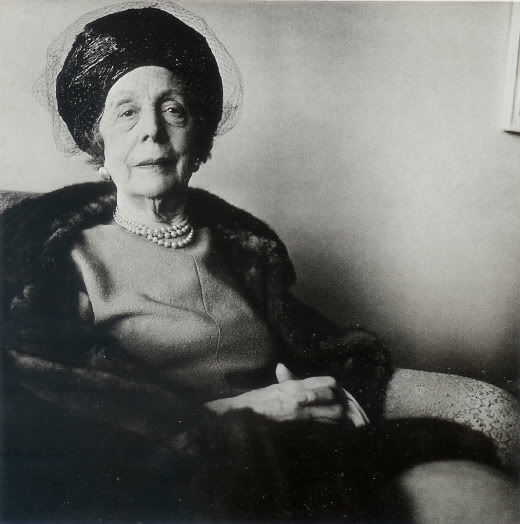

Evans had a towering stage career, celebrated for Shakespeare, Shaw, Wilde, and Restoration comedy, but her international screen reputation rests largely on a handful of films. She won a Golden Globe and a fistful of major critics’ awards, plus an Oscar nomination, for The Whisperers, which cemented her late-career status as a major film actress as well as a legendary stage performer.
You know her as a stage legend, but on film she really lives in just a few key roles: The Importance of Being Earnest, Tom Jones, The Nun’s Story, The Chalk Garden, and The Whisperers. On screen, she peaks with The Whisperers, which brought her the Golden Globe, and quietly reintroduced her to the world, not just as a Grand Dame of the theatre, but as a late- career character actress with real weight and vulnerability.
A notable line in The Importance of Being Earnest is the “A handbag?” comment by Lady Bracknell – her horrified reaction to learning that Jack was found as a baby in a bag at Victoria Station, not born into a proper, traceable family. In the scene, Jack is confessing that he doesn’t know his parentage: a kindly gentleman found him in a handbag in the cloakroom and raised him. For Lady Bracknell, who cares about breeding above all else, being found in a handbag is unthinkable, so she repeats the word with this enormous, disgusted disbelief, as if a handbag were the lowest possible “origin story” for a prospective son-in-law.
The joke is in that outsized shock: Wilde takes something mundane and lets Evans (and others after her) blow it up into operatic outrage, which is why that tiny phrase has become the play’s most famous moment. Evans’s Lady Bracknell repeats the word with such appalled grandeur that Wilde’s little joke about social class turns into one of the great comic line-readings in theatre history.
Edith Evans’s Countess is a figure who shifts between banal complaint and something genuinely haunted, keeping us uncertain whether she’s just an old woman tormented by a madman or a soul that bartered away more than she admits.
Looking back at her youth as a courted beauty at Versailles, we see that she once moved in a glamorous, flirtatious world of cards and of courting favor with eligible gentlemen. But in the present tense, she has been mummified in a life that’s narrow, airless, and ruled by old habits and fear. The Countess, at one time, had a clear romantic escape. Lisaveta’s (Yvonne Mitchell) fantasies replay the possibility the Countess once had and never truly took.
I’ve found that the Countess is usually read as very close to Pushkin’s original figure: decrepit and sharp-tongued on the surface, but with a flinty, unyielding intelligence and complete self-possession underneath, the kind of woman who once broke rules and now survives by sheer force of will in a world that has outlived her. The infamous backstory—the Muscovite Venus who gambled, lost, and bought back her losses with an unholy secret, is the key to her; she embodies a kind of female power that was never supposed to exist in polite society, so the price is loneliness, bitterness, and this uneasy status as both legend and liability.
She isn’t just a wicked old crone; she’s exhausted, alienated, and taking her disappointment out on the only people she still has any power over, which makes her bullying of Lisaveta feel as much like a survival strategy as simple cruelty.
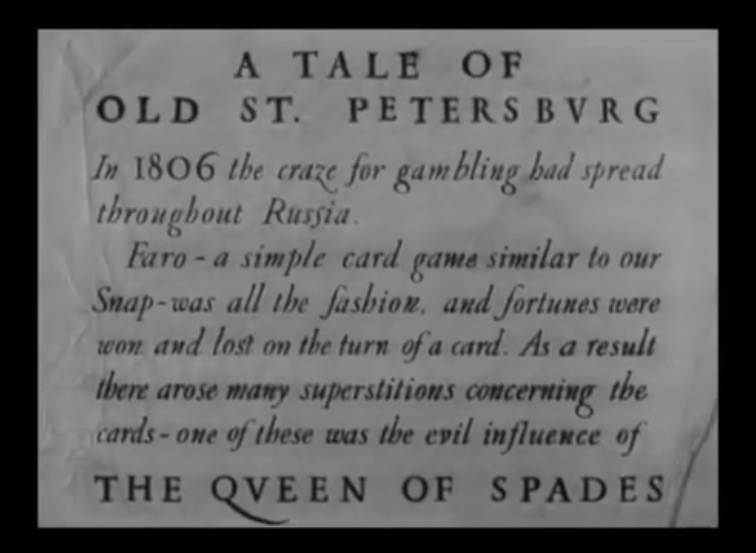
After a frustrating night of watching a few of his fellow army officers play Faro, taunting Herman Suvorin as if he was not of the same class, he bursts out of his room in a self absorbed rage, and wanders onto the streets and into a dusty old book store, first picking up a book about Napoleon Bonaparte whom he admires (his portrait hangs in Herman’s humble room) because Napoleon came into his power at age 26!

Herman Suvorin possesses a similarly intense, maniacal quality that makes him a very unapproachable, manipulative, and unlikable man. Looking at him was like “looking into the eyes of Satan!”
Fatefully placed next to Napoleon’s book is another book. Suddenly, with a creepy alacrity, the old bookshop owner picks up the ancient bound leather and starts relating its contents to Suvorin, as if he’d been chosen as the messenger… warning Suvorin about the secrets and dangers of tampering with the universe. The old man told him that he’d either wind up having riches… or lose his eternal soul!


In his appearance and manner, he kept making me think of Riff Raff from The Rocky Horror Picture Show, and I found myself wondering if this bookish little crypt-keeper hadn’t slipped into Richard O’Brien’s imagination somewhere along the way
Herman Suvorin purchases the book for 3 rubles and starts reading aloud to us. This mysterious book, about people making deals with the Devil, and a certain elusive Count d. Saint Germaine, who lived in an isolated palace and molded wax images of his chosen victims, thereby trapping their souls forever in his power.


Herman Suvorin slowly and thoughtfully recites to us from the book:
Containing the true stories of people who sold their souls in return for wealth, power, or influence.” Chapter IV The Secret of The Cards Countess R (Countess Ranevskaya )In the year seventeen hundred and forty-six, (60 years ago)
The Count d. Saint Germain arrived in St. Petersburg.
He chose for his residence a palace on the outskirts of the city. And soon there were strange rumors about the weird dwelling and its mysterious occupant. It was certainly true that in the vaults of the palace. He had a curious collection of wax figures, which, so it was whispered, contained the souls of those who had fallen under his evil influence. He would derive intense pleasure from modeling the wax figures of his intended victims, each one of whom was chosen.
with deliberate appreciation. Thus, the countess Ranevskaya, acknowledged as the most beautiful woman in Russia, came to excite his attention. He learned that, in spite of a jealous husband, all the men had vied for her favors.

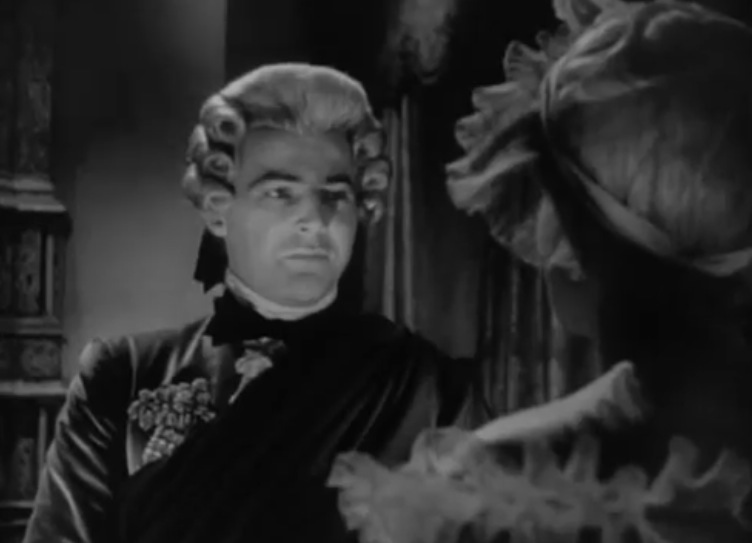
The story goes: When the last of the guests had left. The Countess went down the secret stairway. To admit the young stranger, she had promised to meet. She alone had the key to the hidden door. They had an amorous meeting. He was a cad and threatened her with scandal. Taking all her money. She was haunted by the fear of scandal. She needed to replace the money. In her despair, she remembered the message from Saint Germain. She had no alternative but to answer the mysterious summons. She would sell her soul for anything to save herself…


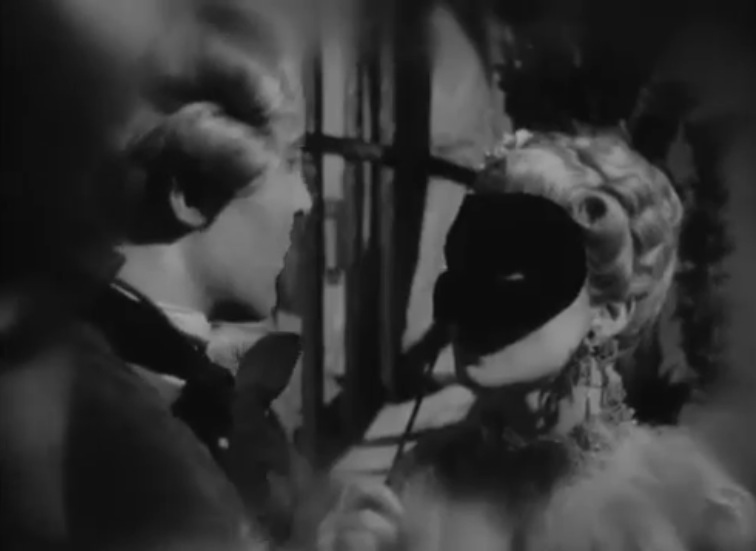




There are glass jars filled with blurred, indistinct forms that could be waxen figures of people sealed inside. The camera refuses to dwell on them for long, and that very brevity leaves us with a prickle of unease, a kind of reluctant horror.


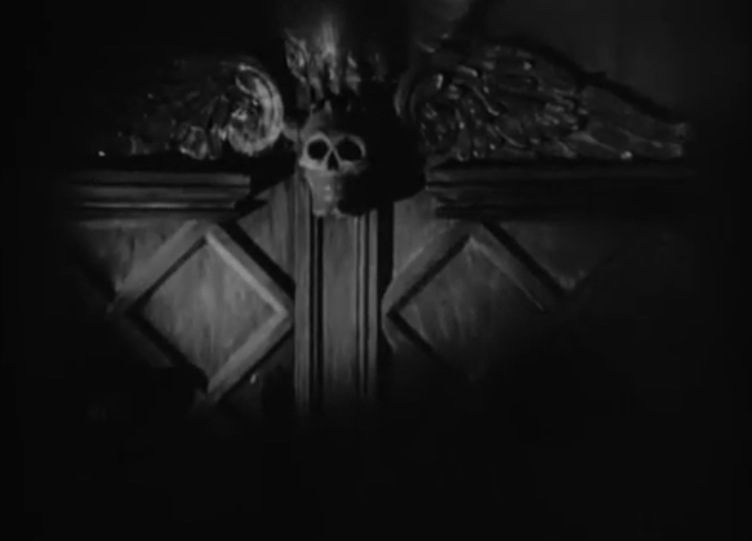
In a flashback, we are shown part of the legend of the Countess’s origin from her time as a young woman. In a very chilling scene that helps transport this obscure classic into the realm of Gothic horror film, the young and beautiful Ranevskaya (Pauline Tennant, daughter of actress Hermione Baddeley) is approached by Saint Germain’s messenger, briefly played by Valentine Dyall. Once at the eerie Saint Germain palace, the horsemen leave her off through a large wooden door with a skull set atop as an augury to what lies in wait. She begins to descend into the darkness, until WE hear her… a horrifying scream from outside. The horses rear up and begin to kick violently as they whinny. And then a sudden quiet as the camera frames the cloudy night sky, dreary, desolate, and still. The scene fades to Saint Germain’s vault, which contains obscurities in darkly glowing glass jars.
Herman Suvorin reads some more:
Saint Germain gave her the secret of the three winning cards. In return, she made a solemn vow that no one else would ever know the secret.
One hour later, she was on her way to the gaming rooms. She played the three cars in succession. She won a fortune, but the horrors of her visit to Saint Germain left a mark on her soul for the rest of her life.


Later, she is kneeling, as she prays to The Holy Virgin for mercy, we see the icon lit up in detail, until the face of the blessed virgin is eclipsed by a blackness, at the same time the candle which burns in her honor goes out and so drifts it’s whitish vapor across the screen as young Countess Ranevskaya puts her hand on her face in shame and abject fear or what is to come, what has been done…


Now… As The Old Countess, a freakish sort of caged bird herself, Evans is incredible as she inhabits her environment like a grotesque caged thing. One who understands her captivity and so settles into her misery. Surrounded by wealth, she is still damned for eternity.


She shows no kindness or love, except to her little dog. She moves along the floor in her tremendous apparatus of a dress, scraping the ground as she drags her obscene body around. Her hair, yet again a macabre decoration of human foliage, feathers and fur. The use of sound in this film highlights the scraping as if The Countess were a large serpent or reptile, slithering along the ground. After all, Raneyskaya has entered the dark side, where the serpent reigns.


In contrast to the hideous existence the decrepit, noxious, almost lizard?like Countess imposes on her servants—especially her ward, the kind and gentle Lizaveta—it is Lizaveta who invokes the image of birds in cages after meeting Andrei at the village market. Lizaveta, played by the absolutely stunning Yvonne Mitchell, wants to “set them free and watch them fly away with the clouds.”

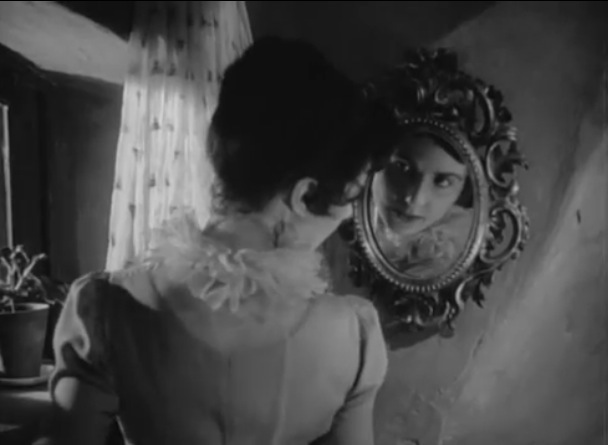
Along with images of birds in cages, the camera often frames one character or another within a ‘mirror.’ There’s a great use of mirrors in this film. The symbolism of duplicity, of souls being trapped inside an alternative reality. The players often see themselves as WE see them, acting and expressing themselves within their reflective self.

To continue with our story:

While glancing at this fatalistic book in the streets of St.Petersburg, Herman Suvorin notices a young woman sitting by a window. She winds up being The Old Countess’s ward, Lizaveta Ivanova.
Yvonne Mitchell is especially noted for The Divided Heart (1954), where she won a British Film Award, and Woman in a Dressing Gown (1957), which brought her a Silver Bear at Berlin. She turns up in key 1950s British dramas and thrillers like Turn the Key Softly (1953), Sapphire (1959), Tiger Bay (1959), Conspiracy of Hearts (1960), and The Trials of Oscar Wilde (1960), where she plays Constance Wilde. Later, she appeared in titles such as Genghis Khan (1965), Crucible of Horror (also known as The Corpse, 1971), Demons of the Mind (1972), The Great Waltz (1972), and The Incredible Sarah (1976).


It is then that Herman Suvorin conspires to win Lizaveta’s affections in order to gain access to The Old Countess herself. And so Suvorin begins his ‘cold-blooded seduction’ of Lizaveta.


The rumors and the book now in his possession speak of how The Countess Ranevskaya made a deal with the devil to learn the secret of the cards, so that she could win a fortune at Faro. He begins a feverish mission to gain entry to the Countess and force her to tell him the secret. S9 he sets out to seduce Lisaveta, the girl closest to the Old gilded caged bird.
The Queen of Spades is a story someone might whisper over cards at three in the morning, with a man who has spent too long watching other people win. Herman Suvorin, an outsider among his fellow officers, stands at the edge of the gambling table, his eyes fixed not on the glitter of coins but on the calm assurance of men who’ve learned to live with risk. He’s a man who hoards his money and his emotions, an observer who insists on control, and it is precisely this hunger for certainty that makes the legend he hears one night feel less like gossip and more like fate clearing its throat.
The tale of the old Countess who, decades earlier, supposedly sold her soul for the secret of a three-card sequence that guarantees victory is too intoxicating for Herman Suvorin to simply ignore as legend of how she used it once, twice, thrice, and locked the knowledge away. As the story is told, you can feel Suvorin already rewriting his own future in his mind: the cards are not just a trick, they are a shortcut past the humiliations of chance. From that moment, the film quietly shifts his obsession from money to something more corrosive: the dream of escaping risk altogether.
His path to the Countess doesn’t run straight; it curls through Lisaveta, the young companion trapped in the suffocating orbit of that ancient, embittered aristocrat. Lisaveta’s life is a routine of small humiliations, scoldings, surveillance, and being treated more like an accessory than a person. And this makes her both vulnerable and dangerous to Hermann. He courts her at first with a sort of fevered sincerity that looks like romance from a distance but, under the light, reveals itself as pure calculation. She becomes dangerous to him in a very specific, almost ironic way: she’s the one person who can expose how calculated his “love” really is.
In Pushkin’s story and in most critical readings, Herman Suvorin targets Lizaveta because she’s vulnerable and isolated; he sends her plagiarized love letters, banking on the fact that she’s never read the novel he’s stealing from, and counts on her desperation to escape the Countess’s household. That makes her an ideal mark, but it also makes her the witness who can later see him clearly: she knows his entry into the house wasn’t fate or romance, it was strategy. Once she understands that, Lizaveta becomes dangerous because she can puncture the story Herman tells himself, that he “had no choice” and was simply obeying destiny, by revealing the cold, premeditated steps he took to get to the Countess.
Herman Suvorin may treat Lisaveta as a tool, but she is also the one who is witness to the evidence that his supposed grand, fated mission is, in fact, just a con.
Through stolen glances, letters slipped into her path, and clandestine meetings, he constructs the illusion of a love story, but every gesture is angled toward the same goal: gaining access to the Countess’s rooms. The film lets these scenes play out with a deliberate sweetness, softening the edges just enough that we, like Lisaveta, almost want to believe in him, even as his eyes give him away. It is a cruel irony that her first taste of passion is, in fact, part of his strategy.
The turning point comes the night Suvorin finally crosses the threshold. Lisaveta, persuaded and betrayed in the same breath, arranges for the door to be left open, and he slips into the Countess’s bedroom like a shadow that has decided to act. The old woman is presented as something between relic and revenant, wrapped tightly in fabrics and rituals from another century, attended to like a living museum piece.
To get to her, Suvorin doesn’t storm the fortress; he seduces the gatekeeper. Yvonne Mitchell’s Lizaveta is lonely enough to mistake his attention for affection. He uses her, quite ruthlessly, as a key—slipping into the old woman’s world of candlelight and secrets. What starts as a scheme to crack a gambling code quickly sours into something darker, as if the air itself thickens around the Countess and the man who dares to trespass.
She has been unaware that the real reasons for Suvorin’s constant vigil outside her window are merely to learn the secret of the cards from her Benefactor.
I think we can push back against the idea that Lisaveta is just a disposable ingénue, arguing that Yvonne Mitchell’s performance quietly hints at intelligence and resilience stifled by her status as a poor female dependent.
She’s constantly scolded and used as a go-between for the Countess’s moods, and when Suvorin begins sending those ardent letters, the film makes it clear she’s responding partly to the intoxication of being seen at all.
For Lisaveta, she moves lightly through each frame but in a way has even less freedom than the Countess; her days are spent catering to the older woman’s whims, confined to corridors and back rooms, treated as a useful object rather than a person with any future of her own.
Yet Mitchell’s Lisaveta refuses the idea of her naïveté as a simple plot device; in her hands, you can see the outline of a woman who might be formidable if she were ever allowed a life beyond the Countess’s suffocating household. That’s the thread I’d like to pull on: the film quietly suggests that the older Countess has, in a way, raised a version of herself, trapping Lisaveta in the same unhappy cycle of dependence and desperate romantic escape.
With Lizaveta, I think a lot of critics are basically wrestling with how much room the film actually gives her to move, and how much of her fate is already written by the social script she’s stuck in. On the surface, she’s the classic poor ward, the modest, prettily downtrodden, forever being snapped at by the Countess and half-ignored by everyone else. From what I have read in other critical reviews, the
adaptation trims away some of the complexity Pushkin gave her on the page, nudging her closer to a conventional Gothic heroine who’s there to be deceived and discarded.
But even within that framework, there’s this sense that Lisaveta isn’t just a passive ornament.
I can see that she calculates, hesitates, weighs her choices, and doesn’t immediately fall for Suvorin so much as test the fantasy he’s offering her, weighing it against the dull certainty of the life she already knows. It could be the difference between exhaling and having no oxygen in the room to breathe at all.
She is clearly lonely and vulnerable, but the film also shows her as cautious, practical, and trying to negotiate her way out of the Countess’s household rather than surrendering to pure fantasy.
Her letters and decisions often have a strangely formal edge, agreeing to the rendezvous not as if swept away by some grand romantic passion, but as someone trying to manage a bad situation and grab whatever lifeline of escape she can.

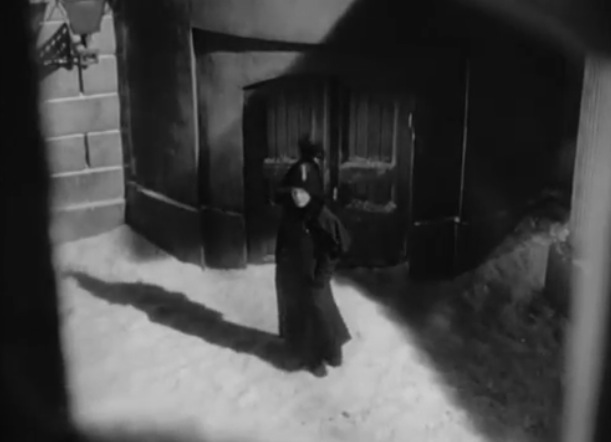

Andrei discovers this and tries to warn her of Suvorin’s duplicitous nature and motivation for his romantic overtures toward Lizaveta, but she is already caught in Herman Suvorin’s web of deception.


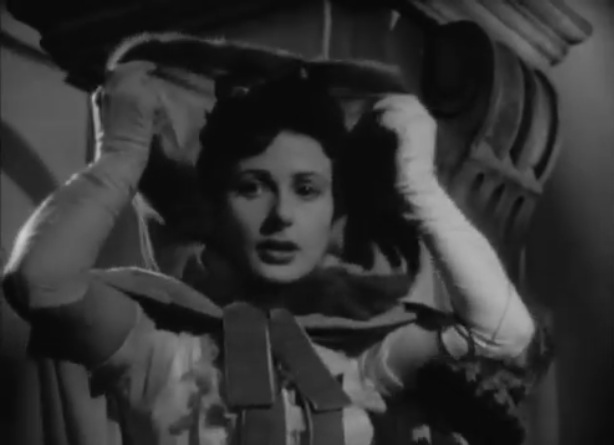

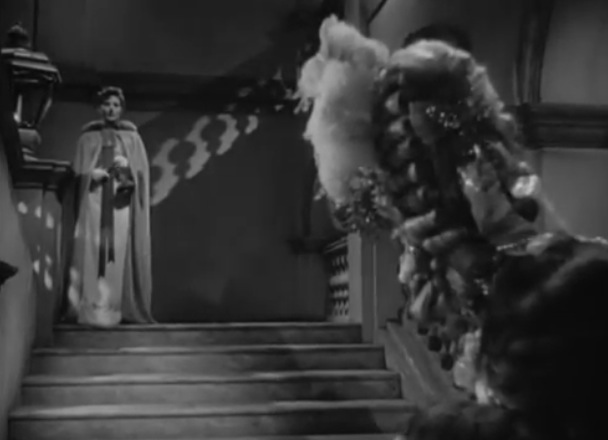


The Countess tended like a prized exhibit that somehow never got packed away. Suvorin hides and waits while the house winds down for the night, servants dismissed, candles lowered, that last little shuffle of an enormous building settling into sleep. When she’s finally alone, he steps out of the dark, not as a lover or someone begging for mercy, but as a man trying to strong-arm fate. He demands the secret of the three cards, his voice starting out almost reasonable and then souring into a threat as he shows her his pistol. The scene plays, to my eyes, like an argument with history itself: a fragile figure clinging to what’s left of her past and a desperate intruder insisting on a formula that should never have been written down in the first place.
She’s terrified; she refuses, her body buckling under the shock of his presence, and she dies without giving him what he wants. It’s one of those sickening beats where you feel everything he thinks he’s been controlling drop straight through his fingers. He’s violated a sanctuary, scared an old woman to death, and still ends up with nothing but his own empty hands.


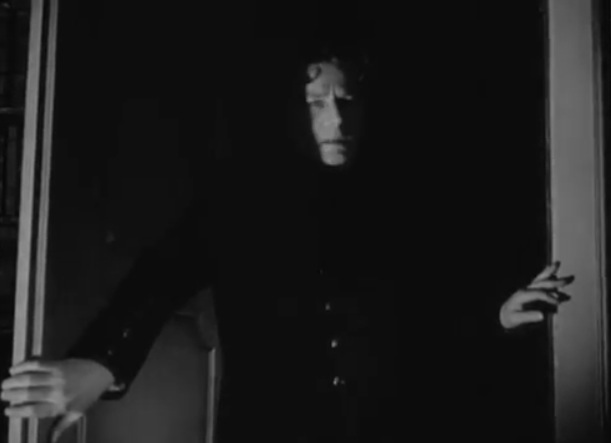


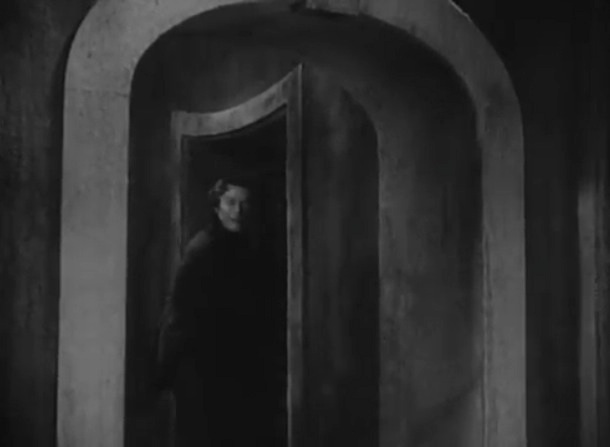
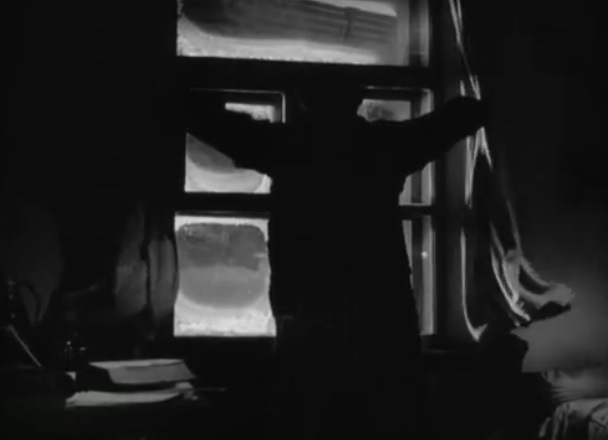


Her death does not end the story; it merely moves it to a less forgiving plane. Guilt, which Herman Suvorin tries to dismiss as an inconvenience, begins to seep into his days. At the funeral, he stares at the coffin with a mixture of resentment and unease, as if the countess has cheated him even in death. The church, with its echoing chants and candles flickering against black cloth, becomes less a place of mourning than the stage for his unraveling. It is after this, in the privacy of his room, that the film tips fully into the uncanny.
The ghost of the countess appears to him, whether as a genuine apparition or the product of a mind stretched beyond reason, is left pleasingly unresolved, and in this visitation, she finally gives him what he wanted. She names the three cards that will win, but there is a condition attached, a stipulation that he must marry Lisaveta, the very woman he has used and discarded as a means to an end. The bargain sounds almost like a moral correction built into the universe: you may have the numbers, but you must also accept a human responsibility you never wanted.
When her ghost appears, the story finally steps fully into the uncanny. The condition to marry Lisaveta sounds suspiciously like the universe trying to force a bit of conscience on him. He takes the numbers and quietly ignores the rest.
Suvorin hears only what he wishes to hear. Armed with the secret, he plunges into the gambling hall with a fervor that borders on religious, acting like the night belongs to him. The atmosphere there is electric—smoke hanging in the air, a mix of tobacco, murmurs, the clink of chips, and the quiet, predatory attention of men who have seen ruin more often than glory. They are wondering if he really has found a way to beat the odds. He sits down at the table like someone stepping into his rightful place. He plays the first card: it wins. The money accumulates in front of him with a strange, hollow inevitability. He plays the second card: it wins again. Each victory confirms his belief that he is no longer at the mercy of chance; the room’s whispers turn into a kind of awe, and for a moment, it looks as though he has outwitted not just the other players but the entire cruel machinery of fate. There is a fatal momentum to this sequence, the sense that the world itself is leaning in to watch.


The final hand is where the story closes its trap. Certain of triumph, Suvorin places an enormous bet and lays down what he believes is the last card of the magical trio. The onlookers lean forward; the air stills; everything narrows to what we imagine is the green felt of the card table, and the rectangle of paper he reveals. But where he expects the winning card, he finds the Queen of Spades, staring back at him with a face that, in his fevered perception, seems to bear the features of the dead countess. In that instant, all his careful calculations, all his rigid control, collapse into a single, devastating realization: he has been playing not with the secret of invincible cards, but with his own delusion. In a heartbeat, the money is gone, lost, the crowd’s fascination turns cold, and Herman Suvorin, stripped of the illusion of mastery, breaks—his mind buckling under the weight of a fate he thought he could bully into submission.
The three-way knot of greed, fate, and secret knowledge: Suvorin thinks he’s exercising free will in pursuing the three-card secret, yet every choice seems to walk him straight into a destiny already laid out for players who confuse secret knowledge with power.
The Countess, as both relic of the past and agent of his downfall, embodies how old sins and old bargains refuse to stay buried; even as a ghost or hallucination, she enforces the rule that you cannot hijack the machinery of chance without paying in some other, more intimate currency.
By the time the story closes, the legend has claimed its latest victim, and everyone is left to live with what remains. Lisaveta is not granted a neat, consoling resolution; she is one more person who has seen how easily “love” can be weaponized by someone chasing a private miracle. Herman Suvorin is reduced to a husk, a man who tried to stand outside the ordinary brutalities of luck and instead found himself crushed by them. The film, like Pushkin’s story before it, ends with the sour aftertaste of irony, but the cinematic version lingers more on the atmosphere of ruin; the empty rooms, the extinguished candles, the lingering sense that the Queen of Spades herself is still somewhere in the deck, waiting patiently for the next hand, and who have found their way around luck.
The supernatural, when it enters, doesn’t feel like a sudden intrusion from another world but like the house finally answering back, as if the accumulated resentments, secrets, and bargains of this society have solidified into the figure of the Countess alive or dead, it hardly matters; who appears just long enough to prove that the rules cannot be rewritten for the convenience of one desperate man. By the time Herman Suvorin sits down at the table with his infallible sequence, the film has quietly made it clear that he isn’t outwitting fate at all; he’s fulfilling it, playing the part of every outsider who thought he could force entry into a closed circle, only to discover that the game was always going to end with him as the cautionary tale.
By the time the final card is turned, The Queen of Spades isn’t just a story about a man who wants to win at the gambling table. It’s about the cost of wanting too much, the ghosts we create for ourselves, and the way a single obsession can redraw the entire deck of a life. It’s the kind of film that makes you feel, just for a moment, that if you glanced over your shoulder, you might see an old woman watching you from the dark, smiling as if she knows exactly how your luck will run.


Folklore at the Card Table: Old Stories, New Stakes: Cheating the Devil
There’s a long, pan-European folklore tradition about playing cards with the Devil; Pushkin is drawing on and refining an existing mythic pattern, not inventing it from scratch. Stories from Scotland, Ireland, Wales, and beyond tell of strangers joining late-night card games, only for someone to drop a card, peer under the table, and discover cloven hooves or some other telltale mark before the Devil vanishes in smoke or flame, often up the chimney, sometimes with the money in tow. In other tales, a proud gambler boasts he’d play with the Devil himself if no one else will, and the Devil obligingly appears for a game that ends with the man’s soul as the real stake.
Pushkin’s The Queen of Spades sits right in that lineage but makes a crucial shift: instead of a rustic cautionary anecdote about card-playing and damnation, he turns the motif into a sharp, psychological story about obsession, calculation, and fate, with the “deal with the Devil” displaced into the secret of the three winning cards and the spectral countess who becomes their guardian. So the mythology of gambling with diabolical forces was already in the air; Pushkin’s brilliance lies in how he domesticates it into Petersburg society, making the Devil less a literal card partner and more the invisible logic behind Hermann’s fatal bargain with chance.
Somewhere behind The Queen of Spades, you can feel those older fireside stories about men who swore they’d play cards with the Devil if no one else would, only to have the stranger finally appear at some ungodly hour. In the old versions, the spell breaks when a card slips or a chair tips and someone glimpses cloven hooves under the table before the Devil vanishes up the chimney in smoke, the money gone with him. Pushkin doesn’t discard that folklore so much as refine it: he takes the rough tavern tale and distills it into a psychological story about obsession and calculation, where the “deal with the Devil” migrates into the secret of three winning cards and the ghostly countess who guards them.
By the time we reach the film, the backroom card tables have become candelabra and Petersburg salons, but the superstition underneath is unchanged: the moment you convince yourself there must be a perfect sequence that lets you outwit chance, you’ve already sat down across from something you can’t possibly beat.
More than a handsome literary adaptation, it’s treated as a strangely intense hybrid of ghost story, psychological horror, and class parable, with Thorold Dickinson’s direction and Anton Walbrook’s performance doing the heavy lifting in turning Pushkin’s concise fable into something feverish and baroque on screen.
There are thousands of wonderful films in my collection; this is just one of them. So remember, keep your head, darlings, it’s okay to grab life by the throat as long as you know, it might just grab you back with a vengeance!


Fear and Status: Panic in the Parlors and Corridors
The film is about an outsider burning with resentment in a world where status, influence, money, breeding, and lineage are stacked against him. What makes The Queen of Spades so unsettling is the way it treats Herman Suvarin’s obsession as both a personal flaw and a symptom of a rigged world, turning his fixation on a trio of cards into a kind of class war conducted in whispers and candlelight. He isn’t just greedy; he’s a man standing at the edge of aristocratic glitter, convinced that somewhere there must be a code, a secret pattern, that will let him bypass the humiliations of birth and money and simply claim the life he believes he deserves. The three-card formula becomes almost like his theology, a promise that if he can just force this hidden, forbidden knowledge out of the past and out of the countess’s tightly guarded history, he’ll be able to step across the invisible threshold that separates the players from the onlookers, essentially. The card secret is not just about wealth; it’s about forcing entry into a class that would otherwise never let him in.
In terms of class and social anxiety, Dickinson litters the frames with beggars outside the privileged world and polished officers inside, making the city itself a visual logic of inequality, with Suvorin perpetually conscious of which side of the threshold he belongs to.
His seduction of Lizaveta then becomes not only cruel emotional opportunism but a symbolic assault on the protective gilded armor of the old aristocracy.
Lizaveta is part of the Countess’s household, and in the film, she functions as the essence of vulnerability, the thin veil between the Countess’s sealed-off world and the streets outside. She’s not a noblewoman, but she’s literally and figuratively inside that aristocratic space: she knows its routines, its secrets, its locked doors. When Herman Suvorin targets her, he’s using her as an entry point, not just exploiting her feelings but forcing a crack in that closed, decaying social bubble.
The irony is that the Countess, by keeping Lisaveta in such emotional and social isolation, effectively manufactures a younger version of herself: a woman so desperate for escape that she becomes easy prey for a man like Suvorin, who treats romance as a sly act of positioning and quiet strategy.
In that sense, gender and class collide; the film shows how a patriarchal-aristocratic system pits women against one another, with the older Countess guarding and handing down the same constraints that once left its mark on her.
Not having read his novella but having familiarized myself with the text, in Pushkin’s story, he already plays with social satire on the page; in the film, I feel Dickinson underlines it in bodies and spaces: who occupies the big chambers? Who’s confined to servant-like corridors, who moves smoothly and glides through the salons, and who’s left lurking in doorways?
Dickinson really leans into that tension by showing Suvorin’s descent — setting him adrift in rooms and corridors around him that so clearly belong more securely to other people: officers who gamble with a nonchalance that appears like second nature to them, nobles who drift through the salons like they own gravity itself, and an old woman so wrapped within her own rank that even her sins have become a kind of legend.
Lisaveta, the Countess, and the Rules for Women: Trapped in a Man’s Gamble: Gender, Power, and the Price of Being Seen


Gender in The Queen of Spades can be seen as a haunted triangle among three very different positions for women: the ruined power of the Countess, the constrained potential of Lisaveta, and the predatory entitlement of the man who moves among them. The film’s treatment of gender plays out like a haunting relay between two women who have learned, in different eras, how little control they are allowed over their own lives, and a man who mistakes their vulnerability for an open door.
The Countess is introduced as a relic, tightly wrapped in lace and a bad temper, but the legend that clings to her is that of a woman who once gambled like a man and bought herself power with a forbidden bargain, only to turn her into a specter of female agency that history has punished into near-immobility.
She can be seen as a figure of decayed female power: once a celebrated beauty and gambler who dared to cut a deal for control at the card table, now reduced to a cranky, overly pampered and spoiled remnant of an older world whose body and secrets are both treated as things to be plundered.
And though the Countess is one of those characters who looks, at first glance, like pure decay—an old woman rattling around in a mausoleum of her own past, the more time you spend thinking about her, the more you realize the film is circling a very specific kind of female power: power that was once transgressive, briefly intoxicating, and then punished into something brittle and shadowed.
Inside the legend, the film shows us that she wasn’t always this irascible dowager; she was the Muscovite Venus, a nickname she earned as a young beauty from Moscow who dazzled Parisian high society. She was a celebrated beauty and socialite who dared to gamble like a man, lost catastrophically, and clawed her way back by making a bargain that essentially let her sit at a table women weren’t supposed to touch.
That history trails her like a phantom, hangs on her like smoke; she’s both the proof that a woman once seized control in a male world, and the warning of what it costs: she’s alive, rich, and feared, but she’s also isolated, alienated from friends, and reduced to policing the narrow little realm of her household as if that’s all that’s left to rule.
What I love is that Dickinson and Edith Evans never let that power feel simple or benign; it’s there in the way her silk skirts rustle down the corridors, in how servants and Lisaveta jump at her moods, in how Suvorin and the officers talk about her as if she’s a vault that has to be cracked rather than a person. She tyrannizes her ward and staff, yes, but that cruelty feels, to me, more like a reflex: a woman who once staked her freedom on a single dangerous secret and has since watched her world shrink into pure status and empty ritual.
Even in death, the film won’t quite let her power dissipate: her eyes fixing on Herman Suvorin as she dies, the ghostly visitation where she sets the terms of his victory, the suggestion that the Queen of Spades itself bears her face — these all cast her as an almost supernatural enforcer of the rules she once broke.
So when you talk about her as a figure of female power, it’s not the clean empowerment arc we’re used to; it’s something knottier and more gothic. She’s the woman who once broke into the system and won, but she’s now trapped inside the very legend that made her formidable, wielding what authority she has left by making other women small and, finally, by dragging one arrogant man down to meet the same moral order that has been tightening around her for decades.
One of the great tragedies is that the Countess once tried to carve out a bit of freedom for herself at the card table, now presides over a domestic order that leaves Lisaveta so starved for affection and escape that she becomes the perfect mark for a man like Herman Suvorin; the film quietly suggests that patriarchal structures don’t simply crush women, they recruit them to pass on the damage, like a very vicious cycle.
That earlier life of sexual and social freedom sours into a kind of cautionary tale. She’s a woman who once grabbed at a little power on her own terms and ended up paying for it with a bargain that won’t let her sleep easily, even decades later. The film keeps her in an uneasy place: hovering between being both the victim at the mercy of a younger man’s violence and the spooky instrument of his downfall, caught between being sinned against and doing the haunting herself.
We’re also asked to look at the Countess in two ways at once. On the surface, the story keeps tugging us into Suvorin’s impatience, his feeling that he has to wring the secret out of her somehow. But the way Dickinson frames her, and the way Edith Evans plays those scenes, nudges us to see the cruelty in turning an aging female body into the battlefield for masculine ambition.
Suvorin’s obsession seizes on what binds those two women’s lives together in the ugliest way: he courts the younger woman, Lisaveta, not as an equal but as a key, and when that key turns to unlock the entrance, he storms the older woman’s bedroom as though her body and her secret were just another prize the world owes him.


By the time the story reaches its feverish climax, both women have been used up in the service of his climb toward a male-coded arena of risk and power, and the Queen of Spades begins to look less like a mere card than an emblem of how femininity and women’s power in this world is alternately exploited, entombed, and finally weaponized against the very man who thought he could play it like a winning hand.
Taken together, these two women turn Suvorin’s behavior into a study in predatory masculinity: he seduces the younger woman as a means to reach the older one, and then terrorizes that older woman for a secret that will help him join a male?dominated sphere of power and gambling.
Suvorin looks right through Lisaveta, regarding her primarily as a doorway to wealth and status, and as the film’s suspense traps both women in rooms and situations shaped by his obsession.
It’s a pattern where women’s bodies and lives become collateral in a masculine quest to escape poverty and social instability: the Countess’s youthful bargain, Lisaveta’s coerced complicity, and Suvorin’s final breakdown each show how the costs of that quest fall unequally along gendered lines.
Eternally Yours, and I don’t mean makin’ a deal with the devil eternal – MonsterGirl


