


Â

Â


In Nightmare Alley Barbara McLean contributes to creating a landscape of a distorted reality alongside the dark, clandestine, and arcane carnival atmosphere. The film is beautifully woven, as the seamless images flow into one another. McLean blends together the invisible strands that only one’s dreams could effectively manifest. McLean’s editing constructs much of the surreal and tormented ‘movement’ of the film. It’s what transports each scene of the film, making it every bit as if WE were inhabiting someone’s nightmare.


With 62 film credits to her name, half of which were with filmmaker Henry King, Barbara McLean is a master of cutting and shaping. She’s worked on some of my all-time favorite films including this film, Goulding’s Nightmare Alley, Joseph L. Mankiewicz’s No Way Out (1950), Henry King’s The Song of Bernadette (1943), Robert Wise’s The Desert Rats (1953), John Ford’s Tobacco Road (1941) and again Mankiewicz’s All About Eve (1950). McLean also worked as an editor on Elia Kazan’s Viva Zapata in 1953, and in 1954 with Michael Curtiz’s on The Egyptian. She edited the first movie filmed in CinemaScope, The Robe (1952), directed by Henry Koster.


Barbara McLean was one of the most recognized editors working during the reign of Darryl F. Zanuck at the 20th Century Fox Studio, from the 1930s to the 1960s. Eventually achieving the honor of division chief of the editing department in 1949. She joined Fox in 1935 as one of only eight female film editors working in Hollywood in the 1930s. McLean was part of a huge team of technicians, writers, directors, and collaborators that Zanuck went to for guidance. She was very influential in much of Zanuck’s decision-making process, as she often acted as an adviser to the Hollywood movie mogul, helping him coordinate even a single shot.
She won the 1944 Academy Award for Film Editing for her work on Wilson (1944) director Henry King’s biopic film of Woodrow Wilson’s political career. McLean was nominated another 6 times for that award, including her work on All About Eve. I think she should have won the 23rd annual Academy Award for All About Eve, but she lost to Ralph E Winters and Conrad A Nerig for their work on King Solomon’s Mines. It was a tough year to compete with nominations also going to The Third Man and Sunset Boulevard. McLean’s greatest collaboration was with filmmaker Henry King, a relationship that spanned over 29 films including Twelve O’Clock High 1949.
Her last editing credit was for Henry King’s Untamed (1955). In later years, McLean acted primarily in a supervisory and administrative capacity, eventually retiring from 20th Century Fox in 1969, due to her husband’s declining health. She received the inaugural American Cinema Editors Career Achievement Award in 1988. McLean died in Newport Beach, California in 1996.

Her impact was summarized by Adrian Dannatt in a 1996 obituary in The Independent: McLean was “a revered editor who perhaps single-handedly established women as vital creative figures in an otherwise patriarchal industry.” Writer Tom Stempel, in a piece about Darryl F. Zanuck, writes of McLean‘s influence on Zanuck‘s filmmaking; “For all her focus on keeping the narrative moving, McLean’s editing could dazzle if called for. In A Bell for Adano (1945), she took material director Henry King shot on the return of the Italian POWs to their village and put it together with such a pure sense of emotion that when she cut at exactly the right moment to King’s overhead shot of the prisoners and villagers coming together in the square, the cut was more heart-stopping than conventional close-ups would have been.”
McLean brings together the writer’s and director’s vision and gives it completeness, a cohesion, like alchemy with film footage, she creates cinema gold. According to Bright Lights Film Journal “the basic rules of film editing, first established in the silent era, still govern the industry today: maintain your eye lines, preserve continuity, respect planarity (the rules governing the transposition of three dimensions onto a two-dimensional plane), find a good rhythm, and, most important, always advance the story.” Here is where McLean excels. If you look at the variety of narratives, milieus, and landscapes McLean has stitched together in the editing room, you can see how expansive her vision explores the realms of the human condition, moral corruption, and redemption weaving together images that shape the story into ‘the big picture’, with all the little pieces of the intricate moments of the framework, revealing an intimate story, a memorable story, a universal notion of people living in a state of transformation.
If I could enter the film industry at this stage of my life, there would be one thing aside from my already being a music composer, of course, would be to sit in the editing chair. One of the things I look for in a film, and feel passionately certain about is the cinematography, scoring, and casting, if there is one singularly essential component to what makes a film greater…it’s the editing.
We should also celebrate the women working in the very male-dominated career of film editing, women like Barbara McLean and even Dorothy Spencer (Lifeboat 1944, Stagecoach 1939, and the film I recently blogged about Valley of The Dolls 1967).
I should also mention, Anne Bauchens, who was Cecil B. DeMille’s editor, cutting nearly all his movies from 1915 until his death in 1959, and Margaret Booth. Two women who haven’t been put in the greatest light in terms of their ‘difficult’ personalities and skill, something I’ll write about in future. But aren’t women always difficult to work with? Geez.
And so let’s raise a toast to Barbara McLean’s contributions to the cinema… a pioneer in the industry not only breaking the glass ceiling but taking all the pieces and putting them back together to make an indelible cinematic mural for ages to come.
And now for the Carnival ‘Geek’ in Nightmare Alley: Tyrone Power’s astonishing portrayal of Stanton ‘Stan’ Carlisle the ambitious carney who rises to evangelistic notoriety as a slick and cunning mentalist, only to descend into the realm of self-destruction when power corrupts, consumes and destroys his life, ultimately leading him back to sideshow freakery becoming the very ‘geek’ he once found repulsive. McLean’s treatment of the film’s climatic excursion into the bowels of the carnival and Stan’s diminution into the shadows is quite viscerally staggering.


According to the book Carny Sideshows by Tony Gangi, a ‘Geek’ is:
An unskilled performer whose performance consists of shocking, repulsive and repugnant acts. This “lowest of the low” member of the carny trade would commonly bite the head off a living chicken, or sit in a bed of snakes. Some historians distinguish between “geeks” who pretend to be wild men, and “glomming geeks” whose act includes eating disgusting things. See the 1949 movie “Nightmare Alley” for a good geek story as well as for an excellent depiction of the mentalist’s technique of “cold reading”. In later years the geek show turned into a “see the pitiful victim of drug abuse” show. “Geek” as a verb (“he geeked”) is one of several terms in use among wrestlers meaning to intentionally cut oneself to draw blood.

Either on the fairway or the cutting room floor, I’ll be there! Your ever-faithful -MonsterGirl!


If you’ve been following my blog for a while, you would have figured out, that I’m a singer/songwriter & recording artist, because I’ve mentioned it, oh about a zillion times…So here I go again taking a song of mine ‘Savage Bliss‘ off my lo-fi neo classical album The Amber Sessions and mashing it up in the editing bowl with Jean Cocteau’s La Belle et la Bete (1946) Starring Josette Day and Jean Marais.
I love working with the films that have inspired me, adding my musical voice to the images, not because I flatter myself as a couch surfing filmmaker, rather as a way of expressing my eternal gratitude for the release and fulfillment that film has given me since I was a little monster girl singer/songwriter. So without any further adieu…!

Here’s to the beauty and the beast in all of us… cheers-MonsterGirl

Director Max Ophüls ( Letter From An Unknown Woman 1948, The Reckless Moment 1949) offers a gritty and volatile film noir starring James Mason, Barbara Bel Geddes, and the imposing figure of Robert Ryan. With an uncredited assistant directorship by Robert Aldrich. Based on the book Wild Calendar by Libbie Block
Written by Arthur Laurents (The Snake Pit 1948, West Side Story 1961, The Way We Were 1973)
Interesting question: If Howard Hughes gained control of RKO in 1949, was Robert Ryan’s characterization of Smith Ohlrig truly based on Hughs?


Also stars Frank Ferguson (regular on Andy Griffith Show) as Quinada’s partner Dr. Hoffman, Art Smith as Ohlrig’s psychiatrist who knows Ohlrig is a walking powder keg, Natalie Schafer as Dorothy Dale and Curt Bois as Ohlrig’s personal assistant, and like many a good Film Noir delivers, the snarky gay cipher – Franzi Kartos, who’s incessantly calling Leonora DARLING… that if subtitled would read ‘you bourgeois cow…’
One of the staples of the Noir catalog, Caught is a brutish and self-contained story about an egomaniac, hungry for power and consumed by a nasty possessiveness that borders on the psychotic.


Robert Ryan is chilling as the Neanderthal bigwig worth millions of dollars, with an explosive rage that rests on simmer until something sets him off when it doesn’t go his way. Oh, and Ohlrig also suffers from panic attacks, which he believes is truly a heart condition and not a nervous disorder.

Barbara Bel Geddes is the naive Leonora Eames, who has childlike fancies of marrying a wealthy man and living a life of luxury. Invited to a party on a boat one night, she meets Smith Ohlrig outside on the pier, near his yacht. Although Ohlrig could have any woman he chooses, something about Leonora sparks on him. From the very first encounter, we can see that it’s not a romantic chemistry that stirs Ohlrig, but something more forbidding and sinister.


Once he sets his sights on her, taking her for a ride in his car, he decides there and then, to marry this plain girl, whom he doesn’t love but knows he can possess easily.
Leonora soon realizes that her dream has become a nightmare and that Smith is a menacing character who treats her like part of the furniture and is not quite right in the head.
Ohlrig refuses to give Leonora a divorce, so she decides to leave her opulent home on Long Island and take a job as a receptionist in the city working for a doctor who runs a free clinic in a very poor neighborhood.


Perhaps this is Leonora’s way of cleansing her soul for making the mistake of marrying for money and not for love.
James Mason is Dr. Larry Quinada the absolute antithesis of Smith Ohlrig. He’s genteel and compassionate, and soon the two fall in love, though Leonora is held captive by her dominating husband.


Complicating matters is the fact that Leonora becomes pregnant by the sadistic Ohlrig who would rather see her a prisoner in the sterile palace that is her home rather than let her go free… Is the threat of financial security and the welfare of their unborn child that which will chain her to him forever…?


Smith Ohlrig: Is she coming down?
Franzi Kartos: [Stands silent, knowing that Leonora is not coming down]
Smith Ohlrig: [Getting angrier] Why the devil do you think I sent you up there, you dirty little parasite? Get her down here!
Franzi Kartos: [Long pause] I think I prefer to be a headwaiter again, Mr. Ohlrig.
Franzi Kartos: [Heads for the door, then stops] You know, you’re a big man, but not big enough to destroy that girl. Goodbye.

There are thousands of fabulous films in my collection just as thrilling, this is one of them! Don’t you get caught-MonsterGirl

Directed by Charles Vidor  the man responsible for the eminent noir classic, Gilda 1946 and no relation to the more well know King Vidor. With a screenplay by Reginald Denham (The Mad Room 1969 a modern reworking of the same play, Suspense, Kraft Theater and Alfred Hitchock Presents)

Based on his play, and given a cast of intelligent performers like Ida Lupino, Elsa Lanchester, Isobel Elsom, Edith Barrett, Evelyn Keyes and Louis Hayward.Â

The film is a suspenseful story with tremors of ethical dilemma, evocative of pity and encompassed by the moor like fog of madness and desperation.
Ida Lupino plays the reticent Ellen Creed, housekeeper to the colorful Leonora Fiske (Isobel Elsom) who has retired from the music hall stage. Ellen is the obsessive guardian of her two loosely screwed sisters Emily and Louisa portrayed deliciously vague sort of loony by Elsa Lanchester (Emily) and Edith Barrett (Louisa).

Ellen manipulates Leonora to allow her quirky siblings to come and visit, well aware that she has no intention of making it a temporary stay. Once Leonora realizes that the two are batty, she demands that they leave forcing Ellen to do the unthinkable, to not only murder her employer, but create a deceptive strategy that will allow the sisters to dwell in sanctuary at the cozy manor house by the moors.

Unfortunately, Ellen not only has the full time job of wrangling her nutty sisters, she becomes the target of her blackmailing nephew Albert Feather, played with a dash of charming malevolence by Louis Hayward. ( And Then There Were None 1945, Ruthless 1958, House By The River, Night Gallery: Certain Shadows on The Wall.)
The film is moody, macabre, theatrical, with a musty air of Gothic as Leonora’s remains lay hidden in the coal bin behind the bricks, near the grand piano where she once boisterously sang Tit -Willow from The Mikado…
The atmosphere stays closed in, as all three sisters flit about exposing their disconnection to reality. Evelyn Keyes is Lucy the house maid who brings a bit of naivete to the atmosphere as she too falls prey to Albert the ‘charming rogue” who gets her to participate unwittingly in his ruthless scheme of blackmail.


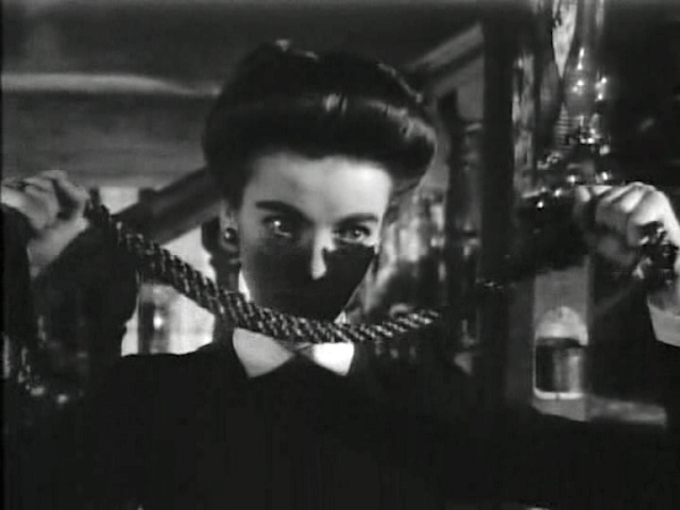


Albert charms his way into Leonora’s home and heart!


There are thousands of films as fabulous as this in my collection, this is just one of them!-MonsterGIrl


Rosalba Neri as Tania Frankenstein


Capucine as Dr. Saforet


Martine Beswick as Sister Hyde


Fiona Lewis as Dr. Gwen Parkinson


Joan Crawford as Dr. Brockton


Gloria Talbott as Janet Smith Jekyll’s descendent


Louise Lewis as Miss Branding-science teacher!


Radaela Ottiano as Malita

Gale Sondergaard as Miss Zenobia Dollard


Laura Bowman as Dr. Helen Jackson


Perla Cristal as Dr. Ilona Alman / Eva Wolfstein

Veronica Lake as Dr.Elaine Frederick


Mabel Karr As Irma Zimmer


Special Assistant Award to Alida Valli as Louise.


Honorary Mention to Jan in The Pan for donating her head to science!
The Brain That Would Not Die! 1962


MonsterGirl from Planet Earth , present day!

The Cassandra Metaphor can have various invocations. Also called a ‘syndrome’, ‘complex’, ‘phenomenon’ ‘dilemma’ or ‘curse.’ This occurs when valid warnings are dismissed or ignored.
Originating from Greek Mythology, Cassandra was the daughter of Priam King of Troy. Apollo became obsessed with her beauty and so gave her the gift of prophecy. But once Cassandra rebuffed Apollo’s sexual advances, he cursed her making it impossible for anyone to believe her warnings. She could never convince anyone of her predictions.
Thus could be the origin of ‘the hysterical woman.’ Women often depicted in films as hysterical, to be dismissed, confined, calmed down, psychiatrically subdued and shut away.
The metaphor has been used in various contexts of psychology, philosophy and cinema.


