“THE MARK OF A MADMAN WHO LIVES TO KILL!”
THE DIABOLICAL DR Z (1966)
THE BLACK PIT OF DR M 1959

THE 5000 FINGERS OF DR T. (1953)
Doctor X (1932)

THE RETURN OF DR X 1939

The H MAN (1958)


Happy it’s a Turkey Day!-MonsterGirl


Lee Remick plays bank teller Kelly Sherwood who is being terrorized by ‘Red’ Lynch (Ross Martin) a psychopath with an asthmatic voice like sandpaper who schemes to use her in a plot to steal $100,000 from the bank where she works. Lynch kidnaps Sherwood’s younger sister Toby played by Stephanie Powers, and then threatens to kill her, if she tells the police. Enter Glenn Ford as F.B.I. agent Ripley who is now on the case… setting off a feverish game of cat & mouse between Remick, Martin and Ford.
Directed by Blake Edwards, this is one hell of a gripping Film Noir/ Thriller, with a screenplay by The Gordons, based on Mildred and Gordon Gordon’s 1961 novel Operation Terror.
I love Ross Martin’s portrayal of the murdering, smarmy crushed velvet jacket wearing, tv host art critic Dale Kingston in Columbo’s “Suitable for Framing”


See you soon!-MonsterGirl
They want my blood. Their lives are mine. I still get squeamish.


Directed by Ubaldo Ragona and Sidney Salkow The Last Man on Earth 1964 is based on the best-selling sci-fi/horror novel I Am Legend by Richard Matheson, who, unhappy with the script, used the pseudonym Logan Swanson for the screenplay. The film remains pretty close to the book, and keep in mind that The Last Man on Earth predates Night of the Living Dead (1968) by 4 years.
Piero Mecacci ( Suspiria 1977, Hatchet For A Honeymoon 1970, The Young, The Evil and The Savage 1968, was responsible for the film’s make-up.
Matheson’s story is perhaps the first involving vampire-like beings whose origin is not rooted in the supernatural but stems from a scientific, biological catastrophe. This pandemic wipes out an entire civilization. It is also the first of three adaptations of Matheson’s book, and stands alone as the most striking, although I will always have a special kind of 70s love for director Boris Sagal’s version of The Omega Man 1971.


Starring Vincent Price as Dr. Robert Morgan, Franca Bettoia as Ruth Collins, Emma Danieli as Virginia Morgan, Umberto Raho as Dr. Mercer, and Giacomo Rossi-Stuart as Ben Cortman. In 1971, it is the wonderful Anthony Zerbe as Matthias who reprises the role of the vengeful cult leader of ‘the family’ who craves Heston’s (Neville) lifeblood.
“Alive among the lifeless… alone among the crawling creatures of evil that make the night hideous with their inhuman craving!”


“December 1965. Is that all it has been since I inherited the world? Only three years. Seems like 100 million.”
The year is 1968, Vincent Price in a somber fashion plays Dr. Robert Morgan who like Sisyphus is condemned to repeat his daily tasks of replenishing his stock of garlic and mirrors (the undead hate both), adding gasoline to his generators, collecting the dead bodies that lay strewn around his dismal and cluttered house, and throwing them into the enormous pit where he burns the remains while wearing a gas mask, which is effectively creepy on its own.


“I need more mirrors, and this garlic has lost its pungency.”
For much of the film’s beginning, Morgan narrates his story as an inner dialogue: “An empty, dead, silent world.”

“There was a time when eating was pleasurable now it bores me. just a fuel for survival, I’ll settle for coffee and orange juice this morning. But first, there’s my life to consider, I better replace that garlic I’ll need more lots more, better stop off and get ’em”
Morgan is the seemingly sole survivor in a global outbreak of an unknown bacterium. By day, he collects his needed supplies, tries to make contact by radio with any other survivors, makes repairs to his house, from the onslaught of undead who attack by night, and basically tries to maintain his sanity in the bleak environment of apocalyptic ruin.


Each day, he wakes up, checks off the date on his primitively scrawled calendars, sharpens his wooden stakes, the weapons he uses to defend himself against a surviving race of vampire-like undead that roams the night air, calling out his name, “Morgan, come out!” pounding at his door. “Morgan! We’re going to kill you!” they taunt him endlessly, led by his old colleague Ben Cortman.


Living Ben Cortman: There are stories being told, Bob.
Robert Morgan: By people who are out of their minds with fear.
Living Ben Cortman: Maybe. But there are too many to be just coincidental. Stories about people who have died and have come back.
Robert Morgan: They’re stories, Ben, stories.Robert Morgan: “I can’t afford the luxury of anger, anger can make me vulnerable. it can destroy my reason and reason is the only advantage I have over them. I’ve gotta find where they hide during the day. Uncover every one of them.”


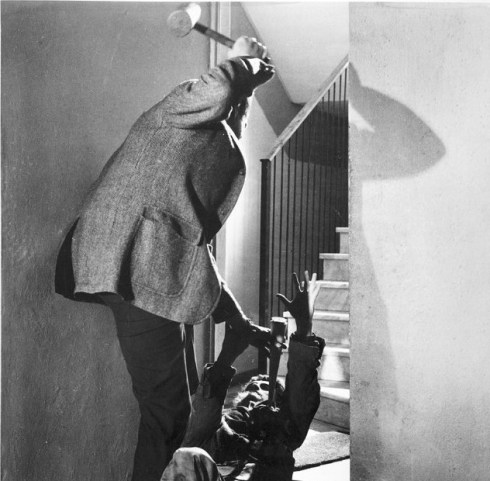


“And how many more of these will I have to make before they’re all destroyed?”
“More of them for the pit. tonight there’ll be more of them, they live off the weak ones., leave them for the pit.”


Less like a Gothic Hammer vampiric epic or prior decades features from Universal and Bela Lugosi featuring swarthy eastern Europeans, The Last Man on Earth is set in a modern urban landscape and acts like a hybrid horror/science fiction morality play, as Morgan drudges on to persevere against the army of soulless humans that haunt his existence.
They have become inhuman things to hunt, and he has been transformed into a veritable Adam living in a post-nuclear anti-paradise with no companionship. It’s merely the primal need to survive that drives him. In this way, he has been reduced to a scavenging animal, living on instinct, with an inescapable mission to hunt and kill people who were once human like himself.

“I can’t live a heartbeat away from hell.”
Morgan inhabits a world, where everyone else has been infected by the plague, they cannot tolerate sunlight, hate to see their own image in mirrors, and more likened to the ancient folklore of Vampires are repelled by garlic.
At night, these undead civilians try to get into Morgan’s house; they have a desire to kill him as much as he has to destroy every one of them.
Each day, he gets in his large automobile in search of more lifeless bodies scattered around the city and seeks out those in hiding to use his wooden stakes to impale and then throw them in the mass grave, fumes rising from the gasoline-soaked funeral pyre.
He finds a dead girl outside his house and picks her up as she flops like a rag doll. He finds another one in his driveway. He loads them into the trunk of his car. He realizes that he’s out of gas. Dead bodies line the road.


“I can get rid of them later, right now I’m out of gas.”
As he drives over scattered bodies like human road kill, he thinks to himself.

“They can wait too, I’ve got my life to worry about, those mirrors will have to be replaced before dark.”
The cinematography by Franck Delli Colli is stunning as it is stark. He paints an apocalyptic wasteland, with the addition of the mass graves and gas masks, which to me, evoke the specter of war-torn Europe after WWII.


In a flashback, we see Morgan as a happily married man with a beautiful wife and daughter. As the memory unfolds, we see that the plague has affected his wife and daughter. While his daughter is taken away to the public burning pit after she succumbs, Morgan secretly buries his wife, not knowing that the dead are coming back to life.


Once he returns home and is attacked by his dead wife, he realizes that he must dispose of all the plague victims before they reanimate themselves into zombies who can spread the plague. Morgan has a theory that his immunity to the bacteria is due to an infected bite he received from a vampire bat while stationed in Panama. This prior exposure to the plague allowed his blood and immune system to build up a tolerance over time.
One day, he finds a wandering dog and takes it home, joyous for the company the little guy will be. Unfortunately, he, too, has fallen ill from the plague, and sadly, Morgan has to kill him, too. Just to let you dog lovers know what to expect…
During one of his daylight excursions, he notices a woman moving around in the distance. It is Ruth Collins, who is terrified of Morgan when she first sees him, but he convinces her to come home with him. When Ruth becomes sickened by a string of garlic waved in her face, she claims she is just weak, but Morgan becomes suspicious of her.


Morgan catches Ruth trying to inject herself with the vaccine that he’s been working on, which seems to stave off the effects of the disease. At first, she attempts to point a gun at Morgan but eventually admits that she was sent to spy on him and that she is part of a secret group of people like her, who are infected by the plague but are using a treatment that restores their health while still in the bloodstream but wears off after a time only to be reinfected again.
Ruth tells Morgan that her group is trying to rebuild their wiped-out civilization, while destroying the remaining infected walking dead, also telling Morgan that many of the people he has killed were technically still alive.
Morgan- “Your new society sounds charming.”
Ruth Collins: You can’t join us. You’re a monster to them. Why do you think I ran when I saw you, even though I was assigned to spy on you? Because I was so terrified, what I’d heard about you. You’re a legend in the city. Moving by day, instead of night, leaving as evidence of your existence bloodless corpses. Many of the people you destroyed were still alive! Many of them were loved ones of the people in my group.
Morgan: I didn’t know.
Morgan transfuses his own blood into Ruth’s while she is asleep, and she is immediately cured.
This encourages Morgan as he sees hope that he can now cure the remainder of Ruth’s people, the surviving yet suffering group of humans between the living dead and Morgan, the last completely healthy survivor of the human race.


In the climatic ending, the hand of irony strikes Morgan’s triumph down, as Ruth’s people begin to attack, forcing Morgan to flee. The band of Ruth’s survivors then kills off the rest of the undead, who are aimlessly threatening, menacing, and, of course, stalking Morgan’s house.
Ruth’s people see Morgan and begin chasing him, as he picks up tear gas and grenades from a police station arsenal, they exchange gunfire, and Morgan is wounded.

He finds his way into a church, with Ruth begging her people to let Morgan live.
They finally impale him on the altar with a spear. Of course, a very Christ-like image, the symbolism is not lost here, he has been sufficiently sacrificed, the only man who could truly save them.
Morgan’s last dying words are “You’re freaks, all of you! All of you, freaks, mutations!” and declares that he is “the last true man on earth.”
This is truly not the end, my friends… -MonsterGirl


If you’ve been following my blog for a while, you would have figured out, that I’m a singer/songwriter & recording artist, because I’ve mentioned it, oh about a zillion times…So here I go again taking a song of mine ‘Savage Bliss‘ off my lo-fi neo classical album The Amber Sessions and mashing it up in the editing bowl with Jean Cocteau’s La Belle et la Bete (1946) Starring Josette Day and Jean Marais.
I love working with the films that have inspired me, adding my musical voice to the images, not because I flatter myself as a couch surfing filmmaker, rather as a way of expressing my eternal gratitude for the release and fulfillment that film has given me since I was a little monster girl singer/songwriter. So without any further adieu…!

Here’s to the beauty and the beast in all of us… cheers-MonsterGirl

Director Max Ophüls ( Letter From An Unknown Woman 1948, The Reckless Moment 1949) offers a gritty and volatile film noir starring James Mason, Barbara Bel Geddes, and the imposing figure of Robert Ryan. With an uncredited assistant directorship by Robert Aldrich. Based on the book Wild Calendar by Libbie Block
Written by Arthur Laurents (The Snake Pit 1948, West Side Story 1961, The Way We Were 1973)
Interesting question: If Howard Hughes gained control of RKO in 1949, was Robert Ryan’s characterization of Smith Ohlrig truly based on Hughs?


Also stars Frank Ferguson (regular on Andy Griffith Show) as Quinada’s partner Dr. Hoffman, Art Smith as Ohlrig’s psychiatrist who knows Ohlrig is a walking powder keg, Natalie Schafer as Dorothy Dale and Curt Bois as Ohlrig’s personal assistant, and like many a good Film Noir delivers, the snarky gay cipher – Franzi Kartos, who’s incessantly calling Leonora DARLING… that if subtitled would read ‘you bourgeois cow…’
One of the staples of the Noir catalog, Caught is a brutish and self-contained story about an egomaniac, hungry for power and consumed by a nasty possessiveness that borders on the psychotic.


Robert Ryan is chilling as the Neanderthal bigwig worth millions of dollars, with an explosive rage that rests on simmer until something sets him off when it doesn’t go his way. Oh, and Ohlrig also suffers from panic attacks, which he believes is truly a heart condition and not a nervous disorder.

Barbara Bel Geddes is the naive Leonora Eames, who has childlike fancies of marrying a wealthy man and living a life of luxury. Invited to a party on a boat one night, she meets Smith Ohlrig outside on the pier, near his yacht. Although Ohlrig could have any woman he chooses, something about Leonora sparks on him. From the very first encounter, we can see that it’s not a romantic chemistry that stirs Ohlrig, but something more forbidding and sinister.


Once he sets his sights on her, taking her for a ride in his car, he decides there and then, to marry this plain girl, whom he doesn’t love but knows he can possess easily.
Leonora soon realizes that her dream has become a nightmare and that Smith is a menacing character who treats her like part of the furniture and is not quite right in the head.
Ohlrig refuses to give Leonora a divorce, so she decides to leave her opulent home on Long Island and take a job as a receptionist in the city working for a doctor who runs a free clinic in a very poor neighborhood.


Perhaps this is Leonora’s way of cleansing her soul for making the mistake of marrying for money and not for love.
James Mason is Dr. Larry Quinada the absolute antithesis of Smith Ohlrig. He’s genteel and compassionate, and soon the two fall in love, though Leonora is held captive by her dominating husband.


Complicating matters is the fact that Leonora becomes pregnant by the sadistic Ohlrig who would rather see her a prisoner in the sterile palace that is her home rather than let her go free… Is the threat of financial security and the welfare of their unborn child that which will chain her to him forever…?


Smith Ohlrig: Is she coming down?
Franzi Kartos: [Stands silent, knowing that Leonora is not coming down]
Smith Ohlrig: [Getting angrier] Why the devil do you think I sent you up there, you dirty little parasite? Get her down here!
Franzi Kartos: [Long pause] I think I prefer to be a headwaiter again, Mr. Ohlrig.
Franzi Kartos: [Heads for the door, then stops] You know, you’re a big man, but not big enough to destroy that girl. Goodbye.

There are thousands of fabulous films in my collection just as thrilling, this is one of them! Don’t you get caught-MonsterGirl

Directed by Charles Vidor  the man responsible for the eminent noir classic, Gilda 1946 and no relation to the more well know King Vidor. With a screenplay by Reginald Denham (The Mad Room 1969 a modern reworking of the same play, Suspense, Kraft Theater and Alfred Hitchock Presents)

Based on his play, and given a cast of intelligent performers like Ida Lupino, Elsa Lanchester, Isobel Elsom, Edith Barrett, Evelyn Keyes and Louis Hayward.Â

The film is a suspenseful story with tremors of ethical dilemma, evocative of pity and encompassed by the moor like fog of madness and desperation.
Ida Lupino plays the reticent Ellen Creed, housekeeper to the colorful Leonora Fiske (Isobel Elsom) who has retired from the music hall stage. Ellen is the obsessive guardian of her two loosely screwed sisters Emily and Louisa portrayed deliciously vague sort of loony by Elsa Lanchester (Emily) and Edith Barrett (Louisa).

Ellen manipulates Leonora to allow her quirky siblings to come and visit, well aware that she has no intention of making it a temporary stay. Once Leonora realizes that the two are batty, she demands that they leave forcing Ellen to do the unthinkable, to not only murder her employer, but create a deceptive strategy that will allow the sisters to dwell in sanctuary at the cozy manor house by the moors.

Unfortunately, Ellen not only has the full time job of wrangling her nutty sisters, she becomes the target of her blackmailing nephew Albert Feather, played with a dash of charming malevolence by Louis Hayward. ( And Then There Were None 1945, Ruthless 1958, House By The River, Night Gallery: Certain Shadows on The Wall.)
The film is moody, macabre, theatrical, with a musty air of Gothic as Leonora’s remains lay hidden in the coal bin behind the bricks, near the grand piano where she once boisterously sang Tit -Willow from The Mikado…
The atmosphere stays closed in, as all three sisters flit about exposing their disconnection to reality. Evelyn Keyes is Lucy the house maid who brings a bit of naivete to the atmosphere as she too falls prey to Albert the ‘charming rogue” who gets her to participate unwittingly in his ruthless scheme of blackmail.


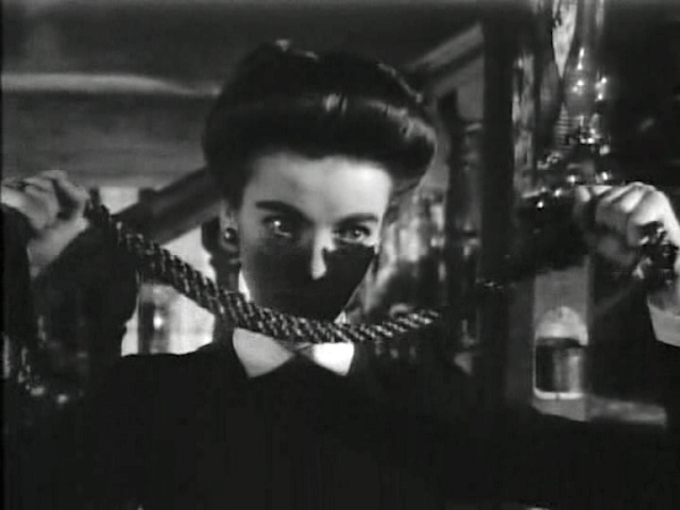


Albert charms his way into Leonora’s home and heart!


There are thousands of films as fabulous as this in my collection, this is just one of them!-MonsterGIrl


Oh the flashy melodramatics, Oh Turner’s wardrobe! There are thousands of films in my collection, this is just one of those deliciously trashy ones.- MonsterGirl…

Directed by William Castle, written by Robb White, and starring Vincent Price, as Dr. Warren Chapin, Patricia Cutts as Isabel Stevens Chapin, Judith Evelyn as Martha Higgins, Philip Coolidge as Ollie Higgins, Darryl Hickman as David Morris, Chapin’s young assistant pathologist, and Pamela Lincoln as Lucy Stevens. Von Dexter’s ominous score helps paint the creepy and menacing atmosphere.

Urbane master of horror Vincent Price stars in one of William Castle’s atmospheric carnival rides as Dr. Warren Chapin, a pathologist whose milieu is the autopsies of executed prisoners from the State prison.


Chapin is driven by a curiosity to find out the source of the mysteriously evil force that creates the SENSATION of fear, and so he sparks a theory that there is an organism called… The Tingler manifests itself at the base of the spine when one is experiencing abject fear. The Tingler however is subdued by the act of screaming. This nightmare from the vertebral id looks like a giant centipede or a flat lobster with mandibles, lots of legs, and armored scales.
Each of us is inhabited by one of these creepy crawling death grippers, which grow larger as our fear expands, but because of our ability to scream, it lays dormant, incognito, and in repose at the base of our spines.
At first, Chapin locks himself in his lab, experimenting by taking doses of LSD and trying to induce fear first in stray cats and then in himself.


So it goes until Chapin meets Ollie and Martha Higgins who own a revival silent movie theater, and oh yes, Martha happens to be a deaf-mute, who also has an extreme phobia of the sight of blood.


As you know, I adore Judith Evelyn and am not very happy when it’s suggested that Chapin injects her with some LSD instead of a sedative in order to induce some nightmarish experiences, in which Martha will not be able to ‘scream’ therefore unable to suppress the little monster waiting to grip her when the moment of fear takes hold…


In one of the most memorable classic horror movie sequences, Martha (Evelyn) during her presumed lysergic acid journey is stalked through her modest, bleak, and sinister apartment by a ghoulish phantom, who hurls a hatchet at her and then maneuvers her into the bathroom, where blood runs from the sink taps and the white porcelain tub fills with actual red-colored blood (the film is of course in B&W) An arm rises from the tub and clutches toward Martha, who is in the throws of primeval fear, made all the more brutal by the fact that she cannot utter a sound thus not… scream out!


Dying of fright on the bathroom floor, Ollie wraps her up in a sheet and brings her to Dr. Chapin’s house. Sensible, skip the police and straight to the autopsy I say!


Chapin had figured that Martha’s extreme fear would enable the Tingler to grow to its veritable actual size, and thus give him the opportunity to catch a living specimen, by slicing open Martha’s back and peeling the monster from her spinal column.
Having set out to try his experiment, he was unaware that husband Ollie equipped with a ghoul mask, axe, and tub filled with tomato red blood ( in a B & W film, using special focus lenses for the colored sequences) was plotting to scare his poor wife to death, and appropriate Chapin’s LSD inducing experiment to frighten Martha to death.


Once Chapin has the Tingler, Ollie takes his de-tinglered wife back home and Chapin’s wife Isabel (Price always seems to have a scheming hussy for a wife in these flicks) slips him a Mickey and lets loose the Tingler on her unconscious husband, which proceeds to clutch at his throat like a tick on a sunny august hound dog. Luckily sister-in-law Lucy arrives just in time to… SCREAM!


The Tingler lets go of its death grip, Chapin puts the thing in a pet carrier and goes off to Ollie’s apartment to put the darn thing back onto Martha’s backbone. He soon realizes that Ollie murdered his wife, a fight ensues, and the Tingler gets loose, slipping through the floorboards, and is now inside the movie house looking for someone to death grip!
From Guilty Pleasures of The Horror Film page 137- Article by Tom Weaver
William Castle had told Price that:
“Usually people who are frightened scream, and that keeps their Tingler from growing. Judith Evelyn will play a deaf-mute who runs a silent movie theater. Experimenting you scare the hell out of her, but because she can’t utter a sound she’s unable to scream-her Tingler grows, crushing her to death, you operate, remove the Tingler from her spine, but it escapes and gets into the silent movie theater. Well then, make believe that the theater is actually where the picture is playing…all hell breaks loose!”

In Weaver’s article, he discusses the waning horror movie genre after WWII and how Henri-Georges Clouzot’s Diabolique in 1955 was at the vanguard of cinema.

Castle was so impressed with how much the younger audiences had a hunger to be scared pantless, that supposedly it was this French thriller, that inspired Castle to try scaring the pants off audiences as well.

Many a Film Noir was tinged with elements of the horrific, with dark undertones and psychological angles that became very influential in American and British cinema. Where else did darker cinema have to go in order to funnel its often transgressive, unorthodox, taboo energies but through the Psychotronic, Cult, or B-Movie horror genres?


Around the time of Clouzot’s macabre masterpiece, there were also some very unsettling dark-psychological themed offerings such as Autumn Leaves 1956, The Night Holds Terror 1955, The Three Faces of Eve 1957, A Cry in The Night 1956, Cast A Dark Shadow 1955, The Killer is Loose 1956, The Snorkel 1958, Edge of Fury 1958, Screaming Mimi 1958 and Tennessee William’s emotionally violent Suddenly, Last Summer 1959 which suggested cannibalism, devouring motherhood and Oedipal rage.
Screaming Mimi 1958 Part II: “The way he looks after her, you’d think a bossom was something unique”
Just a little later in the early 60s, I think of The Strangler with Victor Buono in 1964 or Grant Williams in The Couch in 1962, The Nanny in 1965, or The Naked Kiss 1964 which filtrated pretty grotesque narratives of, Pedophilia, deranged psychosis, incest and again, the Oedipus complex.
Aldrich had ushered in a whole new persona for Bette Davis and Joan Crawford with his Grand Dame Guignol tour de force, What Ever Happened To Baby Jane 1962.


The trumpets were hailing for Castle to step up and create his own uniquely tacky ballyhoo! While not Freud in the inkwell, certainly at least some kitschy Schadenfreude.

Castle could see that young Americans were starving for entertainment that was part horrific and a little exhibitionist. He purchased a copy on the cheap of a horror/mystery novel called The Marble Forest and got television writer Robb White to put a screenplay together, and hey while they were at it, why not give it a french sounding title as a tout to Diabolique!

That’s when they released Macabre 1958 which actually didn’t come until 3 years after the release of Diabolique. Weaver doubts Castle’s accuracy about certain details in his relatings about the series of events but then again William Castle was admittedly a showman, a huckster, the PT Barnum of Horror films, and didn’t deny that he could tell big whoppers at times. It was all in fun…!


There are even conflicting stories as to how the project for The Tingler came about. White who also wrote the script for House on Haunted Hill claims that it was makeup man Jack Dusick who showed White a foot-long rubber worm that he had created. “This worm, it haunted you… it scared you!!!”

White thought about the idea and went to Castle and told him that they should find out “where fear comes from” and they’ll use the WORM!

Actually, the concept of FEAR itself becomes a vital character to the narrative of The Tingler, although I’m sure Castle couldn’t give a hoot about the real ‘why’ more likely it was the ‘how’ to go about doing the ‘how’! He was more of the discount provocateur than an auteur. He had vision, it was just in 3D.
According to Castle, he asked an artist at Columbia’s art department what a Tingler should look like, ” Sort of like a lobster but flat, and instead of claws, it has long slimy feelers!”

Of course, the cast thought the script preposterous, but Price always approached anything he did with style, and an urbane dignity.


White had written that they couldn’t find anything to make the Tingler look more frightening until Castle (Bill) came in one morning with a small vibrator which eventually saved the picture.
It was his idea to take out all the motors from thousands of vibrators and screw them under the theater seats, then rig everything up at crucial moments so that the audience would suddenly begin vibrating in waves, six rows at a time!

Again, whether this is true or not, Castle claims he got the idea one night after he got a violent electrical shock from changing a light bulb on his bedside table. William Castle wrote in his Step Right Up! “I’m going to buzz the asses of everyone in America!”Â
By installing little motors under the seats of every theater in the country, the projectionist would get the special cues on the film itself, then press a button once the Tingler appears on screen to ‘jolt’ the audience, leading them to believe that the Tingler was loose in the actual theater!
Dona Holloway the Associate to the Producer dubbed the process PERCEPTO!

Now that I’m back in the NYC area, I have to see if the Film Forum on Houston Street still runs their horror/sci-fi/fantasy Festivals. Years ago, I happened to catch a showing of The Maze 1953 where they passed out 3D glasses to the audience. At one time the Film Forum ran The Tingler complete with Percepto! I would love to have had my ass in one of those seats…


As far as Robb White, he considered these films dumb, “I hated ’em” and “And for years didn’t see some of the films I made with Bill Castle. I mean they’re so dumb God!- there’s not a worm in your backbone when you get scared.”

It’s been a SCREAM!-MonsterGirl…!