A trailer a day keeps the Boogeyman away! The Night Holds Terror (1955)

“Three young, empty-eyed killers, without mercy or morals, turn a private home into a house of horror!”

The Night Holds Terror 1955

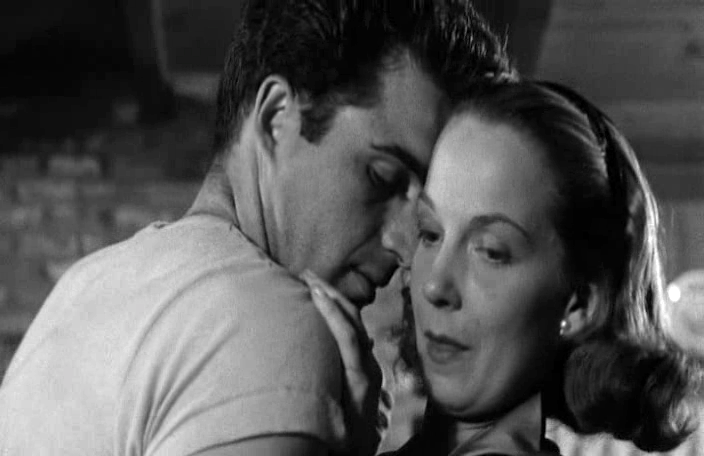
Based on a true crime, A nice suburban family man Gene Courtier makes the mistake of picking up a hitch-hiker who turns out to be dangerous escaped convict Victor Gosset, on the run from the police. 

His gang proceeds to hold Courtier’s family hostage at their home at gunpoint.

As time ticks on, the situation becomes more tense and volatile culminating into a living nightmare!

Directed and written by Andrew L. Stone as a crime noir thriller, it stars Jack Kelly and Hildy Parks as the Courtiers and Vince Edwards as the ruthless woman hungry Victor Gosset.

At first Gosset wants Courtier to sell his car for the cash, but Batsford (Cassavettes) wants to hold the family hostage for the ransom money instead…

Also stars John Cassavettes as Robert Batsford. and David Cross as Luther Logan the other two men in Gosset’s gang. A real gripping thriller!

“With a gasp in your throat… and a gun at your back!”

Don’t pick up any hitch-hikers, but of course you knew that by now-MonsterGirl cares!

Begin ‘The Bagheeta’: Val Lewton’s fantasy/ reality world of Curse of The Cat People: fearing the female/feline monster and the engendering child. Part I

Val LewtonMaster of Shadow.

Val Lewton’s short story ‘The Bagheeta’ appeared in Farnsworth Wright’s July 1930 issue of Weird Tales Magazine. Lewton was dabbling in concepts of terror, before he even got to RKO.

The story takes place in Ukraine (from which MonsterGirl’s people hail!) and is a coming-of-age story about a 16-year-old boy named Kolya who helps his Uncle forge armor. Someone comes into the village with a slaughtered sheep, who claims to have seen a Bagheeta, a monstrous black leopard that can change its form into a beautiful woman. Only one person can kill a Bagheeta,  and that is a virgin male, for he needs to be able to resist her seductive powers. If he is seduced, the woman will change back into the black leopard and kill the boy and eat him! Lewton would eventually adapt and produce his story for RKO in the form of Cat People in 1942 starring Simone Simon, the suggested embodiment of a Bagheeta.

The Panther

His vision, from the constantly passing bars,
has grown so weary that it cannot hold
anything else. It seems to him there are
a thousand bars, and behind the bars, no world.

As he paces in cramped circles, over and over,
the movement of his powerful, soft strides
is like a ritual dance around a center
in which a mighty will stands paralyzed.

Only at times the curtain of the pupils
lifts, quietly — An image enters in,
rushes down through the tensed, arrested muscles,
plunges into the heart and is gone.

-Rainer Maria Rilke

Panther at the zoo, caged in Cat People 1942.

CURSE OF THE CAT PEOPLE 1944

Produced by Val Lewton and directed by Robert Wise and Gunther von Fritsch, scripted by DeWitt Bodeen, and stars Simone Simon as the ghost of Irena, Kent Smith as Oliver Reed, Jane Randolph as Alice Reed, Eve March as Miss Callahan, Julia Dean as Mrs. Julia Farren, Elizabeth Russell as Barbara Farren, Sir Lancelot as Edward, and Ann Carter as Amy Reed. Ann Carter played Beatrice Carroll in the riveting noir classic The Two Mrs. Carrolls (1947)with Humphrey Bogart and Barbara Stanwyck.


Curse of the Cat People is filled with poignant original music by Roy Webb and with Cinematography by Nicholas Musuraca (Cat People 1942, The Fallen Sparrow 1943, The 7th Victim 1943, The Spiral Staircase 1945 Bedlam 1946 and Out of The Past 1947) It’s no wonder Curse of The Cat People has many of the elements of a classic film noir piece.

After the tragic death of his wife Irena, played by the beautiful Simone Simon, Oliver Reed, once again played by Kent Smtih, has remarried his co-worker Alice (Jane Randolph). They now have a very serious yet gentle six-year-old girl named Amy (Ann Carter) who is taken to daydreaming and being a loner.

She does not mix in well with the other children at school who do not understand her sensitivity or her private world of fantasy that she has built around her as a survival mechanism.

“My beautiful friend”

Symbolic of Amy’s free spirit, the little boy captures her ‘beautiful friend’ and crushes it. Thinking that this would make her happy, he destroys the very thing that symbolizes her own spirit and her connection to the natural world.
Amy is framed here in absolute alienation from the rest of the world.

Amy’s father, Oliver, constantly wields authoritative criticism of his daughter’s daydreaming and wants her to play with the other children and exist in the ‘real’ world. Amy has a birthday party for which she invites the children in her class, but no one shows up that day, and Oliver discovers that she has mailed out the invitations by placing them in the magic wishing tree, which is a hollowed-out knot of the large tree out behind the house.

Waiting for her classmates to share her birthday wishes. But no one ever comes.

Oliver reaches into the wishing-tree and pulls out the birthday invitations.

.

Amy is again admonished for believing that the tree was a real wishing tree. Something he himself had told her not too long ago.

Oliver had told Amy this was a magic spot when she was younger, and she remembers it, understanding it to be true because her father told her it was. She was taught to believe in magic and then, without preparation, was expected to denounce all things wondrous without any serious provocation on her part. She is only six years old, after all.

Saddened by her classmates’ absence at her party, Oliver, Alice, and Edward, the manservant from Jamaica, throw Amy a smaller party instead, complete with a birthday cake decorated with six little candles.

Amy is told to make a wish but not to tell anyone what it is, or it won’t come true. Again, Amy is conflicted by the mixed messages the adults in her life are giving her. She tells her father that wishes don’t come true. Oliver tells her, “Some do.” Her mother, Alice, embellishes by saying that you just can’t say it out loud, or it will nullify the magic wish.

Once again, there is a suspension of disbelief on their terms, disavowing Amy and her ability to develop a clearly defined sense of fantasy and reality. How can she properly order her world?

The children at school are furious with Amy for not inviting them as promised. As they shun her, they lead her to an old, sinister-looking mansion, where someone calls to her from the window. A voice calls out to her to come closer. Amy looks around, and the unseen person throws down a white handkerchief threading a gold ring.

Continue reading “Begin ‘The Bagheeta’: Val Lewton’s fantasy/ reality world of Curse of The Cat People: fearing the female/feline monster and the engendering child. Part I”

From The Vault: Corridor of Mirrors (1948)

Corridor of Mirrors (1948)

Directed by Terence Young, and starring Eric Portman, Edana Romney, and Barbara Mullen. Edana Romney co-wrote the script.

Eric Portman plays Paul Mangin, who thinks he is Cesare Borgia reincarnated and that Mifanwy Conway (Edana Romney) is his lost love from a previous life. Corridor of Mirrors also showcases appearances by Christopher Lee and Valentine Dyall. A table at a nightclub with Mifanwy and her companions offers a fleeting glimpse of an astonishingly young Christopher Lee in his film debut, marking the beginning of a legendary career.

Terence Young’s film is a masterpiece of exquisite British filmmaking, immersing us in a rich atmosphere and evoking a mood that rivals the best psychological suspense thrillers and horror films from the forties, like the shadow plays of Val Lewton and the Gothic dark romances such as Wuthering Heights 1939, Rebecca 1940, and Jane Eyre 1943.

Corridor of Mirrors evokes an atmospheric, hallucinatory spectacle akin to Henri Alekan’s cinematography as he follows Josette Day’s travels through the mansion in Cocteau’s 1946 fable-like masterpiece Beauty and the Beast, imbued with its baroque, gilded, and ornate set design. Andre Thomas’s poetic lighting and camera angles suffuse the landscape of labyrinthine corridors, creating a somber and otherworldly landscape that evokes traces of Lewis Carroll’s Alice in Wonderland as Edana Romney journeys through the dreamy complexity of the mansion, trying to break free of the spell, as she pursues the white cat, who is an emblem of Alice’s white rabbit.

Terence Young’s haunting directorial debut is one of those rare films that sweeps you straight into its opulent, unsettling dreams. It is a stunning and dreamlike gothic noir steeped in romantic obsession, sorrow, and psychological unease. At the center of it all is Paul Mangin, an enigmatic, larger-than-life artist absolutely obsessed with the past. The story spirals around this mysterious figure who cloaks his mansion and himself (in velvet capes), in Renaissance grandeur and holds the profound certainty that his soul has spent lifetimes, shaped by love and loss, echoing across centuries. Paul’s interest in Mifanwy is nothing more than a reflection of a cherished image, a portrait whose allure her appearance unsettlingly echoes, devoid of true understanding or affection.

Edana Romney wasn’t just cast as Mifanwy; she shaped the role herself, working closely with co-producer Rudolph Cartier to adapt Chris Massey’s novel into the screenplay. Watching her on screen, she moves almost like she’s sleepwalking, and while her acting is somewhat restrained, it actually adds to the film’s hypnotic, dreamlike quality. Throughout, she’s shadowed by a mysterious woman and a fluffy white cat, both quietly watching, which only deepens the sense of eerie voyeurism and subtle unease.

When Paul meets the beautiful Mifanwy Conway, lovely, possibly shady, and just curious enough to get drawn into the sinister spell, his fixation deepens. He’s convinced she’s the reincarnation of a long-lost lover from centuries ago and seeks to shape her to fit this spectral ideal. She rides beside Paul through shadowed London streets, the horse-drawn cab winding toward a vast, brooding mansion at the city’s heart. Paul, a forbidding aesthete veiled in grand delusions of a past life as an Italian noble, seeks to ensnare the sensuous Mifanwy in the dark embrace of his twisted reverie.

From its shadow-drenched corridors and warped reflections, the film blurs the boundary between reality and hypnotic fantasy. Corridor of Mirrors is a wild, shadowy fever dream drenched in mystery and illusion. It carries you from these dark, mirror-lined hallways and the lavish costume balls right into haunting galleries filled with faceless mannequins. Reality and fantasy melt together here; sometimes, you aren’t sure which is which. It’s like stepping into a twisted fairy tale. Each scene pulses with the quiet torment of lives trapped in mirrors, echoes of Pygmalion, Bluebeard, and Cocteau’s haunted fairy tales. It is as if the characters are caught in a maze of glass, unable to escape their own reflections and obsessions.

Paul Mangin’s obsession leads to madness, murder, and a shattering denouement amid wax effigies in Madame Tussauds, where the film’s onyx gloom gives way to truth and a tragic sense of justice.

The film’s Gothic atmosphere occupies a rare and haunting space, yet it draws subtle echoes from both Hitchcock’s Vertigo (1958) and Fritz Lang’s eerie 1947  thriller, The Secret Beyond the Door. In the latter, a new bride, Joan Bennett, uncovers a chilling secret: her husband’s obsession with recreating rooms where murders have taken place, a macabre blurring of the lines between love and death, passion and violence.

André Thomas’s cinematography is a world unto itself, with its eerie, poetic visual style transforming the film into a hypnotic dreamscape. He plays with light and reflection brilliantly so that you almost lose track of where the real world ends and fantasy begins, those iconic mirrored corridors, where characters and their secrets multiply endlessly in flickering candlelight, and movement, fracturing reality and plunging the film’s characters into a labyrinth of shifting perspectives. Thomas’s cinematography exquisitely captures the film’s sumptuous costumes and intricate décor, draping each scene in a play of shimmering shadows and delicate highlights. His lens lingers on textured fabrics and ornate surroundings, bathing the opulence in a luminous glow that feels both intimate and grand, inviting us to step into a world where every detail is a visual feast. Thomas bathes the set in a chiaroscuro haze in key sequences, such as Mifanwy’s passage through the mansion’s long, mirrored hall lined with faceless mannequins. Nothing is quite what it seems. This approach blurs the line between fantasy and reality, uniting the film’s aching romantic longing and its creeping psychological dread. In every veil and distortion, the characters’ tangled obsessions and fractured selves mirror each other.

George Auric’s (who scored Cocteau’s La Belle et La Bête) score for Corridor of Mirrors flows like a dark, Gothic, melancholic river beneath the film’s haunting imagery, its melodies rising and falling with the rhythm of obsession and longing. The music is at once ethereal and grounded, shimmering with delicate strings that weave through shadowy passages and shadow-drenched ballrooms, while moments of brooding brass and subtle piano suggest the deep undercurrents of psychological unease and brooding desperation. The late moments, underscored by sweeping, delicate orchestration, evoke the grandeur and tragic beauty of the unfolding drama, making his score an essential part of the film’s haunting allure. Auric’s composition turns every whispered secret and silken touch into a symphony of passion and peril. The gowns were designed by Owen Hyde-Clark and constructed by French couturier Maggy Rouff.

“In projecting the slow abandonment of one’s identity, her third and final performance on the big screen evokes the pleasure, and the terror of romantic submission,  Smith says — Mifanwy is a princess who, unlike Cinderella, who waits for a prince, or Snow White or Sleeping Beauty, immobile without the touch of a man’s lips, must break her own spell.” (Imogen Sara Smith for Criterion)

Corridor of Mirrors is a lush, visually extravagant meditation on identity and desire, where the past’s spectral grip suffuses every candle-lit room and character’s haunted gaze. The artistry of set and cinematography deepens its poetic melancholy, making the film a rare British gem, finely blended of exquisite and unsettling, and forever suspended between passion and despair, somewhere between the promise of love and the weight of memory.

See you in the mirror soon, MonsterGirl

A Trailer a day keeps the Boogeyman away! The Girl in Black Stockings 1957

“High Society Dames For Hire!”

THE GIRL IN BLACK STOCKINGS (1957)

Howard W. Koch directed this bit of Film Noir/Thriller and stars Lex Barker, Anne Bancroft, Mamie Van Doren, Marie Windsor, John Dehner, Ron Randell, Stuart Whitman, and Diane Van der Vlis.

A party girl is murdered, and everyone at a Utah motel is a suspect, and they all have something to hide!

Lex Barker plays David Hewson, a lawyer passing through the small town in Utah, who finds the mutilated body of party girl Marcia Morgan, one of the guests staying at Parry Lodge.

The wonderfully dry John Dehner plays Sheriff Jess Holmes, who is looking at everyone at the motel as a possible suspect. While Holmes investigates, the killer strikes again!

WHO WILL BE NEXT?

“She’s every inch a teasing, taunting “Come-on” Blonde.”

“One Will Die Tonight!”

Monday Morning Mondo: Angel Angel Down We Go (1969) “My childhood was perfect. Paradise… lost. When you’re a fairy princess everyone dies on schedule, beautifully.”

“Why should Bogart Peter Stuyvesant go to war and kill strangers, when the pickings are better in his own bedroom?”

ANGEL ANGEL DOWN WE GO (1969) aka CULT OF THE DAMNED

Written and Directed by Robert Thom who is perhaps best known for his Wild In The Streets 1969. For me, the film that really struck a chord was his configuration of childhood abuse in , The Witch Who Came From The Sea 1976 while a little fractured, and slightly queasy in its linear storytelling, was a startling, unsettling, imaginary, and often disturbing piece of work, much thanks to Millie Perkins’ performance.

Consider that Thom also wrote the scripts for Bloody Mama 1970, Crazy Mama 1975, and Death Race 2000 (1975). Angel Angel Down We Go is perhaps a psychedelic take on the Rasputin archetype with a modern conflation of the Svengali mystique.

RASPUTIN-Mad Monk, Religious Pilgrim, Elder, Psychic, or Faith Healer?
Stick an unkempt beard on him, a shabby coat…the dark piercing eyes say it all…Egomaniac!!!!!!!!!!!!!!!

The film opens with Tara Nicole revealing to us, through Tara’s childlike imaginings, her childhood, and the mythical parentage by the outre wealthy Steeles, they are as Demi-Gods from Mount Olympus. We see her musings in flashback and via graphic collage work that depicts her life as it was, as it is now, and as it will be.

Astrid Steele, ex-stag film actress, cigarette girl, and all-around whore to the masses. “Whoever said they slept with me, didn’t!”
Willie Steele, a closet homosexual and absent father.
Gazing into her mirror Tara Nicole Steele. the richest girl in the world recalls her childhood…

Tara Nicole recites a glorified fantasy completely contrary to what her life truly is. She is being sarcastic, she is teasing us with the truth. She is the cultivation of a female monster, whose lack of nurturing, and exposure to abuse and mistreatment has manifested something abhorrent to the world, but mostly to herself, a self-loathing, loveless thing, vulnerable to the dark prince in Bogart Peter Stuyvesant, who will come to the palace and awaken her sleeping rage.

On the surface, A perverse, grotesque fairy tale, about an over-weight heiress whose parents are hypocrites and superficial, living in a psychologically toxic battlefield of emotional turmoil, self-serving, repressed, and angry enough to create a bitter, ugly, and lonely world for their only child, a life Tara cannot live up to, nor can she satisfy the expectations put upon her nor fit into this artificial world.

Enter chaos, enter entropy, enter Bogart Peter Stuyvesant. Tara meets him at her coming out ball, a party was thrown by her mother Astrid, not to celebrate her glorious daughter’s coming of age, but as a showcase for Astrid’s bejeweled necklace that ‘Marie Antoinette wore at her beheading’. An opulent bauble, a shiny thing, a symbol of the empty and idle collectors, wealthy Americans become with their plunder of the poor masses. So the film will inform you over and over again.

A lysergic cinematic (ACID CINEMA) tale about a tragic fat princess who refers to herself as ‘Virgin Americanis.’ Until she sees Bogart gyrating his pelvis in skin-tight leather hip huggers on stage, she nearly swoons at the sight of his crotch. He is singing the film’s theme song, “Angel Angel Down We Go”. The theme is the Fall of The American Empire. The fall of the Steele family, the American Imperialist hypocrites who languish in their wealth, and self-hating misery. Hallucinogenics for the now generation, and booze and pills are still the drug of choice for the breed of uptight Americans.

Is there anti-fat sentiment in the film or is it as offensive as it intends to be so? As Tara represents the spoiled ‘fat’ and languid American Bourgeoisie when Roddy McDowall paws at Tara on the bed and spews out “God is America FAT!” while pawing her like a piece of meat.

“Only the poor know what’s really real. America doesn’t know. America’s FAT baby, good and FAT!… Oh God is America FAT… and Bogart Peter Stuyvesant love’s his country-he’s a patriot!”

Continue reading “Monday Morning Mondo: Angel Angel Down We Go (1969) “My childhood was perfect. Paradise… lost. When you’re a fairy princess everyone dies on schedule, beautifully.””

Coming Soon from Speakeasy The Val Lewton Blogaton!!!!

Kristina of the Speakeasy Blog and Stephen also know as Classic Movie Man will be co-hosting this marvelous event!

There’s just sooo much that can be said for Val Lewton’s contribution and influence on cinema. I have been dragging my feet with a feature, myself, but this years blogathon gives me a chance to talk a little bit about the man who truly created several masterpieces of cinematic history. So join Kristina, and Stephen and all the other bloggers who will be contributing their coverage.

Simone Simon

I am working on a piece for Curse of The Cat People 1944 which was the follow up to Cat People, still appearing is Simone Simon as the ghost of Irena. I’ll be discussing a few things, The Merging of Reality and Fantasy,

The Fear and Threat of Children, the corruption of their innocence, imagination and how their freedom of expression challenges us to either push the boundaries of belief or succumb to Christian myth that would crush it, deem it evil, or call it mental illness.

Also I’ll talk about the Fear of The Female Monster and  The Feminine. Especially in this case, a female child….!

And of course being an avid cat worshiper I’ll address that absurd superstitious malarkey centered around fear of cats being servants of the Devil… in particular black cats. So, stay tuned for a very informative and beautiful ride through the Shadowlands of one of the greatest film makers of all time-

Val Lewton

See it here: Oct 31st 2012

http://hqofk.wordpress.com/val-lewton-event/

See you there-MonsterGirl!

A trailer a day keeps the Boogeyman away! I Married A Monster From Outer Space

I MARRIED A MONSTER FROM OUTER SPACE (1958)

Directed by Gene Fowler Jr. and starring Tom Tryon (he just happened to write 2 of the BEST psychological/supernatural stories The Other, and The Dark Secrets of Harvest Home) who plays Bill Farrell a regular guy newly married to Marge Bradley Farrell (Gloria Talbott) who’s body is taken over by an Alien from Outer Space. Bills’ body is left as a dead shell in the woods.

The Aliens are invading with the purpose of mating with earth women! Gee I thought most earth men had the same idea!

Anyway, the Aliens begin switching places with the real humans. But Marge is no dope. She starts to realize that something’s very wrong with Bill, Alien Bill wants to have children with Marge anyway. Has he fallen for this earth girl?

Much like Invasion of The Body Snatchers 1956, this wonderful sci-fi thriller from the 50s evokes the period’s sense of paranoia, as the townspeople are slowly being taken over by an alien force!

She sees the alien’s face reflected in the pane glass window! And that creepy doll, no wonder she loses it!

 “Shuddery things from beyond the stars, here to breed with human women!”

Make sure you know who you’re kissing tonight – MonsterGirl

The She Creature (1956) Bridey Murphy’s Reincarnation meets Beulah the Busty Crusty ‘She Creature’ from Paul Blaisdell’s imagination.

“Hypnotized! Reincarnated as a monster from hell!”

THE SHE CREATURE 1956

In 1952 the world celebrated the famous Bridey Murphy regression case. It began when one Morey Bernstein hypnotized a Colorado housewife named Ruth Simmons. Under a trance, emerged the personality of Bridey Murphy an 18th Century Irish woman.

from the film The Search For Bridey Murphy

In 1956 Bernstein published his book The Search For Bridey Murphy. Eventually the story made it onto the screen by Paramount Pictures, starring Teresa Wright and Louis Hayward, a film which is on my short list of things to watch.

And if you have a guilty pleasure for musicals as I do, you’ll see the story retold in Vincente Minneli’s On A Clear Day You Can See Forever 1971 starring musical diva Barbara Streisand, Yves Montand and Jack Nicholson. With some of the BEST music by Burton Lane and lyrics by Alan Jay Lerner.

Barbara Streisand as Daisy Gamble in Vincente Minneli’s 1970 On A Clear Day You Can See Forever.

Now in 1956 when A.I.P was churning out goodies like It Conquered The World 1956  for Roger Corman, the idea of past life regression became of some interest to producer Alex Gordon.

The She Creature incorporated the concept of a lovely girl harboring a past soul or souls, but due to the fact that A.I.P. wanted monsters in their pictures, they used the best of both worlds and mixed an unconventional idea that was all the rage at that time, and threw in an ancient busty crusty beastie that rose from the sea, whenever the girl was in a trance.

So you have it, a girl from the 20th century inhabited by a female creature from the primordial edges of time’s beginning. Schlocky fun from Samuel Z. Arkoff, Alex Gordon and one of my favorite directors who can take a b-movie sci-fi/horror picture and bring a bit of grimy noir sensibility to it the great Edward L. Cahn.

Jerry Zigmond’s contribution was coming up with the title THE SHE CREATURE and the screenplay was written by Lou Rusoff. The film stars Chester Morris as Dr Carlo Lombardi, Marla English as his subject Andrea, good ole Tom Conway as Timothy Chappel, Cathy Downes as Dorothy Chappel, Ron Randell as Lt. Ed James, Lance Fuller as Dr. Ted Erickson Frieda Inescort as Mrs Chappel and of course Paul Blaisdell as Beulah!

Chester Morris (Alibi 1929, The Big House 1930, Five Came Back 1939) plays the smarmy Dr. Carlo Lombardi, carnival hypnotist and prognosticator extraordinaire. Morris brings smarmy to a whole new level here, that it even makes Jack Cassidy‘s villains’ seem Christ like. Lombardi travels around rich circles impressing the affluent patrons, with his ability to regress his female hostage, oops I mean patient back in time, probing old memories of their past lives, thereby proving that reincarnation is real.

Another nifty trick is the claim that he can summon forth the incorporeal spirit or soul from the past and manifest it into a physical form.

It starts out on the desolate beach at night where the mustachioed mad hypnotist Lombardi is standing in silhouette , then walking along the shore, dressed in black like a villain from a silent movie, about to tie a maiden to the train tracks. He’s staring out at the sea, a distant shape is forming in and out of the breaking tides.

Dr. Carlos Lombardi communing with the ancient she creature that is waiting out in the misty turbulent ocean.

“Now on This very night I have called into the unknown depths of time itself. She is here. And with her coming, the world will never be as it was. Neither man nor animal will be the same. This, I, Dr. Carlo Lombardi have brought into being!”

Suddenly the camera focuses on a monstrous invisible foot print in the sand. The moment is broken when King the loyal dog of Dorothy Chappel, starts barking and breaks Lombardi’s concentration. Dorothy’s father Timothy Chappel a promoter, is hosting a party this particular weekend at their fancy beach house. Invited to the party is Dorothy’s boyfriend Dr. Ted Erickson who is a notable expert on the subject of psychic research. He’s not comfortable mingling with the idle rich, he’s basically just a ‘farm boy’ and just doesn’t fit in with Dorothy’s father’s crowd.

Mrs.Chappel believes in the powers of the supernatural She tries to convince her husband that Lomardi’s prediction that something terrible is going to happen along this part of the coast tonight, they’ll be ‘a visitation from the occult world’ and tells him seriously that he must meet him. Tim Chappel laughs at his wife, and remarks, that “Some women keeps pets, or grow roses for kicks, my wife supports quack occultists.”

Mrs.Chappel tells her husband that he puts this girl in a deep trance and sends her back over 300 years. When she was a girl in England. ” I tell you it’s uncanny!” Mrs.Chappel is vehement!

Continue reading “The She Creature (1956) Bridey Murphy’s Reincarnation meets Beulah the Busty Crusty ‘She Creature’ from Paul Blaisdell’s imagination.”

A trailer a day keeps the Boogeyman away! Look In Any Window (1961)

LOOK IN ANY WINDOW 1961

In the 60’s Paul Anka was considered a dreamy teen idol. In Look In Any Window directed by William Alland (more known for his work as producer Creature From The Black Lagoon 1954, The Deadly Mantis 1957, Tarantula 1955, This Island Earth 1955 stop me I could go on and on!) , Anka plays the very distressed Craig Fowler, a troubled young man who is surrounded by inappropriate, over sexed adults, and very dysfunctional parents played by Ruth Roman and Alex Nicol as Jackie and Jay Fowler.

Craig’s world stinks, as his mother is an unhappy woman starved for attention, and he witnesses his father Jay erupt into a mess while on a drinking binge, after losing his job and his ‘manhood’.

It’s ever so angst ridden for the boy being crowded by so many pathetic adults and oh…the ‘Suburbia Traumatica’  of it all! The film rips wide open the myth of clean suburban living and the even more mythic ‘All American Family.’

The entire neighborhood is on the prowl in this film. Carole Mathews plays Betty Lowell who’s lecherous husband steps out on her every chance he gets. Perfect for the role of the womanizing Gareth Lowell is the wonderfully slickety and smarmy Jack Cassidy.

While all the adult drama and provocative neighborly love is going on, an attraction starts to bloom between Craig and Betty’s daughter Eileen (Gigi Perreau).

And what about the secret compulsion that Craig is hiding!How about his naughty proclivity for peering into windows!

Anka sings the theme song, “Look In Any Window” with a breathy tone that makes your skin crawl…creepy yes, haunting… not so much.

“Nothing between their secrets and the neighborhood except a pane of glass!”

“The screen shocks with the truth about what goes on in the most ‘respectable’ neighborhoods in town!”


“It’s The Must-See Story Of Morals And Mistakes… Told With Unashamed Biting Frankness!”

From The Vault: The Queen of Spades (1949)

“The Dead Shall Give Up Their Secrets!”

THE QUEEN OF SPADES 1949

The Queen of Spades is a masterpiece if ever I saw one. Associate Producer Jack Clayton was on board for this film, directed by Thorold Dickinson (Gaslight 1940) who came onto the project last minute. Adapted to the screen by Rodney Ackland and Arthur Boys from the story written by Alexander Pushkin. The story could have easily been dreamt up by Aleksei Tolstoy,  Ivan Chekhov -(The Drop of Water) Nikolai Gogol  or even Oscar Wilde.

My partner Wendy even mentioned Edgar Allan Poe as she watched along with me. It brought to my mind, his short story Never Bet The Devil Your Head. Which of course was brought to life by Frederico Fellini in the segment of Spirits of The Dead 1968 called Toby Dammit, featuring the work of actor Terence Stamp.

Terence Stamp as Toby Dammit in the segment of the same name as part of Spirits of The Dead. Directed by Frederico Fellini 1968 Based on the short story by Poe, Never Bet The Devil Your Head.
From Mario Bava’s Black Sabbath 1963 vignette The Drop of Water based on a story by Chekhov.
Boris Karloff stars in an adaptation of Tolstoy’s story in the segment about The Wurdelak.

It’s clear that Russians are very good at telling Ghost stories and notorious for telling tales about selling your soul to the Devil!

The Queen of Spades, stars Anton Walbrook, Edith Evans, Yvonne Mitchell and Ronald Howard.

The gorgeous music scored by Georges Auric   (Beauty and The Beast (1946), The Innocents (1961), and Wages of Fear 1953 just to mention a very few!) is as heart wrenching as it is heroic, drawing out the exquisite melody and chord changes to reach the soul and twist it into knots while it lingers.

What can I say about the gorgeous cinematography by Otto Heller.The odd camera angles are reminiscent of the great German Expressionist movement, something from Fritz Lang or the use of light and darkly dreamy angles like that of Carl Theodor Dreyer.

Even without any sound, the story would have emerged from the screen as a powerful cautionary tale, rife with grotesque and compelling characters.

The film is an arresting fairytale, that’s dreamy, and haunting in it’s imagery and perhaps, yes perhaps as visually stunning as I dare say Jean Cocteau’s  La Belle et la Bête 1946 or Julian Duvivier’s Flesh and Fantasy 1943 and collaborative efforts of Alberto Cavalcanti, Charles Crichton, Basil Dearden and Robert Hamer’s Dead of Night 1945.

Betty Fields and the mysterious mask salesman in Flesh and Fantasy
Michael Redgrave and his dummy in Dead of Night

There are frames so masterfully conjured in shadow, that you might even think you’re watching Film Noir or an obscure Val Lewton production. Either way, The Queen of Spades sort of defies being labelled a specific genre.

It has it’s own melancholy fantasy that draws from many elements of  the mystery/suspense crime/noir and supernatural horror gems of that golden age, when visual structure was as essential to the narrative as was the character development and dialogue.

Anton Walbrook is wonderful as Moira Shearer’s domineering impresario Boris Lermontov in Michael Powell and Emeric Pressburger’s The Red Shoes 1948

Anton Walbrook  plays the bitter and venomous Capt.Herman Suvorin an army engineer, who is so poisoned by his resentments toward the ruling aristocracy , that he wants to gain his own wealth, and punish those around him who have benefited by their birthright and title. Suvorin does not want to take life as it comes, he wants to “Grab life by the throat and force it to give him what he wants!”-Suvorin.

This he conspires to do by trying to learn the secret of winning at a card game named Faro, from the Old Countess Ranevskaya, played by Edith Evans.

The marvelous British actress Dame Edith Evans
It’s always a bad omen to draw The Queen of Spades!

After a frustrating night of watching a few of his fellow army officers play Faro, taunting Herman as if he was not of the same class, he bursts out of his room in a self absorbed rage, and wanders onto the streets and into a dusty old book store, first picking up a book about Napoleon Bonaparte whom he admires (his portrait hangs in Herman’s humble room) because Napoleon came into his power at age 26!

Herman Suvorin possess a similar intensely maniacal quality that makes him a very unapproachable,manipulative and unlikable man. Looking at him was like “looking into the eyes of Satan!”

Fatefully placed next to Napoleon’s book is another book, suddenly and with a creepy alacrity, the old bookshop owner picks up the ancient bound leather and starts relating it’s contents to Herman, as if he’d been chosen the messenger… warning Suvorin about the secrets and dangers of tampering with the universe. The old man told Herman that he’d either wind up having riches… or lose his eternal soul!

“You might wind up gaining a fortune or losing your precious soul!”

In terms of appearance and demeanor I thought of Riffraff from Rocky Horror Picture Show, and wondered if this little bookish crypt keeper was an inspiration for Richard O Brien!

Herman purchases the book for 3 rubles, and starts reading aloud to us. This mysterious book, about people making deals with the Devil, and a certain mysterious Count d. Saint Germaine who lived in an isolated palace and molded wax images of his chosen victims, thereby trapping their souls forever in his power.

Herman Suvorin slowly and thoughtfully recites to us from the book:

Containing the true stories of people who sold their souls in return for wealth, power or influence"¦ Chapter IV The Secret of The Cards
Countess R"¦(Countess Ranevskaya )
In the year seventeen hundred and forty six, (60 years ago)
The Count d. Saint Germain arrived in St. Petersburg.
He chose for his residence, a palace on the outskirts of the city.
and soon there were strange rumors, about the weird dwelling and it’s mysterious occupant. It was certainly true that in the vaults of the palace. he had a curious collection of wax figures, which, so it was whispered, contained the souls of those who had fallen under his evil influence. He would derive intense please from modeling the wax figures from his intended victims, each one of whom was chosen.
with deliberate appreciation. Thus the countess Ranevskaya, acknowledged as the most beautiful woman in Russia came to excite his attention. He learned that in spite of a jealous husband, all the men had vied for her favors.

Sleeping with a handsome stranger, gets The Countess into grave trouble!
This stranger warns the Countess of having amorous encounters, then robs her of her jealous husband’s money!

When the last of the guests had left. the countess went down the secret stairway.. To admits the young stranger she had promised to meet. She alone had the key to the hidden door. They had an amorous meeting. He was a cad and threatened her with scandal. Taking all her money. She was haunted by the fear of scandal. She needed to replace the money. In her despair she remembered the message from Saint Germain. she had no alternative but to answer the mysterious summons.  She would sell her soul"¦ anything  to save herself…

Is Saint d. Germain really The Devil?

Germain’s messenger tells the young Countess to meet him at his palace!

In Saint Germain’s vault of waxworks, just before the darkness closes in, and the Countess screams off screen…

Continue reading “From The Vault: The Queen of Spades (1949)”