What a Character! Blogathon 2015: Agnes Moorehead- The Lavender Lady

wac3

Agnes
Ages from the famous ‘boiler scene’ as the tormented Aunt Fanny in Welles’ superior to Citizen Kane’s The Magnificent Ambersons. Fanny to the self-obsessed & spoiled Georgie “It’s not hot!!! it’s cold, the plumbers disconnected it… I wouldn’t mind if they hadn’t…!  I wouldn’t mind if it burned!!!”
 quote-it-s-an-unavoidable-truth-fear-of-life-closes-off-more-opportunities-for-us-than-fear-agnes-moorehead-79-52-48
agnes historical society photo
A simple and wholesome beginning… Agnes Robertson Moorehead was born on December 6th, 1900 in Clinton, Massachusetts. Her mother was a mezzo-soprano and her father was a Presbyterian minister whose work eventually moved the family to St. Louis, Missouri. She started her acting career on stage at the age of 3, and by the time she was 12, she was active in the St. Louis Municipal Opera as a dancer and singer. She went to college for biology at Muskingum College in Ohio but remained active in acting. After college, she moved to Wisconsin (her family was now in Reedsburg, Wisconsin), and taught drama and English at local schools. She earned a Masters in English at the University of Wisconsin in Madison. Agnes eventually would earn a doctorate from Bradley University.
acting school
college
My partner Wendy and I happened to have lived in Madison for a wonderful 8 years while she was in grad school at the University of Wisconsin. I wrote my favorite album Fools & Orphans while living on Starkweather Creek on the East side of town. So Agnes’ presence there is all the sweeter to me…
To earn the money she would need, not only to eat but to build toward her dream of heading to New York City and acting school, she taught English, Speech, and Ancient History at Centralized High School in Soldiers Grove. Teaching was something she maintained a strong affection for.
059-agnes-moorehead-theredlist
When she eventually saved enough money to get to New York City she audition for the American Academy of Dramatic Arts in the summer of 1926- she was accepted. I’m reading Charles Tranberg’s wonderful book, she talks about starving herself, being grateful for enough loose change to buy a buttered roll from the Automat  "¦
Afterward, she moved to New York City and enrolled in the American Academy of Dramatic Arts. Agnes studied with Charles Jehlinger at The (AADA) American Academy of Dramatic Arts, where he taught people that ‘imagination’ is the key!
Not making it on Broadway during the 30s, she used her marvelous voice to make a name for herself in the media of radio. She began performing as many as six shows each day. During her radio performances, she met Orson Welles, and Joseph Cotton and the three formed the famous Mercury Players Theatre. Agnes made her film debut in 1941 in Orson Welles' "˜Citizen Kane'. She went on to play vital, high-spirited saucy & strong female roles in film and television eventually landing the iconic role as "Endora" on the popular & timelessly beloved television show "Bewitched" (1964-1972). She was married twice but eventually lived alone, enjoying solitude. She died quietly away from friends and the public, from lung cancer that had spread from her Uterus, she succumbed in 1974 in Rochester Minnesota. With Agnes’ work ethic, she had maintained a busy schedule though drained and tired from the illness, performing hours on the stage and doing television appearances until she could no longer manage.
IMDb tidbit- Agnes’ death from cancer is often linked to other actors and crew members who worked on The Conqueror (1956). Including Susan Hayward, John Wayne and director Dick Powell, to name a few. The conspiracy theory behind the strong beliefs are that they were exposed while on location at the site which received heavy fallout from nuclear testing at the (then) Nevada Proving Grounds.

Fiercely private. Considered not beautiful because of her ‘hawk-like’ face. I would boldly beg to disagree. Agnes Moorehead has a beauty that transcends the quaint and lovely upturned nose. She has a regal beauty as if royalty runs in her veins, with a sage otherworldliness and a voice like a chameleon that can change its tone and tenor to fit her myriad characterizations. I wish she and hope she knew that although she was THE consummate character actress for the ages, she too was as beautiful as any other leading star with a deep & fiery magnetism that draws you in ~

young agnes

Agnes had that spark in her since she was a very little Agnes, embodying, manifesting & emoting like the characters from the books she read and from the theater. Her adoring father or mother would find her re-enacting scenes in her room!

Here’s a beautifully written snapshot of Agnes Moorehead by The Red List– data base by Romuald Leblond & Jessica Vaillat

“Wanting to become a comedian from a young age – her mother had become accustomed to discovering her daughter in her imaginary world and often asked her: "˜Who are you today, Agnes?' -  Agnes Moorehead appeared regularly on Broadway stages during the late 1920s.  She rapidly became a celebrated radio actress and joined Orson Welles's Mercury Theater on the Air from 1940. In 1941, Orson Welles offered the "˜Fabulous Redhead' her first film role in Citizen Kane as the cruel and bitter mother of the lead role. The part soon shaped the other roles Agnes Moorehead would be offered while they privileged heartless authoritarian or neurotic women such as the menacing aunt of Johnny Belinda, in 1948. In 1943, on the radio, the American comedian delivered one of her most legendary performances in Sorry, Wrong Number for which she created an exhausting and dynamic presentation – "˜radiant and terrifying'. In 1964, she was cast as Samantha Steven's sarcastic and buoyant mother, in Bewitched and, although she disliked the rapid pace of television series, the show helped install the actress in the pantheon of American pop culture icons. Quite an irony for a woman who didn't "˜particularly want to be identified as a witch.”

Agnes Moorehead went on from her imaginative childhood musings to play some of the most colorful characters on stage, radio, film, and television- perhaps her persona had been ‘shaped by Citizen Kane’ but Agnes obviously had a range of emotions and archetypes she could readily tap into as she is a natural, authentic artist… making her a cultural icon recognized by so many people & an even a new generation of avid fans!

004-agnes-moorehead-theredlist-Agnes Moorehead, 1920s

Agnes -[commenting on the “Method” school of acting] “The Method school thinks the emotion is the art. It isn’t. All emotion isn’t sublime. The theater isn’t reality. If you want reality, go to the morgue. The theater is human behavior that is effective and interesting.” –from Charles Tranberg’s book I Love the Illusion: The Life and Career of Agnes Moorehead

Tranberg’s book is a wonderful read, he discusses from the beginning, the wealth of material he found at the historical society at the University of Wisconsin’s Historical Society. It is a marvelous place with marble floors worn down by years and the warm & musty smell of bygone years, the building holds the archives of so many historical documents and films. For Agnes Moorehead, 159 boxes of material to be precise. He was not just a fan of Endora but her performances on old-time radio in which she really shined. His book hints that her fire and brimstone Rev. John Moorehead with his sermons had a bit of the frustrated actor in the man, and why Aggie felt drawn to theater in the first place. He also read Shakespeare to the children. Her mother Molly was the boisterous outgoing flamboyant one who lived to be 106 and died in 1990"¦ always saying what was on her mind, unless it was a strictly personal subject… sound familiar?

022-agnes-moorehead-theredlist-Endora

He also writes about Agnes' spirituality and religious devoutness. That is "˜wasn't a gimmick or publicity stunt' she really was a devoted Christian. It might cause heads to tilt, how such a fundamentalist woman would pick a career where she would be surrounded by creative types, often gay people that would become her friends. And though she was not thrilled with the idea of playing a witch, she certainly conjured the most iconic embodiment of the vexing & colorful Endora.

060-agnes-moorehead-theredlist
Elizabeth Montgomery and Agnes Moorehead publicity shot Bewitched -courtesy of The Red List

“Lavender is just pink trying to be purple” she paraphrased Proustby Quint Benedetti from his book- (My Travels with) Agnes Moorehead: The Lavender Lady: (more BEWITCHING than Endora)– he goes onto to say, “And now I can see all the hues of her personality in that statement: the royalty, the naivete, the selfhishness, the piercing intuition and sometimes the astonishing lack of it  (her two marriages), the phoniness and the irrepressible humanity it contained, the coldness and the longing to be warm and sometimes the warmth, the insecurity and the yearning to be loved, the human simplicity touching greatness. Agnes Moorehead in a way did what so many actor and actresses never did. She left her mark on society both as an actress and as a person.” Benedetti knew Agnes Moorehead for ten years and was her personal assistant for five of those years.

In her long & unforgettable career – Agnes Moorehead’s film debut as Charles Foster Kane’s picture of stoic motherhood, the bitter and icy cold Mary Kane.

Citizen Kane mother image 2
Stoic Motherhood-Mary Kane in Orson Welles’ Citizen Kane (1941).

Citizen Kane

She went on to play the emotionally tortured Aunt Fanny in what Charles Transberg rightly refers to Orson Welles’ The Magnificent Ambersons as "˜a mangled masterpiece' I would give anything to see the footage that RKO hacked to pieces"¦ and the ending that should have been, where Fanny is playing cards in the boarding house with the other old maids. The more nihilistic coda that RKO feared would turn the public off in the midst of WWII.

Agnes as Aunt Fanny Magnificent Ambersons

I know what you're gonna do... you're gonna leave me in the lurch
Aunt Fanny-“I know what you’re gonna do… you’re gonna leave me in the lurch…”
008-agnes-moorehead-theredlist-Tim Holt and Agnes Moorehead in The Magnificent Ambersons directed by Orson Welles, 1942
The Magnificent Ambersons (1942) directed by Orson Welles co-starring Joseph Cotton. Agnes Moorehead plays poor Aunt Fanny-Image courtesy of The Red List.
Fanny Georgie and Uncle Jack- The cake and milk indulgence scene. Jack tells Georgie
Georgie (Tim Holt), Uncle Jack (Ray Collins), and Aunt Fanny- The milk and cake indulgence scene. Jack tells Georgie later after teasing her “Can’t think of anything Aggie does have except her feelings for Morgan.”
CapturFiles
Fanny-Can't you see that I approve of what you're doing?” Georgie (Tim Holt)-“What the heck is wrong with you” Fanny- “Oh you're always picking on me, always"¦ ever since you were a little boy.” Georgie- “Oh my gosh” Fanny- “You wouldn't treat anybody in the world like this, except old Fanny Old Fanny you say nobody but Old Fanny so "¦ I'll kick her! Nobody will resent it. I'll kick her all I want to and you're right, I haven't got anything in the world since my brother died. Nobody nothing.”

jane-eyre-agnes-moorehead
Agnes Moorehead as the heartless & cruel Mrs. Reed who sends young Jane away to Thornfield in Jane Eyre-aside from mothers, aunts spinsters & old maids, Moorehead performs her first evil character! in director Robert Stevenson’s adaptation of Jane Eyre (1943).

026-agnes-moorehead-theredlist-Agnes Moorehead in Mrs. Parkington directed by Tay Garnett, 1944
Agnes Moorehead in Mrs. Parkington directed by Tay Garnett, 1944- courtesy The Red List.
044-agnes-moorehead-theredlist-Humphrey Bogart and Agnes Moorehead in Dark Passage directed by Delmer Daves, 1947
Humphrey Bogart and Agnes Moorehead in Dark Passage directed by Delmer Daves, 1947.
024-agnes-moorehead-theredlist-Agnes Moorehead in The Women in White directed by Peter Godfrey, 1948
Agnes Moorehead in The Women in White directed by Peter Godfrey, 1948-courtesy of The Red List.
020-agnes-moorehead-theredlist-James Stewart, Agnes Moorehead and June Allyson in The Stratton Story directed by Sam Wood, 1949
James Stewart, Agnes Moorehead, and June Allyson in The Stratton Story directed by Sam Wood, 1949- courtesy The Red List
001-agnes-moorehead-theredlist-Agnes Moorehead for Government Girl directed by Dudley Nichols, 1943
Agnes Moorehead for Government Girl directed by Dudley Nichols, 1943-courtesy The Red List.
her heiness and the bellboy -hedy
Agnes Moorehead as Countess Zoe and Hedy Lamarr as Princess Veronica in Her Highness and the Bellboy (1945).
013-agnes-moorehead-theredlist-Agnes Moorehead for The lost moment directed by Martin Gabel, 1947
Agnes Moorehead publicity shot for The Lost Moment directed by Martin Gabel, 1947.
092-agnes-moorehead-theredlist-Selma Jacobson, Edward G. Robinson and Agnes Moorehead in Our Vines Have Tender Grapes directed by Roy Rowland, 1945
courtesy of-the red list-Edward G. Robinson and Agnes Moorehead in Our Vines Have Tender Grapes directed by Roy Rowland, 1945.
028-agnes-moorehead-theredlist-Agnes Moorehead with Moira Shearer in Story of Three Loves:The Jealous Lover directed by Gottfried Reinhardt, 1953
Agnes Moorehead with Moira Shearer in Story of Three Loves: The Jealous Lover directed by Gottfried Reinhardt, 1953.
015-agnes-moorehead-theredlist-All That Heaven Allows 1955
Rock Hudson, Jane Wyman, and Agnes Moorehead in All That Heaven Allows 1955 directed by Douglas Sirk.
012-agnes-moorehead-theredlist-Agnes Moorehead and Tallulah Bankhead in Main Street to Broadway directed by Tay Garnett, 1953
Agnes Moorehead and Tallulah Bankhead in Main Street to Broadway directed by Tay Garnett, 1953.
032-agnes-moorehead-theredlist-Vincent Price and Agnes Moorehead in The Bat directed by Crane Wilbur, 1959
Vincent Price and Agnes Moorehead as mystery writer Cornelia Van Gorder in The Bat directed by Crane Wilbur, 1959.
033-agnes-moorehead-theredlist-Agnes Moorehead and Tyrone Power on the set of Utamed directed by Henry King, 1955
Agnes Moorehead and Tyrone Power on the set of Untamed directed by Henry King, 1955-courtesy of The Red List.
010-agnes-moorehead-theredlist-Agnes Moorehead and Kim Novak in Jeanne Eagels directed by George Sidney, 1957
Agnes Moorehead and Kim Novak in Jeanne Eagels directed by George Sidney, 1957.
046-agnes-moorehead-theredlist-Agnes Moorehead and Eleanor Parker in Caged directed by John Cromwell, 1950
Agnes Moorehead as the kindly Warden Bond and Eleanor Parker in Caged directed by John Cromwell, 1950 One of THE best women in prison films : courtesy of The Red List.
Aggie as Velma
Agnes Moorehead as the irascible Velma Cruthers in Robert Aldrich’s Grand Dame Southern Gothic follow-up to What Ever Happened To Baby Jane? (1962).

Stage: Agnes began touring in George Bernard Shaw's Don Juan in Hell (1951) & revival 1973, Gigi 1973 co-starring with Alfred Drake.

Don Juan in Hell Boyer, Moorehead and Hardwicke
Charles Boyer, Agnes, and Sir Cedric Hardwicke in the stage production of Don Juan in Hell.
052-agnes-moorehead-theredlist-Agnes Moorehead in Don Juan in Hell on Broadway, 1952
Agnes Moorehead in Don Juan in Hell on Broadway, 1952- Image courtesy of The Red List.
054-agnes-moorehead-theredlist-Agnes Moorehead in Don Juan in Hell on Broadway, 1952
Agnes Moorehead in Don Juan in Hell on Broadway, 1952-Image courtesy of The Red List.
042-agnes-moorehead-theredlist-Alfred Drake and Agnes Moorehead in the stage version of the musical Gigi, 1973
Agnes Moorehead in the stage version of the musical Gigi, 1973-image courtesy of The Red List

Selected Radio:– Mercury Theater founded with Orson Welles- Mysteries in Paris, The Gumps, The New Penny, The March of Time (1967-38), The Shadow (1937-39), The Mercury Theater of the Air (ensemble) The Campbell Playhouse, The Cavalcade of America (1938-41), Mayor of the Town

049-agnes-moorehead-theredlist-Lionel Barrymore and Agnes Moorehead for The Mayor of the Town, NBC Radio, 1943
Lionel Barrymore and Agnes Moorehead for The Mayor of the Town, NBC Radio, 1943. For 7 years Moorehead would perfect her persona as the Mayor’s grousy housekeeper Marilly, a little of Marilly would emerge again as part of her Velma in Hush… Hush, Sweet Charlotte 1964.

(1942-49), Suspense (1942-1960.) And of course, in 1945 she played the women-in-peril-(in bed) Mrs. Stevenson in the CBS radio mystery program Suspense- Sorry, Wrong Number, which became “radio’s most famous play.” 

Radio

According to Charles Tranberg, Agnes was offered a supportive role in the film version starring Barbara Stanwyck, saying that she wisely turned it down, coming to understand that she would always be considered a ‘character actress’ and not a leading lady. This would influence her decision to focus more on the stage, beginning with her affiliation with the acclaimed Don Juan in Hell and later her very popular one-woman show.

one woman show

On December 10, 2008 Celebrating Moorehead's 108th anniversary on Turner Classic Movies- Moira Finnie writing for Movie Morlocks published a wonderful interview with Tranberg when asked if Agnes enjoyed both the mediums of radio and stage, he answered "I think she liked the challenges offered by all he mediums she worked on. The stage because it's proximity in front of an audience. Radio because she had to create a complex characterization without being seen and could use her voice in many different ways. Film because it offered her the opportunity to visualize a characterization. Television because of its intimacy."

Aggie Radio

Aggy in Dracula with The Mercury Theater
Agnes Moorehead and Orson Welles with The Mercury Theater’s radio production of Dracula

Moira Finnie’s piece is wonderfully insightful and witty. While watching David O Selznick's Since You Went Away (1945) "It struck me for the hundredth time that the presence of Agnes Moorehead in many classic and not so classic films was often what gave a movie a spine."

"She proved her versatility throughout her career. She arranged her aquiline features accordingly  to convey a believable briskness, sometimes comforting, sometimes disapproving. She most often appeared as a pragmatic presence in many films that have etched themselves on our collective memory."

Moira Finnie aptly says it perfectly, honing in on the essence of what truly makes Agnes Moorehead such a powerful performer, "The actress could shift her characterizations easily from vinegary disapproval to warmly compassionate to richly detailed portraits of good and evil women."

034-agnes-moorehead-theredlist-Agnes Moorehead on CBS Radio, 1945

Selected FilmsCitizen Kane 1941 (Mary Kane), The Magnificent Ambersons 1942 (Fanny), The Big Street 1942 (Violet Shumberg), Journey into Fear 1943 (Mrs. Mathews), Jane Eyre 1944 (Mrs.Reed), Since You Went Away 1944 (Mrs. Emily Hawkins), Dragon Seed 1944 (Third Cousin’s Wife), The Seventh Cross 1944 (Mme. Morelli), Mrs Parkington 1944 (Baroness Aspasia Conti), Our Vines Have Tender Grapes 1945 (Bruna Jacobson) Dark Passage 1947 (Madge Rapf) The Lost Moment 1947 (Juliana Borderau), Summer Holiday 1948 (Cousin Lily), The Woman in White 1948 (Countess Fosco), Johnny Belinda 1948 (Aggie MacDonald-nominated best supporting actress) The Great Sinner 1949 (Emma Getzel), Caged 1950 (Ruth Benton progressive Prison Warden), Captain Blackjack 1950 (Mrs. Emily Birk), Fourteen Hours 1951 (Christine Hill Cosick) , Showboat 1951 (Parthy Hawks), Magnificent Obsession 1954 (Nancy Ashford), All That Heaven Allows 1955 (Sara Warren), The Left Hand of God 1955 (Beryl Sigman), The Revolt of Mamie Stover 1956 (Bertha Parchman), Jeanne Eagels 1957 (Nellie Neilson), Raintree County 1957 (Ellen Shawnessy), The Story of Mankind 1957 (Queen Elizabeth I), Night of the Quarter Moon 1959 (Cornelia Nelson), The Bat 1959 (Cornelia van Gorder) Pollyanna 1960 (Mrs. Snow), Twenty Plus Two 1961 (Mrs. Eleanor Delaney) How the West Was Won 1962-(Rebecca Prescott), Who’s Minding the Store? 1963 (Mrs. Phoebe Tuttle), The Singing Nun 1966 (Sister Cluny)

Nominated four times for Best Actress in a Supporting Role for The Magnificent Ambersons (1942), Mrs. Parkington (1944), Johnny Belinda (1948), and of course as Velma in director Robert Aldrich’s Hush… Hush, Sweet Charlotte (1964)

velma and charlotte
Velma Cruthers and Charlotte Hollis in Robert Aldrich’s Grand Dame Southern Gothic thriller Hush… Hush, Sweet Charlotte 1964.

agnes and bette set

It is the vitriolic, cantankerous yet loyal & righteous companion Velma to Bette Davis’ tragic Southern Gothic has- been belle Charlotte that won my heart. Moorehead brought to life a raw and rugged plain quality of humanness that touched me so deeply, as did Davis’ incredible performance.

How impressed I was with her pantomime in The Invaders credited as "˜The Woman' in Rod Serling’s sociological anthology fantasy series Twilight Zone"¦ Moorehead had no dialogue in the episode yet she demonstrated so much art and emotion from her ‘primal woman’s body language.

The Woman 2

The Woman the invaders
Credited as The Woman… here Agnes plays The Primal woman in Rod Serling’s The Invaders episode of The Twilight Zone aired on Jan. 27, 1961.
CapturFiles_136
Moorehead’s use of body language and her knowledge of pantomime brought to life primal undomesticated women from ‘a’ planet terrorized by invaders who didn’t need to speak one word to convey her fear or instinct self-preservation.

She did win a Golden Globe Award for Best Supporting Actress -Laurel Award 2nd place for Top Supporting Performance for Hush… Hush, Sweet Charlotte 1964.

For many people, she will be remembered as Endora, Samantha, and Darrin Steven's (the fabulous Dick York) caustic ill-provoking mother-in-law from the netherworld. who hands down the legacy of being Bewitched"¦ from 1964-1972. Initially, Moorehead had turned down the role of Endora, and it wasn’t until Elizabeth Montgomery herself asked the actress to join the cast, never expecting it to last more than one season!

Elizabeth and Agnes color 2

Agnes Moorehead, Elizabeth Montgomery, and Dick York in Bewitched.

Moorehead did her string of horror films in the 70s that featured many fine actresses who had played fine ladies in their day, only to find Grand Dame Guignol roles waiting for them on the other side of fabulous fame…

What’s The Matter With Helen 1971 Curtis Harrington’s wonderful horror of personality psycho-drama where Aggie plays an Aimee Semple McPherson-type character called Sister Alma co-starring with friend Debbie Reynolds and the incomparable Shelley Winters!

What's+the+Matter+With+Helen_Agnes+Moorehead-1971

What's+the+Matter+With+Helen_Shelley+Winters_Debbie-Reynolds-1971

Dear Dead Delilah
Here’s Aggie as Delilah the ill-tempered heiress whose relatives all want their grimy hands on her millions! It’s a 70s horror gem

And then there’s always the campy & gruesome Dear Dead Delilah 1972 she plays Delilah Charles, and appeared in Night of Terror 1972 a tv movie of the week& Frankenstein: The True Story 1973.

frankenstein the true story tv films

frankenstein The True Story

This slideshow requires JavaScript.

Some very special clips of the immortal Aggie!

The much talked about ‘boiler scene’ Agnes as Aunt Fanny from The Magnificent Ambersons (1942)

Mary Kane the picture of stoic motherhood in Orson Welles’ Citizen Kane (1941)

Agnes as Baroness Conti in Mrs. Parkington (1944)

Agnes as Aggie MacDonald in Johnny Belinda (1948)

Agnes as Warden Bond with poor Eleanor Parker in prison noir classic Caged (1950)

Agnes as mystery writer Cornelia Van Gorder in The Bat (1959)

Agnes as Madame Bertha Parchman in The Revolt of Mamie Stover (1956)

Agnes as Mme. Morelli in The Seventh Cross (1944)

Agnes as the indomitable Velma Cruthers in Hush… Hush, Sweet Charlotte (1964)

Agnes as The Primal ‘Woman’ in a short clip -The Invaders ep. of The Twilight Zone 1961

Agnes as the vexing but always colorful Endora in television’s popular series Bewitched

Beautiful Agnes

With all my love & admiration, Agnes Moorhead… You are one of a kind! -Love, Joey

Carnival of Souls (1962): Criterion 60s Eerie Cinema: That Haunting Feeling

Criterion Banner FINAL

The Criterion Blogathon is hosted by three truly prolific bloggers, and I want to thank them for allowing me to join in paying tribute to the collection of landmarks, art-house & original films from around the globe! Hosted by Aaron at Criterion Blues, Kristina at Speakeasy, and Ruth at Silver Screenings!

When they started to hint that this blogathon was going to be BIG… none of us had any idea just how BIG!!!! BIG was!

Criterion Eerie Cinema of the 60s -‘That Haunting Feeling!

The trend of classical Gothic ghost stories in a decade of disorder…

Carnival-of-Souls-horizontal

Carnival of Souls 1962:

Carnival of Souls

  • “When we are young we read and believe the most fantastic things. When we grow older and wiser we learn with perhaps a little regret that these things can never be. We are quite, quite wrong!” Noel Coward, Blithe Spirit

  • Is all that we see or seem… But a dream within a dream?” Edgar Allan Poe – A Dream Within a Dream

  • “I don’t belong in the world”Mary Henry-Carnival of Souls 1962

carnival1-101715

Carnival of Souls (1962) was produced & directed by Herk Harvey who originally shot industrial & educational geographical shorts and found himself traveling all over the United States. He came across some inspiring locations when he decided to try his hand at an intellectual horror story. When he stumbled onto the abandoned Pavilion in Utah, which at one time was a grand party spot in the earlier part of the century, between the corrosive salt water air and the years of neglect, Harvey knew that he had found the right place to film his arty horror film.

Saltair
Saltair Pavilion: Historical photograph

Carnival of Souls doesn’t rely on its sparse dialogue to tell its story, for it’s the visual cues and the spasms of unreality that become the narrator. Mary Henry (Candace Hilligoss) is a ‘liminal’ wanderer, a heroine who is in a state of transition and occupies both sides of a threshold between reality & oblivion.

CapturFiles_126

mirror

CapturFiles_31 liminal
When Mary experiences bouts of her non-existence in public places, where people act as if she isn’t there, and when all noises and sounds go away and she is stuck in a silent world… she can touch a tree and the chirping of birds re-connects her to reality. This image represents the liminal space she occupies. But don’t get smart alecky with me, I know the difference between a liminal and a tree limb! just a co-incidence people just a co-incidence…

After having several unfortunate misdealings with corrupt distribution houses like Hertz Lion on its initial release, and small indie companies that packaged the film as part of a collection of B-Movie horror box sets in 1989. In 2000 Carnival of Souls received its rightful induction into the Criterion Collection when they put this beautifully artistic horror gem in their extraordinary catalog.

Herk Harvey was a devotee to Ingmar Bergman and more specifically his cinematographer Sven Nykvist (The Virgin Spring 1960, Through a Glass Darkly 1961 Persona 1966, Pretty Baby 1978, The Postman Always Rings Twice 1981, The Unbearable Lightness of Being 1988). Harvey tried to impart this inspiration to his camera guy Maurice Prather, in terms of how he envisioned lighting the film.

persona-1966-

Here’s a dismissive description of our female heroine aside from ‘misfit heroine’ which at least the character sees herself as an ‘outsider’… going through some life altering surreal journey … from Roger Ebert in 1989: “The movie stars Candace Hilligoss, one of those worried blonds like Janet Leigh in Psycho (1960)…

When women have something praying on their minds , it’s called worry, or if she takes that worry further and voices her anxiety, it’s called hysteria. If the same situation befell a man, he’d be a courageous loner trying to find his way through a challenge. No look of worry on his face. It would be called ‘determination.’

Film critic Roger Ebert also had this to say about Carnival of Souls back during it’s revival in 1989. Carnival of Souls” is a odd obscure horror film that was made on a low budget in 1962 in Lawrence Kansas., and still has an intriguing power. Like a lost episode from “Twilight Zone”, it places the supernatural right in the middle of everyday life and surrounds it with ordinary people. It ventures to the edge of camp, but never strays across the line taking itself with an eerie seriousness.”…{….} And another effective moment when she’s in a car on a deserted highway and the radio only picks up organ music.”

Harvey came up with the story but it was scripted by writer John Clifford, who fashioned his hallucinatory version of the story as a psychological funhouse ride in the same mold of Rod Serling’s anthology series, Twilight Zone. I got the same vibe myself when re-viewing the film, as it reminded me of the Hitch-Hiker episode with Inger Stevens. You can see the correlation between the heroine falling into a nether space that mimics life’s mundane locations, yet something is quite off — between her reality and the connection to those places. The tone of Carnival of Souls is somber and the colors are monochromatic which allows for the emergence of the “Man” to project even more supremacy over the mood and motion because of the lack of grey areas. He stands out superbly as the film’s boogeyman. Carnival of Souls is a story that doesn’t rely on elucidating or crucial dialogue. It is driven by eerie & arresting visual cues.

CapturFiles_18

CapturFiles_16

CapturFiles_17

Carnival of Souls is a hauntingly gritty, menacing, and ethereal nightmarish journey that our ‘misfit heroine’ (source -Jarenski) -archetype Mary Henry must roam through in order to find her place in the world… it is a visual and sensory-driven allegory. Mary Henry straddles the plain between reality and unreality, life & death, belonging & alienation, an outcast who is “unfit for the mundane world.” The film works based on the premise that Mary is unusual, an outcast, or an outsider. Even the people surrounding her act jittery, a bit bewildered, and uncomfortable by her strange manner.

Gene Moore was responsible for the score that consists of REUTER ORGAN with exposed pipes. He had access to the Reuter Organ Factory and became inspired to use it as the musical undercurrent of the calliope. It also gave Harvey the idea to use this motif as Mary Henry’s profession, and place of employment. With all the organ inflections and swells it is only Mary and us, who ever hear the magnificent instrument playing, filling out all the nuanced spaces without intruding, it is subtle and multi-layered for such a powerful instrument, that works well with the macabre carnival atmosphere.

The art and set direction are literally the real locations that Harvey and Clifford felt inspired by. They would sneak the crew in to film before getting booted out. The amusement park Pavilion called the Saltair, was shot in Great Salt Lake City Utah.

CapturFiles_64

With the exception of Candace Hilligoss who trained in New York City as a method actor under the tutelage of Lee Strasberg, and character actor Sidney Berger as the lascivious neighbor John Lindon, the rest of the cast is virtually unknown non-actors. Herk Harvey had requested that they scout for an accomplished New York Actress, and they found Hilligoss! Although Harvey refused to give Hilligoss any cues or background motivation for her character. She, like the other players had no rehearsals nor were they allowed or given any re-takes.

CapturFiles_55

Herk Harvey himself plays the ever-present ‘the Man’ as he is credited, who is the sinister presence that stalks Mary throughout the film. He creates an unsettling presence like the lurking archetype of ‘Death.’

Both Herk Harvy and John Clifford evaluated the final film saying that it had the art-house feel that they were shooting for, in their words  “The visual style with an Ingmar Bergman look & the mood of a Jean Cocteau film.” with a supernatural theme.

The film could also be viewed slightly in the realm of a Neo-Realist work, ‘Post WWII, Italy working under the constraints of a war torn nation, they were filmed in real locations with non-professional actors.’ -Gary J. & Susan Svehla

CapturFiles_114

CapturFiles_52 liminal

Carnival of Souls attains a gritty naturalism, with the non-created sets or the use of recognizable actors, except for Candace Hilligoss who wasn’t even given any direction about her character’s motivation! ironic for a method actor who trained under the master Lee Strasberg… Hilligoss’ state of un-ease was authentic…

The makeup for what I’m calling the ‘Dead Ensemble‘ came about because of budgetary restrictions. Using egg whites, yes egg whites, what happened as a happy accident was a chilling & effective look of rotting flesh and the pale gray glow of death. The egg whites created a pasty grey and flaky tone due to the use of B&W film stock.

To get permission to film the car plunging into the Kaw River in Kansas, the film crew had to agree to pick up the tab for any repairs to the bridge. In fact, the police attempted to arrest Harvey for attempted murder til Harvey showed it to be a simulation for their film and not a real accident.

Filming the entire movie in a month much of the footage was executed with guerrilla-like shooting tactics because they would have to get in and out of the settings, grab the few shots on that location due to not having permits to be there, or close the streets for filming! Most of the audio was post-dubbed, so it was an impossible task to get the syncing just right.

Sadly, With all the financial problems and the lack of recognition that the film failed to get initially turned both Herk Harvey and John Clifford off from making another picture.

The film opens on a street in a Midwestern heartland town where three young women in a car are being challenged to a drag race by a gang of young hoodlums. When the driver agrees, the girls begin to tear up the road and head over the very narrow bridge. All three including Mary Henry (Hiligoss) plunge off the bridge into the murky waters below. As the car falls beneath the clouded river, the film’s credits ripple over the surface of the water, creating an eerie prelude to the story.

CapturFiles_1b

drag race begins

CapturFiles_2

CapturFiles_3

car goes into the river

CapturFiles_8 Shelby Lee Adams
This image strikes me as a portrait of Americana- a photo that Shelby Lee Adams might have taken. The menfolk almost looming as apathetic vultures over the car wrecked in the river below

out of the water onto the landing

CapturFiles_10

CapturFiles_15

CapturFiles_18

CapturFiles_20 another similar view men looking down on her objectification
another similar view -the men looking down on Mary Henry -objectification & a silent pronouncement from the patriarchy!

The sole survivor, Mary emerges from the cold river, drenched like a drowned and rotting water lily, smeared and splattered in mud. When the rescue party arrives on the scene, local townspeople are there, and the police work on raising up the submerged car, Mary walks out of the water staggering onto the jetty. Mary is asked about the other two women in the car but she tells them that she doesn’t remember anything. Mary just walks away from the scene of the accident.

As if the entire ordeal was just a dream you wake from to find that it isn’t real, it hasn’t happened, Mary walks away and returns to her job at the organ factory. She tells her boss that she has decided to make a change in her life. She has taken a position as a church organist in another city in Utah. When her co-workers gossip about Mary’s decision they remark in a bit of foretelling dialogue, giving away some dreary foreshadowing of things to come for Mary, “If she’s got a problem, it’ll go right along with her.”

CapturFiles_21

CapturFiles_22

CapturFiles_25

CapturFiles_26
“Mary it takes more than intellect to be a musician"¦ put your soul into it.”

Mary leaves town, she drives past the scene of the accident. She begins to experience a sense of panic, of trepidation washing over her, but she makes it across the bridge safely. It’s nighttime, she’s driving by herself and she sees the abandoned pavilion which instantly sparks her interest. But when she reverts her gaze back to the road she sees directly in front of her a vision of the pale-faced stranger whose sinister presence startles her, and for a moment she veers off the road. Managing to gain back control of the car she makes it onto the road and continues driving til she gets to the gas station.

CapturFiles_27

CapturFiles_29

CapturFiles_32

CapturFiles_34
The only music Mary can get on the car radio is organ music…

CapturFiles_37

CapturFiles_39
Once there, she is haunted by either strange hallucinations or actual supernatural contact with a sinister man (Herk Harvey) with a macabre pale dead face in an off-rack suit and then a tuxedo.
CapturFiles_40
The monochromatic frames work to intensify the look of the ‘Man’ who literally appears to be part of the seducing void & darkness moving around Mary.
CapturFiles_47
Mary meets her new landlady at the boarding house where she’s taken a room, near the church where she’ll be the organist.
CapturFiles_1 if they say I'm a fine organist that should be enough
The minister tells her that the congregation would be interested in meeting their new organist but she coldly replies to him. If they say I’m a fine organist that should be enough.”
CapturFiles_1 we have an oganist capable of stirring the soul
“We have an organist capable of stirring the soul” sure but consider the fact that she’s a ‘lost’ soul herself!

CapturFiles_1

She makes it to her new rooming house, getting ready for bed she catches another glimpse of the ‘Man’ outside her bedroom window. In the morning, she goes to her new job at the church. The minister (Art Ellison) tells her that he’d like the congregation to meet her as she’s the new organist and part of the community now. Yet, odd bewildered Mary isn’t interested in this ceremonious display, he imparts a fatherly cliché to her “You can’t live in isolation from the human race.”

CapturFiles_48

CapturFiles_2

CapturFiles_4
the ‘Man’ appears at the church looking strangely at the stained glass panel, what is he thinking? it’s an interesting juxtaposition of the image of a pious figure being gazed at by the figure of ‘death’

CapturFiles_5

CapturFiles_9

CapturFiles_13

CapturFiles_14

CapturFiles_15

Mary feels cut off from the world and is believed to be crazy by the people she encounters. She also becomes drawn to a decaying old amusement park where the ‘Man’ who visits her hallucinations, escorts her into a waltz of the dead in the empty ballroom. Meantime, the police are back at the scene of the accident pulling up the wreckage of the car from the river. Mary is pursued by the sleazy roomer at the boarding house, John Linden who’s got plans on getting Mary in the sack!

From CRITERION The Liner notes by Bruce Kawin–there are fun references to other movie titles like "Call it Orpheus meets An Occurrence at Owl Creek Bridge–organ

there are similarities.. After the accident she plays the church organ without any religious conviction and has a date without desire, She is accused of having no soul.
She feels cut off and doesn't know why and to find out the reason is to be destroyed : To synchronize with and , quite literally meet her fate.

CapturFiles_100

CapturFiles_21

saltair window

saltair window 2
Mary can see Saltair Pavilion from her bedroom window.

CapturFiles_117

CapturFiles_42

The film is filled with signals and omens that forewarn that something has shifted in Mary’s life either through her dreams or her new reality. John Clifford’s script seems inspired by the old expressionist fantasy dramas and Harvey’s direction allows the atmosphere to embrace a weird style, that could easily have been a silent film. Carnival of Souls depends much on visual cues and a quirky narrative filled with curiosity, honesty, and repressed primal fear.

Once Mary walks away from the commotion of the accident she drives to a local garage for assistance. She sees the ‘Man’ and flees on foot. (This is very reminiscent of the Twilight Zone episode called The Hitchhiker starring Inger Stevens being stalked by what looks like a hobo, but just might be death himself trying to take her back with him.)

Inger_Stevens_Twilight_Zone_1960
Inger Stevens is Nan Adams in The Hitch-Hiker episode of Rod Serling’s brilliant anthology sci-fi/fantasy show The Twilight Zone The Hitch-Hiker aired on Jan. 22, 1960.

On Mary’s day off she goes shopping, and in the midst of a retail transaction she becomes disconnected from her surroundings. First people refuse to acknowledge her as if she’s not there. (great idea for a film effect right M Night Shyamalan? yeah as I was saying) Then Mary begins to lose her sense of hearing. Nothing seems to make noise, there isn’t a sound to be heard.

CapturFiles_24

CapturFiles_25
While shopping in the department store, the people around Mary act as if she isn’t there. As if she were a ghost… 

CapturFiles_26

CapturFiles_27

CapturFiles_28

why can't I hear anything
“Why can’t I hear anything?”

CapturFiles_113

CapturFiles_32

CapturFiles_33
Mary becomes hysterical when she thinks the older gentleman at the water fountain is the ‘Man’ Dr. Samuels tells her she’s hysterical and that she should control herself…

CapturFiles_34

CapturFiles_35

She flees to the tranquility of the city park and leaves the urban stresses behind her, and suddenly her senses start coming back to her. Once she lays her hands on a tree trunk the natural world lets her in again. She can hear birds chirping and becomes connected to reality again. But this is only shortly lived as it lasts briefly before, she thinks she sees the ‘Man’ standing by the water fountain. Mary becomes hysterical. Dr. Samuels comes to her aide and tells her she’s hysterical and to control herself. He takes her to his office across the street.

CapturFiles_36
Mary- “It was more than just not being able to hear anything, or make contact with anyone. It was as though, as though for a time I didn't exist. As though I had no place in the world. No part of the life around me.” Dr. Samuels-"And then you saw this, this man?" He tells her that perhaps the Man represents a ‘guilt’ feeling. She tells him that it's ridiculous. Mary  "Well I know one thing. If my imagination is playing tricks on me, I'm gonna put a stop to it!" He tells her she's strong-willed. She tells him that she's survived if that's what he means. He tells her that the Pavilion holds some kind of meaning to her. She's going out there alone and proving that it’s just her imagination.

CapturFiles_39

CapturFiles_40

CapturFiles_115

CapturFiles_45

CapturFiles_47

CapturFiles_48 liminal

CapturFiles_44

CapturFiles_49

CapturFiles_53

She tells him she has no interest in being with other people. She also figures that her unease is somehow connected to the abandoned Carnival/Pavilion. So fixated on it is she, that she feels compelled to return there and try to exorcise these recent terrors. While visiting it during daylight she interprets it as a harmless place. But… she is unaware of the ‘Man’ lying beneath the surface of the water… waiting for her.

tumblr_liqbren5VH1qcay1ao1_500

CapturFiles_62

CapturFiles_66

cast the devil out

CapturFiles_74

CapturFiles_76

CapturFiles_79

CapturFiles_83

CapturFiles_80

CapturFiles_85

CapturFiles_90

CapturFiles_87
Mary is cast under the spell of the lurking dead and the strange draw to the abandoned & desolate Saltair.

CapturFiles_92

CapturFiles_94

Profane

CapturFiles_95
“Profane"¦ sacrilege What are you playing in this church. Have you no respect Do you feel no reverence? Well, I feel sorry for you"¦ and your lack of soul. This organ and the music of this church these things have meaning and significance to us. I assumed they did to you. (to Mary it was just a job) But without this awareness, I'm afraid you cannot be our organist. In conscious I must ask you to resign.”
fired

At Church Mary is compelled to play the organ like a feverish madwoman, beyond the control of her hands, she hits the keys and creates dark progressions. Her music becomes malevolent on the pipe organ (Much like Siobhan McKenna’s Emmy in Daughter of Darkness 1948) As Mary strokes the keys inflamed, overcome and aroused by the inexplicable desire, she sees images of the ‘Man’ and the others, the dead ensemble rising from the water, then waltzing at the Pavilion, moving in a quick pace, toward her. The jump cuts are very effective as if they create the illusion of the dead ones hurling themselves at her. The minister interrupts Mary’s day-mare he cries ‘Sacrilege’ and he dismisses her from her post at the church.

CapturFiles_67a

CRITERION liner notes: All the music with the exception of the jukebox is the organ.

“The organ is the music of Mary's mind and of the world in which she finds herself. the world as a gain the way things are. It may be that she imagines her story in her own terms. With a soundtrack as cold as she is said to be, or that she "˜really' lives for awhile in a world where the dead intrude. The underscoring and the underwater undead make it likely that what we see and hear is her windscreen. But the horror film can have it both ways.”

“An alternate world and an imagined one. Aside from the music the most artistically daring element of this film-one that defies a central convention of the horror genre -is its flight from romanticism , it's concentration not on a foaming monster or on the hammering bosom of a Hammer heroine, but on a cold fish. If she is a magnet for the Gothic , there is nothing exciting or sexy about it. The thrills of this carnival are cold ones…. bits of death.”

The ‘Man’ continues to pursue Mary, she sees him everywhere, even while she’s playing the organ. The minister shows Mary around town and she asks him to accompany her to the Pavilion. Strange too, Mary can see it from her bedroom window.

When she returns to the rooming house Mary has to rebuff the seedy lecherous John Linden (Sidney Berger) who keeps trying to insinuate himself into Mary’s apartment. She also sees the ‘Man’ again.

CapturFiles_98

CapturFiles_19

CapturFiles_102

Mary is fixated on the Pavilion in the way Eleanor Lance (Julie Harris) is fixated on Hill House. The Pavilion has become a catalyst, a place of connection to Mary who til now has been literally disconnected from the living world. The old rusted machinery of the ballroom and the rusted collapsing spiral staircase reveal the old is enticing both women who don’t belong in this world that is new and young and vibrant. Both Eleanor and Mary Henry exist in a dust-filled space of detachment and estrangement.

Mary accepts a date with her sleazy predatory neighbor Lindon but refuses to drink, dance, or be held close. They go back to her room, she sees John’s face become the ‘Man’s’ reflection in the mirror. The next morning she checks out of the rooming house, determined to leave this town behind. She is detained by car trouble. Dropping off the car at the gas station even proves to be an ominous affair.

at the garage

at the garage under the lift

at the garage on the lift

at the garage the man

Having been fired, and wanting to leave town, the car is in the garage, she goes to the bus depot, but can't buy a ticket because no one hears or sees her. She tries to get onto the bus, but the dead ensemble is inside laughing and approaching her She tries to get on the train, but they close the gate on her. She runs, and there is a motorcycle cop, but he pulls away, as does the taxi cab that doesn't see her"¦she runs the organ and the heels of her shoes, in a frenzy, her inner monologue why can't they hear me, why can't I hear anything.

CapturFiles_112
Trying to buy a bus ticket people walk right over her, but the teller doesn’t acknowledge her. She is invisible to the world.
CapturFiles_11
She tries to get onto the train. they close the gait in her face. She is not there…
She screams "why can't anybody hear me!!!
Mary screams… “Why can’t anybody hear me!!!”

She attempts to buy a bus ticket and becomes separated from the world again, so she attempts to just get on the bus. Jumping through the open door of the idling bus, she is confronted by the passengers, the dead ensemble.

tumblr_mp6egzxrng1snmmclo1_500

She meets with Doctor Samuels again in his office. He sits and listens with his back to her, she tells him “I don’t belong in the world” As the psychiatrist turns to answer her, it is revealed to be the ‘Man’ sitting in the chair. Mary screams… and wakes up in the garage. For a moment Mary is allowed to acknowledge the experience as a dream.

You've got to tell me what to do
Mary to Doctor Samuel’s chair back -“You’ve got to tell me what to do!”

tumblr_mp8da1TpaJ1snmmclo1_500

Mary drives away from town, directly to the Pavilion. The outside lights are illuminating the dead ensemble dancing. Mary sees herself as one of them. She’s dancing with the ‘Man’, caught in his embrace. The quick cuts create a frenetic dizzying night torment. The dead ensemble begins to chase Mary onto the sand by the beach. Then the scene changes to the austere sky and the bleached-out white of daylight.

There she is haunted by strange visions involving the pasty-faced wraith who continues to be a menacing force. Mary is disconnected from the natural world, and the people around her experience her as odd perhaps even crazy. Even the most ordinary and mundane places like church, retail shops, parks, train stations, and doctor’s offices are not safe as the pale-faced wraith that shadows her seems to be everywhere.

It is this feeling of isolation & being alienated by the world that draws Mary to the eerie abandoned Pavilion. At the Pavilion she is escorted by the ‘Man’ to come join the dance with the ‘pale-faced pushing up Daisy’s gang’ in the empty ballroom.

CapturFiles_120

CapturFiles_122

CapturFiles_125a

CapturFiles_128

giphy-1

CapturFiles_133

CapturFiles_134

CapturFiles_135

CapturFiles_136

carnival-of-souls-beach-

the end

The quick cuts of the ‘Man’ are appropriately horrifying because of the lack of grey tones, he appears with a ghastly pasty white face in dark contrast to his evening wear and the dark corners in which he appears to be occupying.

The power in the Pavilion comes on and the festive lights come up in the ballroom -the dead ensemble in their evening attire are waltzing. She sees herself as one of them, she is dancing with the ‘Man’- she screams and runs but they chase her down to the beach. Now it’s daytime, the cold light of day at the Pavilion-slipping in and out of a dream, reality, darkness & light or belonging of terror.

We see the police, the minister of the church, and the locals investigating Mary’s disappearance. Mary’s car is still at the Pavilion. There are many sets of footprints leading down toward the beach and then… they end abruptly.

Is she trapped between the world of the dead or the world of the living? Mary Henry avoids death throughout the film as she is stalked and seduced by the pale-faced ‘Man’ with the mocking gaze and the ‘Lifeless Mob’, the ‘Dead Ensemble’ but it might just be a tryst she’ll have to show up for eventually…

Just to recap- The opening prelude shows us Mary rising from the cold waters of the river, her hair splattered with mud, she staggers onto the river bank passing the rescue party. She moves awkwardly as she emerges. It is perhaps the most powerful scene in Carnival of Souls, as Mary Henry is indifferent toward ‘rescue’ or ‘deliverance.’ The extraneous attempt is mocked by the reality that Mary doesn’t seek salvation and soon will embark on a nightmare journey trying to find her way out of purgatory. She is lured to the deserted Pavilion, trying to exorcise the nightmarish wraiths that stalk her even in the stark light of day.

giphy

The film fell into obscurity for a while because of a bad deal struck with the corrupt Hertz-Lion Company to distribute the film in small theaters, which either didn’t understand or didn’t care to embrace Harvey/Clifford’s vision for the film. So Hertz Lion packaged it as a B-Movie venue exclusively, and playing at drive-ins in the Southeastern U.S., not allowing its intended urban city Indie arty audience to see it. The Company also kept the profits then went out of business in 1964. Leaving Harvey and Clifford unpaid, the film lab who struck the release print unpaid as well. Carnival of Souls was edited for release to be used as double billing. The film was butchered by Hertz Lion, sacrificing mood and the script’s intelligibility for the sake of a shorter print, which would be easier to distribute.

Now you may suppose that the film’s continuity was sacrificed by this, yet Carnival of Souls does not seem to suffer from lack of atmosphere, unique camera work, or said continuity, the film still deserves the art-house label as Herk Harvey and John Clifford originally intended.

Even after  ‘it languished in obscurity due to the dubious distribution strategy by the corrupt Hertz Lion Company and despite all the cuts and edits from the original film, Carnival of Souls has gained a tremendous cult following,

It’s one of my favorite classical horror films of the 60s! Many of us discover this horror gem on late nite television with its spooky programming like Chiller Theater, Creature Feature, and Night Fright on WOR Channel 9 in New York… all of which I was nourished on as a really young horror fan in the 60s & 70s.

giphy-2

Candace Hilligoss was frustrated with Herk Harvey because he gave her NO motivation for her character, and little to no explanation for Mary’s actions. Coming from the method school of acting, this created a conflict with her role, yet the blank stare and the disconnection to the narrative inadvertently or unconsciously created the no-affect heroine that propelled Mary even further into a netherworld caught between reality and unreality. Sound and silence. Visibility and imperceptibility. Mary Henry walks through the film perplexed and alienated.

Hilligoss would appear in one more horror picture from the 60s Corpse of the Living Dead (1964) a gruesome horror whodunit with a heavy dose of cynicism and sadism, Del Tenney style.

curse of the living corpse

Carnival of Souls has a visual narrative that is somewhat like a dark poem, or a funeral dance.

I’ve read an interesting essay that touches on a corollary between Carnival of Souls and Robert Wise’s 1963 ghost story The Haunting based on Shirley Jackson’s novel, The Haunting of Hill House. From Hidden Horror the chapter on Carnival of Souls by Prof. Shelly Jarenski- They make a few interesting comparisons. Such as the prelude… “… And we who walk here… walk alone.” in my malleable childhood mind, both the prelude and the coda stayed with me like a creepy lullaby or maudlin soliloquy. Jarenski says “The film’s core themes are encapsulated in that line uttered by the misfit heroine Eleanor Lance.”

Jarenski also mentions that ‘Eleanor seemed happiest becoming a ghost, belonging to the house.’

CapturFiles_43

the haunting

Words like ‘we’ or ‘walking’ does create an ominous ambiguity. That Eleanor will either join the collection of lost souls in Hill House or be doomed to walk alone for all eternity in ‘isolation and despair.’

Jarenski asserts that Carnival of Souls can be understood as a corollary to the more ceremonious and celebrated The Haunting because “It portrays what being part of the community of the dead, while simultaneously feeling utterly alone, looks like.”

Source From: More Things Than are Dreamt of- they point out the idea that The Haunting is much more than just a ghost story. As Shirley Jackson wrote in her novel, “During the whole underside of her life, ever since her first memory Eleanor had been waiting for something…”

Because of the key player Eleanor Lance not being a professional para-psychologist or a willing believer, what surfaces during the story’s reveal is that we are witnesses not just to a haunting, but a lonely woman, a disillusioned spinster, most likely a virgin who is yearning for release.

Mary Henry is also an isolated outcast, drawn to something possibly nefarious, but it’s something better than being a nothing, or being invisible around regular people… “I have no desire for the close company of other people.”

Mary Henry goes through portends and psychic spells that tamper with her senses, spells that are jarring and utterly frightening. The idea of abject ‘horror’ as with The Haunting (1963) or Daughter of Darkness (1948) doesn’t necessarily prove or disprove the existence of a supernatural force behind the fear that is awakened. The apprehension of evil, the supernatural or the fine line between life and death are made a disturbing odyssey as we aren’t sure what is happening to Mary or us. The disturbing tone as Jarensky puts it, is ‘atmospheric oddness.’ The oddness that is familiar in Robert Wise’s The Haunting as Hill House’s angles were all ‘odd’ leaving one to feel that there is one big distortion as a whole. Mary Henry has been shifted off the mortal plain, journeying through a dizzying quagmire of nocturnal terrors or daytime sensory ordeals and alienation from the world.

Eleanor Lance

I’ve made my own connection with another stunning picture that deals with the fine line between death and life, reality and unreality. I’m talking about Tim Robbins in Jacob’s Ladder (1990) where the hero also takes a grotesque and frighteningly nightmarish journey from life… through death…

So is it a ‘death journey’, a collective hallucination, or is Mary Henry going mad?

From the booklet notes of CRITERION by Bruce Kawin

“In Carnival of Souls (1962) one place is allowed to be blatantly creepy: The Amusement park where ghosts rest under the water and rise to dance. The rest of the world appears both normal and somehow wrong and part of what is wrong about it -and within stand encompassing it- it the liminal protagonist , Mary Henry (Candace Hilligoss) For she has gone wrong , and in the world with her. It may be her subjective world, as in the Cocteau and Bergman films that producer -director Herk Harvey and screenwriter John Clifford admired, but it is ours as long as we are in the theater, and it look too much like the real world outside the theater for comfort.

Mary Henry could also be said to be the archetypal “alienated heroine’, ‘the misplaced heroine’ or as Jarenski calls it ‘the misfit heroine’ who also feels like she lives on the fringes of society, with no place she truly belongs.

CapturFiles_81

Now this is where Mary Henry and her queer mannerism, church organ playing that becomes almost diabolically fevered, and the peculiar magnetism to either attract men or repel them still puts me in mind of director Lance Comfort’s Daughter of Darkness (1948) concerning the odd Irish lass Emily ‘Emmy’ Beaudine (Siobhan MacKenna) Emmy too, was the church organist, who aroused every man in the county with a supernatural allure, yet she repelled dogs, horses and the womenfolk. And, when a man did want to go further she would scratch their eyes out or murder them in a fevered rage. Emmy is a wild thing, driven out of town for being one of the devil’s own. When Emmy played the organ, she became entranced not unlike Mary Henry, often she would lose herself in long drawn out musical conflagration to darkness. But was it supernatural or a monstrous feminine morality play about women’s primacy?

capturfiles_212

Both women, provocative and strange possess the power to attract and repel, with Emmy’s boxer and Mary’s neighbor Linden. Mary plays the organ with a “pragmatic irreverence.” When the minister admonishes her, calling it ‘sacrilege’ she leaves her town “I am never coming back!

The parishioners talk behind her back, “If she’s got a problem, it’ll go right along with her.

But even as Mary is seen as renegade, wicked, or immoral she still doesn’t seem comfortable in her own skin, not as much as the people on the periphery of her world are. Those who inhabit the tenuous wall between life & death.

When Mary states that she feels separate from other people, we are dropped into a scene where the outside world that invades and surrounds her, loses all its sound. It is a marker of how she is cut off from the world.

Julia Kristeva the scholar who expanded brilliantly on Freud’s postulations on the subconscious & fear in his The Uncanny describes something that is pervasive through Carnival of Souls. The film takes the mundane, the familiar, and these familiar points of reference, department stores, city parks, train stations and brightly sunlit beaches, suddenly become ‘out of place’ This is what happens to Mary Henry as she bares witness to the manifestation of the uncanny. She experiences a ‘profound psychological disturbance’ that is virtually impossible to describe.

As Jarensky says, “Everything seems familiar to her, and yet she feels an inexplicable sense of separateness.”

With each time the sinister and other-worldly ‘Man’ shows himself to Mary, the film begins to spiral into a nightmarish hazy Kaleidoscope of eerie unreality. It not only seems like an assault on Mary, it makes us really uncomfortable as well, causing us anxiety.

Carnival of Souls has an enduring eerie charm that has sustained its cult status for years. Part of what works so well for this unique film is the lack of direction Hilligoss got from Herk Harvey leaving her as authentically lost as her character Mary Henry wandering through a netherworld too frightening to navigate. Low budget, filled with happy accidents that when viewed in retrospect bares the look of an art-house horror though unintentional the low-grade quality creates a haunting appeal…

carnival-of-souls

Continue reading “Carnival of Souls (1962): Criterion 60s Eerie Cinema: That Haunting Feeling”

The Sea Hawk (1924) Swaggering Bullies & Wallace Beery’s Ten Holy toe bones!

THE SWASHATHON HOSTED BY MOVIES SILENTLY-a blogathon of swashbuckling adventure!

swashathon-ohara-500x600

 Poster

"Our love is God's gift. It will endure though men part us and the seas divide us."

CapturFiles_65

Maybe not so much?…Well perhaps there’ll be a lot of parting, and doubting and love isn’t as much of a gift as it seems like a principle stuck in a revolving door of the moment, and not some enduring feeling…with these two lovers!

The Sea Hawk is epic, visually stunning, adventurous, and filled with great characterizations, possessing an old-style pageantry that enlivens the screen, with a lovely damsels, Barbary Coast pirates, mustachioed & beardedly dashing heroes, rakes and plunderers, drunkards, the horrors of the slave market, ‘harams’ sweaty men in manacles, crossbows, duels, derring- do – realistic ship battles at sea, and just a simply spectacular fable-like indulgence of danger and peril. On screen there’s a sense of excitement, mystique of the maritime atmosphere, the roaming corsairs that held sway on the Barbary Coast & the seven seas during the 16th-18th centuries- it's possesses the great lost art of romanticism"¦

You must see this gorgeous film available through Warner Archives!

seaHawk-1924

CapturFiles_70
Milton Sills may be a cerebral thinking man’s actor but he’s still one heck of a he-man! look at those pecks! Look at that manly grimace, the sweat,the flailing masculine nostril, the fearless glean in the eye.

CapturFiles_216

CapturFiles_52

CapturFiles_54

CapturFiles_52

CapturFiles_161

Wallace Beery adds the wonderful gruff, brutish and colorful comic relief as the lovable scalawag and scoundrel with a tidbit or more of loyalty in his heart. Beery & Enid Bennett as Lady Rosamund had co-starred together in the Fairbanks version of Robin Hood as Richard the Lion Heart and Maid Marian. Albert Pisco's role as a galley slave is short but quite memorable.

CapturFiles_76

CapturFiles_11

And while you might say that The Sea Hawk (1924) shows deference to other religions as being the more humane, by the end of this film, all religions directed by man alone, from Christian to Muslim are capable of barbarity, capable of cruelty, and the horrors of slavery, torture and blood thirsty greed… There is jealousy and betrayal in both houses, in England and Algiers!

So whether Sir Oliver denounces Christianity for being inhumane and hypocritical and changes his allegiance from Jesus to Allah, faster than superman slips into his satin red undies and cape in that phone booth… The Sea Hawk shows no one is above betraying their conscience even more than Captain Jasper (Wallace Beery) with his ten holy toe bones!

“A sword was forged today that will need blood to temper.”

CapturFiles_92

CapturFiles_98

“A sword was forged today that will need blood to temper.”

In honor of our amazing host here’s a look see at what Movies Silently had to say about this adventurous film filled with her hilarious commentary–astute & informative background info on The Sea Hawk A Movies Silently Review    Fritzi’s take is right on about the central love story and the emotional scenes consisting of fraternal strife, taking a bit of a back seat to the main narrative, which is a lot of lashing, oaring, sweating and Swashbuckling!

Actually there is more of a profound physical connection between Sakr/Oliver and Yusuf (Albert Prisco) during their enslavement, chained together-which evokes a strong emotional bond, than the few tenuous smiles Mistress Rosamund is capable of mustering for our sexy central figure of controversy…

CapturFiles_9

Added to the unquenched love & The Wrong Man theme, the film’s melodrama sort of feels as if it’s lacking the luster & oomph that the action scenes possess with battling ships, men in irons and all that said-Swashbuckling. It’s an epic film that utilizes incredibly elaborate, seemingly authentic ships, and showcases such vivid detail that they used footage of the battle ship scenes in future films because of the film’s realism.

And due to the lack of a strong female presence (no criticism of Enid Bennett, it’s the part that is thin), I experienced The Sea Hawk as more of a fable about the human spirit, a story of what revenge can do to the human heart, and the barbarism that mankind (all factions of mankind) is capable of….

CapturFiles_38

Director Frank Lloyd's (Mutiny on the Bounty 1935, Blood on the Sun 1945 ) film is marvelously lavish and as usual he is great at achieving a grandiose sense of adventure with an exhilarating & compelling mise en scène.

frank-lloyd3

The 1924 silent version is a captivating adaptation of Rafael Sabatini's (he wrote Captain Blood) swashbuckling novel and is considered pretty faithful to the original story though I have not read the novel myself. The galley scenes are just worth relishing enough as cinematographer Norbert F. Brodin (The Beast of the City 1932, One Million Years B.C. (1940) Kiss of Death 1947) creates an epic fabulist milieu- and the gorgeous costuming… (I am not a maven on period costuming, so I can't comment on their accuracy but I can say that they are splendid) … and the battle ships are magnificent theatre alone.

CapturFiles_47

CapturFiles_46

Taking us back to the Heroic days of the sixteenth century when rogues, cut throats, scalawags, renegades, mischief-makers abound, terrorizing the high seas (actually The Sea Hawk was shot off the coast of the Catalina Islands) The Sea Hawk is a richly dark romantic and harrowing costume story about interfered love, betrayals, fraternal conflict, sword fights, derring-do, sweaty stinky men chained to oar rigging called ‘The Torture Bench’, manacles and more sweat – hierarchy, enslavement, lecherous concubine, and a lazy Infanta who doesn’t like the smell of men upwind of her party– it's a swashbuckling adventure film overflowing with action and the piercingly handsome Milton Sills playing our hero/anti-hero The Sea Hawk! and Sills‘ got the penetrating stare, physique, dark eyeliner and threatening beard to pull it off.

CapturFiles_100

CapturFiles_185

Milton Sills, was a former professor of psychology and philosophy who became a very successful silent film star, not generally cast as a swashbuckling hero as say, Errol Flynn and Douglas Fairbanks, Sills did more dramatic roles, but as Sir Oliver/Sakr he is every bit a heartthrob.

Sea-Hawk-Robson
Flora Robson and Errol Flynn in The Sea Hawk 1940

Sills with his sexy scowl & a grim intensity is a strikingly handsome chap an English Baronet turned terror of the high seas! Errol Flynn is indeed a debonair and iconic figure of the literal swashbuckling paragon, but Sills has a presence that is sexy as the undertones of his attraction is in his eyes that convey a penetrating sensuality"¦ As Sir Oliver he also possesses a wicked smouldering temper!

His first role was in 1914, in The Pit an adaptation of Frank Norris' novel and directed by the great Maurice Tourneur. He co-starred with Gloria Swanson in her first lead role in The Great Moment (1921). The Sea Hawk was his 60th film! And also to his credits he was one of the founders of both Actors Equity and the Academy of Motion Pictures Arts and Sciences.

Sadly, after filming Jack London's The Sea Wolf 1930, Sills died at the age of 48 from a heart attack.

Hawk's Nest 1924
Here’s the sophisticated Sills with Doris Kenyon in The Hawks Nest (1928)

Milton Sills, a major star in the silent era who is now seemingly forgotten, much of his films have either not been preserved or are lost- when you consider he has 86 credits to his name"¦ it’s tragic… Continue reading “The Sea Hawk (1924) Swaggering Bullies & Wallace Beery’s Ten Holy toe bones!”

MonsterGirl’s Halloween – 2015 special feature! the Heroines, Scream Queens & Sirens of 30s Horror Cinema!

tumblr_mrdmksI2HG1suchdko1_400

gif5

tumblr_msogmvVn8O1sx3mjso1_500

tumblr_muj99vpFow1qa70eyo1_500

Horror cinema was at it’s spooky peak in the 1930s~ the era gave birth to some of the most iconic figures of the genre as well as highlighted some of the most beautiful & beloved heroines to ever light up the scream, oops I mean screen!!!!

We all love the corrupted, diabolical, fiendish and menacing men of the 30s who dominated the horror screen- the spectres of evil, the anti-heroes who put those heroines in harms way, women in peril, –Boris, & Bela, Chaney and March… From Frankenstein, to Dracula, from The Black Cat (1934), or wicked Wax Museums to that fella who kept changing his mind…Jekyll or was it Hyde? From the Mummy to that guy you could see right through, thank you Mr. Rains!

tumblr_nkwgyn1paz1rltb2zo1_1280

Gloria Stuart The Invisible Man

Last year I featured Scream Queens of 40s Classic Horror! This Halloween – – I felt like paying homage to the lovely ladies of 30s Classic Horror, who squealed up a storm on those stormy dreadful nights, shadowed by sinister figures, besieged by beasts, and taunted with terror in those fabulous frisson-filled fright flicks… but lest not forget that after the screaming stops, those gals show some grand gumption! And… In an era when censorship & conservative framework tried to set the stage for these dark tales, quite often what smoldered underneath the finely veiled surface was a boiling pot of sensuality and provocative suggestion that I find more appealing than most contemporary forays into Modern horror- the lost art of the classical horror genre will always remain Queen… !

Let’s drink a toast to that notion!

freakgif3

tumblr_lkv0lu7sdN1qb7328o1_500

The Scream Queens, Sirens & Heroines of 1930s Classic Horror are here for you to run your eyes over! Let’s give ’em a really big hand, just not a hairy one okay? From A-Z

DoctorX4

FayWray_KingKong_d

phantom in the rue morgue 1954
Phantom in the Rue Morgue 1954.

ELIZABETH ALLAN

Elizabeth Allan

A British beauty with red hair who according to Gregory Mank in his Women in Horror Films, the 1930s, left England for Hollywood and an MGM contract. She is the consummate gutsy heroine, the anti-damsel Irena Borotyn In Tod Browning’s campy Mark of the Vampire (1935) co-starring with Bela Lugosi as Count Mora (His birthday is coming up on October 20th!) Lionel Atwill and the always cheeky Lionel Barrymore… Later in 1958, she would co-star with Boris Karloff in the ever-atmospheric The Haunted Strangler.

Mark of the Vampire is a moody graveyard chiller scripted by Bernard Schubert & Guy Endore (The Raven, Mad Love (1935) & The Devil Doll (1936) and the terrific noir thriller Tomorrow is Another Day (1951) with sexy Steve Cochran & one of my favs Ruth Roman!)

The film is Tod Browning’s retake of his silent Lon Chaney Sr. classic London After Midnight (1927).

The story goes like this: Sir Karell Borotin (Holmes Herbert) is murdered, left drained of his blood, and Professor Zelin (Lionel Barrymore) believes it’s the work of vampires. Lionel Atwill once again plays well as the inquiring but skeptical police Inspector Neumann.

MARKOFTHEVAMPIRE
Irena (Elizabeth Allan) and Professor Zelen (Lionel Barrymore) hatch an intricate plot to trap the murderers!

Once Sir Karell’s daughter Irena ( our heroine Elizabeth Allan) is assailed, left with strange bite marks on her neck, the case becomes active again. Neumann consults Professor Zelin the leading expert on Vampires. This horror whodunit includes frightened locals who believe that Count Mora (Bela in iconic cape and saturnine mannerism) and his creepy daughter Luna  (Carroll Borland) who trails after him through crypt and foggy woods, are behind the strange going’s on. But is all that it seems?

Mark of the Vampire (1935)

Elizabeth Allan and Carroll Borland Mark of the Vampire
Elizabeth Allan (below center) and Carroll Borland as Luna in Tod Browning’s Mark of the Vampire (1935).
Allan and Borland
Elizabeth Allan and Carroll Borland in Mark of the Vampire (1935).

The Phantom Fiend (1932)

Directed by the ever-interesting director Maurice Elvey (Mr. Wu 1919, The Sign of Four, 1923, The Clairvoyant 1935, The Man in the Mirror 1936, The Obsessed 1952) Elizabeth Allan stars as Daisy Bunting the beautiful but mesmerized by the strange yet sensual and seemingly tragic brooding figure- boarder Ivor Novello as Michel Angeloff in The Phantom Fiend! A remake of Alfred Hitchcock’s first film about Jack the Ripper… The Lodger (1927) starring Novello once again.

the-phantom-fiend-ivor-novello-elizabeth-allan-1932
Ivor Novello is the strange & disturbing Michel Angeloff. Elizabeth Allan is the daughter of the landlords who rent a room to this mysterious fellow who might just be a serial killer. Daisy Bunyon falls captivated by this tormented and intense young man…
The Phantom Fiend
A.W. Baskcomb plays Daisy’s (Elizabeth Allan)father George Bunting and Jack Hawkins is Joe Martin the regular guy in love with Daisy.
You trust me, no matter whatever I've done
Michel Angeloff (Ivor Novello) to Daisy Bunting (Elizabeth Allan) “Stay away from me… don’t ever be alone with me…{…} -You trust me, no matter whatever I’ve done?”

The Mystery of Mr. X (1934)

There is a murderer loose in London who writes the police before he strikes with a sword cane, he signs his name X. It happens that his latest crime occurs on the same night that the Drayton Diamond is stolen. Robert Montgomery as charming as ever, is Nick Revel the jewel thief responsible for the diamond heist, but he’s not a crazed murderer. The co-incidence of the two crimes has put him in a fix as he’s now unable to unload the gem until the police solve the murders.

Elizabeth Allan is the lovely Jane Frensham, Sir Christopher Marche’s (Ralph Forbes) fiancé and Police Commissioner Sir Herbert Frensham’s daughter. Sir Christopher is arrested for the X murders, and Nick and Jane band together, fall madly in love, and try to figure out a way to help the police find the real killer!

CapturFiles_1

CapturFiles_4

HEATHER ANGEL

HEATHER-ANGEL-

Heather Angel is a British actress who started out on stage at the Old Vic theatre but left for Hollywood and became known for the Bulldog Drummond series. While not appearing in lead roles, she did land parts in successful films such as Kitty Foyle, Pride and Prejudice (1940), Cry ‘Havoc’ (1943), and Lifeboat (1944). IMDb notes -Angel tested for the part of Melanie in Gone with the Wind (1939), the role was given to Olivia de Havilland.

Heather Angel possessed a sublime beauty and truly deserved to be a leading lady rather than relegated to supporting roles and guilty but pleasurable B movie status.

The L.A Times noted about her death in 1986 at age 77 “Fox and Universal ignored her classic training and used her in such low-budget features as “Charlie Chans Greatest Case and “Springtime for Henry.”

Her performances in Berkeley Square and The Mystery of Edwin Drood were critically acclaimed… More gruesome than the story-lines involving her roles in Edwin Drood, Hound of the Baskervilles or Lifeboat put together is the fact that she witnessed her husband, stage and film directer Robert B. Sinclair’s vicious stabbing murder by an intruder in their California home in 1970.

Heather Grace Angel was born in Oxford, England, on February 9, 1909.
Heather Angel in Berkeley Square (1933) Image courtesy Dr. Macro

The Hound of the Baskervilles (1932)

Heather Angel is Beryl Stapleton in this lost (found negatives and soundtracks were found and donated to the British Film Institute archives) adaptation of Sir Arthur Conan Doyle’s Sherlock Holmes thriller Originally serialized in The Strand magazine between 1901 and 1902.

In this first filmed talkie of Doyle’s more horror-oriented story, it calls for the great detective to investigate the death of Sir Charles Baskerville and solve the strange killing that takes place on the moors, feared that there is a supernatural force, a monstrous dog like a fiend that is menacing the Baskerville family ripping the throats from its victims. The remaining heir Sir Henry is now threatened by the curse.

hound-of-the-baskervilles-chien-des-baskervilles-1932-g

Mystery of Edwin Drood (1935).

heather_angel_
Douglass Montgomery as Neville Landless and Heather Angel as Rosa Bud in the intensely superior rare gem The Mystery of Edwin Drood (1935)

Mystery of Edwin Drood (played by David Manners) is a dark and nightmarish Gothic tale of mad obsession, drug addiction, and heartless murder! Heather Angel plays the beautiful and kindly young student at a Victorian finishing school, Rosa Bud engaged to John Jasper’s nephew Edwin Drood. The opium-chasing, choir master John Jasper (Claude Rains) becomes driven to mad fixation over Rosa, who is quite aware of his intense gaze, she becomes frightened and repulsed by him.

tumblr_ntr7a0kTvf1qbnleeo1_500

The brooding & malevolent Rains frequents a bizarre opium den run by a menacing crone (Zeffie Tilbury), a creepy & outre moody whisper in the melody of this Gothic horror/suspense tale!

Angel and Hobson

Valerie Hobson plays twin sister Helena Landless, the hapless Neville’s sister. (We’ll get to one of my favorites, the exquisite Valerie Hobson in just a bit…) When Neville and Helena arrive at the school, both Edwin and he vies for Rosa’s affection. When Edwin vanishes, naturally Neville is the one suspected in his mysterious disappearance.

OLGA BACLANOVA

Olga Baclanova

Though I’ll always be distracted by Baclanova’s icy performance as the vicious Cleopatra in Tod Browning’s masterpiece Freaks which blew the doors off social morays and became a cultural profane cult film, Baclanova started out as a singer with the Moscow Art Theater. Appearing in several silent films, she eventually co-starred as Duchess Josiana with Conrad Veidt as the tragic Gwynplaine, in another off-beat artistic masterpiece based on the Victor Hugo story The Man Who Laughs (1928)

Freaks (1932)

Tod Browning produced & directed this eternally disturbing & joyful portrait of behind-the-scenes melodrama and at times the Gothic violence of carnival life… based on the story ‘Spurs’ by Tod Robbins. It’s also been known as Nature’s Mistress and The Monster Show.

It was essential for Browning to attain realism. He hired actual circus freaks to bring to life this quirky Grand Guignol, a beautifully grotesque & macabre tale of greed, betrayal, and loyalty.

Cleopatra (Baclanova) and Hercules (Henry Victor) plan to swindle the owner of the circus Hans, (Harry Earles starring with wife Frieda as Daisy) out of his ‘small’ fortune by poisoning him on their wedding night. The close family of side show performers exact poetic yet monstrous revenge! The film also features many memorable circus folks. Siamese conjoined twins Daisy & Violet Hilton, also saluted in American Horror Story (Sarah Paulson another incredible actress, doing a dual role) Schlitze the pinhead, and more!

Freaks

Anyone riveted to the television screen to watch Jessica Lange’s mind-blowing performance as Elsa Mars in American Horror Story’s: Freak Show (2014) will not only recognize her superb nod to Marlene Dietrich, but also much reverence paid toward Tod Browning’s classic and Baclanova’s cunning coldness.

Baclanova-Olga-Freaks

( BTW as much as I adore Frances McDormand, Lange should have walked away with the Emmy this year! I’ve rarely seen a performance that balances like a tightrope walker, the subtle choreography between gut-wrenching pathos & ruthless sinister vitriol. Her rendition of Bowie’s song Life on Mars…will be a Film Score Freak feature this Halloween season! No, I can’t wait… here’s a peak! it fits the mood of this post…)

Annex - Baclanova, Olga (Freaks)_02

Baclanova and Earles

harry-earles-180
“You Freaks!!!!”
freakgif4-1
Gooba Gabba… I guess she isn’t one of us after all!

here she is as the evil Countess/duchess luring poor Gwynplain into her clutches The Man Who Laughs (1928).

Annex - Veidt, Conrad (Man Who Laughs, The)_01

Flicker Alley and Universal Pictures Present Paul Leni’s The Man Who Laughs (1928) The Tortured Smile “Hear how they laugh at me. Nothing but a clown!”

Continue reading “MonsterGirl’s Halloween – 2015 special feature! the Heroines, Scream Queens & Sirens of 30s Horror Cinema!”

The Mystery of Marie Roget (1942) “Every man knows what sort of a woman she is!”

This post is celebrating Hollywood’s Hispanic Heritage Blogathon hosted by Once Upon a Screen on Oct. 12, 2015

banner-3

“When I look at myself, I am so beautiful… I scream with joy!”-Maria Montez

Maria Montez the Queen of Technicolor

The Queen of Technicolor!….   Maria Montez!

"You must always act as if you are the most beautiful desirable woman in the world, you must always be treated like a queen and you must not let any directors intimidate you, because the public has the last word!"

Mystery of Marie Roget

BEAUTIFUL BEAST! MADDENING"¦ WITH HER SOFT CARESS! MURDERING WITH STEEL-CLAWED TERROR!

"The Mystery of Marie Rogêt" was originally published in 1842 a short story by Edgar Allan Poe, it was his first fiction story that played out like a true-detective tale about an unsolved murder that he placed in Paris rather than in New York. This was Poe’s follow up to his Murders in the Rue Morgue and follows the exploits of crime solver detective Paul Dupin. Incidentally the detective had been named Pierre Dupin in Rue Morgue 1932.

Adapted to the screen by Michael Jacoby (Doomed to Die 1940 with Boris Karloff, The Undying Monster 1942, The Face of Marble 1946).

The Beautiful Cigar Girl murder mystery

Loosely based on an infamous story that made the headlines in New York during the 19th century, it concerns the murder of Mary Cecilia Rogers who earned the nickname “Beautiful Cigar Girl” who disappeared once, only to find out that she had run off with her sweetheart, a naval officer. The next time Marie showed up was three years later, floating in the Hudson River. Because of the notoriety Marie had become a national conversation piece for quite a while. Until the inquest, where her fiancé had committed suicide, leaving a remorseful note next to an empty bottle of poison. An unsolved mystery that still haunts New York.

This wonderfully atmospheric film is directed by Phil Rosen (The Crooked Road 1940, I Killed that Man 1941, Sidney Tolar/Chan films, Spooks Run Wild 1941 with Bela Lugosi) Patric Knowles play’s Poe’s detective Dr. Paul Dupin. Also part of the marvelous cast is the great Maria Ouspenskaya as Mme. Cecile Roget, John Litel as M. Henri Beauvais, Edward Norris as Marcel Vigneaux, Lloyd Corrigan as Prefect Gobelin, Nell O’Day as Camille Roget, Norma Drury Boleslavsky as Madame De Luc and Charles Middleton (Emperor Ming in Flash Gordon) as the zoo curator.

Patric Knowles as Paul Dupin and Lloyd Corrigan as Prefect Gobelin truly steals the show as their banter is marvelous and they succeed in playing a team of the straight man and the comic foil.

8240-16

Maria Montez with her black hair as shiny as a raven's wing, the most sensual full shaped lips, and a creamy complexion Montez was considered The Reigning Queen of Technicolor in the 1940s A Diva on and off the set. She had a single-minded professional drive and wouldn’t settle for anything less than being a star.

Peter Rubie who wrote Hispanics in Hollywood claims that the beauty of the Dominican Republic- Montez learned English by reading magazines and listening to American pop songs. After her short-term marriage in 1939, she dumped her husband left for New York and decided to become a model. Creating an incredible wardrobe for herself and hiring several maids to keep up with her trousseau.

Maria-montez

She'd go out at night with her dazzling wardrobe flirting and flitting about at all the ‘in’ places to dine and dance, until a talent agent from RKO saw her and signed her. Later on Universal saw the screen test she made and they scooped her up with a better offer.

Montez arrived in Hollywood in the summer of 1940 and started working on becoming a star"¦.

siren-of-atlantis-maria-montez-1949-

Maria Montez in Sirens of Atlantis (1949).

Universal could promote her easily because the camera loved her. They did these promotional stills of her. She was so sensational to photograph and had a presence that just leaped off the page.

She was loaned out to 20th Century Fox to be in a film with Carmine Miranda, Don Ameche, and Alice Fay called That Night In Rio 1941
Ameche, Montez and Miranda

Though she was only in the film for less than a minute, LIFE magazine took so many photos of her, she could not become anything but a STAR"¦.

Now about the suspense film where she plays a Parisian beauty who goes missing twice, the second time having been murdered. It’s called The Mystery of Marie Roget (1942)

A slick Universal mystery with all the eerie trappings to attract the horror trade. "Who is the Phantom Mangler of Paris?

This is an effective Universal chiller, though a "˜B' movie in the ranks, what elevates it to a higher level of macabre deliciousness isn't just that it's based on a Poe short story, the means by which the murderer mutilates his victim's faces is rather horrible and grotesque for the time period it was released. One could see sparks of competition with RKO's master teller of chilling tales, Val Lewton due to its device of using a real leopard, i.e. The Leopard Man (1943) and Cat People (1942).

Even Mme. Cecile’s (Maria Ouspenskaya ) pet Leopard might be a suspect as the murderer in this mystery chiller.

In The Mystery of Marie Roget, the killer has a fetish for using a steel claw as the murder weapon, which is how he destroys the women's faces beyond recognition. It also might remind you classic horror fans of the underrated SHE-WOLF of LONDON (1946) starring June Lockhart.

Cinematographer Elwood Bredell Man Made Monster (1941) The Strange Case of Dr. X (1942) Christmas Holiday 1944, Phantom Lady 1944, The Killers 1946 The Unsuspected 1947 Female Jungle 1956.

man-made-monster

MAN MADE MONSTER 1941.

fc0Z0Flsc53jMnSWqnsACzr41lf

The Strange Case of Dr. X (1942).

Killers-4

Robert Siodmak’s The Killers 1946.

Murders in the Rue Morgue 1932

In Murder in the Rue Morgue (1932) Poe’s detective Dupin is played by actor Leon Ames. Reprising the role, his name is changed to Paul Dupin as the forensic expert in this film with actor Patric Knowles ( THE WOLF MAN 1942 & FRANKENSTEIN MEETS THE WOLF MAN 1943.)

Maria Ouspenskaya has more presence in this film than in The Wolf Man 1941,

tumblr_l7mngp9Zd71qzr8nao1_500

playing off the Prefect of Police's Lloyd Corrigan as Gobelin, the gesticulating police chief, whose marvelous facial expressions make for great comedic relief.

To capitalize on Montez's growing popularity she became the Universal attraction in this mystery chiller, based on Edgar Allan Poe's short follow-up to his Murders in the Rue Morgue. Montez receives star billing in the film's opening credits!

Jacoby who adapted the screenplay also imbued the story with a bit more sensationalist pulp from the original tale, adding veritable Poe-esque elements of the macabre, also using ‘B’ movie red herrings necessary to throw us and Dupin off the scent of the truth.

When the story opens in late 19th century Paris, we are thrown into the middle of the frenzy concerning the missing popular musical comedy star of Comédie Française -the beautiful Marie Roget.

CapturFiles_1a

CapturFiles_2

A real character reading the paper with her husband laughs- "Every man knows what sort of a woman she is, I'll wager she has gone off with one of her sweethearts."

CapturFiles_5

CapturFiles_6

during the argument when Beauvasi threatens to have the perfect relieved of his commission.

Gobelin-"Believe me I haven't slept for the past ten days, I have every gendarme in the city on the case now what more can I do? "

CapturFiles_10

Henri Beauvais (John Litel), a friend of the Roget family is in the office of Police Prefect Gobelin (Lloyd Corrigan The Manchurian Candidate 1963, It’s a Mad Mad Mad Mad World 1963 ) whose facial expressions are delightfully droll and add such great comedic relief to the dark and dreary mystery. Henri is harassing Gobelin to find Marie who has been missing for over ten days, that it is of the utmost importance.

Gobelin introduces chief medical officer Dr. Dupin to M. Henri Beauvais (John Litel) the minister of naval affairs, a very close friend of the Roget family.

Beauvais " Dupin?"¦ you had something to do with those murders in the rue morgue didn't you?"
Gobelin says- "He practically solved those murders single-handedly."
Beauvais barks- “Yes then why haven't you done something about this Marie Roget case!?"

CapturFiles_14

Beauvais threatens both Gobelin and Dupin that they better solve it quickly
They are interrupted when come in an reports that a woman's body has been found floating in the river Seine at the wharf below the second bridge, believed to be Marie Roget… It has been mutilated beyond recognition as her face has been completely destroyed. "She has no face!”

Gobelin says-"Good Good Marie Roget You see we found her! I told you we would"
Beauvais "Why are you so sure it's Marie Roget?"
Dupin " Why that's easily decided Monsieur, You yourself can identify her.. will you come with us now?"

CapturFiles_15

CapturFiles_26

"˜Her face! (he winces) -Dupin " Steady Monsieur can you identify the body?” Beauvais-“I don't know… About the same size as Marie Roget, same shaped head and color hair." Dupin " Does it look familiar Monsieur?" He says “Yes, yes it must be she. But it has no face."

Gobelin asks "Who could have done it, Dupin?" Beauvais says it's the “work of a fiend.”
Dupin answers"¦ "Or a beast. It looks as if the face had been torn to a pulp by the claws of an animal.”

Gobelin and Dupin go to the Roget home to tell Madame Cecile who is Marie’s grandmother.

CapturFiles_29
Mme Cecile Roget (Maria Ouspenskaya) is in her wheelchair feeding scraps to her pet leopard. Camille says "Oh Granny even if we heard anything definite.”

Mme Cecile "My child.. the police are doing everything possible to find your sister.

CapturFiles_30

Beauvais and Gobelin enter, Camille asks if they found Marie"¦ He tells her that she must be brave. Granny Cecile says "Speak up. Where is she? Come come what have you found?"

CapturFiles_33

When he tells her that unfortunately there is nothing more they can do for her granddaughter. “We found her body in the river."

CapturFiles_35

CapturFiles_36

CapturFiles_37

Camille doesn't believe it"¦ as Beauvais tries to calm her"¦ suddenly sweeps in like a gust of dressed-up wind"¦ But Marie Roget!
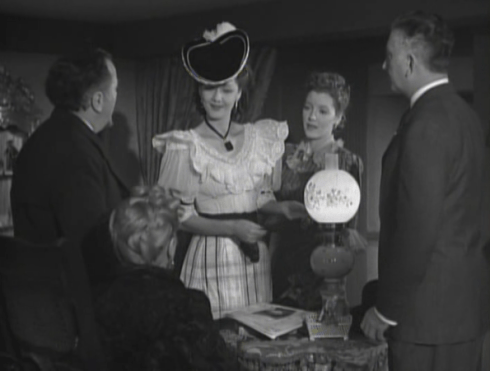
CapturFiles_40

sister Camille about the news, suddenly Marie Roget enters the house as lit up as a string of paper lanterns, acting as if nothing has happened. When they tell her that her disappearance has been a sensational news story and ask where she has been.

“The police found a body in the river that they thought was yours."

Cecile "Marie where in heaven's name have you been?" Camille just happens she's home, but Beauvais says she owes them an explanation. Gobelin tells her that she's had the whole city in an uproar. Cecile hands her the paper.

CapturFiles_43

CapturFiles_45

Marie remarks about the news headline and asks who Gobelin is- "What an awful picture of me"¦ Who is the little man?"

CapturFiles_45b

“Madamoiselle I happen to be the Prefect of Police" Marie "hhm how nice!"

CapturFiles_45c
Granny Cecile insists on knowing where she's been-"Oh Granny You too!"

Gobelin goes on that she doesn't understand he must make a full explanation to the public.
CapturFiles_1a

”Oh you must, well I'll explain to you. It is nobody's business where I go, what I do"¦ "
CapturFiles_3

Beauvais tells him to consider the case closed. Granny Cecile says "You heard him"¦ there's no more need for the police monsieur. "

CapturFiles_4

CapturFiles_6

As Gobelin leaves Grandmother Cecile’s leopard growls he is comically frightened and asks "What's that?"

"A leopard, what's the matter with you! (Granny Cecile barks at him) "¦. Haven't you ever seen a leopard before?"
Beauvais remarks "It's perfectly harmless I assure you."

Gobelin shaken mumbles to himself- "Yes, of course."

CapturFiles_7

Gobelin puffs on his cigar tell his clerk to file the case away, and Dupin comes in and tells him that the murderer did a thorough job. Gobelin says it's the most curious case, "A woman without a face." Dupin has different means of identification and he will not quit"¦

Gobelin also has a hunch that there's a definite connection between the mutilated body and the Roget case.

CapturFiles_9

CapturFiles_12
"Maybe it's too fantastic to mention but you yourself said that the claws of an animal could have done it!" Dupin answers "Yes but I said could of I didn't say did. What's on your mind?"Â  "The Old Lady old Madame Roget! now there's a queer customer. She's eccentric. She's a little bit twisted I think. She's got scads of money and yet she lives in an old-fashioned house in the Latin quarter. And listen to this. She's got a pet cat. (Dupin just sits quietly calmly listening to Gobelin as if he had lobsters crawling out of his ears- Gobelin leans in -) Only it's a leopard!" Dupin remarks quizzically- "A Leopard?"

CapturFiles_16
"A full-grown leopard" "That's very interesting Gobelin but it's a blind alley" "Well I"m not so sure…" Dupin tells him… " You can forget it!"
CapturFiles_18
Dupin walks out of his office"¦ Gobelin still trying to talk to him, "I can, well wait.." Dupin slams the door on him"¦

CapturFiles_22

Camille (Nell O'Day) is sitting in the parlor with Marcel Vigneaux (Edward NorrisThey Won't Forget 1937, The Man with Two Lives 1942, Decoy 1946 ) She's telling him that she wants Marie to be the first to know of their engagement. Marcel wants to elope and surprise everyone. "But I'd have to tell Marie Marcel I've never had any secrets from her" "Well does she tell you everything?"¦ Do you know where she's been for the past ten days?"

"No, but it's been the first time she hasn't. For that matter you haven't told me where you've been yourself for nearly two weeks" She pouts"¦

CapturFiles_23

Marie comes into the room, telling Camille that it's nearly 8 O' Clock and they're going to be late. Then she notices Marcel"¦ and acts happily surprised. Camille tells Marie that they are going to be married. She wishes them “all the happiness in the world," She says she will be late, then she turns and tells Camille that she forgot her purse. "Would you be an angel and get it for me" Marie walks Camille out thanks her touching her back gently then slams the door and turns around as if she were a python about to strike! "Our plans didn't include you marrying Camille!" "I don't intend to marry her. (the cad, the scoundrel) "Then why did you propose to her?"

CapturFiles_25

CapturFiles_28

CapturFiles_31

CapturFiles_32 now take it easy Marie don't let your temper spoil all our plans

“Now take it easy Marie don’t let your temper spoil all our plans!”

CapturFiles_33

Just then Grandmother Cecile walks down the stairs with a cane in each hand. The shadow on the wall could be a frame right out of a Val Lewton shadowplay film. She overhears the two arguing. Marie threatens to tell them everything. She doesn't care if anyone hears"¦

"You're not going to change my mind!" Marcel tells her "Don't be a fool Marie" "A fool is what I'm not going to be. I won't let you marry her. I'll tell her everything. That you promised to marry me.

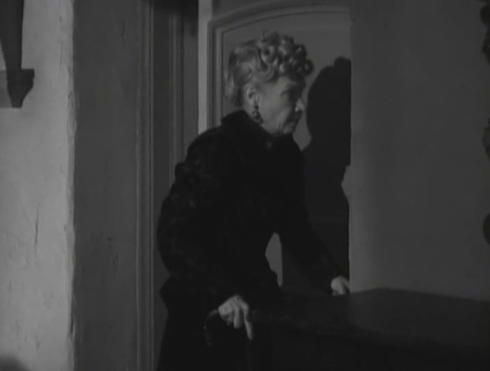
CapturFiles_37

CapturFiles_35

CapturFiles_38

CapturFiles_44

"Are you going to let petty jealousy ruin all our plans?" "Our plans did not include you marrying Camille. I won't let you. I won't!" " I have no intention of marrying her." "Then why did you propose to her?" the scene cuts to Cecile behind the door listening to the couple conspire. Marcel tells her "It should be very obvious to you. It's only to cover us. Who would possibly suspect me her fiance when she disappears tomorrow night can't you see!"Â 

CapturFiles_47

"Marcel, darling you're so clever! And I am stupid, you do love me don't you?" "Nothing can ever change that if you'll just believe in me." "Then we'll go through with our plans at the party. Once Camille is gone, we'll have everything." The two embrace. The scene cuts to Cecile who has now stumbled onto the nefarious plan to kill her other granddaughter.

CapturFiles_48

Marie's half-sister Camille’s fiancé, Marcel (Edward Norris), who is on the staff of the Navy is secretly having an affair with Marie. Marie is also toying around with a flirtation but the non-committal relationship with M. Henri Beauvais (John Litel), Marcel's boss. Maria Ouspenskaya as the wonderfully crafty Cecile the grandmother overhears Marie's plan to kill Camille before she turns the age of 21. And so she hires Dupin the grave-robbing, brain-extracting forensic scientist hero to keep a close eye on Camille when she goes to Marie's welcome home party.

CapturFiles_1

Gobelin goes to Dupin's lab where he has determined that the dead girl is English. "You see we are what we eat" They can consult with Scotland Yard"¦.

He also decides that Gobelin might be right that there is a connection between the dead girl and the Roget case. He decides to work on the case unofficially even if the case has been closed. He's working on a few angles. Dupin asked Gobelin to arrange for him to meet Marie Roget. Since there's a party given in her honor that night he will go. Then a gendarme brings a message for Dupin.

"My dear Dr Dupin it is imperative that you see me immediately. Do not waste time it is a matter of the utmost importance. You'll come alone and at once”–Signed Madame Cecile Roget"¦"

CapturFiles_2

CapturFiles_5

CapturFiles_11

Dupin and Gobelin arrive at Mme. Cecile’s home-Elwood Bredell’s photography creates street scenes that are set up like wonderful postcards.

“Exactly what is her relationship to Marie?" "The grandmother," Dupin asks him to come along, and jokes that Gobelin is afraid of the pet cat"¦ "I'm very fond of animals really, but it's not so little really."

CapturFiles_13

Madame Cecile tells Dupin that she made it clear she wanted to see him alone. He apologizes but Gobelin is his most trusted friend.

"Trusted friend my foot there's no such animal" She wanted to avoid policemen. She invites them to sit down. There is something she wants him to do. Then she barks at Gobelin. "Well why don't you sit down" It's hilarious how she bullies the poor Prefect as if he were a little boy being scolded.

CapturFiles_14

“And it's worth fifty thousand francs"Â  "Well that's quite a sum of money Madame," Gobelin says. She replies, "You keep out of this!"

CapturFiles_17

"I don't believe I'd be interested in that sort of money Madame" but she tells him that's all anyone is interested in"¦ money. She will give Dupin fifty thousand francs to escort her granddaughter Camille to Madame De Luc’s party given for Marie that night.

When Dupin asks why she is having her granddaughter escorted in such a curious manner Mme Cecile tells him "I happened to know that she is going to be murdered tonight!"¦ And I want you to prevent it" Gobelin says "Madame"¦ do you know what you're saying?" "Of course I know you fool and I don't want any police notoriety about it!"¦ Do you hear?"

CapturFiles_19

Dupin asks. "Why did you select me, Madame?" "For your work on the Murders of the Rue Morgue"¦ my memory's even sharper than my ears" "Your ears then you heard something?" Gobelin asks. "That's none of your business. I am speaking to Dr Dupin as a private individual and not as a member of your fine police department" She says sarcastically.

CapturFiles_26

CapturFiles_29

"Madame"¦ I have the honor of being the Prefect of Police!

CapturFiles_30
"Go have yourself stuffed!" Cecile says with audacity!

Gobelin asks how she knows Camille is to be murdered tonight.
" let me remind you that this is no concern of yours," Dupin tells her. "In that case madame I'm afraid I can't do as you ask." "You're not fooling me. Do you want to know what she is to be murdered? She comes into her grandfather's fortune tomorrow"¦ it's better than a million and a half francs. Now do you see?" Gobelin ires her once again by asking who benefits from her death. She reprimands him once again, "Don't ask me fool questions." Gobelin finds it hard to believe that if Cecile suspects Camille to be murdered at Madame De Luc’s party why she'd let her go?

"Who cares what you believe? That's why you're nothing more than a gendarme" He looks offended again. His facial expressions of stupefied are very effective in the midst of the serious suspense melodrama. He rises to defend himself.

Dupin understands Cecile's logic. That if an attempt on Camille's life the party would be the logical time to try and catch the killer before they try it again …

CapturFiles_31

CapturFiles_35 CapturFiles_33

Dupin asks. "I trust you don't allow your little pet to roam the streets at night Madame?" "Certainly not, she's never out of  my sight"

Gobelin comments that those claws are dangerous. Cecile acts curious as to what he is talking about but changes the subject and asks Dupin, why he's not interested in earning fifty thousand francs. But then…

CapturFiles_38

CapturFiles_37

Camille comes into the room. Granny Cecile introduces her to Dr. Dupin. “You were saying, Dupin?" "I was saying Madame that it would be indeed a pleasure" after he sees the beautiful Camille"¦

CapturFiles_39

Madame De Luc (Norma Drury Boleslavsky-Stage Door 1937, That Hamilton Woman 1941) is furious about having to give a party for"”"Making me the talk of all my friends"¦ giving a party for that notorious creature, bringing her into her own home!" "But it's business my new show's a big hit thanks to her"¦ She's sensational, every man in Paris is interested in her."Â  Madame De Luc "That's just what I'm afraid of…"

CapturFiles_2

Beauvais meets Marie out on the terrace, longing for her attentions he jokes that he could send Marcel to Indochina for a year. "He's nothing to me, it's Camille he's going to marry"¦ they can have a honeymoon in China for all of me."

CapturFiles_3

CapturFiles_7

"Whom do you think you're fooling"¦ You know you once gave me to understanding"¦ " she interrupts him"¦ "Oh you take everything so seriously" "And you never do" "I could make you very happy I could give you everything"¦ won't you reconsider?" She laughs at him"¦ "Henri you're a dear and I love you but let's go in before you overwhelm me."

CapturFiles_8

CapturFiles_10
Inside Camille shows up with Gobelin and Dupin. Marie reprimands her "Camille what kept you?" The host Madame De Luc introduces Dupin to Marie Roget and Beauvais whom he met at the Prefect's office earlier.

Then Marcel walks in and apologizes to Camille for being late. Marie says "Have you met the famous Dr. Dupin?" Montez looks exquisite in her Vera West gown and beautiful jewelry. Marcel compliments Dupin on his success with the murders in the Rue Morgue. Marie shoots a knowing look at Marcel. Then Marcel asks Marie to dance, and Dupin asks Camille. A waltz is playing.

CapturFiles_12

CapturFiles_13

CapturFiles_14

CapturFiles_18
"What are the police doing here" "I wish I knew" "We can't go on with our plans it's too dangerous" "We'll never get a better chance than this" "We'll go through with our plans despite this"

Dupin is dancing with Camille there is an obvious chemistry between the two"¦

CapturFiles_20

CapturFiles_21
CapturFiles_23
Once they stop waltzing, Marcel takes Camille to get a drink and Marie asks Dupin out onto the terrace. "You know there's something very mysterious about you. Very becoming too."

CapturFiles_24
"Every woman is mysterious until the man marries her," " It isn't just any woman who creates a sensation just when she disappears and returns mysteriously as you did" "Is that an official inquiry monsieur?" "Oh no I didn't mean it that way." Marie gets angry and turns away from him"¦ "Please I don't wish to discuss it any further."

"She we drink to a mutual understanding and a lasting friendship?" he raises his glass.

CapturFiles_28

CapturFiles_29

CapturFiles_30

CapturFiles_31

Marie is asked to sing one of her new songs.

As she is escorted off the terrace a phantom hand reaches up and puts something into both glasses, while Dupin has his back turned. But Gobelin rushes out to ask him about his impression of her. He tells him it's too early to classify her yet. Then he notices that both glasses have been taken away by the same mysterious hand. Dupin asks where Camille is"¦

CapturFiles_33

" There she is. I told you nothing would happen to her. That old lady was talking a lot of nonsense, you know she oughta to be in an asylum where she belongs, I mean it."

CapturFiles_34

CapturFiles_37

CapturFiles_38
The orchestra begins to play"¦ Marie is ready to entertain the party"¦ She begins singing (overdubbed by Dorothy Triden singing ‘Mama Dit Moi’ written by Everett Carter and Milton Rosen).
CapturFiles_39

CapturFiles_40

CapturFiles_42

CapturFiles_43

CapturFiles_45

CapturFiles_47

CapturFiles_50
Marcel is worried that the old lady found out, he's concerned about Dupin being there as Camille's bodyguard. Marie thinks it's impossible that the old lady had found out about their plans "Oh you're just making a mountain out of a molehill, why don't you just say you don't want to go through with it" "Oh don't be silly" "It would only take a few minutes after you get her out here"¦ delivery is so near, it could look like an accident" "Yes, maybe the police being here is just what we need, we'll do it under their very noses" "You know Marie, sometimes you're very clever."
CapturFiles_51

CapturFiles_53

A strange set of gripping hands grab Marie’s neck.. she screams.

CapturFiles_54

CapturFiles_55CapturFiles_56

CapturFiles_57

CapturFiles_59
Dupin is out on the balcony when Gobelin tells him that it's nearly midnight and they should be taking Camille home. First Dupin wants to smoke a cigar and offers him one"¦ Marie smiles and begins to walk toward Dupin when a pair of hands reach out of the brush and pulls her in"¦ she screams.

Dupin and Gobelin react instantly! He runs into the house, and sees that Camille is perfectly safe talking with Madame De Luc -Gobelin tells Dupin that the scream came from the garden and points in that direction. It’s a fabulous noir shot. Dupin discovers Marie Roget's purse. Gobelin goes back into the house looking for Marie and meets Madame De Luc. who tells him that she went into the garden the last time she saw her. "She's a sort of an illusive sort the men tell me."

CapturFiles_60

CapturFiles_61

CapturFiles_62

CapturFiles_63

Dupin continues to search the garden and finds Marie's scarf"¦

CapturFiles_65a copy

CapturFiles_67

Beauvais wants to take charge of the body. But Dupin hasn't finished his examination.

CapturFiles_69

A couple in the street are reading the headlines"¦ "Marie Roget is missing for the second time" "What do you suppose she's up to" "That my lady is what the police would like to know"

Another body is fished out of the Seine. Gobelin exclaims "My goodness Dupin this one doesn't have a face either!"

CapturFiles_70

CapturFiles_71

CapturFiles_72

CapturFiles_73

CapturFiles_73a
CapturFiles_76

CapturFiles_78

CapturFiles_79

CapturFiles_81

In a twist, Marie not Camille once again disappears during the party and is found as the other body had been, floating in the Seine with her face mutilated. By modern standards of criminal psychology, I would say it was not only a case of personal, overkill, it has everything to do with obliterating her identity as a way of demeaning her beauty. But for this 1942 film’s purpose, her face was smashed to a pulp… And I’m not spilling the beans about why.

Mme. Ouspenskaya who has the pet leopard in the film had said that she loved all animals. They could see she was not afraid of the big cat. Though she appeared so vulnerable in her wheelchair, it was the rest of the crew who always looked worried.

The wonderful music is composed by Hans J. Salter and the spectacularly mesmerizing allure of Montez adds another layer of flamboyant mystique as she flits around in Vera West gowns"¦!

maria-montez-04

The film is just around an hour long, and the sensual Montez is brought in to give her a desirable appearance, though it may not count as a leading role, her presence adds the right seductiveness to the plot.

What we do come to learn is that Marie is considered a wicked woman. Dupin (Knowles) uncovers and becomes the judge of her character. As a forensic scientist, he ghoulishly extracts her brain in the morgue to study it at lengths, which invokes the profane ideals of Frankenstein 1931. He announces that the lady had a twisted criminal mind… Dupin has no desire to resurrect the dead woman as did Henry Frankenstein, he merely aspires to understand the workings of the criminal brain. But it’s still a creepy passion…

Whatever the truth, The Mystery of Marie Roget is an easy surrender to an hour, a nifty little programmer that uses Maria Montez's aloof sensuality perfectly in the role of the missing/found/missing/murdered girl.

It would have been my wish to have had time to do a companion post to this one in tribute to the Hispanic Heritage Month Blogathon… by paying tribute to yet another sensually volcanic actress Lupe Vélez who terrorized poor Virginia Bruce in the ‘B’ chiller Kongo 1932!

kongo1932

maria-montez-06

It’s no mystery gang, I’ll always be your everlovin’ MonsterGirl

Halloween treats with no tricks!: Obscure 40s Horror!

tumblr_mcfs3lwYIO1qko4x4o1_500

Frenzy aka Latin Quarter (1945)

frenzy_1945_poster_01

Derrick DeMarney as Charles Garrie & Joan Greenwood as Christine, a Ballet dancer/artist’s Model star in this rare ghost story about a Bluebeard-type mad sculptor Manetti (Beresford Egan whose hair style & beard is frightening enough!), and his beautiful wife Christine who haunts her lover Charles in order to get at the truth! Very atmospheric and creepy obscure horror, including a séance!… thanks to director Vernon Sewell (Black Widow 1951 Ghost Ship 1952)

The Seance

films-1945-latin-quarter

House of Darkness (1948)

A very young Laurence Harvey is the greedy and twisted pianist Francis Merryman who wants the family inheritance and the house all to himself! When he murders the violinist’s father John Merryman (Alexander Archdale) it seems to place a curse on the house in particular over Francis who descends into madness! The film also co-stars Leslie Brook. Directed by Oswald Mitchell of the Old Mother Riley series. Very nice touches that make this a pleasing little dark tale of greed and things that go bump in the night!

CapturFiles

CapturFiles_1

CapturFiles_3
The ghost of John comes back as a shadow on the wall, his accompanying Francis on Violin! Well done, Spooky stuff!

The Vampire's Ghost 1945

The Vampire's Ghost poster

“Slave of the bloodlust!”

Director Lesley Selander (The Fatal Witness 1945, Catman of Paris 1945) In a small village near an African port, John Abbott plays a 400-year Vampire Webb Fallon who runs a seedy bar and scares the hell out of the surrounding villagers. This is a very well-paced and viable contribution to the vampire archetype. Charles Gordon is Roy Hendrick who falls under his control… the film also co-stars Peggy Stewart and Adele Mara as Lisa.

giphy-1

Catman of Paris 1946

catman_of_paris_poster_02

Another taut and well-done tale of horror/suspense directed by Lesley Selander. There’s a vicious killer stalking Paris in 1896. Is he insane or can it truly be a supernatural cat that turns into a man with fangs and claws?

Meow!!!! Lenore Aubert (Abbott & Costello Meet Frankenstein 1948) plays the incredibly beautiful Marie Audet in love with writer Charles Regnier (Carl Esmond) who has just returned from his trip where he might have picked up something supernatural along the way… When the Ministry of Justice bans his book and winds up shredded to death, Inspector Severen (Gerald Mohr) and Fritz Field playing the Prefect of Police turn to Regnier as their lead suspect!

Prod DB © Republic Pictures / DR THE CATMAN OF PARIS de Lesley Selander 1946 USA avec Adele Mara et Carl Esmond monstre, ogre, ombre, fantastique, ambiance, griffes code BW
Prod DB © Republic Pictures / THE CATMAN OF PARIS directed by Lesley Selander 1946 USA.

tumblr_nbp3fdwTb71sp74ayo1_400

Hope we’re scaring up some good treats for you this Halloween season!

Your EverLovin’ MonsterGirl


THE BEACH PARTY BLOGATHON- CREATURE FROM THE BLACK LAGOON (1954) & Night Tide (1961) : Gills-A LOVE STORY!!!

THE BEACH PARTY BLOGATHON hosted by the fabulous Speakeasy & Silver Screenings

CapturFiles 2

CREATURE FROM THE BLACK LAGOON (1954) directed by Jack Arnold

the_creature_from_the_black_lagoon_wallpaper_jxhy

There have been sympathetic monsters that elicit our understanding, who cause you to care about them and their ordeal whether they’re the focus of a rampaging mob of villagers with flaming torches and pick axes or scientists armed with spear guns at the ready as surrogate penises –okay maybe I didn’t think about that surrogate penis thing when I was 9, but I see it so clearly now!

Back in the day of the musty cool matinee theatre’s air smelling of buttered popcorn and old leather shoes, you could slink down in your good ‘n plenty and Milk Dud encrusted red velvet seat and wish that the monster would not only get away… but that just maybe he’d get the girl– instead of the self righteous hyper-science macho hero who objectifies everything! After all, the creature is not the one invading their territory, he’s prevailed in that environment for ions, before these macho nerds came along!

As a little monstergirl, I used to think, and still do… just leave the ‘Gill Man’ alone!

We can sympathize with monsters, like Victor Frankenstein’s creation, due in large part to Karloff’s complex and poignant interpretation of the monster, & The Gill Man from Creature From the Black Lagoon. We can find our involvement (at least I can), as one viewed with empathy toward the monster’s predicament. Embedded in the narrative is a simultaneous pathos that permits these monsters to express human desires, and then make sure that those desires are thwarted, frustrated, and ultimately destroyed.

The Creature from the Black Lagoon embodies the seductive mystery of the unknown, a restless ripple in the waters from the murky depths of classic horror, a synthesis of primal fear and awe,  of human and waterborne beast, blending horror, adventure, and myth into one unforgettable creature feature.
The Gill-Man stands as a potent symbol of nature’s raw, untamable force, and the era’s fascination with scientific discovery teetering on the edge of hubris. Whether it intended to do so or not, The Creature from the Black Lagoon isn’t shy about exploring themes of colonial arrogance and the ruthless plundering of indigenous lands, as well as colonial extractivism. The film touches on the harsh reality of greed, the tragic cost of intrusion, the taking, destroying, and plundering of Indigenous lands and their resources.
What really stays with me about Gill-Man is what a sympathetic hero he is, how he captures the tragic cost of human arrogance; he’s an innocent force of nature caught in the unsettling squeeze between man’s devouring hunger and the tightening grip of primal threat, making him less a monster to be feared and more a silent victim of a world that refuses to understand him.
Unlike typical ’50s monsters who are villains by design, he feels like a displaced guardian, more victim than villain, struggling to survive against relentless exploitation. His haunting presence resonates as a poignant reminder of what is lost when curiosity crosses into invasion, making it less a creature to be feared and more a symbol of nature’s misunderstood and mistreated majesty.
Behind this iconic figure lies a lesser-known story: Milicent Patrick, a brilliant artist whose visionary design shaped the Creature’s unforgettable silhouette but whose name was largely erased from the credits. The Gill-man drifts between worlds—horror, myth, and adventure—beckoning us into those shadowy waters where curiosity, fear, and Julie Adams, and us, swim side by side. Milicent Patrick, a pioneering artist and makeup designer who created the iconic Gill-Man design for The Creature from the Black Lagoon. Unfortunately, her groundbreaking work went largely uncredited at the time, overshadowed by Bud Westmore, her jealous supervisor, who took credit and effectively ended her Hollywood career. Her story has only recently been reclaimed and celebrated as an important chapter in horror film history

photo 4

CapturFiles_9
Richard Carlson, Julie Adams, Richard Denning, and Whit Bissell as Dr. Edward Thompson study the fossil of an amphibious man found near the Amazon.
photo 3
The crew catches something in their net… and whatever it was… has ripped a giant Gill Man size hole in it leaving behind a claw!

“He who fights with monsters might take care lest he thereby become a monster. Is not life a hundred times too short for us to bore ourselves?” -Friedrich Nietzsche

CapturFiles

CapturFiles_9

CapturFiles_8

CapturFiles_12
Mr. ‘It’s mine all mine” and Kay and Mr. “But think of the contribution to science!” looking at the poor trapped Gill Man-a lonely prisoner of scientific hubris and egocentric men.
CapturFiles_7
The creature trapped in a bamboo cage… floats, quietly thinking deep thoughts–while the three look on, pondering what to do with him..

“The Outsider Narrative” can be seen so clearly in Jack Arnold’s horror/sci-fi hybrid, Creature From The Black Lagoon. Film monsters like The Gill Man form vivid memories for us, as they become icons laying the groundwork for the classic experience of good horror, sci-fi, and fantasy with memorable storytelling and anti-heroes that we ‘outliers’ grew to identify with and feel a fondness for.

As David Skal points out in The Monster Show, he poses that films like Creature From the Black Lagoon …are the “most vivid formative memories of a large section of the {American} population…{…} and that for so many of these narratives they seem to function as “mass cultural rituals.”

creature-from-the-black-lagoon

Creature From The Black Lagoon is quite a perfect film, as it works on so many different levels of examining human nature and nature as human.

CapturFiles_17

When belligerent scientists and their relentless pursuit of expanding control over the natural world invade a unique creature’s habitat, forcing their domination of him, naturally, he’s compelled to fight back.

In the midst of this evolves a sort of skewed Romeo and Juliet. The Gill Man never intends to threaten Julie Adam’s character Kay Lawrence, he seemingly wants to make her his love object and maybe just maybe (idealizing of course while I imbue the ‘creature’ with a higher consciousness) the Gill Man seeks to free Kay from the dangerous men she is surrounded by. An amphibious knight in scaly armor, a rugged green scaly Adonis with limpid eyes and full lips.

The arrival of the expedition creates chaos and swampy mayhem due to the intrusion of the two opportunistic men who tote phallic harpoons around and fight with each other over questions of ethics, how to conduct scientific research, and naturally who will conquer Kay– acting like spoiled children-the both. Only the Gill Man sees her beauty from a place of primal hunger and desires her above all else, perhaps with an innate sense of possessing her, but without all the cocky male posturing.

creature-from-the-black_lagoon_2

Creature-Black-Lagoon-Adams-Gill-Man
THE LOVABLE HUGGABLE GILL MAN!! 
“I promise to keep my claws trimmed and never come to bed with cold, clammy feet!”

“Yes, yes,” said the Beast, “my heart is good, but still I am a monster.” –Among mankind,” says Beauty, “there are many that deserve that name more than you, and I prefer you, just as you are, to those, who, under a human form, hide a treacherous, corrupt, and ungrateful heart.”
“• Jeanne-Marie Leprince de Beaumont

CapturFiles_14

CapturFiles_15

CapturFiles_8

CapturFiles_16

“What freedom men and women could have, were they not constantly tricked and trapped and enslaved and tortured by their sexuality! The only drawback in that freedom is that without it one would not be a human. One would be a monster.”
“• John Steinbeck, East of Eden

“When is a monster not a monster? Oh, when you love it.”
“• Caitlyn Siehl, Literary Sexts: A Collection of Short & Sexy Love Poems

In trying to capture the amphibian man he is driven out of his home in the mysterious upper Amazon by these otherizing anthropologists. And so the Gill Man–being shot at by spears and besieged by sweaty men in bourgeois khakis and unfashionable swim trunks blech! –must defend his realm.

He who is just lazing around, dreaming through the sun’s rays which sparkle upon the surface of the water amongst the little fishes and coral… bothering no one. Suddenly surrounded by intruders with weapons and nets, poison, and cages.

But wait, one of them is leggy and soft and looks divine in her one-piece bathing suit designed by Rosemary Odell... (Brute Force 1947, It Came from Outer Space 1953, This Island Earth 1955, To Kill a Mockingbird 1962) and what a pair of eyes!

CapturFiles_10
The Gill Man goes on a mission to get the girl, and so endures his attackers because he has fallen for the simple beauty of Kay Lawrence (Julie Adams).

Though his world has become disordered, the presence of the beautiful Kay Lawrence (Julie Adams) has awakened his sexual desire.

The film stars Richard Carlson as David Reed and Richard Denning as Mark Williams. The two men invade The Gill Man’s quiet life and argue about what should be done with the subject of their research findings, to exploit, study, or bring back to the states to gain notoriety and get paid lots of clams! without an ethical thought in their curly scientific brains, forcing themselves on the creature and making him an object of entrapment & exhibition.

CapturFiles_6
“I think I love you, so what am I so afraid of? I’m afraid that I’m not sure of a love there is no cure for I think I love you isn’t that what life is made of? Though it worries me to say that I’ve never felt this way”— Insert music from The Partridge Family –
CapturFiles_7
“There’s just something about an Aqua Velva Gill Man!”

The Gill Man watches from below the surface, as Kay Lawrence casually smokes a cigarette, taking long sensual puffs and throwing the butts upon the lagoon like trinkets for him to worship. He feels compelled to reach out to her, but decides to be a voyeur for a bit longer.

Later the Gill Man sees Kay on the beach, the camera catches a notable deep sigh when he lays those deep green eyes on her. He moves closer. She lets out the obligatory monster movie scream queen shriek, that siren squeal, you know the kind, with the carefully place hands cupping her face in shock.

One of the men from the expedition takes a machete and tries to attack the creature, but he is killed for his efforts. Dave and Mark hear Kay scream and approach just in time for the knock-out powder they’ve placed in the lagoon to finally take effect and subdue the creature, who is now out cold. He falls flat on his green-gilled face down in the sand.

CapturFiles_18

CapturFiles_19

CapturFiles_17

CapturFiles_21

CapturFiles_20
Kay passes out. The Gill Man places her down gently on the sand...
CapturFiles_11
Mark (Richard Denning) can’t wait to beat the fish guts out of the creature!

CapturFiles_12

CapturFiles_13
David (Carlson) has to intervene before Mark (Denning) bashes the creature’s head in “Stop, you’ll kill him!…”

CapturFiles_16

Once Williams (Denning) sees that the Gill Man has fallen down, he says, “Got him!” then begins brutally smashing at him with his rifle, until David (Carlson) tells him to stop before he kills him. They throw a net over the unconscious creature. The scene shows the level of ferocity that man is capable of, and with this violent overkill, we, on the other side of the evolutionary scale, become monsters as well. It is a not-so-subtle contrast with the main character, who is considered the ‘creature.’

Ricou Browning portrayed the creature in the underwater scenes, and Ben Chapman played the creature on land. There’s wonderfully engaging cinematography by William E. Snyder. (Flying Leathernecks 1951, Beyond a Reasonable Doubt 1956)

The Gill Man has dwelt in the warm existential depths of the water, the lagoon, his endless cycle of existence, thriving until he is invaded by scientific hubris. While in the lagoon, he is connected to the creator of his world, remaining bound to a body of water that is symbolic of the eternal maternal womb. He is then forced out of his quiet, habitual life, where he becomes otherized. With an ‘Outsider’ narrative, the familiar then becomes monstrous.

Our perceptions are focused on how this creature’ shatters the mold of normalcy. He transforms the ordinary world into something provocative and forces the outside world to define him, once again, as with Frankenstein’s monster, he is perceived as a thing… a creature.

creature-from-the-black-lagoon

A film like Creature from the Black Lagoon can suggest to us the recognition of our notions of conventional sexuality and gender as well. The Gill Man is similar to a frog, yet walks upright and has the stance of a man, and possesses that archetypal ogling that shows he has sexual designs on our heroine, Kay.

creature3
Kay Lawrence: “And I thought the Mississippi was something.”

While he is placed in a role that sees Kay as the “˜object’ of his affection, he’s sort of an androgynous amphibian, and yet he suggests that  “alternatives can exist which may be more desirable”-Mark Jancovich Rational Fears American Horror in the 1950s. Jancovich goes on to say that the film is “unremittingly sexual” The film has sexual symbolism throughout, as the outside world intrudes on an ambiguous sexual being living in the womb of the water, now unleashed as a sexual peril to women. The water scenes between the water ballet swimming Kay unaware that the creature is also swimming very near to her–are absolutely visual foreplay.

CapturFiles_10

Sweaty men baring their chests, wielding shotguns and Phallic harpoons as much as possible.

CapturFiles_5
Need I say more???

The most significant scene of the film is when The Gill Man swims a slight distance away from Kay, under the murky lagoon while Kay unaware, simultaneously moves through the water embracing its import with pleasure and liberation. She whirls above him, barely hinting at an erotic intimacy between the two.

Under the water the creature is not a threat to Kay, he’s almost shy, as he barely touches her leg, he swims away as if he’s conflicted with uncertainty about this new experience. William E Snyder is responsible for the striking underwater footage, that creates an erotic spacial world of shimmering light.

It’s almost a type of Eden, that those pesky aggressive scientific males spoil…

200-25

200-27

We know that the creature shows a fascination toward Kay, but she sort of shares a kind of bond with him, as both are threatened by the domination of the two male scientists Mark and David. She tells the men to leave the creature alone, that it won’t bother them. Mark wants to capture the creature as proof of his discovery, rather than just study him in his own habitat. Mark also wants to possess Kay, both of them are treated as ‘objects’. There are several scenes where Kay and the creature stare at each other as if they see something in common within themselves. Harry Essex wrote the screenplay, but hated the script at first so he added the Beauty and the Beast theme, to give the creature more of a sense of humanity.

photo 2

CapturFiles_1

CapturFiles_4

CapturFiles_1

CapturFiles_2

CapturFiles_5

CapturFiles_3

CapturFiles_4

The Creature from the Black Lagoon is relentlessly sexual. Inhabited by mostly male characters, scientists have traveled to the deep Amazon in search of undiscovered animal life. What they find instead of more fossils is the Gill Man who refuses to give up his freedom. And why shouldn’t the creature react violently to their intrusion into his quiet domain? What’s more interesting is how he quickly becomes attracted to the gorgeous Julie Adams and her gutsy character Kay, the only female on the expedition who once again looks smashing in a one-piece white bathing suit and swims like she’s in the water follies. Jancovich quotes Biskind from his Seeing is Believing – claiming that the creature is “driven into a frenzy by the proximity of Julie Adams in a one-piece bathing suit.” That sounds about right to me!

The Gill-Man evokes our sympathy who has become an object’ to be controlled, dominated and assaulted by the outside world. It’s the ‘men doing science’ who become the “˜aliens’ the bad guys, the human monsters, and the creature another existential anti-hero who we identify with. It’s just a different slant on the theme of unrequited love in the lagoon…

Creature-From-The-Black-Lagoon-1

Continue reading “THE BEACH PARTY BLOGATHON- CREATURE FROM THE BLACK LAGOON (1954) & Night Tide (1961) : Gills-A LOVE STORY!!!”

Dark Patroons & Hat Box Killers: 2015 The Great Villain Blogathon!

Banner

IT’S HERE AGAIN… THAT TINGLING ON THE BACK OF YOUR NECK BECAUSE THERE’S FOUL DEEDS AND MURDEROUS MACHINATIONS AFOOT…HOSTED BY SPEAKEASYSHADOWS & SATIN… AND SILVER SCREENINGS… THE GREAT VILLAIN BLOGATHON OF 2015!

tumblr_mkl34waubl1qgk6gio1_500

“Sometimes human places, create inhuman monsters.”
“• Stephen King, The Shining

“What would an ocean be without a monster lurking in the dark? It would be like sleep without dreams.”
“• Werner Herzog

“Monsters cannot be announced. One cannot say: ‘Here are our monsters,’ without immediately turning the monsters into pets.”
“• Jacques Derrida

DRAGONWYCK  (1946)

Vincent Price – “I don’t play monsters. I play men besieged by fate and out for revenge…”

vincent price
Vincent Price is perhaps one of THE sexiest men in the film. Eventually, typecast, albeit an icon of the horror film industry… enough of us are aware of his range of talent and his sophisticated manner. If I were to have met him, I would have swooned… and that’s not a lie. He possessed a unique sensuality both tragic and dynamic that just drew you in.

Price could always play ONE of the most cultivated, enigmatic, and beguiling villains at any time…

Dragonwyck
-Secret thoughts… That led to secret love… That led to rapture and terror!-

Gene Tierney as Miranda Wells:Nicholas – you do believe in God?”

Vincent Price as Nicholas Van Ryn: “I believe in myself, and I am answerable to myself! I will not live according to printed mottoes like the directions on a medicine bottle!”

The chemistry between Price and Tierney is authentic and captivating. When Miranda Wells feels humiliated by the gaggle of high-class snobbish debutantes because she’s from the wrong end of the river, not from the Hudson but the Connecticut River bottom, Nicholas tells her she’s better than all of them and asks her to dance. He seems so gentle and human, but he has a dark and villainous side!

CapturFiles_52 You couldn't help yourself any more than I
“You couldn’t help yourself any more than I” – Nicholas.

CapturFiles_39

CapturFiles_40 what makes you think you're so much better than I am
“What makes you think you’re so much better than I am!”

DRAGONWYCK 1946 was Vincent Price’s 18th film. He had previously appeared in The House of the Seven Gables 1940 as Shelby Carpenter opposite Gene Tierney in Laura 1944 and Leave Her to Heaven 1945, right after he appeared as the cold-blooded Dr. Richard Cross in Shock 1946.

Produced by Ernst Lubitsch uncredited and overseen by one of my favs– Writer/Director Joseph L Mankiewicz. This Gothic & dark romance is based on the novel by Anya Seton, with cinematography by Arthur C. Miller (The Ox Bow Incident 1943, The Razor’s Edge 1946, Whirlpool 1949, The Prowler 1951), Art Direction by Lyle Wheeler and Russell Spencer, Set Direction by the great Thomas Little. The lighting alone is a mixture of noir chiaroscuro and offers dramatic shadings of the best classical elements of horror. The narrative speaks of familial secrets and twisted vengefulness, not unlike Lewis Allen’s spooky debut masterpiece, The Uninvited 1944.

CapturFiles_84

CapturFiles_33

Added to the moodiness is the eerily haunting score by Alfred Newman with Orchestral arrangements by Edward B Powell. Edited by the keen eyes of Dorothy Spencer (Stagecoach 1939, The House Across the Bay 1940, Lifeboat 1944, The Ghost and Mrs.Muir, The Snake Pit 1948).

Costumes by Rene Hubert and Makeup by Ben Nye. The film bears shades of  Hitchcock/de Maurier’s Rebecca 1940 and Robert Stevenson’s/Charlotte Brontë Jane Eyre 1943. Even a bit of de Maurier’s tautly suspenseful My Cousin Rachel 1952 directed by Henry Koster and starring Olivia de Havilland and Richard Burton. The book is a hell of a good read if you enjoy Gothic melodrama.

Gene Tierney and Vincent Price reunite after having appeared in Otto Preminger’s memorable film noir masterpiece, Laura, in 1944.

Annex - Tierney, Gene (Laura)_05
Otto Preminger brings together these two fine actors in his noir masterpiece Laura 1944.

Here-Gene Tierney plays Miranda Wells, and Walter Huston is her devoutly Christian working-class father-Ephram Wells.

CapturFiles_5 reading from the bible
Walter Huston as Ephram Wells reading from his bible to Miranda.
CapturFiles_6 I thought so it's got spirits in it. A little bit. Even a little bit of evil cannot be good Mirdanda
Miranda takes a drink of wine. Her father reproaches her-“I thought so, it’s got spirits in it. A little bit. Even a little bit of evil cannot be good Miranda”– Her stifling life with her religious father pushes her further into the arms of Nicholas Van Ryn.

This scene foreshadows the dangerous path Miranda is willing to wander through, as she starts to break free of her puritanical upbringing and reach for a life of being a free spirit. Believing that Nicholas represents that freedom. But there is a hint of evil that her father can sense.

Vincent Price once again manifests a passionate yet conflicted antagonist Nicholas Van Ryn with a magnetism you cannot escape, yet you may despise his cruelty and his self-indulgent murderous arrogance.

CapturFiles_52 I must not feel like my life is finished as long as you are with me
“I must not feel like my life is finished as long as you are with me”-Nicholas
CapturFiles_41 You must never be afraid when you're with me Miranda
“You must never be afraid when you’re with me, Miranda.”

CapturFiles_58

Glenn Langan is the handsome yet vanilla Dr Jeff Turner, Anne Revere adds a depth of nurture as Abigail Wells-Miranda’s mother who is weary of her daughter’s intentions to marry such a powerful man.

CapturFiles_56

Spring Byington is one of the maids-Magda. Connie Marshall is the young melancholy Katrina Van Ryn, Henry Morgan is Bleeker one of the farmers who challenges Van Ryn and fights back against the antiquated laws.

Vivienne Osborne plays wife Johanna Van Ryn. Jessica Tandy gives a marvelous performance as Miranda’s maid the feisty Peggy O’Malley. Trudy Marshall is Elizabeth Van Borden. Reinhold Schunzel is Count de Grenier, Jane Nigh is Tabitha. Ruth Ford is Cornelia Van Borden, David Ballard is Obadiah. Scott Elliot is Tom Wells and Boyd Irwin is Tompkins.

DRAGONWYCK 1946 is a Gothic suspense melodrama in the grand classical style. It even brushes against the edges of the classic horror film, not only because of the way it’s filmed, but there are certain disturbing elements to the story. The shadows and darkness that are part of the psychological climate work are almost reminiscent of a Val Lewton piece. There’s even a pale reference to that of a ghost story that is concealed, or I should say unrevealed, with the first Mrs.Van Ryn’s spirit playing the harpsichord, and the eerie phantom chords that add to the mystery and gloom that hang over the manor house.

CapturFiles_48 I don't like it now The singing's getting louder now, I'm afraid I'm afraid
Katrine-“I don’t like it now. The singing’s getting louder now, I’m afraid, I’m afraid.”

Ghostly Dragonwyck

With swells of atmospheric tension and darkly embroidered romance, there are just the right tinges of shadows and danger. This lush and fervent tale combines tragic Gothic romantic melodrama with the legitimate themes of social class struggle wrapped within dark secrets and suspense.

As always, Price conveys tragic pathos even as the story’s villain. He is a man who manifests layers upon layers of feeling: brooding, charming, sensual, intellectual, menacing, passionate, conflicted, self-loathing, and egomaniacal all at once.

One of my favorite roles will always be his embodiment of Corman/Poe’s Roderick Usher in House of Usher 1960.

Vincent Price in House of Usher, 1960.

CapturFiles_10

CapturFiles_11

The film also offers us the sublime acting skill and divine beauty of Gene Tierney as the heroine or damsel in peril, a simple farm girl living near Greenwich, Connecticut. She dreams of the finer things in life, swept up by the allure of a fairy tale existence, only to find out that her dream has become a nightmare.

CapturFiles_1 copy

Once Miranda receives a letter inviting her to come and visit Dragonwyck, she is perhaps at once young and naive when she arrives at the austere place to be a companion to Van Ryn’s despondent daughter Katrine, a lonely sort of isolated child. First triangulated by Van Ryn’s over-indulgent wife, Johanna, after her death, the two begin a whirlwind romance that leads Miranda to marry the imposing Nicholas Van Ryn.

Almost in the style of a Universal monster movie, the central focus is the mysterious mansion, surrounded by volatile thunderstorms and restless villagers who want to take action against their oppressors. The film works as a period piece, seeming to possess an added heaviness due to the provincial settings and underpinnings of class unrest, which lends itself to the bleak mood.

CapturFiles_55

CapturFiles_4

CapturFiles_35

DRAGONWYCK’s villain or very human boogeyman is the inimitable and urbane Vincent Price, who holds sway over the locals as the patroon—lord of the land, as well as master of all he surveys and, of course, his new wife. Driven by his obsession with having a son, he is a brooding dark figure whose descent into drug-addicted madness comes to light like a demon who has escaped from a bottle.

CapturFiles_88 Neitzche quote here

Nietzsche quote

Van Ryn is vain and contemptuous, scornful, condescending, and cruel. Eventually driven by his immense pride, love, and desire to murder his first wife, who is in the way of his ultimate legacy.

DRAGONWYCK is an interesting film that belies any one genre. As I’ve pointed out, beyond the dark melodramatic suspense elements, it’s every bit a horror film. It is also Joseph L. Mankiewicz’s directorial debut.

Ghost Story

It was set during the nineteenth century when parts of New York were still founded as feudal estates. It’s a fascinating portrayal of the history of the 19th-century Upstate New York Dutch colonies and their struggles between the rich and poor against the reigning yet dying tradition of aristocratic rule over the small family farms, which were overseen by Patroons. A Patroon owns the large land grants along the Hudson River. They are descendants of the original Dutch patrons, “and they’re terribly rich and elegant.” –Miranda.

Yet, as in the case of Nicholas, they can be brutal and self-opportunistic landlords who collect the rent from these hard-working, exploited, and poor farmers.

This is what first impresses Miranda about Nicholas, his power and station in life. Her sister Tibby tells her she’s not anxious to leave home.

CapturFiles_2 copy

Miranda says, “That’s not fair, you know that I love you and Pa, all of you, and my home, it’s just that I try to be like everyone else, and want what I’m supposed to want. But then I start thinking about people I’ve never known and places I’ve never been. Maybe if the letter hadn’t come, I’d. Oh, I don’t know, I must be loony.”

Nicholas Van Ryn is a brooding and powerful aristocratic patroon who runs all matters with an iron hand. In the Nineteenth Century, the upstate New York counties were still dealing with a system run by these Patroons. There began a social uprising of the surrounding farmers who wanted more power over their land and a rule that would abolish the aristocracy that was a tribute to a dying past practice. Soon there would be an end to these ruling Estates.

As seen in Van Ryn’s maniacal demonstration of his being seated in an elaborate throne, he remains poised while collecting the farmer’s rent. Henry Morgan plays the tough and prideful farmer Klaus, who has brought nothing with him. “Not rent– nor tribute.”

CapturFiles_36

CapturFiles_37

CapturFiles_38 I'm a free citizen I take my hat off for no one
“I’m a free citizen, I take my hat off for no one.”

When Nicholas’s first wife cannot bear him a son as heir to carry on the Van Ryn name, the wealthy and wicked Nicholas Van Ryn secretly plans to poison her with the help of an Oleander plant. Setting his sights on the younger, more beautiful cousin Miranda.

Oleander

He then invites Miranda (Gene Tierney just naturally exudes a uniquely dreamy-eyed splendor) to come and visit Dragonwyck. She is an innocent girl fascinated by the urbane Nicholas but by the film’s climax, she becomes entrapped in the foreboding and bleak atmosphere of Dragonwyck, a place of secrets, sadness, and insanity.

CapturFiles_13
Nicholas-“The Breeze must feel wonderful indeed on a face as beautiful as yours, I imagine.”

Miranda is so taken with the idea of dancing the waltz and how fine a gentleman cousin Nicholas seems. Her father always reads passages from the Bible, and she hungers for adventure. Miranda craves the freedom to experience a better life.

CapturFiles_15

Vincent Price is incredibly handsome as Nicholas. Mysterious, his deep blue eyes crystallize through the stark black and white film. He has a strong jawline, and possesses vitality”¦ at first, he is so charming. Nicholas-“The Breeze must feel wonderful indeed on a face as beautiful as yours, I imagine.”

CapturFiles_16

The first meal at Dragonwyck is a grotesque scene in which his wife Johanna (Vivienne Osborne) shows herself to be a lugubrious sow, a glutton, and a spoiled child who now bores and disgusts her husband. He tells Miranda, “To my wife, promptness at meals is the greatest human virtue.” 

Nicholas is already starting to reveal his cutting tongue by commenting on how his wife overeats and is not refined—a hint of his cruel nature.

CapturFiles_18 I think I'll have the bon bons before going to bed
“I think I’ll have the bonbons before going to bed.”
CapturFiles_18
Look at the detail of this frame. It’s almost the perfection of a Late 19th-century painting.

CapturFiles_21

CapturFiles_20

CapturFiles_19
Miranda meets the despondent Katrine, a hapless child.

At dinner, Johanna begins to nag him about bringing home the pastries from New York, the Napoleons, she appears to be a glutton, and though very pretty, a most unattractive portrayal of her character is given for the narrative’s purpose of Nicholas justifiably ridding himself of her so that he might pursue Miranda. In contrast to Johanna’s piggishness, Miranda is given a clear bowl of broth for her supper. The scene is set up so we feel a bit of sympathy toward Nicholas.

As Johanna shoves another bonbon into her mouth…

CapturFiles_17

CapturFiles_24

Cinematographer Arthur C. Miller frames the shot as Johanna is placed in between Nicholas and Miranda. His wife Johanna appears like a fairy tale character–the over-exaggerated plump wife who gorges herself on sweets while Nicholas and Miranda talk of love and loss. Miranda is wildly curious. He is withdrawn and pensive.

CapturFiles_27

CapturFiles_28

CapturFiles_29

CapturFiles_30

Nicholas plays the harpsichord. Miranda listens contentedly and then asks who the woman in the painting is. He tells her it’s his grandmother Aziel –“That’s a strange name” she looks like a frightened child.”

Miranda asks him to tell her more about his grandmother. Was it love at first sight?

Nicholas-“No Van Ryn does anything at first sight.” Miranda-“Oh, but she must have been happy to live here.” Miranda smiles, her face glowing. Nicholas adds, “As it turned out it didn’t matter, soon after her son was born she died. She brought this harpsichord with her from her home. She played it always.”

Johanna: “If you listen to the servants, they’ll have you believe she still does!” she laughs. But Nicholas quickly turns around to look at her. A dark shadow creeps along his brow, and his eyes raise.

Nicholas-“Fortunately, we don’t listen to either the servants or their superstitions.”

CapturFiles_31

CapturFiles_34

Magda (Spring Byington) tells Miranda about Nicholas’ grandmother from New Orleans, the woman in the portrait. That his grandfather never loved her, he never wanted her at all. He wanted their son. he kept her from him… He forbade her to sing and play. He broke her heart. And drove her.” Magda stops short”. “She prayed for disaster to come to the Van Ryns and she swore that when it came she’d always be here to sing and play”¦ She killed herself in this room.”

Magda asks-“Miss Wells, why have you come here? Do you think Katrine is in need of a companion? Miranda answers her, “Well, that would be for her father and her mother to decide.”
Magda says, “Don’t you think she’s in need of a father and a mother”¦ that was a silly question wasn’t it?”

The meddling maid pierces Miranda’s innocence with her honesty like venom–causing a bit of shock on Miranda’s face that usually seems as tranquil as a quiet lake of sparkling water.

“You like it here?” Miranda answers–“Of course, I do.” Magda comments- “Course you do, you like being waited on, I could see tonight it was the first time. You like peaches out of season. You like the feel of silk sheets against your young body. Then one day, with all your heart, you’ll wish you’d never come to Dragonwyck.”

The handsome young Dr. Turner (Glenn Langan) comes to take care of Johanna, who has taken to her bed.

CapturFiles_44

He and Miranda sit and talk by the fire. He tries to imply that living at Dragonwyck has changed her, he tells her that the last time he met her he felt like they had so much in common. “Frankly right now I doubt you have any idea about the slightest thing to talk to me about.”

Johanna’s illness gets worse, of course, we know Nicholas has poisoned her. Lying in bed, she tells him that sometimes she thinks he hates her, but asks if they can go away together once she’s better. He says yes because he knows she’ll never get better. In fact, she will never leave that bed alive.

CapturFiles_42

Continue reading “Dark Patroons & Hat Box Killers: 2015 The Great Villain Blogathon!”

Virgins, Venuses, Miniskirts, Sorcerers, Pretty Poison, Peeping Toms & WomanEaters

The Brood 1979
A scene from David Cronenbergs The Brood 1979.

It’s a psycho-sexual smorgasbord of cinematic thrills & filmic frissons! As women are in peril and perilous are some women!

RACHEL, RACHEL 1968 directed by Paul Newman.

rachelrachel2

Rachel Cameron: I’m exactly in the middle of my life. This is my last… ascending summer. Everything else from now on is just rolling downhill into my grave.”

Joanne Woodward is the dowdy-looking emotional time bomb Rachel a 35-year-old school teacher who lives with her mother and needs to either break free or break down. Kate Harrington is fabulous as her mother, James Olson who was often cast as the male figure of desire in the 60s & early 70s psycho-sexual thrillers plays her lover Nick. The marvelous Estelle Parsons is her well-intentioned misguided friend Calla who has a budding lesbian attraction for her and Donald Moffat plays her dad.

I almost included this film with my compendium of cult films, though it is more melodrama than a crossing of noir, or psycho-sexual horror. The film works on the underlying premise that establishment culture has become like a sort of imprisonment to Rachel, reinforcing a repressive landscape and marginalizing the character of Rachel thus creating her own counter-culture reflecting the eroding of the American Dream and crumbling Idealism. (source American Cinema of the 1960s Themes and Variations Edited by Barry Keith Grant).

38786016

Rachel is the archetype of the repressed New England girl from a small town. Where everyone knows your business and it becomes impossible to breathe. One reviewer on IMDb called it “deep-level collective cultural phantoms” I particularly like that phrase. A suffocating lifestyle or stasis of life more aptly, Rachel is trapped by caring for her overbearing mother. and pulled to one side by the desire she has for Nick. Haunted by memories and collected damage over the years, she carries her emotional baggage til it is too heavy to bear.

rachel_rachel_kate_harrington
Kate Harrington in Rachel, Rachel.

A few very memorable scenes come to mind. Of course when Calla has the awkward revelation that she is in love with Rachel. But there is the bizarre church scene and several flashbacks that allude to her childhood trauma.

nprachel44

Will Rachel decide to free herself from the shackles of stifling conformity and become a liberated individual?

The film also co-stars the great Geraldine Fitzgerald as Rev. Wood.

Who was she? Sometimes she was a child skipping rope. Sometimes she was a woman with a passionate hunger. And one day the woman and the child came together…

who cares about a 35-year-old virgin?

Rachel Rachel 1968
Joanne Woodward and James Olson in Rachel Rachel 1968.

1977650

VENUS IN FURS 1969 directed by Jesús Franco

venus_in_furs_poster_02

CapturFiles_2

In Istanbul, a jazz trumpeter Jimmy Logan (James Darren) finds the corpse of a beautiful woman named Wanda Reed (Maria RohmHouse of 1,000 Dolls 1967. The Blood of Fu Manchu 1968, Eugenie… Her Story into Perversion 1970, Count Dracula 1970) washed up on the beach.

CapturFiles

Jimmy remembers her from the night before when he saw her at a party and then later as she was assaulted by the party’s host and two of his friends.

17

He winds up in  Rio where he hooks up with Rita, played by Barbara McNair a singer who invites him to live with her and help him shake the nightmare off and stop thinking of Wanda.

Jimmy Logan:She was beautiful, even though she was dead.”

CapturFiles_4

Suddenly a woman appears who looks exactly like Wanda. Jimmy becomes obsessed and pursues her trying to get to the bottom of this mysterious woman.

CapturFiles_1

The woman returns from the dead to take revenge on the group of wealthy sadists responsible for her death. The film also stars Margaret Lee, Dennis Price, and Klaus Kinski.

Frenzied, dream-like colorful excursion into the psycho-sexual mind of Jess Franco.

Venus in Furs 1969

The coat that covered paradise, uncovered hell!

A Masterpiece of supernatural sex!

Venus In Furs -wrong side of the art

THE MINI SKIRT MOB 1968 directed by Maury Dexter

miniskirt_mob

Driven by jealousy, Diane McBain plays Shayne the jilted leader of a female motorcycle gang whose sociopathic and ruthless nature instigates a sadistic reign of terror against her ex-lover Rodeo Cowboy Jeff Logan and his new bride Connie (Sherry Jackson)

Stars Jeremy Slate, Diane McBain, Sherry Jackson, Patty McCormack, and Harry Dean Stanton.

1968-Diane-McBain-The-Mini-Skirt-Mob
Diane McBain plays Shayne the head of The Mini Skirt Mob Patty McCormack plays her little sis… and the ruthless Shayne only has eyes for Jeff Logan (Ross Hagen).

mini skirt mob

Diane McBain Mini Skirt Mob boss
They’re hog-straddling female animals on the prowl.

MINISKIRT-MOB_jpg

khbu1lzs

tumblr_nh3ya7RgKH1qzbra9o1_500

Patty McCormack not beating a little boy to death with her tap shoe.

THE SORCERERS 1967 directed and screenplay by Michael Reeves (Castle of the Living Dead 1964, Witchfinder General 1968).

sorcerers_poster_02

aCSNjtvqBHAlDjs9k1fVU0kzGJp

Set in the atmosphere of the mod 60s of LondonBoris Karloff is a subtly imposing looking more time-worn elderly Professor Marcus Monserrat scientist and hypnotist extraordinaire who has discovered the secret of mind control, and the ability to become empathic with the object of their desire.

Monserrat and his wife Estelle (Catherine Lacey-stage actress who was a regular performer with the Old Vic Company from 1951-went on to play eccentric spinsters-) can literally share sensations, thoughts, and feelings of the subjects they wish to control.

Sorcerers_2

Ian Ogilvy is the shady swinger Mike Roscoe who falls into their trap and allows them the excitement of experiencing what he does, virtually enjoying the self-indulgence of being young again. But as usual, power corrupts and greedy Estelle begins to crave devouring Roscoe and the pleasure it gives her. Roscoe begins to lose control of himself, mind, and body as the battle of wills ensues with the power-hungry old bird trying to experience ‘kicks’ vicariously through the unlucky chap. Co-stars Elizabeth Ercy and Susan George.

Boris The Sorcerers

Sorcerers_1

2

Sorcerers

 Boris Karloff, He Turns Them On…He Turns Them Off…to live…love…die or KILL!

PRETTY POISON 1968 directed by Noel Black

Perkins and Weld

When a mentally disturbed young man Dennis Pitt (Anthony Perkins) tells a pretty girl that he’s a secret agent, she believes him and murder and mayhem ensue. Anthony Perkins’s character of Dennis Pitt is every bit more of an emotional enigma as the young man with a pathological imagination who is an outlier in society. Released from an institution he gets a regular job at a lumber yard. But he meets the All-American Cheerleader squeaky clean blonde apple pie Sue Ann Stepaneck (Tuesday Weld) who just might be even more disturbed than Dennis. He informs her that he’s working undercover for the CIA and enlists her in helping him on his case. Dennis cannot help but live in his fantasy world. She is a stone-cold sociopath with ulterior motives.

pretty-poison-1968-0justima-jpg

As she manipulates his vulnerabilities into committing acts of dangerous vandalism and eventually murder, she is in control of this Folie à deux

Co-stars Beverly Garland as Sue Ann’s Mama.

She’s such a sweet girl. He’s such a nice boy. They’ll scare the hell out of you.
Did you ever see two kids like Dennis and Sue Ann? We think not…
…Wait till you see what they did to his aunt – the night watchman – to her mother.
What brought a nice kid like Sue Ann to a shocking moment like this?

Pretty Poison

PEEPING TOM 1960– directed by Michael Powell

peeping-tom

Powell had been known for his very barbed visual style.

The background story behind Mark Lewis’ madness/murder compulsion.

Mark Lewis-focus puller on Arthur Baden’s new film The Walls Are Closing In-he also moonlights as a photographer of racy pictures on the West End. He is smitten with 21-year-old Helen Stephens (Anna Massey) and they are carrying on a very civil and sweet courtship. Almost child-like which is probably what kept Helen safe from Mark’s darker side.

peepingtom2

CapturFiles

What Helen doesn’t know is that Mark has a blade hidden in the armature of his tripod, and stabs the object of his desire, filming their deaths, as a surrogate for his past abuse. When he was a young boy his father, a biologist researching the effects of fear on children, ‘the physiology of fear’ used to film Mark continuously like a mouse in a maze, throughout his childhood, subjecting him to various fear-inducing incidents as his experimentation.

peepingtomb

0000228108

Voyeurism and psycho-sexual compulsion drive this very startling horror/suspense film starring Karl Böhm, as Mark Lewis who works as a cameraman at a British film studio. His fetish is to kill women with his camera tripod while filming their death. It’s not hard to envision that the tripod is a surrogate for his phallus, and the act of stabbing them with it is his act of penetration. A mirror is fixed to the tripod so that the women can see the expression on their own faces right before death, to witness their own fear.

1029

Unfortunately in the way, Psycho with its subversive themes propelled Hitchcock’s status to auteur, the controversial Peeping Tom ended Michael Powell’s career with all the reviled reviews.

Nothing, nothing nothing… has left me with such a feeling of nausea and depression as I got this week while sitting through a new British film called Peeping Tom… Mr Michael Powell (Who once made such outstanding films as Black Narcissus and A Matter of Life and Death) produced and directed Peeping Tom and I think he ought to be ashamed of himself. The acting is good. The photography is fine. But what is the result? Sadism, sex and the exploitation of human degradation- Daily Express

Mark has had a very traumatic upbringing by his father who used his own son in experiments of the effects of fear and self-loathing. Well, they produced a son who is a sexual sadist who makes his female victims watch their own deaths-specifically the expression of terror on their faces right before death. Co-stars Moira Shearer, Anna Massey, and Brenda Bruce as Dora. Absolutely chilling for 1960. Bohm’s Mark Lewis almost elicits sympathy due to his childhood psycho-trauma. Much like Anthony Perkins’ Norman Bates and his fateful childhood.

its_too_late_ive_seen_everything

peeping+tom+03

BRIDES OF HORROR – Scream Queens of the 1960s! – Part 3

The gist of why this film shook up the British film industry at a time when they were trying to tone it down was the idea of this gruesome ‘snuff’ filmmaker getting off on sublimating his own sexual impotence by finding victims to penetrate with his camera or gaze. The way Otto Heller sets up our participation as voyeurs make it doubly uncomfortable to watch the killings. For example. Mark takes a red-bloused prostitute up to her room. His camera with its several lensed eyes like an insect about to prey is concealed, the whirring is cloaked inside his duffel bag. See they even had kill bags back then. As she leads him upstairs he throws an empty box of Kodak film in the garbage. Not cigarettes, or a box of condoms, but still the very sexual instrument in his mode of arousal + fixtion+ object/spectacle +gaze =murder. Also turning their own destroyed images back on themselves is quite disturbing–It’s a kinky and interesting little detail. Otto Heller also added a wonderful detail to the film as Mark’s private ‘viewing room’ was bathed in a sanguinary red tone.

peeto6

Director of Photography was Otto Heller, Art Director- Arthur Lawson, and Editor Noreen Ackland.

Anna Massey plays Helen Stephens, Maxine Audley is Helen’s mother Mrs Stephens who while blind senses that there is something off about Mark, Moira Shearer is Vivian, and Nigel Davenport is Sergeant Miller.

Can you see yourself in this picture? Can you imagine yourself facing the terror of a diabolical killer? Can you guess how you’d look? You’ll live that kind of excitement, suspense, and horror when you watch “Peeping Tom”.

Peeping Tom
Karl Böhm and Anna Massey in the skin-crawling thriller Peeping Tom 1960 directed by Michael Powell.

THE WOMAN EATER 1958 directed by Charles Saunders

woman_eater_poster_02

Woman+Eater+(1958)_002
Oh, those silly Colonialist white dudes get to have all the fun — feeding young native girls to those flesh-eating plants!

native girl

A mad scientist Doctor Moran (George Coulouris) captures women and feeds them to his carnivorous tree with tentacle-like branches that only have a taste for the ladies preferably young ones, this in turn gives him a serum that helps bring the dead back to life.

womaneater1

Because the tree gets fed its nourishment, it provides the evil doctor with a liquid that restores life to the dead. So naturally the first woman you would want to be resuscitated would be a good housekeeper, right? No… She goes all Rochester’s crazy wife Bertha on the place, you know the violently insane first wife of Edward Rochester; moved to Thornfield and locked in the attic and eventually commits suicide after setting fire to Thornfield Hall in Jane Eyre., that sort of way! and ruins everything…

It’s really just a silly B movie from the 50s that finds unique ways to destroy beautiful women by way of mad science or mad obsession.

womaneater2

The film also stars Robert MacKenzie, Norman Claridge, and Marpessa Dawn as a ‘native’ girl. Jimmy Vaughn as Tanga, Sarah Leighton as Susan Curtis, and Vera Day as Sally.

27908 - The Woman Eater
Vera Day in The Woman Eater 1958.

Womaneater%2Bhisself

“No Beautiful Woman is Safe!
See the nerve-shattering Dance of Death!
See the Woman Eater ensnare the beauties of two continents!
See the hideous arms devour them in a death embrace?”

Your Everlovin’ MonsterGirl saying hope you stay on the good side of the camera and watch out for those strange large plants at Home Depot!

4 Outstanding Actresses: It’s 1964 and there’s cognitive commotion!

MBDPUEA EC001
Anne Bancroft is a lady who lunches and listens to gossip in The Pumpkin Eater – being held hostage by the intensely neurotic Yootha Joyce a lonely housewife sitting next to her while trapped under the hair dryer of life…
CapturFiles
The woman at the hairdresser’s-“It’s like I told you, my life is an empty place!” Jo-“Well, what do you want me to do about it?”

“The question isn’t who’s going to let me; it’s who is going to stop me.” – Ayn Rand.

Cognition-(noun) The mental action or process of acquiring knowledge and understanding through thought, experience, and the senses.” A result of this: a perception, sensation, notion, or intuition.

CapturFiles_8 copy 2

These 4 particular films seem to be part of a trend of films that deal with either women’s brewing emotional turmoil or in the case of Jean Seberg’s Lilith- a creeping organic madness, perhaps from childhood trauma that is not delved into.

Let’s consider women either in distress or the oft-used “hysterical’ trademark that summons every neurotic ill associated with women. With these 4 films, it’s the same root problem: Why should society determine what counts as an emotional problem? This is especially true for women as if she were the engendering source of a specific kind of female mayhem, the creator of the tumult itself… Capable of giving birth, does she also give birth to a certain kind of madness directed inwardly or aimed outward at society and its unyielding ethical questions?

It’s not that I think Barbara Barrie is troubled because she falls in love with a black man. It’s that the world is troubled by her decision. Because of her choice, a society inherently cruelly punishes her by taking away the one thing she had personal power over, to remove her child from her life. Although she has a wonderful relationship with Frank, both are being judged and condemned.

CapturFiles_16

CapturFiles_2 copy

The judge awards custody of her little girl to the biological father even though he is not the better parent. Not too long ago, women could be hospitalized just for being menopausal, based on what their husbands said.

Women were at the mercy of white male society’s judgment. So if a white woman loves and marries a black man in the volatile climate of the civil rights 60s, it would absolutely cause turmoil and quite the commotion.

CapturFiles_31 copy

All these women experience cognitive commotion but are not necessarily crazy. One Potato Two Potato is about the societal impositions forced upon an interracial couple and the strain of a child custody battle forcing her to qualify herself as a good mother. The sentiments of the time, the courts, and society, in general, are disempowering Julie through her motherhood.
This inflicts an agonizing torture on Barbara Barrie’s character Julie. Barrie’s performance as well as Bernie Hamilton as a man whose own masculinity is tested, tears me up inside…
A white woman, Julie Cullen, falls in love with Frank Richards, a black man, against the will of everyone around them, including his parents, who think he should stick with his own kind. Eventually, Frank’s mother and father come around and embrace Julie and her daughter, who considers Martha and William her grandparents.
Julie has a son with Frank…and suddenly is being faced with a white judge deciding on who will gain custody of her little girl from a previous marriage to a man, Joe Cullen, who abandoned them years ago. Not til he finds out that she is being raised by a black man does he rise to take action and gain custody of his daughter.
This is a courageous story to relate to in 1964. Barrie’s anguish is one that is not self-inflicted, there is no mental disorder or neurotic dilemma yet it would challenge anyone who dares to be truthful and follow their heart in a world where many people must hide who they are. A beautiful love story that becomes tainted by the stain of ingrained hatred and ignorance. And causes ruination to a happy family. Barbara Barrie’s performance as Julie Cullen Richards is nothing short of intuitively astounding.
CapturFiles_16 copy
Just for funzies, I wanted to paint some contrast into the mix, therefore pointing to films that truly deal with women and mental illness. More than cognitive commotion, they’re unstable, non compos mentis, deranged, knife-wielding, murderous femmes, traumatized, delusional dames… or all out CRAZY NUTS!!!!!!!!!
And…
I’ll probably write about all these films mentioned–the women on the verge of a nervous breakdown or already on the shoulder of the weary road of life with all four tires flat at some point. I’ll consider Charles Vidor’s Ladies in Retirement 1941 where Ida Lupino has to take care of her two dotty sisters, Elsa Lanchester and Edith Barrett, as the Creed sisters… They’re wonderfully cuckoo!!! I did a little piece on this gem a while back…
Robert Siodmak’s The Dark Mirror 1946 with Olivia de Havilland playing twins Terry & Ruth Collins, Gene Tierney gorgeous yet cunningly homicidal in Leave her To Heaven 1945, Laraine Day is totally unhinged in The Locket 1946, Joan Crawford as Louise Howell has a nightmare filled flashback in Curtis Burnhardt’s Possessed 1947.
“she is shown as alienated and stricken with psychological torture”– {source Marlisa Santos The Dark Mirror; Psychiatry and Film Noir 
Then again, in Anatole Litvak’s story, actually set in a mental institution with Olivia de Havilland stuck in The Snake Pit 1948, Vivian Leigh is the consummate delusional Blanche DuBois in Tennessee Williams’ A Streetcar Named Desire 1951Marilyn Monroe gives a riveting performance as the deranged babysitter–(oh god kid just be quiet for Nell) in Roy Ward Baker’s Don’t Bother to Knock 1952, Joanne Woodward is in emotional conflict with three different personalities all herself…In The Three Faces of Eve 1957.
Don't Bother to Knock
Eleanor Parker gives a stunning portrayal of multiple personality disorder in Hugo Haas’ Lizzie 1957, I’ve written about Liz Taylor almost getting her frontal lobe sucked out at the request of her domineering Aunt -(Katherine Hepburn) just to hide her son’s sordid secret life in Suddenly, Last Summer 1959, Jean Simmons tries to find happiness in a loveless marriage that isn’t her fault in the engrossing Home Before Dark 1958, Ingmar Bergman’s Striking minimalist piece about mental turmoil in his beautifully photographed Through a Glass Darkly 1961, William Castle’s groundbreaking gender-bending Homicidal 1961.
Three Faces of Eve
Woodward in The Three Faces of Eve 1957.
Homicidal
Joan Marshall is Homicidal in 1961 in William Castle’s answer to Psycho.
Carroll Baker is a traumatized rape survivor in Something Wild 1961 and what I found to be a misogynist romp wasting several wonderful actresses who were offered these humiliating roles in The Chapman Report. In particular, Clare Bloom deserved better with her talent -as a nymphomaniac struggling with her sexual desires until she ultimately commits suicide in The Chapman Report 1962 and good old William Castle’s once again with his Strait-Jacket 1964 starring one of the ultimate Grande Dames Joan Crawford this time wielding an axe in addition to her nightmarish flashbacks.
Now… none of the 4 women I am covering here are homicidal or dangerous, all these women are experiencing a psychic struggle with issues that speak from their place in the world as women… who are defining somehow in their own way, what their identity means to them… Well, perhaps Lilith is a bit more volatile in terms of how she wields her sexuality and influences men & women! But she is a divine innocent albeit-nymphomaniac living in a dreamy world of her own –not a homicidal vamp who devours men and spits them out… She is innocent without malice. The men do the damage to themselves…

“And her eye has become accustomed to obvious ‘truths’ that actually hide what she is seeking. It is the very shadow of her gaze that must be explored”--Luce Irigaray

still-of-max-von-sydow,-harriet-andersson-and-gunnar-björnstrand-in-såsom-i-en-spegel-(1961)-large-picture
Max von Sydow,, Harriet Andersson, and Gunnar Bjormstrand in -(1961)-Through the Glass Darkly directed by Ingmar Bergman.

Beautiful Poison: Jean Simmons in Angel Face (1953) & Gene Tierney in Leave Her To Heaven (1945)

Twentieth Century Fox-Inside the Photo Archive
Gene Tierney as the murderously deranged Ellen Berent Harland in Leave Her to Heaven 1945.

Seance on a Wet Afternoon 1964

Séance on a Wet Afternoon 1964: A Conspiracy of Madness Part II- “They're really quite adaptable, children. They're like"¦ little animals.”

rideau-de-brume-1964-02-g
Kim Stanley gives an unnerving performance as a delusional and dangerous woman who plots to kidnap a child so she can claim her psychic powers and then locate her…

And of course the two titans of Grande Dame Guignol fêtes courtesy of Robert Aldrich…

What Ever Happened to Baby Jane? 1962 & Hush… Hush, Sweet Charlotte 1964

what_ever_happened_to_baby_jane_
repulsion3
Roman Polanski’s very post-modern, almost Brechtian/Picassoesque ode to insanity starring Catherine Deneuve in Repulsion 1965.
There’s always Hitchcock’s Marnie (1964), showcasing an unstable female in distress brought on by childhood trauma. Considering Hitch’s lavish colors and overt psychological embellishments that have created a pulpy romanticized landscape, which at times obfuscates the mental turbulence rather than letting it surface on its own. I chose to set this film aside and instead include the more off-the-beaten-path of psychological leanings pictures. 1964 seemed to be one hell of a year for Women in Distress by virtue of the female psychological crisis, once again to reiterate -not the ‘hysteria’ kind, mind you.”
Marnie (1964)
Tippi Hedren and Louise Latham in Hitchcock’s Marnie (1964).
“From the socially conservative 1950s to the permissive 1970s, this project explores the ways in which insanity in women has been linked to their femininity and the expression or repression of their sexuality. An analysis of films from Hollywood’s post-classical period (The Three Faces of Eve (1957), Lizzie (1957), Lilith (1964), Repulsion (1965),Images (1972) and 3 Women (1977)) demonstrates the societal tendency to label a woman’s behavior as mad when it does not fit within the patriarchal mold of how a woman should behave. In addition to discussing the social changes and diagnostic trends in the mental health
profession that define “appropriate” female behavior, each chapter also traces how the decline of the studio system and rise of the individual filmmaker impacted the films’ ideologies with regard to mental illness and femininity.”

— from FRAMING FEMININITY AS INSANITY: RE PRESENTATIONS OF MENTAL ILLNESS IN WOMEN IN POST-CLASSICAL HOLLYWOOD by Kelly Kretschmar

WOMEN ON THE VERGE… OF A BREAKTHROUGH!

Psyche 59
Curt Jurgens carries Samantha Eggar after she has fallen off her horse. There is more going on than Patricia Neal’s blind eye can see.

Psyche 59 (1964)

Patricia Neal and Sammantha Eggar in Psyche 59
Patricia Neal and Samantha Eggar in Psyche 59 (1964).

The Pumpkin Eater 1964

the-pumpkin-eaters-27498_3
Ann Bancroft and Peter Finch are a married couple in crisis. Having perpetually popped out a myriad of children, she is yet again pregnant. Will this keep him home this time…? The Pumpkin Eater (1964).

One Potato Two Potato 1964

onepotatoetwopotatoe1964_85738_678x380_11212014041259
Barbara Barrie falls in love and marries Bernie Hamilton. Once her ex-husband realizes that his child is being brought up by a black man, times get even tougher for the couple.

Lilith 1964

lilith7_t500x373

THE WOMEN!!!

Barbara Barrie

Barbara+Barrie2

Patricia Neal

tumblr_m2lppoR2UK1rt5rzxo1_1280

Anne Bancroft

2-the-graduate-anne-bancroft-1967-everett

Jean Seberg

Jean Seberg

LET’S BEGIN WITH…!

Alison Crawford (Patricia Neal)“Love has to stop somewhere along the line, otherwise it’s almost “like committing suicide. “

PSYCHE 59 (1964) Alexander Singer (A Cold Wind in August 1961 with Lola Albright and Scott Marlowe) directs the remarkable Patricia Neal as Alison Crawford, a woman struck down with a form of psychosomatic or hysterical blindness. Alison is aware that the affliction is all in her mind since the doctors can’t find anything organically wrong with her sight. Her ‘hysterical blindness’ and memory loss of the events leading up to her accident follows a fall down the stairs while she is pregnant. When she awakens, she is unable to see.

CapturFiles_9
Alison “My Brain won’t accept the images that my eyes make.”

What is happening for Alison is that she is subconsciously blocking out the truth about her husband and her younger, coquettish sister Robin.

She is now living a very quaint life with her husband, played by the austere Curd Jürgens  (I love him as the devilishly urbane concert pianist Duncan Mowbray Ely in The Mephisto Waltz, 1971).

CapturFiles

CapturFiles_6

CapturFiles_7

Aside from her intense husband Eric, Alison’s very sexually charged sister Robin (Samantha Eggar) has now come to live with the couple after a divorce. Robin hovers very close to Eric like a carrion bird waiting to pick the bones of Alison’s troubled marriage. While Alison doesn’t have any cognitive memory of what led up to her fall, it’s obvious to us that she can sense the strong attraction between her husband and younger sister. At one time, her younger sister Robin and Eric had been involved before Alison caught and married him. Robin hasn’t stopped lusting after him. Slowly, Alison’s memory comes back as the flashes and images of what she experienced right before she lost her sight literally come into view.

Singer builds the tension in the air slowly, methodically, until it all comes to a head against the skillfully contained cinematography by Walter Lassally (The Loneliness of the Long Distance Runner, 1962, Zorba the Greek, 1964, To Kill a Clown, 1972).

IMDb tidbit-Patricia Neal was offered the lead in The Pumpkin Eater, but it was not 100% confirmed she would get the role. She then opted, to her later regret, to make Psyche 59 (1964) instead, since it was an official offer.

Neal gives a restrained yet powerful performance of a woman who is trapped in self-imposed darkness by her fear of the truth.

There is very subtle theme of self-brutality that exists for each of the characters, Alison’s self-imposed sightlessness, Eric’s indignant stoicism is palpable as he walks through the story like a trapped stray dog, He is agitated by Robin’s presence because he can not resist her.

Robin, her younger sister, must have been quite young at the time of her relationship with Eric, which begs the question of appropriate behavior on his part. Robin constantly asserts a seductive influence on Eric right in front of the disadvantaged Alison.

CapturFiles_10

She is both a hyper-sexual narcissist and a bit self-destructive at the same time; either way, she gets off on playing the seductress, torturing Eric, right in front of her sister, dark sunglasses, and delicate pout. Although Alison suffers from blindness, she maintains a certain dignity that, although all three characters seem like she is, one of the trapped animals in a psycho-melodramatic forest, we get a sense that she will one day regain her freedom and spread her wings and fly away from it all, truth in hand.

CapturFiles_12

CapturFiles_13
Alison “We must be near the marshes” Robin “We just passed it “¦ Coming to the old windmill soon”¦ it’s still turning.. nothing’s changed” Alison “There’s a factory there now, Don’t protect me, Robby. Don’t make up windmills.”

CapturFiles_15

CapturFiles_17

Based on the novel by Françoise des Ligneris, with a screenplay by Julian Zimet (who wrote Horror Express 1972 and one of the best atmospheric little horror obscurities The Death Wheelers 1973 formally called Psychomania about a group of British motorcycle thugs and their pretty birds who dabble in the occult. Beryl Reid and George Sanders being one of their relatives, learn the secret of immortality. But you have to die first to obtain it.)

Psyche 59 is an interesting psychological mood piece, almost post-modernly impressionistic with its stark and polished black and white photo work. And Patricia Neal who had just won an Oscar for her role as Alma Brown in Hud 1963 and gave a command performance in 1957 as Marcia Jeffries in A Face in the Crowd is just exceptional as Alison who is trying to navigate the dark world surrounding her.

CapturFiles_18

CapturFiles_20

The film is strange and at times subtly cruel yet Neal’s character relies on our visual journey which becomes quite painful at times yet beautiful as she begins to emerge. In the film, Patricia Neal’s relationship with Curd Jürgens has an eerie parallel to real-life marriage to writer/spy Roald Dahl, but I don’t want to get into the sensationalized tidbits of public people’s wreckage.

The film also stars Ian Bannen as Robin’s poor, befuddled boyfriend, Elspeth March, and Beatrix Lehmann as Alison’s staunch, science fiction-reading grandmother—I wish I had one of those!

CapturFiles_22

CapturFiles_23

CapturFiles_25

CapturFiles_26

CapturFiles_27

CapturFiles_29

Continue reading “4 Outstanding Actresses: It’s 1964 and there’s cognitive commotion!”