“She went to sleep as a secretary… and woke up a madman’s bride!”
“I don’t know what this is all about, but I promise you some very serious trouble unless you stop it immediately. You know perfectly well I’m Julia Ross.”
Directed by Joseph H. Lewis (The Mad Doctor of Market Street 1942, So Dark the Night 1946, Gun Crazy 1950, A Lady Without Passport 1950, The Big Combo 1955) Screenplay by Muriel Roy Bolton from the novel The Woman in Red by Anthony Gilbert. With a fabulous odd-angled, shadow-stricken spin by cinematographerBurnett Guffey, it’s no wonder this suspense thriller has the elements of a stylized psychological noir. Â
Nina Fochis Julia Ross, a young English girl seeking employment. She answers an ad at a fake employment agency run by none other thanAnita Sharp-Bolsteras Sparkes, who’s even more cantankerous in this role. Julia, saddened by the news that the guy she loves is marrying another girl, thinks she’s found the perfect job working for a wealthy widow Mrs. Hughes (Dame May Witty), whose son, the creepy Ralph (George Macready), lives with her.
George Macreadyis exceptional as a psychotic murderer who is prone to fits of violence. He has already killed his wife, stabbing her to death and throwing her body into the quiet sea.
Ralph Hughes– {Looking out at the ocean] “Beautiful, isn’t it? Would you like to listen to the sea and hear what it says? It doesn’t say anything, does it? That’s what I like about the sea. It never tells its secrets, and it has many – very many secrets.”
Ralph has a thing for knives, and Mommy Hughes has to keep taking sharp objects away from him and locking them away in a drawer. Dame May Witty is superb as his overprotective mother, who is willing to concoct an elaborate scheme and even kill in order to cover up her son’s murder.
Ralph Hughes- “It’s all Marion’s fault. She shouldn’t have cried.”
Mrs. Hughes- “Ralph, you never told me – was it an accident, or did you intend to kill her after she made her will?”
Ralph- “I didn’t plan it. I liked her well enough, but when she found out I’d been lying about my income, she accused me of marrying her for her money. I said of course that was what I’d married her for. Then she cried. She was always crying. Then she slapped me. I had my knife in my hand, and I…” [He begins slashing at the sofa cushion with his knife, slicing it over and over]
Mrs. Hughes- “Stop it, stop it!” (she tries to take the knife away)
Ralph- “Don’t do that!”
Mrs. Hughes- “Put that away! Ralph, I’m trying to help you.”
Ralph- “I still say we should have called the police and told them a prowler broke in and killed her.”
Mrs. Hughes- “With the marks of your fingers on her? The scratches on your face?”
Julia goes to live at the house, but once she’s there, Mrs. Hughes, Ralph, and Sparkes drug her tea and spirit her off to the ocean village of Cornwall.
They’ve burned her clothes, stopped any means of communication from getting through, put bars on her windows, and convinced the village that she’s out of her mind so no one believes her story about being held prisoner by these seemingly well-bred murderous grifters.
There, they gaslight Julia, telling her that she is the first Mrs. Marion Hughes who has had a nervous breakdown. They’ve even convinced Alice, the maid (Queenie Leonard), that she’s going mad and that she’s suicidal. Alice gossips around town, and soon after, everyone, even the police, the doctors, and the reverend and his wife, believe Hughes’ story. It seems like there’s no escape for Julia in sight. Along the path to doom, Ralph torments Julia with his menacing presence, and every attempt Julia makes to escape is thwarted.
They plan on making it look like she’s committed suicide so they can bury her as Mrs. Hughes since the real wife is lost at sea – and take her money.
After, it looks like Julia has taken an overdose of poison… Ralph –“Why try to save her? Let her die. That’s what we want.” Mrs. Hughes- ” Don’t be stupid, Ralph. If she’s taken poison, we must act as though we cared!”
This is a very taut little suspense yarn that keeps you on the edge up until the end. With some extraordinary camera work and a very simple tale of murder, mistaken identity, and mayhem!
Co-starring Ottola Nesmithas Mrs. Robinson,Joy Harringtonas the resentfully sullen Bertha, Doris Lloyd is marvelous as Mrs. Mackie, Julia’s landlady, Roland Varno and as Julia’s love interest Dennis Bruce, Olaf Hytten as Reverend Lewis and Leonard Mudie as Peters.
As a treat I thought I’d talk about 4 really interesting films that were released amidst the slew of suspense thrillers of the 1940s. Some Gothic melodrama and a few perhaps conveying an almost hybrid sense of noir with their use of flashback, shadow, odd camera angles and elements of transgressive crime. I’ll just be giving a brief overview of the plot, but no worries there are no spoilers!
I recently had the chance to sit with each film and said to myself… Joey, these would make for a nice collection of obscure thrillers so without further adieu, I offer for your enjoyment, The Suspect, Love From A Stranger 1947, Moss Rose & The Sign of the Ram!
THE SUSPECT 1944
Directed by Robert Siodmak (The Spiral Staircase 1945, The Killers 1946,Criss Cross 1949, The Dark Mirror, Cry of the City, The File on Thelma Jordan 1950) and adapted to the screen by Bertram Millhauser and Arthur T Horman from the novel This Way Out written by James Ronald. This film, very loosely based on Dr. Hawley Harvey Crippen’s murder of his wife, was sensationalized at trial in 1910.
The Suspect stars the inimitableCharles Laughton (Dr. Moreau – Island of Lost Souls 1932, my favorite Quasimodo in William Dieterle’sThe Hunchback of Notre Dame 1939, the most lovable ghost Sir Simon in The Canterville Ghost 1944, The Paradine Case 1947, The Strange Door 1951, Witness for the Prosecution 1957, Spartacus 1960, Advise and Consent 1962 and notably–director of two films–his masterpiece Night of the Hunter and his uncredited The Man on the Eiffel Tower 1949)
The film also stars the underrated Ella Raines (Phantom Lady 1944,Impact 1949), Dean Harens, Stanley Ridges (Possessed 1949, The File on Thelma Jordan and No Way Out 1950)Henry Daniell, Rosalind Ivan and Molly Lamont (The Dark Corner 1946, Devil Bat’s Daughter 1946) Raymond Severnplays the delicious little urchin Merridew who works for Phillip as he tries to keep the little guy on the straight and narrow. Merridew would make the perfect name for a little tabby cat!
Charles Laughton gives one of his most subtle performances as a kindly man trapped by an abusive wife. Siodmak, as usual, creates a dynamic framework for this psychological thriller, lensed in shades of darkly ominous spaces that seem to shape themselves around Laugton’s comfortable face and Ella Raines’ intricate beauty.
Lux Radio Theater held broadcast of a 60-minute radio adaptation of the movie on April 9, 1945, with Charles Laughton, Ella Raines, and Rosalind Ivan reprising their film roles.
Music by Frank Skinner (Blond Alibi 1946, Johnny Stool Pigeon, The Brute Man, The Spider Woman Strikes Back, and way more ) with cinematography by Paul Ivano. Who did the camera work on director Hugo Haas’s treasures like Strange Fascination 1952, One Girl’s Confession 1953, and Hold Back Tomorrow 1955!
And marvelous gowns and hats by Vera West. (The Wolf Man 1941, Shadow of a Doubt 1943, Flesh and Fantasy 1943, Son of Dracula & The Mad Ghoul 1943, Phantom Lady 1944, Strange Confession 1944, Murder in the Blue Room ’44, House of Frankenstein ’44, The Woman in Green 1945, Terror by Night 1946, The Cat Creeps, She-Wolf of London, Dressed to Kill, Danger Woman & Slightly Scandalous 1946.)
In 1902 London, a respected middle-class Englishman but unhappily married shopkeeper Phillip Marshall (Charles Laughton) develops a loving and warm friendship with young and beautiful Mary Gray (Ella Raines), whose father has recently died, leaving her down on her luck and looking for a job. Phillip Marshall is such a kind and genteel man he stops to say a kind word about his neighbor Mrs Simmon’s garden, loves his son, and shows real affection. He is like a father to young Merridew, and beloved by the community. Even when he approaches Mary, and she hasn’t yet looked up from her tear-soaked hanky, thinking a lecherous man in the park is approaching her, “I’m not that sort,” tells her, only wanting to see if she needs help.
Mary, like Phillip, is lonely. The first night, Phillip begins to walk her home —“A cup of tea, a six-pence novel and a good cry.”
Mary- “I’m afraid you’ve been looking in my window.”
Phillip’s dreadful wife Cora (Rosalind Ivan –ideally suited to play the emasculating harpy-she had a similar role tormenting Edward G Robinson in Scarlet Street 1945) is a reprehensible shrew who humiliates and demeans both her husband and her son (Dean Harens who had more room to act in Siodmak’s terrific noir Christmas Holiday 1944 which starred a very different kind of Gene Kelly and the self-persecuting Deanna Durbin) John is shown moving out of the house because his horrible mother has burned some important papers of his. She got into one of her rages, and before he could stop her, she burned a whole week’s work.
Cora Marshall is vicious and cruel, showing no maternal feeling and caring little that her son is leaving home.
Cora-“That’s just what young hopeful did, he’s clearing out bag and baggage that selfish ungrateful good for nothing.” Phillip-“What did you do to him?” Cora- “What did I do to him… that’s right, put the blame on me. All I did was bring him into the world, nurse him, and make myself a doormat for him to walk on!… Go on, go to him and tell him from me that when he leaves this house, needn’t think he can come crawling back. Deserting his own mother!… And what do you think you’re doing now?” Phillip- “I’m moving into John’s room.” Cora- “Of all the indecent…we’re married, aren’t we?” Phillip (deep sigh)- “Oh, we’re married, all right.”Cora –“Then how dare you! I forbid it do you hear me. I forbid you to treat me like this.” Phillip says, “Now Cora, that’s all over now that John’s gone. It’s all over and done with, do you understand me?… I’m moving out of here, and there’s nothing you can do about it.” Cora- “Oh yes, there is. There’s plenty I can do!”
They wrestle with his clean, folded white shirts, which he’s busy moving out of the bedroom. She tries to grab them, but he finally loses his composure and yanks them away.
Cora- “What’s got into you? I’d like to know what’s going on in your head.”Phillip- “It’s much better that you shouldn’t, Cora, it might frighten you…”
Saddened by John’s departure, whom he loves and will miss, Phillip prompts Cora to move into his son’s room. Cora, so bent on appearances, is driven to tirades of abusiveness toward the meek and genteel Phillip, harassing him at every turn. I might have thrown her down the stairs myself or given her one of those late-night glasses of milk!
The scene with Merridew tickles me and shows how kind, compassionate, and caring Phillip is. He calls Merridew over talking to him in a quite earnest and fatherly tone, all the while you can tell he’s quite fond of the little fellow and visa versa.
Phillip- “Merridew, I have to bring a very serious matter to your attention. I regret to say there’s a shortage in your accounts there’s a penny missing from the stamp box.” Merridew- “It… it was for a sugar bun this morning, but I’ll put it back on pay day, honest Mr. Marshall.” Phillip- “And the tuppence the day before yesterday, what was that for?” Merridew- “Acid drops, sir.” Phillip- “Acid drops???Quizzically… that’s very serious. And the hay penny the day before?” Merridew- “For the monkey with the hurdy-gurdy, but I’ll put it all back Saturday every last farthing. “ Phillip- “That’s what all embezzlers plan to do.”
tears in Merridew’s voice make it quiver as the camera shows Mary listening in, she smiles and laughs at this whimsical inquisition.
Merridew- “But I’m not an embezzler.”
Phillip- “Yes, but you can get started that way. It’s the first step that counts… after that, it all becomes too easy. Six pence tomorrow, half a crown the day after… then a five-pound note… I know you’ll always mean to pay it back, but I’m afraid you’ll finish by paying it back in the Portland quarries.”
Merridew- “Don’t send me to no quarries, please, Mr. Marshall(sniffling).”
Phillip- “Well, not this time, Merridew. Now stop sniffling and wipe your eyes.” he hands him a hanky.
Mary has come into the shop looking for employment. When Phillip tells her there isn’t a position available, he later finds her crying on a park bench. He takes her to dinner, gets her a job with a colleague and the two begin a very tender friendship.
Phillip continues his platonic relationship with Mary, but once his wife finds out that he’s been seen supping with the young lady, he breaks it off, as he’s a gentleman who truly thought his wife would want out of a loveless marriage.
Still, Cora threatens him with scandal as well as making trouble for Mary. When Cora refuses to divorce him, worried that gossip will spread that she has failed to hold onto a husband, he is driven to the point of frustration and despair. She tells him the neighbors are all beginning to gossip about him coming in at all hours.
Phillip- “None of that business, Cora.”
Cora- “Ha! Married people’s lives is everyone’s business, and I’m not going to be made an object of pity in front of my friends, do you hear!…I wonder what ever possessed me to tie myself up with a poor stink like you… walked through the forest and picked a crooked tree that’s what I did. A crooked, fat, ugly tree.”
Even after she’s been so cruel, he tries to reason with her about getting a divorce and face things honestly by admitting that they’ve never been happy together. He asks her to let him go. But she wants to punish him because she is a bitter and cruel woman, calling him immoral and indecent.
Phillip is very decent; in fact, even though there’s only been friendship between him and Mary, he breaks it off with her so as to do what’s expected of him, telling Mary that he behaved badly, but he was afraid that she wouldn’t want to see him again. He was sure Cora would let him go… Phillip tells Mary, “And I couldn’t let you go once I’d met you.”
But Cora won’t be happy til she drives them both ‘into the gutter where you belong!”
Because of his gentle nature, Laughton is affable and wonderfully believable as a romantic figure.
His murderous response is more to protect Mary from Cora’s wrath, who tells him with a face like a Victorian harridan spewing poisonous vitriol.
“You better be afraid. As sure as the sun rises tomorrow, I’ll give her the Merry Christmas she’ll never forget.”Paul Ivano’s brilliant camera angle frames Laughton as somewhat diminished, seemingly trapped or rather oppressed by the space around him.
And so, Phillip murders his wife. We see him grab one of his canes and assume, though we don’t see him actually bashing her head in with it, that he has, in fact, brained her. The next morning, she is found dead at the bottom of the stairs, and it is deemed an accident.
Added to the plot’s layering of Sturm & Drang is the always wonderful scoundrel in Henry Daniell’s Gilbert Simmons, Phillip’s neighbor a stumbling drunkard who also beats his wife (Molly Lamont) Mrs Simmons and Phillip also have a very sweet relationship, one that ultimately anchors Phillip to his integrity. But I won’t reveal the outcome of the story. The miserable Gilbert Simmons also has the distinction of turning to blackmail, adding to his other earthly vices.
Amidst all these dreary, grim, and dark ideas, the film still emerges as a beautiful story, partly due to Siodmak’s ability to guide suspense along its way with an appealing cadence. As Foster Hirsch states in his must-read Film Noir-The Dark Side of the Screen, “Siodmak films like Christmas Holiday and The Killers have an extremely intricate narrative development…{…} the relative extremeness of Siodmak’s style is reflected in his obsessive characters.”
The Suspect works as a great piece of Melo-Noir mostly due to Laughton’s absolute perfection as the sympathetic, trapped gentle-man. As always, he is masterful with his intonations, sharpened wit, and ability to induce fellowship with the characters he’s playing… well, maybe not so much with Dr. Moreau, Capt. Bligh, Judge Lord Thomas Horfield or Sire Alaine de Maledroit in The Strange Door. But he’s a lovable sort most of the time, one can’t deny.
Charles Laughton and Margaret O’Brien in Jules Dassins’ The Canterville Ghost, 1944-based on the story by Oscar Wilde.
Ella Raines is just delightful as Mary. She’s such a treat to watch as you start to believe that this beautiful young woman genuinely has fallen for this older, portly, yet kind-hearted misfit. You find yourself hoping that he gets away with his wife’s murder and that the two find happiness together.
Scotland Yard Inspector Huxley (Stanley Ridges) stalks Phillip Marshall, believing he killed his wife.
Phillip is staunchly pursued by Scotland Yard Inspector Huxley (Stanley Ridges), who has the tenacity of Columbo. Speaking of which, a poster of The Suspect appears in an episode of Columbo – “How to Dial a Murder” in 1978.
LOVE FROM A STRANGER 1947
On the darker, more sinister side of these suspense yarns, we find Sylvia Sidney as Cecily Harrington at the mercy of a very deranged bluebeard in John Hodiak as Manuel Cortez.
The exquisite beauty of Sylvia Sidney.
Directed by Richard Whorf, who became more fluent in television directing. Written for the screen by Philip MacDonald(Rebecca 1940, The Body Snatcher 1945 for Val Lewton, The Dark Past 1948, Boris Karloff’s Thriller episode The Fingers of Fear 1961, The List of Adrian Messenger 1963) based on Agatha Christie’sshort story Philomel Cottage. Hair Stylist Eunice Helene King is responsible for slicking back Hodiak’s swarthy and murderously Lothario hair, he’s almost Draculian. He definitely covets his slickety hair as he shows his first sign of deranged pathology when Cecily tries to stroke his locks, and he lashes out at her, telling her not to touch it.
The marvelous costumes equipped with capes, sequins, and ostrich feathers are byMichael Woulfe(Blood on the Sun 1945, Macao 1952, Beware, My Lovely 1952).
Isobel Elsom plays Auntie Loo Loo with her usual exuberance; Ann Richards is Mavis Wilson’s faithful friend. Anita Sharp-Bolsteras Ethel the maid (wonderfully crabby Christine in The Two Mrs Carrolls)
And again, a terrific score by Hans J. Salter. This period piece is lavishly framed by Tony Gaudio(The Letter 1940, High Sierra 1941, The Man Who Came to Dinner 1942). Once the protagonist and her murderous husband honeymoon at their hideaway cottage, the lens turns the film into an almost chamber piece, becoming more claustrophobic as Manuel and Cecily begin to awaken to the revelation of his dangerous nature.
Sylvia Sidney plays Cecily Harrington, an unassuming English girl in Liverpool who has just won £50,000 in the Calcutta Sweepstakes, which was a fortune in turn-of-the-century England. Cecily meets Manuel Cortez (John Hodiak) when he sees her name in the newspaper next to the headline of his latest murder. He follows her and then arranges to make it appear as if he’s looking to rent her flat. She is taken with this mysterious stranger and suddenly breaks off her engagement to her fiancee Nigel Lawrence (John Howard), rushing into marriage with the mysterious stranger, who turns out to be a Bluebeard who is after her money.
The swarthy Manuel Cortez has already alluded the police for the murder of three women believed to have drowned while trying to escape. He has changed his appearance, with darker hair and no beard. Dr Gribble (Philip Tonge), who is a crime connoisseur, collects journals and books, one with a drawing of him showing his beard. It also mentions his earlier crimes in South America and New York (Hodiak’s character is given several Spanish aliases- Pedro Ferrara and Vasco Carrera).
The newlyweds spend the summer at their secret honeymoon cottage, where he’s been planning to kill her and bury her body in the cellar.
Isobel Elsom plays Auntie Loo Loo with her usual exuberance, Ann Richards is the faithful friend Mavis Wilson.Manuel Cortez pretends to be looking for a flat to rent, showing up at Cecily’s door; he has actually followed her from their ‘accidental’ meeting at the post.
Cortez begins to work his Bluebeard charms on Cecily.The handsome John Howard as Cecily’s fiancee, Nigel Lawrence, is crushed to find her love has gone cold, as the swarthy Manuel Cortez now entrances her.Neither Nigel nor Mavis trust this mysterious stranger with the slickety hair and cape.Everyone around Cecily knows there’s something not quite right.
Auntie Loo Loo is surprised at her niece’s impetuous behavior.
Ethel and Billings, the gardener, greet the newlyweds at the cottage they’ve spirited off to.There’s a dark cellar with a lock on the door. That never bodes well!
Digging the hole!Which poisons to use, decisions, and decisions.Manuel warns Cecily to stay away from his experiments in the cellar.Auntie Loo Loo and Mavis find out where the honeymoon cottage is and pay Cecily a visit to ensure she’s alright.The couple are going away on a long voyage soon, though Manuel hasn’t shown her the tickets.
Auntie Loo Loo is worried!Dr Gribble- Walking over to the book shelf- “Ah criminology are you interested in criminology Mr Cortez?” Cortez- “Yes, it’s a sort of hobby of mine, doctor.” Dr Gribble- “Well, we’re fellow enthusiasts” Cecily: “Yes, I think it’s a horrid morbid pastime.”Dr. Gribble “But fascinating Mrs. Cortez. Here’s a great favorite of mine. Criminals and their mentality. That’s great psychology… Bless my soul, the latest journal of Medical Jurisprudence and the Criminal. I should have thought I was the only person within a hundred-mile radius who ever so much as heard of this publication.” Manuel Cortez-“Really, I’ve subscribed to it for years” Dr Gribble: “Let’s see, did I read this issue? Ah, yes, this is the one with the account of that South American Carrera. It’s a very interesting case.” Manuel Cortez- “I don’t believe I’ve read it.” Dr Gribble- “You should have. This fellow Carrera was a professional wife murderer. They caught him after he completed his third crime. Then he was drowned trying to escape.” Manuel Cortez- “Oh yes, I remember. They never found the body, did they?” Dr Gribble- “No, as a matter of fact, they didn’t. I don’t think there’s any real doubt he’s dead!”
Manuel catches Cecily by the cellar door. Look, his hair has finally lost control!
Love From A Stranger is perhaps the more melodramatic and Gothic of all these films I’ve talked about in this post, but perhaps the most unrewarding in terms of its depth. While there are some truly terrifying scenes, the queer chemistry between Sidney and Hodiak creates a distance from the narrative. It’s still worth watching as part of the canon of 40s suspense melodramas.
Sylvia Sidney has a certain edgy sensuality to her that doesn’t make her performance thoroughly implausible for the story, but perhaps a different actress might have brought another style of vulnerability to the role. And Hodiak has an unctuous, gritty sort of sex appeal, which makes his part as a psychopath believable. He’s got intensely dark, focused eyes, sharply defined features, and an iron jawline that slams shut when he’s internally scheming. Toward the end, he brings it a bit over the top, but he’s sort of good at playing a surly mad dog.
Told to read aloud from the Journal of Criminology- “There is no doubt at all that Vasco Carrera, the last name he was known by, is a truly remarkable character. “He posed as a great world traveler; women, even those from a cultured background, succumbed very quickly to his peculiar charms, possessed of a remarkable charm of manner, Carrera exerted an extraordinary fascination over women.”
YOU AND ME 1938- Sidney, Sylvia, and George Raft- Now that’s chemistry!
Perhaps the one issue I have with the casting is the chemistry between Sidney and Hodiak, which never truly rings authentic. He’s too internally frenetic to be romantic. It’s mysterious, but he’s not convincing in his wooing of Cecily. The character of Cecily doesn’t seem to have the layers that peel innocence away, unveiling a vulnerable yet eruptive sensuality that would be unconsciously drawn to the scent of a dangerous man. That’s why Ingrid Bergman in Gaslight and Joan Bennett in Fritz Lang’s Secret Beyond the Door1947 work so well.
John Hodiak is a puzzle for me. I’ve been trying to decide whether he’s one of the most intriguingly sexy men I’ve come across in a while or if I find him completely cold and waxen in his delivery as a leading man. I’m leaning toward sexy.
John Hodiak and Tallulah Bankhead in Alfred Hitchcock’s marvelous floating chamber piece Lifeboat 1944.
He had me going in Hitchcock’sLifeboat 1944. I would have thrown my diamond Cartier bracelet over the bow to tumble under the tarp for a few hours with that sun-kissed, salt-sprayed crude adonis, sweaty, brash, unshaven -the whole deal. I just watched him in Somewhere in the Night 1946, and once again, I found Hodiak’s character of George Taylor compelling in his odd way of conveying vulnerability but faithful to the lure of the noir machismo. I felt sorry for a guy who can’t remember who he is or if he should stay forgetting- in case he was a rotten human being.
But as the cunning and psychopathic lady killer in Love From A Stranger, he sort of makes my skin crawl, which I suppose means he did a fabulous job of inhabiting the role of Manuel Cortez. Maybe he would have had better chemistry with someone like Alexis SmithorAudrey Dalton.
Now, I haven’t yet seen Basil Rathbone’s version in director Rowland V Lee’s 1937, also known as A Night of Terrorwith Ann Harding -still based on the short story by Agatha Christie but set in contemporary England, Rathbone plays the intrepid type of urbane gentleman who sweeps Ann Harding off her feet and plunges her into a sudden and dangerous marriage. Where he then plots to kill her and take her money. In the earlier version, the heroine gradually realizes that she’s in danger.
Basil Rathbone and Ann Harding in the 1937 version of Love From a Stranger.
Sylvia Sidney looks stunning as the new bride who begins to notice her husband’s strange behavior and realizes once she goes down into the cellar that Manuel is hiding something. He spends hours locked away down there, preparing for the moment he will kill Cecily, and has forbidden her to go down there, claiming that he’s doing experiments that are dangerous. Well, that’s true since he’s mixing poisons and digging her grave.
This version places it back in Victorian England, perhaps due to the success of the melodramatic thrillers that were proving to be so successful in the 40s like, Rebecca, Gaslight, The Lodger, Hangover Square, The Woman in White, Fritz Lang’s The Secret Beyond the Door 1947, and The Two Mrs Carrolls 1947.
Psychological thriller directed byW.S. Van Dyke (The Thin Man series) with a screenplay by Christopher Isherwood and Robert Thoeren, based on the novel by James Hilton (Goodbye Mr Chips, Random Harvest)
Starring Robert Montgomery (who was marvelous as Danny the psychopath inNight Must Fall1937) Here he plays Phillip Monrell a mentally disturbed man who is obsessed and paranoid about his friend Ward Andrews (George Sanders) being after his beautiful wife, the always lovely Ingrid Bergman as Stella. Phillip’s jealous obsession drives him into a murderous detachment from reality. Lucille Watsonplays Philips mother, and Oskar Homolka plays Dr. Rameau.
Directed by Jack Smight (Harper 1966, The Illustrated Man 1969, Airport 1975 (1974) plus various work on television dramas and anthology series) John Gay wrote the screenplay based on William Goldman’s novel (Butch Cassidy and the Sundance Kid 1969, screenplay for The Stepford Wives, Marathon Man ’76, Magic ’78, The Princess Bride. Smight shows us sensationalist traces of The Boston Strangler killings to underpin his black satire.
Lee Remick, George Segal & Eileen Heckart on the set of No Way To Treat A Lady (1968).
No Way To Treat a Lady 1968 Stars Rod Steiger, George Segal, Eileen Heckart, Lee Remick, Murray Hamilton, David Doyle, Val Bisoglio, Michael Dunn, Val Avery, and the ladies… Martine Bartlett, Barbara Baxley, Irene Daily, Doris Roberts Ruth White and Kim August as Sadie the transvestite, a female impersonator who was a featured performer at a Manhattan cabaret.
The film has its gruesome, grotesque, and transgressive set pieces of women splayed with lipstick kisses on their foreheads. Director Jack Smight’s and writer William Goldman’s vision is outrageously dark, sardonic, satirical, penetrating, and contemptuous of motherhood and humanity in general.
From“Ed Gein and the figure of the transgendered serial killer” by K.E. Sullivan–“NO WAY TO TREAT A LADY a story about a serial killer who was psychologically abused by his mother and kills women to get revenge upon her. The killer is most likely based on William Hierans (The Lipstick Killer),yet the narrative foregrounds cross-dressing as part of the murderer’s technique, despite the fact that Hierans did not cross-dress.”
The dynamic Rod Steiger enlivens the screen as lady killer Christopher Gill, living in the shadow of his famous theatrical mother. He impersonates different characters in order to gain access to his victim’s homes, where he then strangles them, leaving his mark a red lipstick kiss on their foreheads. Gill begins a game of cat and mouse with police detective Morris Brummel (George Segal), who lives at home with his domineering mother.
There is an aspect of the film that is rooted in the ongoing thrills of watching Rod Steiger don his disguises as a sex killer. But what evolves through the witty narrative is the moral confrontation between the antagonist and protagonist surrounding their conflicting values and class backgrounds. The one psychological thread that runs through their lives is the parallel and sexual neurosis both have because of their dominating mother figures.
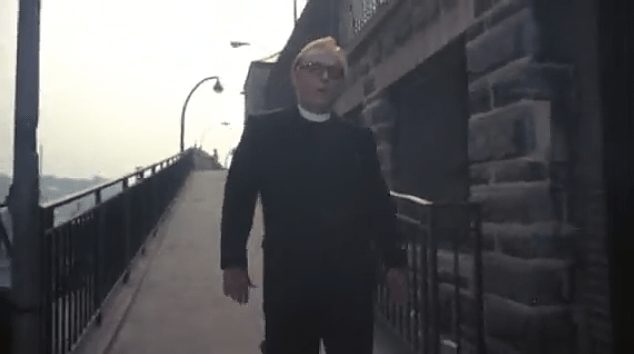
The opening scene… Christopher Gill impersonating Father McDowall (Steiger) is walking down the street viewed with a long shot, he’s whistling a ‘sardonic’ tune… in the vein of “the ants go marching” alongside The East River. Present, is the activity of cars passing by on the East Side Highway.
As he approaches the camera, we can see that he is wearing a priest’s frock.
We hear the city noises, the sounds of cars honking, young children plowing into him as they run by, and a young girl in a short lime green dress greets him as he continues to walk along the sidewalk.
As Gill passes Kate Palmer (Lee Remick) descending the stairs of the apartment house, he says, “Top of the morning to you, young lady!”
Superb black comedy directed by Charlie Chaplinabout an urbane cynical vegetarian, cat-loving bigamist Bluebeard who supports his invalid wife Mona (Mady Correll) and little boy by committing amorous adventures with women whom he then kills and takes their fortunes. Having lost his job of thirty years during a financial depression, he moralizes that this is the only way he can serve to take care of his family.
Chaplin is brilliant as he travels between the ‘object’ of his next bit of income as Henri Verdoux, Alias Varnay, Bonheur, and Floray. The ladies are hilariously diverse and not without ridicule… The rowboat scene is a riot!
I’ll be doing an extensive post on this film as it has caught my heart like the delirious flu… Co-stars Isobel Elsom as Marie Grosnay, Martha Raye is absolutely priceless as his lottery-winning dame Annabella Bonheur, Audrey Betz as the stodgy Martha his other wife, Marjorie Bennett as Marie’s maid, and Marilyn Nash as the young homeless girl…
Charlie Chaplin and Marilyn Nash-Â Monsieur Verdoux ’47
The Girl- “It’s a blundering world and a very sad one yet a little kindness can make it beautiful…”
“It’s a fascinating eerie story of a mad killer, who loved to paint beautiful women and then…and then murder them only because they moved!”
This exploitation film is directed by Erick Santamaria. And stars William Kerwin as Bill an unstable artist who is haunted by nightmares and driven to kill his female models when they move while posing. He’s obsessed by an unattainable beauty that he can’t seem to capture. He finally loses it and goes on a rampage, creating a collection of macabre trophies from his kills. As the tagline says–Playgirl Killer…paint it red for passion, red for rage, and red for his beautiful but bloodied victims. The film also stars Jean Christopher as Arlene, Andree Champagne as Nikki, who knew Neil Sedaka as Bob perhaps singing in the rain with the one he loves, and Linda Christopher as Betty.
Directed by Robert Allen Schnitzer and written by Anthony Mahon, Schnitzer, and Louis Pastore? Okay… While I’ve never seen anything else by Schnitzer, this moody, surreal, haunting, and often frenetically disturbing reverie has remained with me all these years. Some people think it’s a weak film, not even a horror movie. I’m not saying it’s a masterpiece, but I think it’s a genre gem!
What’s really strange about this hidden terror film is cinematographer/director Victor Milt ( Run Stinky Run, Sex Wish) has done some weird really obscure stuff after working on The Premonition and director-writer Schnitzer hasn’t done anything I can talk about here either. So how did this remarkably creepy film become what it is??? I wish I knew the answer, but there have been memorable films created by one-time feature film directors like Herk Harvey who usually did shorts or documentaries that envision the gorgeous dreamlike Carnival of Souls 1962. At least writer-actor Richard Blackburn did Eating Raoul in 1982 after his unbelievable Lemora: A Child’s Tale of the Supernatural 1973. (Coming to the Last Drive In soon!)
Great character actor Jeff Corey plays the investigating Police Det. Lt. Mark Denver. There’s even a gypsy woman, played by Wilmuth Cooper.Â
Jeff Corey plays the investigating Police Det. Lt. Mark Denver.
I saw The Premonition when it first arrived in theaters in 1976. It frightened the bejesus out of me then, with its nightmarish segments in particular Jude’s (Richard Lynch) and Andrea’s (Ellen Barber) uncontrollable fits of rage. Their joint psychosis was a very powerful elixir as part of the carnival set piece. Their relationship alone could have made for an interesting story of madness, obsession, and self-destruction.
This film was my introduction to the interesting actor that is, Richard Lynch. The film has stayed with me. I’ve read other people’s reviews who think the script is ridiculous, muddled and the pacing is choppy. Still, it has a haunting quality to it, especially Lynch and Ellen Barber’s performances. The music by Henry Mollicone is fantastical for the vibe of the film and fascinates me, now I have to see his musical performance in the fascinating documentary The Face on the Barroom Floor 2013.
The lens has a ghostly haze over it. with a low drab subdued tonality. The music brings you in like a soft wailing of an otherworldly siren. An eerie Glossolalia, the fluid vocalizing of the tormented Andrea. Reminding me of the amazing Lisa Gerrard from Dead Can Dance.
The institutional green bus pulls over and Andrea grips herself looking toward something. The clear pale blue sky hovering over Andrea feels chilly. She is beautiful yet strange, walking slowly toward the carnival grounds. A flutter of birds let out into the air, the vocalizing continues and Ferris Wheel comes into focus with another stomach-turning carnival ride. These daydreaming machines add color to the midway landscape. It is desolate here.
It somewhat creates a colorful version of Carnival of Souls the haunting set pieces of desolation, and otherness that play on our deepest thoughts. The impressions effervesce in fairgrounds and we construct fantasies.
Dulcimer and glistening piano bring forth Jude, a cigarette hanging out of his oddly angular face and lion-like blonde mane, he’s almost sexy ugly. The film is still lensed in cold aqua greens and pale blue. He steps out of his trailer, we see he’s wearing white ballet slippers like a mime. The piano rolls magnificently. Henry Mollicone is a virtuoso. With electronic music by Pril Smiley.
Jude steps out onto the pavement, wearing suspenders he begins a series of theatrical movements. Moving dramatically with his scarf.
Jude expresses with his body more fervently as if he hears the grand piano playing. He reaches up to the blue sky so vivid so crystalline blue. As Jude, it is a lonely dance for a sad solitary clown. As he bends downward he sees Andrea standing there. It is a portent, life is about to be turned truly upside down.
The story is a simple and unreserved one, gripping and nightmarish for all the players and us who witness a small girl being hunted psychically by her dangerously unstable biological mother who is traveling with a carnival.
The scene cuts to them sitting in his trailer she’s looking at photographs through a spyglass. He says “Look at those eyes, Andrea, and the mouth… see that. I saw her yesterday when I took the photograph. This time I’m positive I know it’s her” “You sure her name is Janie” “Yeah I’m sure, here look”He flips the photo over and the name and age are on the back.“Janie Bennett the age is right… it all figures… it’s gotta be her” Andrea asks, “Where does she live?” Jude tells her, ” Dover is about 5 miles from here.”
Jude begins to put on his heavy white grease paint. Andrea goes to the board and touches the photo of Janie…
She turns to him…Â ” I thought you’d forgotten about me Jude” ” I told you I’d call you as soon as I found something didn’t I?” “Jude what if it’s not her, what if it’s like all the other times… what if we come out with nothing what then?” Then we wait and we keep on waiting until we find her”
When Andrea shows up at Janie’s school, the music becomes a flutter of wings with flute as the children run free from their inside captivity. Andrea fingers the metal holes in the fence moving slowly, waiting for her little girl to appear. Finally, Janie is standing before her she calls to her, then Janie runs to her adoptive mother Sherrie who is waiting in the car.
Back in Jude’s trailer-Jude says, “We were lucky it couldn’t of taken years to find her” “It did take years… five stinkin’ years in that rotten pit” Jude answers, “Oh it wasn’t all that bad, I mean we wouldn’t have met otherwise.”Â
Andrea’s horrible beer-drinking tv junkie landlady in Curlers.
The use of ‘red’ in this movie is distinct. It is the characteristic color that symbolizes Andrea’s passion, madness, and self-destruction. Red is Andrea’s COLOR… down to her lipstick.
The window impresses me as a Mark Rothko painting. The color red is very impressionistic and so vital to the film’s narrative.
Jude tells Andrea that he has found a house. A small house in the woods, a nice place to settle down with the kid.
Andrea glows and a weird smile emerges at first “Settling down!” Then clenching her teeth as she drags the comb through wet raven tresses. “What are you talking about settling down for… what are you talking about. Sometimes I just don’t understand you Jude. Settling down for what…?this comes first! “
But Jude explains that they can hide out in that house til things blow over. She walks away towel drying her hair.
He remains on the topic “Nobody’s lived there for years. they’ll never find us”
Jude lays on the bed smoking a cigarette while Andrea in a red bathrobe, plays a beautiful piece of music on the piano.
The scene switches to Miles talking to Dr Kingsly his associate about parapsychology as she instructs a small class.
“The Clairvoyant reality is totally rejected by science and finds expression only in our art, music religion.”
At the same time, the film is juxtaposing images of Andrea having a primordial psychic meltdown. Not even a maternal scream, just a core anaphylactic roar from deep within.
Sherrie begins to see visions of a volatile confrontation between Jude and Andrea. On the spectral plane, it comes across in distorted yowls and negative film images. It’s quite a frightening effect. I remember being terrified by these scenes in the darkness of the theater. Like little shock treatments to a burgeoning MonsterGirl mind…
For people who think there isn’t enough explanation to the narrative Sherrie’s friend hints at the idea when spending the night telling Sherrie that she had heard of two minors who had been trapped for several days, they began sharing the same hallucinations. In this way, her question about Sherry’s disturbing visions somehow being linked to Janie’s bad dreams is true.
A psychic storm is brewing from the rage and unrequited desires of both Jude and Andrea. Janie and Sherrie naturally begin to form a single wavelength that tunes into this frequency. At least this is the premise of the film. The one link is Janie the child… and who will be the conquering mother?
While Miles is not working late with the attractive Professor Kingsly, he’s eating cotton candy and riding the merry-go-round with her.. hhm… at the carnival-definitely research related… as she suddenly looks down at Mile’s wedding band her happy expression fades away.
Meanwhile, Andrea and Jude pull up in that fabulous green pickup. The crickets and chorus frogs are singing their night song. Jude shuts the motor off. In her red dress, nails, and oz slippers like the Witch of the West Andrea creeps or slithers into the house to take Janie.
the frame appears to give an almost fun house effect with the striped wallpaper that disorients us.Andrea’s presence on the stairs casts a dark menacing shadow along the wall, reminiscent of Nosferatu.
The use of electronic sounds is excellent.
Andrea’s casting darkness, shadowing the wall is reminiscent of Nosferatu. Andrea is almost as icy as a dead thing herself… wanting to lure the child back, it looks and feels vampiric. Yet this is Janie’s biological mother, which creates some ambivalence for me as she deserves to have at least guided contact with her daughter, otherwise, why let her out of the mental hospital?
It creates the effect of psychic static the use of sound used whenever the camera focuses on Andrea’s movements.
And the framing of Andrea looking back into the den while Sherri sleeps utilizes the striped walls as they also become as distorted as a fun house room. Very disorienting.
The last remnant of shadow left from Andrea creeping up the steps is eerie as Sherri sleeps as if under a spell. Once again… a notion of Nosferatu. Andrea even has a dark complexion that could even be considered Eastern European gypsy, like Bela Lugosi.
The use of electronic static, noise represents Andrea’s state of mind at the moment. The use of low lighting and color is well-placed and creates a surreal atmosphere of worlds colliding.
The electronic noises that represent Andrea’s madness and presence are like a metallic insect. As if she hisses and slithers into Janie’s room. Everything is backlit. Andrea’s color is hot reds, and Janie’s is a cool blue.
Sherrie wakes up to the sound of the rocking chair in Janie’s room.
Nobody can tell me that this film isn’t an eerie, haunting little story, that stays with you… If it doesn’t deliver on the kinds of gruesome gory chills you’d expect from a 70s horror story then you’re watching the wrong film. But this film is highly underrated and often shot down by critics who feel it falls short. Oh well… The rest of us who know its strength will continue to advocate for it…Back to the film….-MonsterGirl ♥
Andrea runs down the stairs taking one of Janie’s dolls after fighting with Sherrie who is clinging to Janie on the bed. Andrea screams up to Sherrie… “She is Mine… she will always be mine-!!!!!!” Her voice is strained, powerful, almost magnetic.
Back at Jude’s little house in the woods, Andrea is holding Janie’s doll as if it were her.
“You are such a pretty baby,” Andrea says to the doll. Jude staring out the bleak window of the little house looks on with a worried stare. He rips the head off the doll as it squeaks Andrea screams and cries. Jude has become more unhinged himself. It has been brewing in him since the beginning. But it is not working out the way he had envisioned. He can’t control Andrea, and she obviously doesn’t care for him the same way. Two mentally ill people fighting over their own neurosis.
“What’d you do to my baby?”“Your baby, your baby is back in the goddam house with its mother.”
“What’s it to you? You’re not her father!! You are nobody’s father. And you’re never gonna be anyone’s father… You aren’t even a goddam MAN!!!!
Andrea destroys Jude’s manhood as if she took a knife and thrust it in.
Jude loses it… we hear screams.
At the same time…Sherrie gets cold in the bathroom, and the mirror freezes over. She cannot see herself. It’s a supernatural event that begins to connect the events surrounding the players involved.
Jeff Corey the investigating cop shows up at Janie’s biological father’s house to ask some questions about Andrea.
I’ve noticed the narrative uses a lot of frames where people are either looking out windows or doors or standing in the doorframe looking in. It’s that tout to parapsychologies’ introspective plane of existence…the within powers that surround all of us on a personal level. The character look inward, we’re watching them look inward and we wind up looking inward with them…
Danielle Briseboismakes her debut playing Janie Bennett the wee one who is being visited by her psychic/psychotic mother through horrifying visions like a vampiric wraith filtering through the ether reaching outward to contact her little girl who was given away to foster parents while she was in the mental ward. But Janie is terrified and wants to remain with her foster parents Prof. Miles and Sherri Bennett played bySharon Farrell  (Larry Cohen’sIt’s Alive 1974) and Edward Bell. Farrell is always good at playing adorable cheap, neurotic, and a little over the edge. Brisebois was still really cute at this stage before she became Archie Bunker’s annoying niece until she grew up into a sexy rock singer.
I have to admit that seeing this film in the theater when I was an impressionable teenager really freaked me out a bit. The images were quite startling, and in retrospect, anything Carnival-related is wonderfully creepy and wonderfully eerie, as it attains its own self-contained world. The vision of the crazy Andrea Fletcher is quite stunning as well, so as far as the pacing being muddled or uninteresting, I suppose those people who hated this film were looking for more 70s bloody, axes, psycho-sexual mind games, animals attacking or devil children. This story is a bit of a childlike nightmare amidst, Folie à deux insanity, loss, possession, motherhood, and longing. The narrative slips between a mordant sense of all these themes, as it expands beyond the literal world and works on our unconscious participation in moral ideals of motherhood, rights, and the boundaries that separate us all by a psychic thread.
Andrea (Ellen Barber who plays Mickey Roarke’s secretary in Nine 1/2 Weeks (1986) comes to Janie’s school to try and grab her, but Janie’s new mommy Sherri has a premonition and manages to arrive just in time to save Janie. Andrea lives with her wildly menacing boyfriend, a clown named Jude. Yikes, as if Lynch wasn’t frightening on a good day, wearing white face paint and painted on tears… it still gives me the heebie-jeebies.
Andrea is obsessed with getting Janie back, and Jude will do anything for his nutty girlfriend. The pair manage to kidnap Janie leaving the Bennetts in a panic who then seek out the help of a parapsychologist Dr. Jeena Kingsly (Chitra Neogy) a colleague of Miles. They hope that she can decipher Sherrie’s terrifying visions, as she also has a psychic link to Janie she must try and track her down before the unstable Andrea loses it completely and harms her daughter.
The story makes it hard for us to sympathize with Andrea as a protagonist longing to be reunited with her daughter because she herself is such a threatening figure. She’s been recently released from an institution and is still emotionally volatile. She met Jude while she was hospitalized. Jude keeps a watchful eye out for Janie, working for the carnival he’s in the position to see a lot of children pass through. One day he spots Andrea’s daughter with Sherri.
He tells Andrea that he’s seen Janie which is the catalyst for a wave of psychic visions that beset Sherri. Dr. Kingsly tries to guide Sherri to use her powers of ESP to find Janie and connect with her to track her down and bring her back.
Jeff Corey is on the scene talking to the landlady and helping to locate the kidnapped Janie.
Filmed in Mississippi the look has a haunting rustic and starkly Gothic feel to it. There’s an untouchable sense of a dreamy, trance-like aura that surrounds the frames. It disconnects us from all things being easily explained, but dreams are like that and the atmosphere of the eerie and urgent narrative compensates for the lack of cohesive and sensible plot design.
In the 70s not all things were explained coherently. Sometimes the figures floated upon landscapes that were nightmarish and made no sense. As in Let’s Scare Jessica to Death 1971, and yet it was this ambiguity that created the mystique, the mystery, and the mood.
What makes a story a thing that is haunting are visions not clearly defined, nor affirmations said aloud. The outstanding theme that jolts you into a sense of agony is the pull between two mothers, one who is emotionally destructive yearning for her child, and the other, desperately trying to protect the child she believes is hers now.
Caught in between is Janie who can only feel the thrust of possession surrounding her, the vivid nightmares and fears of innocence and unknown. Also tangled in the web of possession is Jude who is merely being used as a means to procure Janie for Andrea. His frustration turns outward like the rage of a tornado. Lynch’s face reveals his turbulence well. Andrea taunts him until he is so wounded that he keeps the child even when he doesn’t have to. If I say more I will give away part of the story…
There are some truly shocking moments-The painting crying blood when Dr. Kingsly tells Sherri just to let it flow when trying to teach her to hone in on her psychic insights. -Andrea wearing a ruby red evening gown soaked in blood appears in Janie’s bedroom with a rocking chair (turtle lovers look away) it is extremely eerie and somber. Her hands seem like talons, once again The Monstrous Feminine arrives on cue.
There are a few visions or apparitions of Andrea drenched in blood and the recurring forming of ice on those iconographic mirrors. Mirrors, the pathway to see ourselves is clouded by ice in order to obscure Sherri’s view into the psychic world.
The climax is a mesmerizing sequence, one that will either have you laughing and dismissing this film completely as others have done, or it will stay with you as it has with me, a beautiful little nightmare.
This is your EverLovin’ Joey sayin’ I have a premonition you’ll be back to The Last Drive In!
“Hungrily, he watched her walk down the street…and then he squeezed the trigger!”
There’s a crazed sniper picking off brunettes, as the police scramble to try and profile the psychology of the killer on the loose!
Gritty psycho-sexual film noir based on a story by Edna & Edward Anhalt. Screenplay by Harry Brown (A Place in the Sun ’51, The Man on the Eiffel Tower ’49) Director of Photography is the great Burnett Guffey (From Here To Eternity ’53, Private Hell 36, NIghtfall ’57, The Strange One ’57, Screaming Mimi ’58) With music by George Antheil (uncredited stock music compose)And film editing by the great Aaron Stell(Human Desire ’54, Beginning of the End ’57, Touch of Evil ’58, Lonelyhearts ’58, The Giant Gila Monster & The Killer Shrews ’59, To Kill A Mockingbird 1962).
Directed by Edward Dmytryk  marking his return to Hollywood after he was named on the blacklist and served time in jail for contempt of court.
Richard Kiley as Doctor James G. Kent “I’d look for somebody that’s been getting tough with women from the very beginning… maybe he started small slugging them on a dark street or something like that… maybe some woman did something mean to him when he was a kid. Whoever it was, he’s been killing her over and over again!
The poster for The Baby alone is disturbing in it’s ability to create an instant queasy feeling and queer flutter that hits your senses due to the inappropriate visual environment. A crib with a large pair of legs hanging over the edge. The hands holding an axe and a sexualized young female holding a teddy bear. So let’s just get these words out of the way for starters…
Touching on so many taboos and cultural deviance is director Ted Post’s shocker The Baby 1973. starring the mighty Ruth Roman.
Look at that sensual face… what a beauty Ruth RomanStill of Ruth Roman and Robert Walker in Alfred Hitchcock’s Strangers on a Train (1951)
Day of the Animals 1977, Look in Any Window 1961, Bitter Victory 1957, Strangers on a Train noir thriller Down Three Dark Streets 1954, The Window 1949, various television performances The Naked City’s ‘The Human Trap’ Climax!, Dr. Kildare, The Outer Limits, Burke’s Law, The Name of the Game, I Spy, Marcus Welby M.D, Mannix, Ironside, Gunsmoke, The Sixth Sense, Mod Squad and more!
And I’ve got to mention that Anjanette Comer is an excellent rival to play the ‘outsider’ antagonist against Ruth Roman in this battle of wills.
Anjanette Comer stars in the ABC movie of the week’s Women-in-Peril feature film FIVE DESPERATE WOMEN 1971…
Directed byTed Postwho gave us Beneath the Planet of the Apes 1970, perhaps my favorite of the ‘ape’ films after the original. Saw each of the series during their theatrical release. Sadly Ted Post passed away just this past August 2013.
James Franciscus in Ted Post’s Beneath the Planet of the Apes 1970 Clint Eastwood & Ted Post collaborating on the set of Magnum Force
He directed television for years beginning in the 50s. I love the TV movie also starring Beneath the Planet of the Apes blond hunk James Franciscus… who co-starred with the fabulous Lee Grant in Night Slaves (1970) and Dr. Cook’s Garden 1971 with a murderous Bing Crosby. And hey while I”m touting made-for-TV movies how bout Five Desperate Women1971 where he most likely met Anjanette Comer? He’s also responsible for several episodes of Rod Serling’sThe Twilight Zone (1959-1964), including “Mr. Garrity and the Graves” and “The Fear.”  Post also directed two episodes of the Boris Karloff horror anthology show you know I truly love, Thriller (1961-1962), The Specialists & Papa Benjamin. And geez Columbo ’75-’76, A Matter of Honor and A Case of Immunity. Most people probably cite him for Clint Eastwood’s Dirty Harry vehicle Magnum Force 1973 or Good Guys Wear Black 1978. Ted Post knows how to put together a thriller!
The Baby’s screenplay was penned by Abe Polsky (The Rebel Rousers 1970, The Gay Deceivers 1969)According to IMDb trivia, it took almost a year for Polsky to convince Post to direct the film because Post found the topic too ‘dark.’ While in retrospect the film must have ruffled many feathers, and the themes are truly disturbing, there isn’t anything in there that hasn’t been done in a contemporary film in some way, and ideas that force us to think are a good thing. Especially when it’s wearing 70s clothes, and showcasing groovy genre character actors.
The seventies were rife with psycho-sexual theatre that showcased really uncomfortable themes, but somehow managed to create an atmosphere of low-budget art. Consider this, haven’t you seen episodes of Law & Order SVU, Criminal Minds, & CSI where some of the most brutal acts of inhumanity and grotesque forms of torture and abuse are highlighted in graphic detail? In the 70s it was more nuanced, bathed in muted lighting gels amidst experimental cinematic framing and absolutely moving musical scores.
So on one level refer to the litany of words above and assign your favorite one to The Baby, yet on another level, let’s look at this film and ‘react’ to it and recognize its power.
Baby’s photograph is lensed in an ‘anthropological’ way as it shows him in captivity-the bars of his crib symbolically like the bars of a prison
The Seven Minutes1971 is based on a novel by Irving Wallace. Directed by provocateur Russ Meyer(Lorna 1964), Faster, Pussycat, Kill! Kill! & Mudhoney(1965) with a screenplay by Richard Warren Lewis and an uncredited Manny Diez. This film comes on the heels of his hit at FOX with Beyond the Valley of the Dolls 1970. (Dolls with a screenplay by Roger Ebert) Meyer and Fred Mandl (Checkmate, The Munsters, The Twilight Zone, The Fugitive) create a great visual romp with the cinematography. The opening titles roll over the first almost seven minutes of the film as we hear the ticking of a clock…
With a very unusual cast of character actors starring Wayne Maunder as Mike Barrett, and Marianne McAndrew  (Hello Dolly 1969, The Bat People 1974) as Maggie Russell. Philip Carey (I’ve always been amazed at how much he reminds me of Charlton Heston) as District Attorney Elmo Duncan.
Phillip Carey has always reminded me of Charlton Heston in stature and mannerism- a great underrated character actor…
the ubiquitous John Carradine. I could watch him in anything… he tickles me…the beautiful Yvonne de Carlo here as Constance Cumberland movie actress.love love love that Yvonne de Carlo- a kindly beauty (I met her on the set of Laugh-In at the Westbury Music Fair in the 70s while taping the show live… She was an absolute gem, warm-hearted and filled with tangible grace.)
Music byStu Phillips(Quincy M.E.) with Lionel Newman supervising. BB King sings Seven Minutes.
‘The Seven Minutes’ refers to an artistically erotic banned book published thirty-five years ago in Paris, that essentially opens up the floodgates for the public discourse about pornography, censorship, violence against women, and the dual standards during a time when morality was ambiguous. You know, just like today.
Argo Book Stores clerk played by Robert Maloney… arrested for knowingly selling smut… convenient scapegoat for the cause.Charles Drake plays vice cop Kellogg entrapping the poor Mr. Fremont book seller for being a clerk where an allegedly filthy book is being sold.
A bookstore clerk is indicted for selling obscene material which leads to a court trial. There is also the question as to whether this licentious book actually led to the rape of a young girl. The film is part trial based as the defense lawyers try to hunt down any clues that would prove the author of the book was not a smut merchant but trying to express an artistic viewpoint that can not be silenced by censorship.
Wayne Maundy as Michael Barrett’s defense attorney for bookseller Fremont
The author and the mystery surrounding their identity are key to the plot. Meyers does a high-spirited job of developing this narrative with engrossing scenes that portray a society of zealots and self-serving neophytes in turmoil with themselves. All amidst a groovy 70s palate that’s nostalgic and filled with a colorful verisimilitude.
The film opens with some great 70s devil may care by composer Stu Phillips. At first, we see a beauty chasing her dog passed a small storefront. The story reveals that the vice bureau is staking out the ARGUS bookstore, as Sgt Kellogg (Charles Drake) walks in with his cigarette box tape recorder ready to entrap the clerk for selling smut. He asks the young bookseller for something ‘brand new -unusual, ‘something you wouldn’t find in an ordinary library.’The clerk (Robert Maloney) just tells him to look around, the jackets tell the story pretty well.
Kellogg casually asks for one particular book on display The Seven Minutes by JJ Jadway and the bookseller repeats the title ‘Oh yeah” Kellogg remarks, “That’s a pretty sexy cover ain’t it?” As Kellogg ogles the pretty blonde talking to the young clerk who tells him she’ll see him later.
Sargent Kellogg (Charles Drake) “You read it?” Clerk -“The new addition at least… the first one was banned thirty-five years ago.” Kellogg-Â “How come it was banned?” Clerk– “Cause it was considered obscene” Kellogg-Â “Do you think the book’s obscene?” Clerk– “Why don’t you buy the book and find out for yourself.” “How much is it?” ” $7.30 with the tax.”
“Wrap it up… You the manager around here?” Clerk-“Yeah, the day manager.” Kellogg-“Who do I bring it back to if I don’t like it” The clerk answers– “Fremont, Ben Fremont.”Kellogg waves.
Kellogg’s partner is tape-recording the conversation from the car. “Took you long enough.”“Literary conversations take a little doing, we better start comparing, same jacket same title, same publisher, same publishing date, and copyright… Let’s pay Mr. Fremont another visit.”
They arrest him for knowingly selling obscene matter which is a misdemeanor in the state of California. And this starts the ball rolling in this film. As the powers that be, seek out district attorney Duncan who feels that The Seven Minutes would be found obscene if taken to court.
Mike and Faye Osborne are bed pals. She’s the spoiled daughter of an influential father.Cars the way they used to look… oh those were the days.never had one of these… but I know people who did! cool…70s memorabilia. Even the brown striped sheets.
the hair and the groovy chick appear later on at a funky club but I couldn’t resist putting her in the visual time capsule with the Volkswagon bug and the phone and Selleck…teehee.Mr Selleck don’t you look fine! He plays the publisher’s son Phil Sanford of Sanford Publishing.Â
Check out that cherry Volkswagon and Corvette, check out that cool 70s phallus phone, Check out that really young Tom Selleck as the publishing guy… who calls hot shot attorney Michael Barrett (a very cool Wayne Maunder) who is representing the publisher Phil Sanford (Tom Selleck) who’s in a panic about the book clerk Fremont going to jail for selling one of Sanford House’s books.
The tower of self-righteousness Elmo Duncan the D.A. (Phillip Carey) wants to be propelled into the Senatorial seat in California. The powers that be who want him to become Senator conspire to exploit this contrived issue of corruption & decency so Duncan has a powerful platform to run on. This elite cabal wants to build a state-wide case in which Elmo Duncan can fight the ‘Smut Merchants.’
Defense Attorney Mike Barrett tries to appeal to district attorney Duncan.District Attorney Duncan looms large as the figure of ethical fortitude.the secret cabal setting up the scenario for Duncan to influence public opinion and win the election. Stanely Adams, Olan Soule & Jay C. Flippen
They have a political agenda to stamp all youthful violence incited by salacious material in reading matter and films, and so this cause has become the lynchpin with which they hope to win an election, making ‘The Seven Minutes’ the subject of their campaign.
Meanwhile, a violent rape takes place involving the son Jerry (John Sarno) of a wealthy advertising tycoon Frank Griffith (Lyle Bettger) who owns a copy of The Seven Minutes and was present at the time of the assault committed by his psychotic friend, the one who actually commits the brutal rape.
The rape scene is handled with quick cuts interwoven with Wolf Man Jack doing his thing on the air. It’s all very frenetic as the soundtrack “love train” is sung by Don Reed.
The prevailing secret surrounding pathetic Jerry Griffith (John Sarno) is that he’s been emasculated by his domineering father and now can’t get it up, so he’s impotent sexually and in helping Sheri Moore (Yvonne D’Angers) while she’s being attacked by his violent friend.
Jerry takes the blame for the rape and refuses to talk about it, thereby implicating himself as an impotent sissy and allowing the lynch mob and voyeurs to assert that Jerry would not have committed such an act if The Seven Minutes hadn’t been available to him. Duncan is now convinced that a clean boy wouldn’t have done the crime if it weren’t for the availability of the dirty book.
this is Shawn ‘baby doll’ Devereaux -well it sure ain’t Tennessee Williams and Elia Kazan’s vision of Carroll Baker is it…
These hypocritical old cronies have young girls of their own on the side, watching pornography while salivating at the mouth. Yerkes has a girlfriend he calls ‘baby doll’ who dances provocatively for these guys. She’s got ample boobs (It is a Russ Meyer film after all) hanging out of her 70’s style yellow hot pants. Amidst the interesting subject matter Shawn ‘Baby Doll’ Devereaux gyrates and inserts herself into the frame to show us the hypocrisy of these old farts who condemn others for their own personal agenda all the while being the worst kind of purveyors of sinful behavior.
the wealthy Frank Griffith that wants all this smut taken out of the reach of impressionable teens like his son. What’s carefully framed by Meyers playing in the background is a porn film that the men have been reviewing and enjoying way too much-we witness the HYPOCRISY.
Russ Meyer had his own dealings with censorship so the subject is probably of very personal substance for him. He does a fantastic job of pointing out the duality of persuasions. And he builds the story really well here. Showing the belligerence by equal sides of the coin toward a moral center and a society ripping at the shreds of personal freedom to express, create and destroy.
Whether you’re an avid Russ Meyers fan or just think you might like to venture into the complex questions the film evokes, presented in that real 70s style The Last Drive In weeps for most days, it’s a film worth watching, even just to spot the few character actors that pop up on the screen like baby doll’s and Faye Osborne’s (Yvonne & Edy) eh hems… well you know… the cleavage shot!
What appears on the surface as a controversy surrounding a banned book that contains alleged salacious material-The defense evokes some good examples of Henry Miller’s ‘Tropic of Capricorn’ or, D.H. Lawrence’s ‘Lady Chatterley’s Lover’, etc.
What manifests is an interesting commentary on censorship, masculinity, and the spurious connection between perceived immoral content and violence in society.
Manhood and masculinity is a texture that is not necessarily used as the theme in the story, but let me tell you it is all-pervasive with images of Duncan heaving his heavyweights as he sweats and works out in front of Mike, spouting his holier-than-thou rhetoric. It was almost masturbatory.
He gave Michael that “politician’s holier than thou number” Duncan was hostile while he pumped weights in front of the intellectual Mike Barrett. Dueling of masculinity and the question of causality with pornography and violence against women.
Duncan talks to a church official about ‘freedom’ Duncan–Â “We only want to penalize those who would corrupt it.”
Duncan and his reprehensible comrades belong to a group called Strength Through Decency.
The acronym STD... was this intentional? Probably. It’s hilarious as these types of organizations do spread like a social disease. They’re against lust, motorcycles, homosexuals, and lesbians. All the factors that made the 70s so dangerous of course. Those lustful lesbians on motorcycles riding down 5th Avenue in NYC wreaking havoc with our delicate morality. Why I’m surprised we all survived it…
So as much as the words “smut merchants’ are bandied around, and the question of censorship takes priority in full view, the underlying sub-context is the posturing of masculinity and the double standard of sexism & classism and who gets to play and who must obey.
Marianne McAndrews is fabulous as Maggie Griffith. I really dig those orange orbs… truly the light fixtures I mean…
I won’t get into the story behind the mystery or the trial, the story behind Jerry’s impotence, the elitism, or the ultimate reveal about the author of The Seven Minutes. The media frenzy that occurs feeds on the sensationalism of the situation who condemn the book but want to hear about the details of rape victim Sherri’s violation.
Is The Seven Minutes a beautiful novel about a woman’s awakening or really filthy trash? You’ll have to find out… but I’ll say that Russ Meyer’sThe Seven Minutes is a great addition to the socially conscious sexually charged films of the late 60s & 70s like Roger Vadim’s Pretty Maids All In a Row, and Robert Thom’s Angel, Angel Down We Go 1969…