Disembodied screams, rattling chains, and ghoulish groans amidst creaking doors- all a delicious mixture of frightful sounds that emanate from a jet-black screen.
Suddenly Watson Pritchard’s floating head narrates the evening’s spooky tale…
“The ghosts are moving tonight, restless… hungry. May I introduce myself? I’m Watson Pritchard. In just a moment I’ll show you the only really haunted house in the world. Since it was built a century ago, seven people including my brother have been murdered in it, since then, I own the house. I’ve only spent one night there and when they found me in the morning, I… I was almost dead.” -Watson Pritchard
The marvelously dashing face of Vincent Price or for the film’s purposes, Frederick Loren’s head sporting a plucky mustache and highbrow tone introduces himself in front of the imposing Modern-Ancient structure.
“I’m Frederick Loren and I’ve rented the house on haunted hill tonight so my wife can give a party. A haunted house party"¦ She’s so amusing. There’ll be food and drink and ghosts and perhaps even a few murders. You’re all invited. If any of you will spend the next twelve hours in this house, I’ll give you each $10,000. Or your next of kin in case you don’t survive. Ah, but here come our other guests…”“It was my wife’s idea to have our guests come in funeral cars… She’s so amusing. Her sense of humor is shall we say, original. I dreamt up the hearse. It’s empty now but after a night in the house on haunted hill"¦ who knows.”“Lance Schroeder a test pilot, no doubt a brave man but don’t you think you can be much braver if you’re paid for it?”“Ruth Bridges the newspaper columnist. She says the reason for her coming to the party is to write a feature article on ghosts. She’s also desperate for money. Gambling.”“Watson Pritchard a man living in mortal fear of a house and yet he’s risking his life to spend another night here"¦ I wonder why? He says for money.”“Dr. David Trent a psychiatrist. He claims that my ghost will help his work on hysteria. But don’t you see a little touch of greed there around the mouth and eyes?”“This is Nora Manning- I picked her from the thousands of people who work for me because she needed the 10,000 more than most. Supports her whole family… Isn’t she pretty?”“The parties’ starting now and you have until midnight to find the house on haunted hill.”
Von Dexter’s music, a mixture of solemn strings, and a sustained and queasy Hammond organ & Theremin greet us with an eerie funeral dirge while the shiny black gimmicky funeral cars pull up in front of the quite sinister post-modern structure.
And this is just the opening fanfare of William Castle’sclassic House on Haunted Hill!
White’s story is quirky and wonderfully macabre as it works at a jolting pace delivering some of the most memorable moments of offbeat suspense in this classic B&W B-Horror morsel from the 50s!
The success of the film inspired Alfred Hitchcock to go out and make his own low-budget horror picture- Psycho 1960.
Much of the style and atmosphere can be attributed to the unorthodox detail by art director Dave Milton and set designer Morris Hoffman. The exterior of the house is actually The Ennis Brown House in Los Angeles, designed by Frank Lloyd Wright, built in 1924, and now listed on the National Register of Historic Places.
There’s a pervasive sense of dread in House on Haunted Hill, that makes the house itself a ‘spook.’
Whether the house is haunted or not, its forbidding presence tells us that it just doesn’t matter. The history of the house itself, its violent past is enough to give one chills. While not in the classic sense like that of RobertWise’s diseased and imposing Hill House, William Castle does a fabulous job of inventing a parameter to tell a very cheeky and pleasurable little scare story. As David J Skal puts it succinctly “The real, if unintentional spook in House on Haunted Hill is postwar affluence.”
The narrative is fueled by the creepy atmosphere of the house itself. Not using a claustrophobic Old Dark House trope but rather a modern Gothic construction that swallows you up with odd motifs and a sense of malignancy within the fortress walls. The starkness of the wine cellar and it’s empty minuscule dark grey rooms with sliding panels is almost more creepy than black shadowy corners with cobwebs and clutter. Director of Photography Carl E Guthrie  (Caged 1950) offers some stunning and odd perspective camera angles and low lighting which aid in the disjointed feeling of the sinister house’s magnetism.
The constant explorations into the viscera of the house by the guests is almost as titillating as the criminal set-up and conspiracy that is afoot propelled by Von Dexter’s tantalizingly eerie musical score with deep piano notes and eerie wispy soprano glossolalia.
House on Haunted Hill works wonderfully, partly due to the presence of the urbane master of chills and thrills, the great Vincent Price who plays millionaire playboy Frederick Loren. Vincent Price was a versatile actor who should not be pigeonholed as merely a titan of terror, given his too numerous layered performances in great films like Otto Preminger’sLaura ’44, Joseph L. Mankiewicz’sDragonwyck ’46, etc. Vincent Price did however make his mark on the horror genre with House on Haunted Hill. The New York Herald-Tribune praised Price’s performance as having “waggish style and bon-vivant skepticism.”
As David J Skal puts it in his, The Monster Show {Vincent Price} “Could bring an arch elegance to the most insipid goings-on…“
The omnipresent Elisha Cook Jr. is superb as Watson Pritchard, the neurotic sot who is riddled with fear, spouting anecdotes about the house’s grisly history.
I adore Elisha Cook, from his cameo in Rosemary’s Baby, his performance as George Peatty in Kubrick’s masterpiece The Killing ’56 to his very uniquely intense role as Cliff the sexually jazzed up drummer in Phantom Lady ’44.
Elisha Cook Jr as the doomed George Peatty in Stanley Kubrick’s The Killing ’56.
The strikingly beautiful Carol Ohmart plays Loren’s treacherously seductive wife Annabelle who is sick of her husband’s irrational jealousy. Has she already tried to poison him once but failed? The story alludes to as much. Annabelle wouldn’t be happy with a million-dollar divorce settlement, she wants ALL her husband’s money! Annabelle is Loren’s fourth wife, the first wife simply disappeared.
Hope to see you there for all the thrills and chills and creepy haunted houses up on a hill…There’s willing spirits, crank calling teenage girls, axe murderesses with crazed eyebrows, whistlers and crime doctors, old dark houses, frightened girls, a slew of restless ghosts, homicidal gender benders, spine tingling lobster-esque fiends, mysterious intruders, macabre and sardonic night walkers, stool pigeons and gunslingers, small guys with big hearts, devilish babies, fire breathing beetles, slaves of babylon… and so much more!
In Johnny Stool Pigeon- Dan Duryea plays a sneering tough guy with a gun and Howard Duff looking all dismayed… and Shelley Winters looking all pouty and cheap. Something you can always count on with these three to do- and what a hoot to watch thanks to William Castle!
Dan Duryea courtesy of http://danduryeacentral.blogspot.com/Howard Duff Shelley Winters
I’ll be covering Johnny Stool Pigeon on July 31st!!! And there are so many incredible bloggers lined up to fill your week with all the William Castle chills and thrills you could ever imagine!
Dan Duryea, Howard Duff and Shelley Winters in William Castle’s noir crime thriller Johnny Stool Pigeon
In Edward Dmytryk’sWalk on the Wild SideBarbara Stanwyck is no ordinary ‘Jo’
Stanwyck was the epitome of independence and determination. She had a streak of non-conformity, toughness, and resilience.
Stanwyck was born Ruby Stevens in Brooklyn, July 16th 1907. A New Yorker like me and a fellow Cancerian. Her mother died and her father disappeared when she was 4, leaving her and her brother in the care of her older sister Mildred and foster homes where she’d often run away. At age 9 Ruby toured with her dancer sister, a John Cort Showgirl practicing the routines back stage. Watching her idol Pearl White on the big screen inspired her to go into showbiz. She quitt school at age 14, followed her sister’s lead and became a Ziegfeld Follies girl.
Ziegfeld Girl 1924 Barbara Stanwyck.
In 1929 Stanwyck had the lead in the road company production of the Broadway hit ‘Burlesque’ which was a hit in theater. She shared the stage with Mary Tomlinson, a clergyman’s daughter who most likely ran away from home because she was a lesbian. Mary changed her name to Marjorie Main and become the quick talkin’ ‘Ma’ in the raucous Ma and Pa Kettle series from ’49-’57.
Marjorie Main as the unflappable Ma Kettle.
One of her good friends during those years was pianist Oscar Levant who said Stanwyck was “wary of sophisticates and phonies.”
Ruby became Barbara Stanwyck at age 19 while she had the lead in ‘The Noose’ on Broadway. At 21 she was introduce by Levant to Frank Fay star of Vaudeville and ten years older than she, a closet homosexual, alcoholic and abusive husband. They married and moved to Hollywood in 1929 when Stanwyck was on her way to becoming a star of the silver screen. They used her money and bought a mansion in Brentwood. That’s how she and Joan Crawford (married to Franchot Tone at the time) became neighbors and close friends.
At first Stanwyck starred in a few B movies but began getting attention for her roles in Ladies of Leisure ‘30, Illicit ’31, Night Nurse ’31, and Miracle Woman ’31.
Stanwyck in Illicit 1931.
While working with Frank Capra on Ladies of Leisure he taught her that much of acting was conveyed with the eyes and that unless the audience was drawn in, the dialogue didn’t matter. This was her breakthrough movie. Edward Bernds who worked with Capra said “That first take with Stanwyck was sacred.”
Stanwyck’s first Academy Award nomination was for the downtrodden mother Stella Dallas ’37 where her old friend Marjorie Main played her mother-in-law.
Three nominations followed for Ball of Fire ’42 with Gary Cooper,Double Indemnity ’44, and Sorry Wrong Number ’48 with Burt Lancaster.Stanwyck was now on her second marriage to another gay man, the handsome Robert Taylor. Their ’39 marriage was arranged by the studio. The couple had separate bedrooms.
Barbara Stanwyck and Robert Taylor on the cover of Movie Life
Some assert that Stanwyck had a lifelong relationship with her publicist Helen Ferguson. It’s not for me to wager yes or no nor to be concerned with her private life one way or the other. If she wanted us to know it was her choice to share it.
In ’35 she played the rugged farm girl living in a man’s world– Annie Oakley, a masculine woman who was great with a gun.
She did a slew of romantic comedies with charismatic co-stars. Twice with Henry Fonda in the screwball The Mad Miss Manton ’38, and Preston Sturges‘ The Lady Eve ’41. Remember The Night ’40 opposite Fred MacMurray was her first film with costume designer Edith Head.
Some of my favorite films of her’s were: playing opposite co-star William Holden in Rouben Mamoulian’sGolden Boy ’39. Then Meet John Doe 1941, Lady of Burlesque, and the immortal femme fatale Phyllis Dietrichson in 1944 Double Indemnity, The Strange Love of Martha Ivers ’46, The Two Mrs. Carrolls ’47, Cry Wolf ’47, B. F.’s Daughter ’48, Sorry, Wrong Number ’48, in 1950 The File on Thelma Jordan, No Man of Her Own & The Furies. Fritz Lang’s tumultuous Mae Doyle opposite Robert Ryan in Clash By Night ’52, Witness to Murder ’56, There’s Always Tomorrow ’56, Crime of Passion ’57 & Forty Guns ’57.
Phyllis Dietrichson is brought to life by Barbara Stanwyck in the noir staple Double Indemnity ’44.Stanwyck and MacMurray Double Indemnity ’44.Stanwyck and Wendell Corey in The File on Thelma Jordan 1950.
Clifton Webb who co-starred in Titanic 53 called her his “Favorite Hollywood Lesbian.” It’s pretty significant that Barbara had finally played her one and only screen lesbian in Walk on the Wild Side ’62. Barbara Stanwyck’s sexual orientation has been called ‘the best kept secret in the movies’ by Axel Madsen who wrote the very engaging The Sewing Circle. It’s a hell of a read!
Three years later shecreated a new image for herself as the gutsy matriarch Victoria Barkley in the television western The Big Valley. Stanwyck loved her character ‘an old broad who combines elegance with guts.’Â
Stanwyck as classy & rugged frontier woman Victoria Barkley in 60s television show The Big Valley 1968.
Walk on the Wild Side was Barbara Stanwyck’s return to the big screen since playing Cattle Queen Jessica Drummond in Sam Fuller’s sexually charged western Forty Guns 1957 which had this fantastic line, `Can I touch it?’asks Jessica referring to Griff Bonnell’s (Barry Sullivan) gun. Griff tells her, ‘It might go off in your face’Â Stanwyck was in love with the Western genre.
in 1962 the film sets this lurid lesbian melodrama and peek at the underbelly of bordello life, down in the midst of the underworld revisiting the archetypes of gays being part of the illicit subculture of society. Revisiting the ‘sexual ghetto’ in quite the same way the briefly liberated films of the early Thirties depicted them. As Vito Russo says in The Celluloid Closet,“The movies simply reflected what little they could identify of a hidden world and, in both pre-Code and post-Code times saw Homosexuals solely in sexual terms because that what had always been sold.”
For over thirty years the subject had not been talked about, so when the ban was lifted, filmmakers picked up where they had left off. The film was able to represent the whore house openly as just that, a house of prostitution.
Walk on the Wild Side is the story of a New Orleans brothel and the seductive melodrama surrounding an obsessed drifter in search of his lost love, the lugubrious courtesan who is ensnared in a tangled web of vice, decadence, and the lesbian madame who desires to possess her.
The bordello is stocked with liquor, a bartender who never quits pouring, and a full jazz ensemble who plays fabulous bluesy melodies that cater to their clients while the employees all seem to suffer from a collective languorous state of mind.
Stanwyck’s Jo Courtney’s villainous nature accepts her own lesbianism. Instead of killing herself like Shirley MacLaine’s Martha in The Children’s Hour ’61, Jo decides to declare her power by opening up a brothel and selling sexuality on her own terms.
Jo lusts after and loves her object of desire Hallie, played by model-actress Capucine. But the love that dares not speak its name finds itself disrupted once smooth-talking Texas farmer Dove Linkhorn (Laurence Harvey) comes looking for Hallie. Three years prior Hallie and Dove swam and kissed each other and danced themselves silly til Dove was hopelessly hooked on the lovely divinity that he refers to as his ‘religion.’ Dove had to wait for his ailing father to die before he could come and claim his love.
Jo bitterly resents the intrusion of Dove and feels threatened by this young buck’s presence. The camera frames his coming between Jo and Hallie.
The film was not the huge success they thought it would be despite the adult themes and stellar cast. Probably because of its screenplay which doesn’t allow Algren’s novel to freely express its most provocative and sociological themes. Nelson Algren’s book focused on the seedy underbelly of New Orleans during the Depression Era 30s. Screenwriters, Fante, Morris, and Hecht while synthesizing the essence of the story, their observations gloss over the grittier descriptiveness and atmosphere of Algren’s murky brothels filled with even more vile and violent pimps. A world that showcased fetishistic patrons and sullen whores who wade around in the muck hoping for a better life. While the film has a way of self-moralizing the plot to death at times, Algren’s novel did not show contempt for his prostitutes. It had a real strain of class-conscious angst and didn’t sermonize about the unpalatable people who lived on the fringe of society but rather focused on those in power who exploited them. In some ways the film hones in on the story making it a more intimate venture into melodrama.
SILVER SCENES IS HOSTING THE UNIVERSAL BLOGATHON! SO I THOUGHT I’D BRING OUT THE UNIVERSAL TELEVISION PRODUCTION OF BORIS KARLOFF’S ANTHOLOGY… LET ME ASSURE YOU, IT’S A THRILLER!!! VISIT SILVER SCENES AND CHECK OUT ALL THE WONDERFUL CONTRIBUTIONS TO THIS HALLOWEEN CELEBRATION!
“I think the title leaves the stories wide open to be based on melodrama not violence or shock. They’ll be stories about people in ordinary surroundings and something happened to them. The whole thing boils down to taste. Anybody can show you a bucket of blood and say-‘This is a bucket of blood’, but not everyone can produce a skilful story”–Boris Karloff (1960)
At the bottom of this feature, you will find links to my older Thriller posts. Some of my favorite episodes- as well as 4 newly covered episodes in brief for the MeTV Summer of Classic TV Blogathon!-Masquerade, Parasite Mansion, Mr.George, and The Purple Room!
From the show’s opening iconic musical score, you know something deliciously sinister is about to occur. The word THRILLERappears against a fractured white web-like graphic title design quite a bit in the style of Saul Bass. The discordant piano and horn stabs of modern jazz already bring you into the inner sanctum of menacing storytelling. As Boris would often say as a precursory welcome, “Let me assure you ladies and gentlemen, as sure as my name is Boris Karloff, this is a thriller.”
Thrillerwas filmed on the same network and sound stage as Alfred Hitchcock Presents. Producer Writer & Director Douglas Benton claims though not hearing it directly that Hitchcock resented Thriller, as he considered Hubbell Robinson encroaching on his territory.
Benton states, “Actually we weren’t doing the same thing he was, he was doing some very sophisticated ‘twist’ material. Hitchcock was doing the sort of thing that they started out to do on Thriller… We {Frye, Benton et al} came along and improved the ratings considerably and got a tremendous amount of press and Hitchcock didn’t like the competition. I don’t think he ever came out and said ‘get rid of ’em’ but he did allow them to enlarge his show from -a half hour to an hour, and that made it more difficult for us to stay on.” {source: Boris Karloff-More Than A Monster The Authorized Biography by Stephen Jacobs}
The series was developed by Executive Producer Hubbell Robinson program director and then executive vice president at CBS who was responsible for dramatic shows like Studio One & Playhouse 90 and produced Arsenic and Old Lace (tv movie ’69) with Lillian Gish & Helen Hayes. Boy oh boy would I like to get my hands on a copy of that!
Lillian Gish, Helen Hayes with Bob Crane rehearsing for Arsenic and Old Lace ’69
In 1959 he left CBS to start his own production company, Hubbell Robinson Productions. Robinson had said “Our only formula is to have no formula at all,” endeavoring that each week’s episode would not be like the week before, bringing viewers one-hour feature pictures that were“consciously and deliberately striving for excellence. {…}Each plot will be unique, unusual.” –Robinson {source: Boris Karloff-More Than A Monster The Authorized Biography by Stephen Jacobs}
Also on board were producers William Frye, Fletcher Markle & Maxwell Shane (The Mummy’s Hand ’40, Fear in the Night ’47) who added their vision of a superior mystery & horror anthology for MCA’s Revue Studios which would conform to the trend of anthology series’ featuring a host to introduce each week’s story.
The format had somewhat ambivalent themes, leaving the show’s narrative straddling both genres of crime melodrama and tales of the macabre. But… either of these atmospheres created by some of the best writers, directors, and players delivered a highly intoxicating blend of both, remaining a powerful anthology with uniquedramatic flare.
Karloff loved the title for the show, “It’s an arresting title. And it does not tie you to one type of show. You can have suspense and excitement, without getting into violence {…} There will be none of the horror cliches on this programme {…} we will deal with normal people involved in unusual situations.”
Boris Karloff was very critical of horror for the sake of horror, during Thriller’srun,“We’re in an era of insensate violence. Today it’s shock, so-called horror and revulsion. I think the idea is to excite and terrify rather than entertain. The story is muck for the sake of muck. The over emphasis of violence on screen and tv has reached the point of being utterly absurd… That’s one thing you won’t find on Thriller-violence for the sake of violence, shock for the sake of shock.”{source:Boris Karloff-More Than A Monster The Authorized Biography by Stephen Jacobs}
Not only was there an unmistakable atmosphere to each of Thriller’s episodes, the stories themselves were lensed in a unique way that was very ahead of its time. The actors brought a serious attitude to their characters and the plot development and didn’t treat them as merely short pulp stories as fodder for the tv masses. This was an intelligent show, and the presence of Boris Karloff added a charming and cerebral primacy to the show’s narration. It was like being tucked in by your remarkable grandfather who loved to tell a good spooky tale to you right before bedtime. I’ve said this plenty, I wish Boris Karloff had been my grandfather. Everyone who has ever worked with Karloff had nothing but glowing praise for the great and gentle man. He exuded a quiet grace and was the consummate professional taking every part seriously and extremely generous with his time even as he suffered from his physical limitations. Karloff had been getting on in years and his grand stature was riddled with arthritis causing his legs to bow.
Actress Audrey Dalton said, “Just the perfect gentleman. A terribly British, wonderful wonderful man.” Actor Ed Nelson who was dying to work with Karloff said, “He was a very gentle man” Douglas Benton had said, “Boris Karloff-God, what a lovely man.”
Karloff as Clayton Mace the phony mentalist in The Prediction
While filming The Prediction the scene at the end when he must lie down in the pool of rainy water and die, Karloff asked director John Brahm “Is this the best way for the camera?” who said, “Yes, it is but good lord you don’t have to lie there and have gutter water coursing up your britches like that!” Karloff replied, “Oh yes I do! This is my work. I insist.” {source: Boris Karloff-More Than A Monster The Authorized Biography by Stephen Jacobs}
Every installment of the show offered us a chance to see Karloff as he enters the Thriller stage as a sage Fabulist delivering us the evening’s program with a refined articulation of philosophy and captivating storytelling encapsulated in a compelling little prologue, often infused with its own brand of dark humor.
When I found out that Rachel from The Girl With the White Parasol was hosting a Barbara Stanwyck Blogathon, I chomped at the bit to participate. I love Stanny, pure and simple. She not only changed the way women demonstrated their power in the film, but she’s also gutsy, gorgeous, and persuasive in a very unconventional way.
Barbara Stanwyck, unlike some of her other vice-ridden murderous roles, plays Sally Morton, an archetypal woman in peril, although not as individuated as ‘hysterical’ or pathetic like Leona Stevenson in Anatole Litvak’sSorry, Wrong Number 1948.
The consummate Woman-in-Peril is Stanny as Leonora Stevenson in Anatole Litvak’s Sorry, Wrong Number 1948.
Stanny brought a unique kind of dynamism to the Suspense and noir landscape. Her face, bred with burning spirit and animal coolness, exudes a subtle psychology, ferocious independence, and dramatic intelligence.
The Stanwyck role was originally performed by Elisabeth Bergner in Martin Vale’s stage play. A suspense-thriller that fits within the realm of noir with Gothic tinges of horror. Humphrey Bogart appeared in the classic horror film The Return of Doctor X 1939. Bogart plays the subdued yet sinister malefactor Geoffrey Carroll. He’s a cynical, eccentric, and alienated artist. Stanny plays Sally, the woman he kills his first wife for, poisoning her with glasses of milk, just like in Hitch’s Suspicion 1941.
The Two Mrs. Carrolls is also the second pairing of Humphrey Bogart and Alexis Smith, who plays Cecily Latham, the ‘other woman.’ She first acted opposite Bogie in Conflict 1945, where he played Richard Mason pursuing his wife’s sister, Alexis Smith’s Evelyn Turner.
Bogart and Smith in Conflict 1945.
Produced by Mark Hellinger for Jack Warner and directed by Peter Godfrey (Cry Wolf 1947 also starring Stanny & The Woman in White 1948) The Two Mrs. Carrolls is a woman in peril, female victim story à la Hitchcock.
Barbara Stanwyck in Peter Godfrey’s noir thriller, Cry Wolf 1947.
Stanwyck’s role diverges from some of her more famous female villains, the noir femme fatale who embodies the unacceptable archetype of the sexually aggressive woman. In this film, she plays the more marginalized ‘good woman’ who is worthy of being a wife and often the victim, contrasted by the lustful and conniving femme fatale Cecily (Alexis Smith), who embodies treachery and a freely expressed sexuality.
The film co-stars Nigel Bruce as Dr. Tuttle, Isobel Elsom (Ladies in Retirement 1941, Monsieur Verdoux 1947) as Mrs. Latham Patrick O’Moore as Charles Pennington (Penny), Ann Carter as Beatrice Carroll, Anita Bolster (The Lost Weekend, Scarlet Street 1945) as Christine, the maid, and Barry Bernard as the blackmailing chemist Horace Blagdon. There’s a welter of melodramatic music by Franz Waxman, plenty of Gothic shadows by cinematographer J.Peverell Marley (Hound of the Baskervilles 1939, House of Wax 1953), and gorgeous fashions by Edith Head.
Barbara Stanwyck looks stunning throughout the film in the costumes envisioned by Edith Head.
Made in 1945, Warner Bros. most likely held back the release of this film as it was very close to Bogart’s role in Conflict that same year. Bogart, the quintessential scruffy cigarette-smoking everyman equipped with a trench coat, fedora, and gritty sneer, is very capable of playing complex characters with a disturbed pathology of inner turmoil. I think of his role as the controlling and ill-tempered script writer Dixon Steele in Nicholas Ray’s In a Lonely Place 1950or Captain Queeg in The Cain Mutiny 1954.
Humphrey Bogart as the unstable Dix and Gloria Grahame in Nicholas Ray’s 1950 psychological noir In A Lonely Place.
In The Two Mrs. Carrolls,Bogart is cast as Geoffrey Carroll, a Bluebeardesque psychotic who first feels driven to paint his muse, the object of his desire, only to feel compelled to destroy her once he’s done exalting her essence using poisoned milk as his method of murder. He is not unlike Vincent Price’s anachronism of a Hudson Valley nobleman driven by an insane need for an heir in Dragonwyck 1946, in an extension of the Bluebeard mythos as he kills his wives who are incapable of giving him sons.
Michael Redgrave as the deranged architect married to the object of his desire/destructive force Joan Bennett in Fritz Lang’s The Secret Beyond the Door 1948.
Certain Noir films are the manifestation of psychosis, emerging in the form of the ‘mad artist’, most notablyEdgar Ulmer’s Bluebeard 1944. Franchot Tone was the obsessively deranged sculptor in Siodmak’s underrated film noir Phantom Lady 1944, and Architect Michael Redgrave in Fritz Lang’s incredible depiction of noir psychosis in The Secret Beyond the Door 1947 which had suggestive imagery of a dream-like atmosphere with its overt Freudian fairy tale patterns tied to psychoanalytical interpretations of childhood trauma and sexual significance. Joan Bennett refers to her own ability to purge these ‘repressed poisons’ because she is so chatty and exorcizes her demons by talking too much.
Joan Bennett gazes at her own image in Fritz Lang’s The Secret Beyond the Door- the iconic mirror!
Peter Godfrey’s The Two Mrs. Carrollsand Fritz Lang’s The Secret Beyond the Door 1948 are ideal examples of a leading man portraying creativity and obsessiveness driven to madness. In the former, Barbara Stanwyck plays Sally Morton, who has a whirlwind romance with painter Geoffrey Carroll (Humphrey Bogart), only to learn that he is actually married to an invalid wife. Carroll is desperate to possess Sally, as he claims she has ‘saved’ him so that he can paint again. Before they had met, his work suffered. When Sally finds out that Geoffrey is married, she flees their romantic sojourn, leaving Carroll in a cave, showing dismay and turbulence on his face. Carroll goes to London and sees a chemist, signing a fictitious name. After several glasses of milk, the first Mrs. Carroll is dead, and Sally becomes the second Mrs. Carroll.
Sally becomes his new ‘subject,’ a replacement as the artist’s inspiration and love object. But once the wealthy and decadent tigress Cecily Latham (she wears animal print) aggressively pursues him to paint her and become her lover, Sally’s fate is sealed. Carroll transfers his fixation to his new object, Cecily Latham, played by the gorgeous Alexis Smith (I saw her on Broadway in the 70s. She won a Tony award for her performance in the hit Broadway musical Follies... what a treat!)
The film is an odd and edgy thriller that opens in a pastoral setting in Scotland where Sally and Geoffrey are having a quaint picnic by the lake, while Geoffrey sits upon a rock and sketches her. The initial loveliness and serene atmosphere sets out to misdirect us as a place much like Eden. The couple, we learn, have been dating for two weeks. Everything bears the most ordinary of appearances, as Geoffrey and Sally’s budding romance seems filled with a lighthearted joyfulness in alliance with the surrounding paradisal scenery.
McGregor tells him he’s caught a fish, and Geoffrey yells to him, “Well, from this distance, that takes real talent. Throw that whale back the way I feel today. I don’t want even a fish to be unhappy!”
Geoffrey Carroll tells Sally, “Two weeks of the only real happiness I’ve ever known.” I love you, Sally, I love you.”As soon as Geoffrey utters these words and the couple embraces, the sky begins to well up with uneasy clouds. Accompanied by old man McGregor, who has the typified Scottish accent warning them of the rough weather brewing.
As the foreboding torrential rainstorm quickly breaks the opening serenity, this symbol of strife and disturbance oppresses the joy and becomes a metaphor as the film ends with a similar rainstorm that besets Sally’s world.
This will inevitably turn into a nightmarish landscape for Sally. Still, the serene local diverts us from the darkness to come, as we soon discover that Carroll is a disturbed artist who constantly needs fresh female inspiration in order for his art and sexual gratification to thrive. His art depends on it, and he is willing to kill the women he once desired to sustain himself.
The couple seeks refuge from the rain in a nearby cave. As Geoffrey goes to get his fishing gear and picnic basket from McGregor, Sally remains behind, holding his jacket. As she calls after him, a letter falls out of her pocket. She picks up the small white envelope and is horrified to see it is addressed to Mrs. Carroll. The extraordinary range of emotions Stanwyck is capable of reflecting within a single frame is cogent and palpable as she shifts from content glances to an interior that aches. Her eyes glimmer with a crushed spirit. Franz Waxman’s dramatic score confronts the moment as the dark outline of the cave frames Sally.
Once Geoffrey returns to the cave, he finds Sally suddenly unyielding and in emotional distress.
“This fell out of your pocket; you evidently forgot to mail it when we left the inn. It’s addressed to a Mrs. Geoffrey Carroll.” “My wife.” “Why didn’t you tell me?” ” I tried to from the first day, but I couldn’t. There’s a child, too.” “Are you separated?” “No, that letter was to ask for a divorce.” “Have you been married long?” “We’ve been together for ten years; my wife’s been an invalid ever since the child was born.”“Do you think I’d marry you now? I’m afraid you don’t know me very well.” “I know I love you.” “I don’t want that kind of love.” Why didn’t you tell me before?” “I didn’t want to lose you.” “But it would have saved so much hurt, and now it’s no use.” “I don’t believe that. “Before I found you, I was finished. There was nothing. I couldn’t work. I couldn’t think, I didn’t care. We mustn’t lose each other, Sally, ever. We couldn’t if we tried because our love is.”
Sally breaks down and flees the cover of the cave, crying, ‘No… no.’Not wanting to hear Geoffrey’s excuses, she runs out into the pouring rain.
“Miss Morton, do you hear me, you’ll catch your death,” McGregor calls out to Sally his words echo within the walls of the cave, reverberating in Geoffrey’s mind.
He gives a tortured look as symbolic bars of rain obfuscate his figure. As Waxman’s music acts like a buzzsaw in his twisted psyche, he looks down at the letter lying at his muddied feet and grips his head.
The scene switches to Blagdon (Barry Bernard), the cash chemist, sealing up a package with wax. He’s an unsavory character with a scar that gives him an added edge of sleaziness. Bladgon hands Geoffrey the register, “You’ll have to sign for this, sir.” Blogdan answers the phone; he’s lost a bet on the horses.
“You see this scar, Mr. Fleming, is it?” Well, I got this scar when I was 9 years old. I was kicked by a horse, and I’ve been trying to get even with the ‘orses ever since, but it ain’t quite worked out.”The two walk over to an easel holding a painting. Bea tells her father, “You’re a genius. Wait until you finish this one, Father, The Angel of Death.” “You think it’s good, huh?” “I should say I do. It’s frightening, of course, and makes me shiver sometimes, but so definitely Mother. Do you think she’ll live until we finish the picture?”
Geoffrey Carroll returns home to his London flat where he greets his daughter Beatrice. He takes the little white package from the chemist and puts it in his pocket. Geoffrey asks how her mother is doing, and she tells him about the same.
He says, “What are you talking about, well of course she’ll live. What do you mean?” “Don’t get excited, Father. We both want her to live because we love her so much. That doesn’t mean she will live, does it?”
Bea tells her father that although she spends more time with her mother, she adores him… “I love you, too, and I admire you tremendously.”
A bell rings; it is time for Mrs. Carroll’s milk. Beatrice goes into the kitchen to prepare the hot white liquid for her mother. Geoffrey enters the room and takes the saucepan and glass from his daughter, pouring the milk himself. Standing outside the bedroom door, holding the glass of warm milk, a queer look sploshes over his face like waves of disequilibrium. He suddenly tells Bea that she’ll be going away to school starting tomorrow.
Carroll lurks outside his wife’s door like a fiendish vampire.
Christine, the maid, greets Mr.Pennington at the door, her angular face always an expression of joy!
Bea-“I said it was tremendous. “ Penny-“Yes, but it’s a bit creepy, don’t you think?” “That’s only at first. You get accustomed to it. Then you think it’s wonderful. She was my mother. Died a little less than two years ago.” “I’m sorry.” “You needn’t be. We all die sooner or later.” Bea’s comment is calm and canny. Penny says, “I’ve heard a rumor to that effect.” “It isn’t exactly as Mother was because it isn’t a portrait. Yet it is like her, too. Father says it’s representational.” “Your father took the very word right out of my mouth.”
Two years later, Sally now the second Mrs.Carroll and Geoffrey are living in Ashton in Sally’s Gothic manor house inherited from her father.
Charles Pennington (Patrick O’Moore), or Penny, is greeted at the door by Christine (Anita Bolster), the housemaid. As he waits for Sally, he studies the painting of the first Mrs. Carroll, not noticing Beatrice sitting in the armchair. She tells him the painting is tremendous.
Ann Carter, as Carroll’s precocious daughter Bea, figures prominently in the film as the lens through which the conscience of the story reveals its moral code. Ann Carter exudes a mature seriousness reminiscent of Curse of the Cat People 1944 with her otherworldly air. She possesses a no-nonsense touch to the mixed-up morality she’s surrounded by that contributes to the pervasive despair and instability.
Barbara Stanwyck looks stunning as she enters the room. Sally tells Bea she needn’t leave, that Penny is a dear old friend. Bea tells her they’ve already met, and he’s ‘nice, quite nice.’Penny asks how old she is, “45 or 50?’“She does give that impression, but she’s sweet.”
Penny is kind and obviously still very much in love with Sally. In a very evolved and civil manner, he hasn’t forgiven her for running out on him. She feels terrible about it and says she should have given him some words. But when she met Geoffrey, when he came back, it was as if nothing else mattered. He tells her that all a disappointed suitor needs to do is look at her. He asks if she’s as happy as she looks. Sally tells him, “He’s good to me.”“He better be. Purely out of morbid curiosity, I should like to meet him.”
She tells him that Geoffrey is working upstairs in his studio and that she’ll call on him. Penny tells her that he’s not the only visitor. Mrs. Latham and her daughter Cecily are expected any minute. They’re his friends and clients.
“And Penny, in case I didn’t make myself clear. It’s grand to see you again, really grand.”“Thanks, in case I didn’t make myself clear.” Oh, Sally.”
Sally runs up the staircase, excited about her guests; she addresses the vinegary Christine.
“Christine, there’ll be other visitors. Take them straight to the garden. Tea for five.” “Tea for five! Bread and butter?” “Yes, and some cucumber sandwiches.” “Some cakes, too?” “Well, if there are any.” “We haven’t got any cakes.” “Well then, don’t serve them.” “I will.”
Waxman’s dynamically turbulent score breaks the witty moment as Geoffrey paces his studio. Throwing down his paintbrush and grabbing the canvas, he begins to rub the oil with turpentine, wiping away what he has painted with hostility.
Several frames show Geoffrey bisected by the large paintbrushes. This might be a visual indication of his fractured personality.Sally enters the room and sees him. “What are you doing?” “Something I should have done weeks ago; I’m sick of looking at it. A phony.” “You can’t always paint masterpieces.” “Well, I can always try.” “I don’t understand it, Sally, this fine old house, the most beautiful surroundings I’ve ever known, and you. I have everything here. Then why isn’t my work better? What’s wrong?”
She’s bringing us her glorious Goregirl gifs and grand enthusiasm gushing with nostalgia- I am so grateful to be hosting the William Castle Blogathon with such a groovy ghoul, I mean gal-
Of all the notorious rivalries identified with Hollywood celebrities, the most enduring in the public consciousness is that of legendary Bette Davis and Joan Crawford. As the documentary ‘Bette and Joan: Blind Ambition‘ (2005) insightfully decries ‘Betty Davis was the screens great Sadist and Crawford was the screen’s great Masochist.’
“If equally matched adversaries are bound to create sparks and flames of conflict, then Bette Davis and the late Joan Crawford should offer a good battle.” -Â Publisher’s Weekly
Bette Davis on Joan Crawford:Â “Her eyebrows are like ‘African caterpillars’ and her best performance was "Crawford being Crawford."
Joan Crawford on Bette Davis:Â "She's phony, but I guess the public really likes that."
I want to preface this piece by qualifying something. With all that’s been written about the infamous feud, there are also those who try to dispel it as a myth, stating that rather than loathing each other Bette and Joan were actually cordial to each other-even chatting on the phone occasionally from the 30s until the making ofBaby Jane? And that contrary to what’s been asserted, Davis wasn’t threatened by Joan’s coming to Warner Bros because she felt they were suited to playing different types of roles so there was no conflict there.
Bette Davis, photographed by Maurice Goldberg in 1935 for Vanity Fair.the gorgeous Joan Crawford.
When Joan Crawford started to gain momentum with her best melodramas at the studio where Bette Davis’ was queen, Davis was already planning an exodus anyway. Finally in regards to Hush…Hush, Sweet Charlotte when Joan Crawford saw that Bette Davis was acting more like the director taking control and adding more of her own presence in the script while cutting Crawford’s dialogue to shreds, she decided to bow out of the picture claiming illness so she could be let out of the contract.
Some people assert that while they never became close friends, the two stars only wound up being not so friendly to each other in the end. But, for the sake of my theme of the feuding divas, I felt like putting the more sordid version of the saga out there.
The notable feud, fueled by rumor, gossip, falsehoods, and dished-up dirt, drew so much juicy attention to these fierce Divas whose careers and lives often traversed each other in ironic and titillating ways giving us a peek into the tumultuous allure of Hollywood.Â
Both were incredibly talented, super ambitious, independently driven, and possessing strong personalities. They were each on divergent paths to stardom, Crawford gaining her power remote from the proverbial casting couch "She [Joan Crawford] has slept with every male star at MGM except Lassie." –Bette Davis. Most of Crawford’s leading men found her sexual magnetism hard to resist.
But she proved she could command the screen with an invincible vigor and facility to emoteand Davis who had a determined streak of flair manifested itself into an unyielding spirit and incomparable depth. Both are ironically similar indomitable, independent, and possessing great fortitude. Both married four times, and both were at the receiving end of hostile and vengeful children ultimately ending up as reclusive alcoholics.
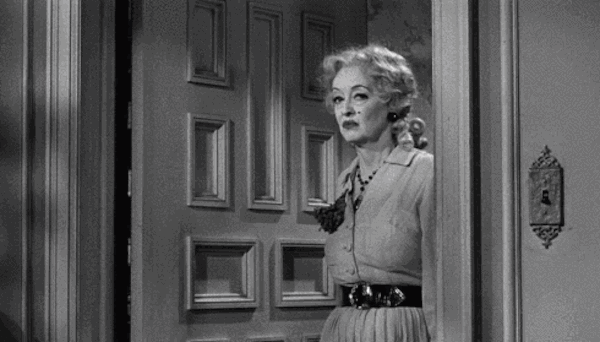
Aldrich’s iconic offbeat Gothic thriller What Ever Happened to Baby Jane? (1962) brought these two legends together culminating in the classic pairing of two bitter adversaries not only on screen but behind the scenes as well. Baby Jane? would forever consign their iconic images engaged in dramatic conflict and defining their rancorous relationship for an eternity.
The film cannily exploited the genuine animosity between both stars who had been competing for good roles in the 40s. Michael Musto of the Village Voice says this – “They just didn’t get along. Bette thought of herself as a real actress she thought of Joan as just kind of a flashy movie star without any depth.”
Crawford and Tone
Was their long drawn-out public war due to Crawford’s marrying co-star Franchot Tone allegedly stealing him away from Bette? Or was it the competitiveness for good roles in the 40s that drew a wedge between them? These two women were the most illustrious female stars of their day, successful at playing ordinary working-class gals with at times questionable reputations. But good roles were something they both had to fight to get. So was it a case of unrequited love or fierce competition? Either way, for both stars it was a genuinely personal and delicate affair.
On Davis’ last trip to London two years before her death, she revealed that the love of her life was Franchot Tone, but she could never marry him because he was Crawford’s second husband. “She took him from me,” Davis said bitterly in 1987. “She did it coldly, deliberately, and with complete ruthlessness. I have never forgiven her for that and never will.” Crawford already dead for ten years, was still the recipient of an eternal hatred on the part of Davis now 80 years old and desiccated from her stroke.
Bette Davis and Franchot Tone in Dangerous ’35.
Bette Davis was filming Dangerous 1935 a role that would win her first Best Actress Oscar. Warner Bros. cast her to play opposite the handsome Franchot Tone. In this fabulous melodrama, Davis portrays Joyce Heath an egomaniacal actress considered to be box office poison living in obscurity in the throws of alcohol addiction. Tone plays Don Bellows a playwright who tries to rehabilitate her. The story is loosely based on Broadway star Jeanne Eagels who died of a drug overdose at the age of 35
Davis wound up falling in love with her leading man, unaware that he was already involved with Joan Crawford who was recently divorced from the dashing Douglas Fairbanks Jr. This began the legacy of love jealousy, and possession. At the time Davis was married to musician Ham Nelson. Everyone on set could see that Davis was attracted to co-star Franchot Tone.
Years later she recalled “I fell in love with Franchot, professionally and privately. Everything about him reflected his elegance, from his name to his manners.”-Bette Davis
Crawford first entertained FranchotTone at her Hollywood home. When he arrived he found her tanned and completely naked in the solarium. According to friends and neighbors, he did not emerge from the seductive sojourn until nightfall.
Franchot Tone and Joan Crawford.
“He was madly in love with her,” Davis confessed, “They met each day for lunch… he would return to the set, his face covered with lipstick. He made sure we all knew it was Crawford’s lipstick.”-Bette Davis
“He was honored that this great star was in love with him. I was jealous, of course.”-Bette Davis
Franchot Tone and Joan Crawford-a dynamic couple.
But instead of Crawford retaliating she reached out to Davis hoping to be friends, but it was too late by then her heart was broken, and she was furious. Crawford announced her engagement to Tone during the filming of Dangerous and they married soon after the film wrapped.
Both actresses were present at the Oscar ceremonies. Davis was nominated for Best Actress. The hostility showed its ugly face when Bette wearing a modest navy blue dress stood up when they announced she’d won the award. Franchot Tone enthusiastically embraced Davis calling her ‘darling”which caused his wife to take notice. Crawford wearing a spectacular gown herself, looked Davis over and coldly said “Dear Bette! What a lovely frock.”
"Joan Crawford and I have never been warm friends. We are not simpatico. I admire her, and yet I feel uncomfortable with her. To me, she is the personification of the Movie Star. I have always felt her greatest performance is Crawford being Crawford."
Interestingly if you consider the inherent veracity of unrequited love that was systemic to their discord we may also consider the allegations that Crawford was herself a promiscuous bisexual in love with Davis, supposedly making several sexual advances toward Davis which were rebuffed with expressed amusement. Davis was an avowed heterosexual. “Gay Liberation? I ain’t against it, it’s just that there’s nothing in it for me.” “I’ve always liked men better than women.” –Bette Davis
Davis also proposed that Crawford used her body and sex to get ahead in Hollywood, “She slept with every star at MGM” she alleged later “of both sexes.”
Some of the women that allegedly were Crawford’s lovers included Greta Garbo, Marlene Dietrich, her friend Barbara Stanwyck & Marilyn Monroe.
The years of hostility and jealousy were only galvanized later by the battle that ensued on the set of Baby Jane? where Davis upended Crawford by endearing herself to director Aldrich. Davis got the Oscar nomination for Best Actress, but Crawford did not. only to have Crawford undermine Davis at the award ceremony sabotaging Davis by accepting the award for Ann Bancroft who won for The Miracle Worker.
Allegedly Joan shoved Bette aside to grab the coveted statue at the podium. Shaun Considine’s book ‘Bette & Joan The Divine Feud’ relates how when Ann Bancroft’s name was announced Davis felt an icy hand on her shoulder as Crawford said, “Excuse me, I have an Oscar to accept.”
Davis recalls“I will never forget the look she gave me.”It was triumphant. It clearly said ‘You didn’t win, and I am elated!”
Making matters worse the newspapers paraded the image of Crawford holding the golden idol that Davis failed to win. According to Bette Davis,Joan was bitter and conspired to keep her from winning the Oscar.
Crawford managed to insinuate herself into accepting the Oscar for Ann Bancroft in case Ann won. The night of the awards Bette Davis shows up fairly confident she could take home the Oscar. She was waiting in the wings with her purse ready to walk on stage when they announced the winner. But Joan Crawford was also hovering in the wings waiting to take her revenge.
From an interview in ’87 -“I was furious. She went to all the New York nominees and said if you can’t get out there, I’ll accept your award. And please do not vote for her. She was so jealous.” Crawford’s scheme worked, it was a terrible slap in the face for Bette Davis.
“The best time I ever had with Joan Crawford was when I pushed her down the stairs in Whatever Happened to Baby Jane?”
“There may be a heaven, but if Joan Crawford is there, I’m not going.”– Bette Davis
And how much does the media fuel this rivalry? Is it partly the paradigm of a film industry that engenders a climate of sexism and ageism that feeds tabloid culture devaluing women’s self-worth and antagonizing the rift that already existed between the two actresses? Consider the symbiosis that occurs between the press and female celebrities, their exploitative and predatory hunger to devour them whole, and the co-dependent dysfunction pervasive in the film industry. You have to wonder how much of the nasty fodder that kept the feud burning was fact and how much of it was a myth the media created.
It isn’t hard to see how both these aging stars were forced to fight for screen supremacy. An irreconcilable difference that put Aldrich in the sad and awkward position of having to fire Joan Crawford from her role as Cousin Miriam in his second feature with the dynamic duo in his Gothic thriller Hush… Hush, Sweet Charlotte.
Davis & Crawford on the set of Baby Jane.Davis & Crawford on the set of Hush… Hush, Sweet Charlotte with Aldrich.
Despite their feud the box office success of Baby Jane? encouraged Aldrich to change the story and characters but reunite the same controversial and quarrelsome stars. Originally called “What Ever Happened to Cousin Charlotte?” written once again by Henry Farrell. Crawford agreed to get back on the screen with her familiar enemy. But when Aldrich asked Bette to star in a second picture with Joan she loathed the idea of ever acting with Crawford again.
“I wouldn’t piss on Joan Crawford if she was on fire.”
Davis used to say that she and Crawford had nothing in common. She considered Crawford “a glamour puss” who depended on her fabulous looks alone, though Crawford did wind up working with some of my favorite auteurs like Michael Curtiz, George Cukor, Robert Aldrich, Nicholas Ray, Otto Preminger, and Jean Negulesco.
Both were very strong women who had to scratch and claw their way through a mire of misogyny to achieve their stardom. Crawford was always playing the formulaic vulnerable ‘girl from the wrong side of the tracks. Born in poverty she reaches for a dream and strives through hard work to make good. Stories reflecting the struggles of the Depression Era and World War II appealed to audiences of the 30s & 40s.
Based on Bette’s early stage performances critics said she was made of lightning filled with fantastic energy. It was George Arlisswho decided Bette would be perfect for his next film The Man Who Played God 1932. He became a bit of a mentor, Bette said he played god to her. In September 1931, she felt finished with her career in Hollywood and was packing her things with her mother ready to return to New York when George Arliss came along and saved her.
Bette Davis and George Arliss’s The Man Who Played God.
Joan Crawford had been married to Douglas Fairbanks Jr. at the time and learned everything about Hollywood royalty and how to become pretentious. When Crawford first arrived in Hollywood she was a dancer, an it-girl flapper for MGM throughout the late silent & early sound eras working alongside Clark Gable.
She didn’t have those signature eyebrows yet. At some point in the 30s, she started changing her look which embraced the heavily arched eyebrows, the wider mouth, and the notorious shoulder pads which became her iconic trademark. She left MGM and joined Warner Bros in 1943.
Crawford before her legendary eyebrows took over her face.Bette and those big beautiful blues.
Bette Davis and Joan Crawford on the set of What Ever Happened to Baby Jane?
Robert Aldrich is one of my favorite directors with numerous memorable films that transcend a restrictive genre tag. He always brings us a cynical and gritty story with very flawed characters who are at the core ambiguous as either the protagonist or the antagonist. Aldrich took economics in college, then dropped out and landed a very low-paying job at first as a clerk with RKO Radio Pictures Studio in 1941.
He studied with great directors like Jean Renoir. It was his training in the trenches that made him the auteur he is, delving inside the human psyche and questioning what is morality.
Aldrich has a flair for the dramatic. He likes to break molds and cross over boundaries. He also has a streak of anti-authoritarianism running through the veins of his films. There aren’t just traces of his ambivalence toward the Hollywood machine in his film philosophy; he also conflates the ugly truths beneath the so-called American Dream and the “real” people who inhabit that world.
He died in 1983, and while he remained inside the Hollywood circle, he maintained an outsider persona. In his work, he memorialized the misfits and outcasts by making them the anti-heroes, all of whom ultimately were destined to fall because they refused to play the conformity game.
In 1961, Aldrich partnered with Joseph E. Levin to purchase the rights to the British writer John Farrell’s Hollywood horror book, but at first, no one seemed interested. Aldrich got Seven Arts Pictures curious about the film, and so Warner Bros. agreed to distribute it but didn’t allow it to be made on the Warner lot.
Bette Davis, Jack Warner, Joan Crawford, and Robert Aldrich.Robert Aldrich with Bette Davis and Joan Crawford.
Aldrich relates in an interview that “Eliot Hyman at Seven Arts read the script, studied the budget, and told him candidly: “I think it will make a fabulous movie, but I’m going to make very tough terms because it’s a high-risk venture.”
Baby Jane? was not an easy sell, even with the double billing, both the actress’s box office draw had diminished by then. Later on, Aldrich said that the problem with Jane was that “the topic was perceived as controversial and not a built-in moneymaker which would alienate portions of the public.”
Jack Warner was quoted as saying he “Wouldn’t give a plug nickel for either one of those old broads.”Warner was an asshole!
Warner Studio head Jack Warner with 2 two star ‘broads’ Bette Davis & Joan Crawford.
In interviews with Aldrich, it has been noted that his working relationship with Crawford was already very good, having worked with her on Autumn Leaves (1959). However, with Bette Davis, he had to do a little more convincing. Eventually, she was on board with the project.
By the time Aldrich bought out Levine, the story price had gone from $10,000 to $85,000, and no one seemed interested. But Aldrich relates in an interview that “Eliot Hyman at Seven Arts read the script, studied the budget, and told him candidly: “I think it will make a fabulous movie, but I’m going to make very tough terms because it’s a high-risk venture.”
It was Aldrich’s persistence and his faith in the project that made Davis enthusiastic about the film. Crawford had already expressed a desire to work with Bette Davis in a film. Bette taking on such an unattractive role was pretty gutsy for her.
I choose to focus on Baby Jane? and Sweet Charlotte, as they are not only my favorites of his, but also they are 2 incredible pieces of film art with the allure of the dynamic pairing of two of THE most legendary actresses from the silver screen.
What’s most fabulous about the film is that it has both Bette and Joan, which gives it such a dynamic double billing. The film really was a seminal work because nothing quite like it had been done earlier. Films like Sunset Boulevard (1950)and Autumn Leaves (1959) set some groundwork for older actresses to wax crazy dramatic in film. But ultimately the pot boiled over with Baby Jane?and Hush… Hush, Sweet Charlotte.
Joan Crawford has the more glamorous role of an aging movie starlet, while BetteDavis must inhabit the role of the decrepitude has-been child of vaudeville.
And while Aldrich has a notable filmography to his credit, like his Cold War scare noir masterpiece Kiss Me Deadly, his film that exposes the flawed Total Institution of the penal system, The Longest Yard with Burt Reynolds, and his iconic war ensemble, The Dirty Dozen 1967. There’s his other psychological thriller with Joan Crawford playing wife to the psychotic Cliff Robertson in Autumn Leaves 1956 and the two Hollywood ventures exposing the darker side, The Big Knife 1955 with Jack Palance, and of course, Kim Novak in The Legend of Lylah Clare 1968.
Joan Crawford and Cliff Robertson in Aldrich’s Autumn Leaves ’56
What Ever Happened to Baby Jane?Directed by Robert Aldrich is based on the novel by Henry Farrell with a screenplay by Lukas Heller. Cinematography by Ernest Haller (Gone With the Wind 1939, Mildred Pierce 1945, Rebel Without a Cause 1955), Art Direction by the fabulous William Glasgow, Norma Kotch won an Oscar for her costume design on Baby Jane? and Hush… Hush, Sweet Charlotte as well as Aldrich’sThe Flight Of The Phoenix (1965).
Co-starring: The main players–Victor Buono as Edwin Flagg, Marjorie Bennett as Dehlia Flagg, Anna Lee as Mrs.Bates, Maidie Norman as Elvira Stitt, and Barbara Merrill (Bette’s daughter) as Liza Bates.
The film premiered on October 26, 1962. and released on Halloween of 1962. Davis was nominated for Best Actress and Victor Buono for Best supporting actor.
What Ever Happened to Baby Jane?is filled with grotesque melancholy, the wasteland of forgotten womanhood, and abject psychosis drenched within the portrayal of a repressed woman-child born of rage and delusion. It’s also a striking condemnation of the rampant sexism and ageism in Hollywood. Another reason I want to talk about Aldrich’s two seminal Grande Dame Guignol films is that both motion pictures set the tone for a whole cycle of films to follow.
For the 50s and 60s, melodramas consisting of plots about mental illness weren’t typically conventional, and a film as extremely grotesque as Baby Jane? could be considered very disturbing. Even as groundbreaking as Hitchcock’s Psycho (1960) was, released the same year as Baby Jane?,Psycho’s narrative veiled Norman Bates as a mild-mannered young man with an Oedipus complex. In Baby Jane? her flagrant derangement is glaring.
Perhaps films like Val Lewton’s Bedlam 1946, Anatole Litvak’s The Snake Pit 1948, and Sam Fuller’s Shock Corridor 1963addressed the systemic institutional problems surrounding mental illness, but Aldrich’s films are very intimate ventures.
This lurid pulp melodrama of abject madness is superb, particularly because of the uninhibited performances by Bette Davis and Joan Crawford. It was pretty courageous of both starlets to leave the glamor behind for such a ghastly and unpleasant ceremony.
Image of glamorous Davis & Crawford courtesy AMC’s Backstory.
First of all, I LOVE Bette Davis with a passion, the actress and the woman herself. Have you ever seen the fabulous Dick Cavett interview? If not, you should track down a copy. Bette is an enduring icon and one of a kind. She has a distinct style, a unique “hitch to her git along”, as Andy Griffith would say, and is a true Hollywood legend, thoroughly intrepid, dynamic, and just downright glorious!
And I adore Joan Crawford as well. She was unbelievably beautiful when she first started out in motion pictures, before her signature crazed galvanized eyebrows took over her face and those shoulder pads in her wardrobe. It makes me sad to think that these women might have truly despised each other. It’s truly a shame.
Aldrich directed this film with crude veracity, leaving us to dwell on some feelings of ambivalence toward these particular characters. I was with Jane even at her cruelest, although I pretend that the bird died of natural causes and the rat was found that way. I never warmed up to Blanche, even though she was an invalid; I got the sense from her that she was not what she appeared to be.
Reducing Davis’s performance in histrionic camp would diminish the moments when she is in stark control of the serious meter of Jane’s growing madness. The oscillation between Jane’s childish tantrums and musings and the all-out fury and retaliations is an artful feat delivered by Davis quite masterfully. She must have enjoyed the role immensely. It must have also been challenging. Jane’s dissipated drunken swagger, the way she literally slouches around the house, and her irritable disposition might be the culmination of not only 30 years of taking care of Blanche, but also a sign that she is inappropriately uninhibited by her years of the undigested bile of animosity, hostility and ultimately her malicious outbursts of paranoia, that lead to her aggression and violence.
In the end, Jane’s macabre corpse’s white makeup, painted like a mask with a heart-shaped beauty mark, Kewpie-doll lipstick, and blond wig of a massive ringlet gives Jane an extra bizarre persona. While Jane is supposedly a vain character, ironically, she is under the impression that she is fashionable; she is a vaudeville clown with caked-on face powder and slouchy dresses that are adult versions of the Baby Jane stage outfits she wore as a child. When Jane goes out in public wearing fur, wilted corsage, and antique jewelry, it represents her attachment to the past, although it is not flattering to her at all, when, in fact, she is perceived as pitiful. Apparently, Davis herself created the chalky, pale, freakish makeup that Jane puts on when she starts to plan her comeback. It’s almost a decrepit version of the artist-painted face of Geisha culture. In Peter Shelley’s book Grande Dame Guignol Cinema- A History of Hag Cinema from Baby Jane to Mother, he compares the way Blanche looks at the end, with her pasty death mask and dark rings to the actress Irene Papas. It was definitely the dark, imposing eyebrows.
Gee-I’ve been excited about Bill Castle ever since I saw his skeleton who is billed as ‘himself’ in House on Haunted Hill ’59 down in the wine cellar with Vincent Price and Carol Ohmart.
First of all, I can’t even begin tell you how incredibly grateful I am to all the amazing contributors who are joining me and Goregirl (who’s got a lot of high spirited fun in store for us) in celebrating one of THE most iconically entertaining auteurs. William Castle reached across many genres not just the B-movie spine tinglers that some people remember him for.
Thanks again to all of you who are joining in the fun. You will not only ensure that it’ll be a week of fabulous thoughts, themes and thrills. I just know in my heart that Mr. Castle would glow with pride to see how many people’s lives were touched by his inimitable style and purely delicious ballyhoo!
Don’t forget to grab yourself a banner or two, thanks to my versatile and lovely partner Wendy Christensen and David Arrate for designing such great graphics for the event…!
In honor of the 40th anniversary of Robert Ryan’s death July 11, 1973 with a special nod to Karen & The Dark Pages for their spectacular tribute to this incredibly real man!
“Ryan was unfailingly powerful, investing his tormented characters with a brooding intensity that suggests coiled depth. Cut off from the world by the strength of their ‘feelings’ his characters seem to be in the grip of torrential inner forces. They are true loners. Ryan’s work has none of the masked, stylized aura of much noir acting. He performs with emotional fullness that creates substantial, complex characters rather than icons.” –Foster Hirsch-FILM NOIR: The Darker Side of the Screen
ClearlyRobert Ryan’sinfinite presence in film and his numerous complex characters manifest an embracing universal ‘internal conflict’ of masculinity. I tribute certain roles the actor inhabited during his striking career. Though he was cast more often in the part as the imposing heavy, the depth and breadth of Ryan’s skill with his rough-hewn good looks should have landed him more roles as a lead male capable of such penetrating levels of emotion. He had a depth that suggests a scarcely hidden intensity smoldering at the surface.
Robert Ryan as Montgomery in Edward Dmytryk’s Crossfire 1947.Robert Ryan in Act of Violence ’48
A critic for the New York Times reviewing Act of Violence (1948)  wrote about Robert Ryan’s persona as the madly driven veteran bent on revenge, Joe Parkson calling him “infernally taut.”
Frank Krutnik discusses ‘Masculinity and its discontents’ in his book In A Lonely Street,“In order to make the representation of masculinity in the noir thriller, there follows a schematic run-through of Freudian work on the determination of masculine identity.” Claiming Freud’s work can be co-opted into film with an emphasis of its relevance to analysis of the cultural machinery of patriarchy.” He discusses patriarchal culture which relies heavily on the maintenance of a gender-structured ‘disequilibrium’ with its roots in the myth of the Oedipal Complex. Involving not only the power-based hierarchy of male service to masculine power but the established normative gender values which inform both the male and female figure.
Act of Violence Robert Ryan as Joe Parkson co-starring Janet Leigh
Many of the characters in Ryan’s noir world are informed by a cultural ‘determinacy of the phallus’ that authorizes toughness and strips the limits of desire as an obligation to masculine identity. The patriarchal power structure predetermines a fixed and limited role that creates a destiny of submission and impotence in Ryan’s characters. But within the framework of these extreme male figures lies an intricate conflict of varying degrees of vulnerability and fragility.
Ryan manifests this duality within hyper-masculine characters. Outwardly physical, confrontational, and hostile, Ryan is a master at playing with men who suffer from alienation and inferiority surrounding their own ‘maleness’ and self-worth. He was never just a dark noir brute or anti-hero but a complex man actualized through layers of powerful dramatic interpretation. His performances suggest a friction of subjugated masculinity bubbling within.
Ryan as Earl Pfeiffer and Barbara Stanwyck in Fritz Lang’s Clash By Night.
The trajectory of the male through the Oedipus Complex encompasses male subjectivity which is a principal issue in the noir ‘tough-thriller.’ The ‘existential thematic’ link to the Oedipus myth concerns questions of male desire and identity as they relate to the overarching law of existing patriarchal culture substituted for the original fearsome ‘divinity.’ This element is one of the driving psychological themes underlying any good classic film noir.
In this post, I put my focus primarily on Ryan’s characters within the framework of each film and while I discuss the relationship between him and the central players I do not go as in-depth as I usually do discussing his co-stars or plot design.
I apply this thematic representation to many of the roles engendered in the films of Robert Ryans‘ that I’ve chosen to discuss here. A patriarchal power structure establishes the tragedy of man’s destiny, a fixed and limited role in the character’s own destiny as there is a predominant power that threatens them into submission and sheds light on their own impotence. So many of the noir characters in a Robert Ryan noir world are shaped by a cultural authority structured through ‘determinacy of the phallus’ that authorizes toughness in the male identity that strips away the limits of desire, as an obligation to ‘masculine identity.’
Ryan’s stoic boxer Stoker in Robert Wise’s The Set Up.
I’m focusing on particular Ryan’s roles within a noir context that depict archetypal hyper-masculine tropes and the problematic strife within those characters. Whether Ryan is playing the deeply flawed hero or the tormented noir misfit, his characters are afflicted with an inherent duality of virility and vulnerability, inner turmoil, alienation, persecution, and masochism. It’s a territorial burden that Robert Ryan so effortlessly explores.
These films show Ryan’s trajectory through forces of menacing restraint and poignant self-expression. Within a noir landscape, the schism of stark virility and tenuous masculinity exposes the complexity of alienation, masochism, and frailty. Robert Ryan’s performances are a uniquely fierce and formidable power.
Within the framework of these ‘extreme’ male figures lies an intricate conflict with varying degrees of vulnerability & fragility within the male psyche. The narratives don’t necessarily flesh out this conflict plainly, but Ryan’s performances certainly suggest and inform us about the friction of this subjugated theme bubbling to the surface as he manifests the duality within his hyper-masculine characters. Robert Ryan was a master at playing men who suffer from alienation and inferiority surrounding their own ‘maleness’ and self-worth.
Ryan is never just a dark noir ‘brute’ or anti-hero but moreover, a complex male who is actualized through layers of powerful dramatic interpretation. A complexity of stark virility and ‘tenuous maleness’ as the narrative witnesses Ryan’s trajectory transforming him through various dynamic forces of menacing restraint and poignant self-expression. Outwardly physical, confrontational, hostile, and ultimately masculine, and the schism that is inwardly emotional, alienated, self-deprecating, masochistic, and fragile within the film noir landscape. Robert Ryan’s performances still maintain a uniquely fierce and formidable aesthetic of the ‘suffering-marginalized man.’