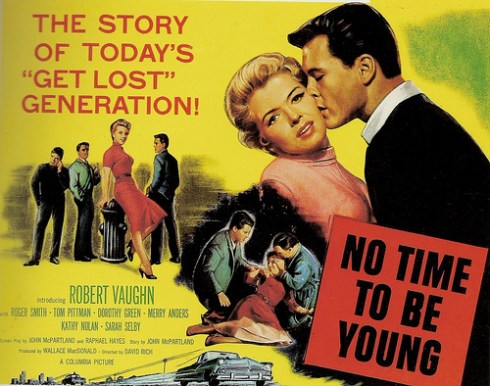
“Unless I miss my guess you got yourself a kiss coming up about now!”
Here’s to Barney Fife the eternal lover – MonsterGirl


Produced by Jack L Warner and Mark Hellinger and directed by Edward A.Blatt, with a screenplay by Daniel Fuchs and based on Sutton Vanes play “Outward Bound” this story is a journey with an extraordinary ensemble cast, featuring John Garfield, Paul Henreid, Sydney Greenstreet, Eleanor. Parker, Edmund Gwenn, George Tobias, George Coulouris, Faye Emerson, and Isobel Elsom.
With an beautifully evocative score by Erich Wolfgang Korngold (Kings Row 1942,The Sea Wolf 1941)


The film begins with an air raid during WWII, in which several people are unable to seek shelter. As the film transcends it’s earthly boundaries, it emerges as a mystical and melancholy tale of lost souls thrown together on a mysterious ship, trying to grasp the meanings of their lives, as they reflect and react to each other.
Aboard this strange ship which acts as a traveling Pergatory the players must wait and see if their final destination will either be heaven or hell, as their paths become clear to them, and they awaken to their final destinies.


Here in this world, saying be happy-MonsterGirl


Orson Welles is the black Irish seaman chump Michael O’Hara who falls head long into a web of desire, subterfuge and murder, when he stumbles across (Everette Sloane) Arthur Bannister’s wife Mrs. Elsa Bannister (the exquisite Rita Hayworth) out for a carriage ride in the park one night. With one of the most staggering climaxes in Film Noir!


-MonsterGirl


Â

Susan Gordon plays Susan Shelley a demented child not unlike Jan Brady, just released from a convent/ institution run by nuns…where she’s been placed after suffering from the shock of seeing her mother, (the flamboyant Zsa Zsa Gabor) Jessica Flagmore Shelley be consumed by flames in her opulent bedroom.


Susan still traumatized by the haunting memories of her mother’s horrific death and surrounded by some of the creepiest toys in all tarnation, comes home to the palatial hearth with father Don Ameche as Edward Shelley and his new lusty, conniving second wife Francene played by sexy Martha Hyer. Edward is so blinded by his desire for Francene that he’d sell out the whole estate contents and all to give his conspiring hussy all the money, vacations, and furs she wants.
Francene starts sneaking around again with brother-in-law Anthony Flagmore played by Maxwell Reed. Flagmore’s face has been charred from that fateful night when Mommy went up in flames. His odd presence and faithfulness to his pet hawk, add an air of the macabre to the already heady script.


The brazen couple plot to drive little Susan over the edge, while trying to get her to reveal the whereabouts of her mother’s missing diamond necklace.
This Grande Dame horror film is a little gem from the vintage 60s, by director Bert I Gordon, and also boasts a great supporting cast with, Wendell Corey, Signe Hasso, and Anna Lee. It’s creepy, it’s campy and a wonderfully colorful psychosomatic romp. Cinematography by Ellsworth Fredericks, who was director of photography on Invasion of The Body Snatchers 1956 and the sublime Mister Buddwing 1966 which I’ll be writing about soon) The soundtrack includes The Hearse Song sung by Gordon…‘The worms crawl in, the worms crawl out.’


Be nice to mother now!- MonsterGirl


Directed by Reginald Beck, and Anthony Bushell. Written by Nunnally Johnson, Edgar Lustgarten is based on his book “A Case To Answer” and W.E. Fairchild. With cinematography by Wilkie Cooper (Stage Fright 1950, Jason and The Argonauts 1963), granting wisps of shadowy montages that are equally noirish, suspenseful, and simply splendid.

Yielding and obsessive Rex Harrison plays Arthur Groome a London gentleman married to the devoted and lovely Mary (Lilli Palmer.)Unfortunately, Arthur becomes consumed by a flirtatious showgirl Rose Mallory (Patricia Cutts), who winds up being brutally knifed in her boarding house room, and left for the credulous Groome to become suspect one. First gets the splatter of Rose’s blood on his jacket, but then fails to prove his innocence in a sea of circumstantial evidence.
Condemned to hang, this allows the real serial killer played by the tall and eerie Anthony Dawson who looks frightened all the time, a destroyer of wanton women who sees himself as ‘an instrument of justice‘, still lurking about, first at the trial spouting off about his obvious philosophy on sexually independent women, and then creepily shadowing poor Mrs. Groome, whom he idealizes as the perfect woman.


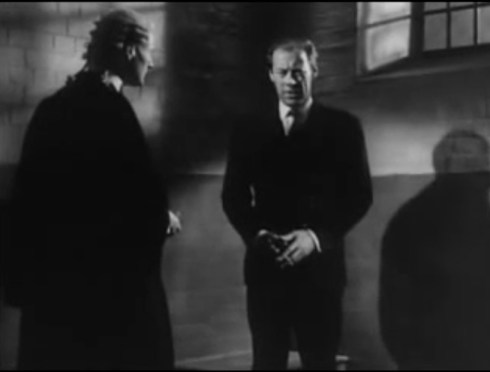


I’ll be up the long dark hall til next time! -Yours always- MonsterGirl

Writer Virginia Kellogg (White Heat 1949) offers us a doozy with this story directed by John Cromwell (Dead Reckoning 1947)
Eleanor Parker is Maria Allen, thrust into the prison system run by a well-meaning warden Ruth Benton played by the inimitable Agnes Moorehead. As in any good women in prison flick, it requires the sadistic matron to roil the exploitation brew with lots of dehumanizing antics like a good head shaving or dare I mention it, a kitten killing. So here’s to Hope Emerson’s mean-spirited Evelyn Harper, kitten killing, bon bon eating, Midnight Romance reading, prison caboose with a mean on, that makes Ida Lupino look like Saint Joan. Also starring one of my new favorites and a staple to these great gritty noirs the sprite Jan Sterling, Betty Garde, Ellen Corby, and Jane Darwell.


Jack Clayton’s The Innocents 1961 starring Deborah Kerr.


I’ll be heading back up the ‘steps’ here at the drive-in, be well- MonsterGirl!


In Nightmare Alley Barbara McLean contributes to creating a landscape of a distorted reality alongside the dark, clandestine, and arcane carnival atmosphere. The film is beautifully woven, as the seamless images flow into one another. McLean blends together the invisible strands that only one’s dreams could effectively manifest. McLean’s editing constructs much of the surreal and tormented ‘movement’ of the film. It’s what transports each scene of the film, making it every bit as if WE were inhabiting someone’s nightmare.


With 62 film credits to her name, half of which were with filmmaker Henry King, Barbara McLean is a master of cutting and shaping. She’s worked on some of my all-time favorite films including this film, Goulding’s Nightmare Alley, Joseph L. Mankiewicz’s No Way Out (1950), Henry King’s The Song of Bernadette (1943), Robert Wise’s The Desert Rats (1953), John Ford’s Tobacco Road (1941) and again Mankiewicz’s All About Eve (1950). McLean also worked as an editor on Elia Kazan’s Viva Zapata in 1953, and in 1954 with Michael Curtiz’s on The Egyptian. She edited the first movie filmed in CinemaScope, The Robe (1952), directed by Henry Koster.


Barbara McLean was one of the most recognized editors working during the reign of Darryl F. Zanuck at the 20th Century Fox Studio, from the 1930s to the 1960s. Eventually achieving the honor of division chief of the editing department in 1949. She joined Fox in 1935 as one of only eight female film editors working in Hollywood in the 1930s. McLean was part of a huge team of technicians, writers, directors, and collaborators that Zanuck went to for guidance. She was very influential in much of Zanuck’s decision-making process, as she often acted as an adviser to the Hollywood movie mogul, helping him coordinate even a single shot.
She won the 1944 Academy Award for Film Editing for her work on Wilson (1944) director Henry King’s biopic film of Woodrow Wilson’s political career. McLean was nominated another 6 times for that award, including her work on All About Eve. I think she should have won the 23rd annual Academy Award for All About Eve, but she lost to Ralph E Winters and Conrad A Nerig for their work on King Solomon’s Mines. It was a tough year to compete with nominations also going to The Third Man and Sunset Boulevard. McLean’s greatest collaboration was with filmmaker Henry King, a relationship that spanned over 29 films including Twelve O’Clock High 1949.
Her last editing credit was for Henry King’s Untamed (1955). In later years, McLean acted primarily in a supervisory and administrative capacity, eventually retiring from 20th Century Fox in 1969, due to her husband’s declining health. She received the inaugural American Cinema Editors Career Achievement Award in 1988. McLean died in Newport Beach, California in 1996.

Her impact was summarized by Adrian Dannatt in a 1996 obituary in The Independent: McLean was “a revered editor who perhaps single-handedly established women as vital creative figures in an otherwise patriarchal industry.” Writer Tom Stempel, in a piece about Darryl F. Zanuck, writes of McLean‘s influence on Zanuck‘s filmmaking; “For all her focus on keeping the narrative moving, McLean’s editing could dazzle if called for. In A Bell for Adano (1945), she took material director Henry King shot on the return of the Italian POWs to their village and put it together with such a pure sense of emotion that when she cut at exactly the right moment to King’s overhead shot of the prisoners and villagers coming together in the square, the cut was more heart-stopping than conventional close-ups would have been.”
McLean brings together the writer’s and director’s vision and gives it completeness, a cohesion, like alchemy with film footage, she creates cinema gold. According to Bright Lights Film Journal “the basic rules of film editing, first established in the silent era, still govern the industry today: maintain your eye lines, preserve continuity, respect planarity (the rules governing the transposition of three dimensions onto a two-dimensional plane), find a good rhythm, and, most important, always advance the story.” Here is where McLean excels. If you look at the variety of narratives, milieus, and landscapes McLean has stitched together in the editing room, you can see how expansive her vision explores the realms of the human condition, moral corruption, and redemption weaving together images that shape the story into ‘the big picture’, with all the little pieces of the intricate moments of the framework, revealing an intimate story, a memorable story, a universal notion of people living in a state of transformation.
If I could enter the film industry at this stage of my life, there would be one thing aside from my already being a music composer, of course, would be to sit in the editing chair. One of the things I look for in a film, and feel passionately certain about is the cinematography, scoring, and casting, if there is one singularly essential component to what makes a film greater…it’s the editing.
We should also celebrate the women working in the very male-dominated career of film editing, women like Barbara McLean and even Dorothy Spencer (Lifeboat 1944, Stagecoach 1939, and the film I recently blogged about Valley of The Dolls 1967).
I should also mention, Anne Bauchens, who was Cecil B. DeMille’s editor, cutting nearly all his movies from 1915 until his death in 1959, and Margaret Booth. Two women who haven’t been put in the greatest light in terms of their ‘difficult’ personalities and skill, something I’ll write about in future. But aren’t women always difficult to work with? Geez.
And so let’s raise a toast to Barbara McLean’s contributions to the cinema… a pioneer in the industry not only breaking the glass ceiling but taking all the pieces and putting them back together to make an indelible cinematic mural for ages to come.
And now for the Carnival ‘Geek’ in Nightmare Alley: Tyrone Power’s astonishing portrayal of Stanton ‘Stan’ Carlisle the ambitious carney who rises to evangelistic notoriety as a slick and cunning mentalist, only to descend into the realm of self-destruction when power corrupts, consumes and destroys his life, ultimately leading him back to sideshow freakery becoming the very ‘geek’ he once found repulsive. McLean’s treatment of the film’s climatic excursion into the bowels of the carnival and Stan’s diminution into the shadows is quite viscerally staggering.


According to the book Carny Sideshows by Tony Gangi, a ‘Geek’ is:
An unskilled performer whose performance consists of shocking, repulsive and repugnant acts. This “lowest of the low” member of the carny trade would commonly bite the head off a living chicken, or sit in a bed of snakes. Some historians distinguish between “geeks” who pretend to be wild men, and “glomming geeks” whose act includes eating disgusting things. See the 1949 movie “Nightmare Alley” for a good geek story as well as for an excellent depiction of the mentalist’s technique of “cold reading”. In later years the geek show turned into a “see the pitiful victim of drug abuse” show. “Geek” as a verb (“he geeked”) is one of several terms in use among wrestlers meaning to intentionally cut oneself to draw blood.

Either on the fairway or the cutting room floor, I’ll be there! Your ever-faithful -MonsterGirl!