Life Lessons from Barney Fife: from Convicts At Large “Let me guide you into the land of rhythm and pleasure”

From Convicts At Large: Barney and Big Maude

Barney – Lets you and me dance…

Big Maude (Reta Shaw )-You kidden’?
Barney – No, I’m not.

Big Maude – What made you change your mind?
Barney – You’re beginning to get to me
Big Maude – You’re a doll.

Barney – Now now… you just gotta relax, just flow with me, let me guide you into the land of rhythm and pleasure.

Boris Karloff’s Thriller: The Ordeal of Dr Cordell: “I know that science and ego make lousy chemistry”

Boris Karloff’s Thriller The Ordeal of Dr. Cordell Episode release date: March 7, 1961

Directed by Lazlo Benedek, Written by Donald S. Sanford and music scored by Morton Stevens. Starring Robert Vaughn as Dr. Frank Cordell and Kathleen Crowley as Dr. Lois Walker.

There are obvious elements of  Robert Louis Stevenson’s The Strange Case of Dr. Jekyll and Mr. Hyde with more of a neo-realism that displaces the Gothic romanticist nature of the story of dualities of the mind/soul connection transplanting it in a modern setting, making it almost hyper eerier. This episode is also one of the few in the series that is an integration of post-world War II science-fiction mystery with the reoccurring themes of crime drama and Gothic horror that most of the other episodes pivoted on in this timeless hybrid television show. Not only are there traces of Neo-Noir realism of the 60s, but it also flirted with good science vs bad science. I find a correlation with the original novella published by Stevenson in the late 1800s.

ROBERT LOUIS STEVENSON

The Strange Case of Dr. Jekyll and Mr. Hyde is the original title of a novella written by author Robert Louis Stevenson that was first published in London on Jan  5th, 1886. The work is commonly known today as simply Dr Jekyll and Mr Hyde Dr Henry Jekyll has unleashed a bestial alter ego Edward Hyde, a violent misanthrope. A fracturing of the self, into two clashing and opposing natures. It is the ultimate parable of good vs evil where 2 vastly different personalities within the same person battle over their moral character and the question of right and wrong.

Continue reading “Boris Karloff’s Thriller: The Ordeal of Dr Cordell: “I know that science and ego make lousy chemistry””

Grande Dame/Guignol Cinema: Aldrich’s Hag Cinema: Hush…Hush, Sweet Charlotte 1964 Part 3 “Murder starts in the heart and it’s first weapon is a vicious tongue”

READ PART 2 HERE:

Grande Dame/Guignol Cinema: Robert Aldrich’s Hag Cinema Part 2 Hush…Hush, Sweet Charlotte 1964 “He’ll Love You Til He Dies”

HUSH…HUSH, SWEET CHARLOTTE (1964) – Continued

Charlotte is sipping her coffee and hears a car pull up. She’s holding her shotgun. She sets the china cup down and starts to get up, moving toward the door. We hear a small bird chirping, then the police vehicle comes up the drive, encircled by glorious oak trees. Charlotte closes the door and runs to the great hall, calling “Velma!” Velma comes to the top of the banister, looking through the wooden slats down at Charlotte. She hangs over the edge, “What?” in a long, drawn-out suspension of the word.

Velma is unpretentious and could be perceived as a crude woman. She’s like an unmade bed or someone who looks like she just rolled out of one, and she doesn’t throw away her words. She is strong, sensible, and reliable. Velma, disheveled, unkempt by the years of working as a caretaker to her Miss Charlotte, is misleadingly simple, yet she is sturdy and obviously faithful to her mistress. Continue reading “Grande Dame/Guignol Cinema: Aldrich’s Hag Cinema: Hush…Hush, Sweet Charlotte 1964 Part 3 “Murder starts in the heart and it’s first weapon is a vicious tongue””

MonsterGirl’s Sunday Nite Surreal: Black Sunday/La Mashera del Demonio 1960

BLACK SUNDAY/LA MASCHERA DEL DEMONIO

Directed by Mario Bava & starring the immortal otherworldly – Barbara Steele!

blacksunday6big

This timeless Gothic masterpiece is also known as The Demon’s Mask, Revenge of the Vampire, and House of Fright. It is the Maestro Bava’s first film as a solo director, since first working as a cameraman with another auteur of the dark Riccardo Freda, Bava co-directed I Vampiri (1956)

With the presence of the enchanting & luscious beauty of Steele– the film becomes a romantic exercise in the Gothic style of European horror. Her eyes alone could mesmerize an audience with an effervescence that few possess with their gaze.

Bava also controlled the prowling camera style and Nedo Azzini’s sets are emblematic of the netherworld the story is steeped in.

Like a malefic allegory shown with gruesome keenness, Black Sunday is loosely based on Nikolai Gogol’s The Vij.

Barbara Steele manifests two characters the mirror image of each other–Princess Asa Vajda is tortured and burned as a witch. This is how the film opens with a ferocity that propels the film to a whole other level of classical horror. It is the stuff that dark fairy tales are made of… and nightmares.

The iconic spiked Devil Mask that is pounded into Asa’s face for the crime of adultery, or what was considered to be an act of ‘witchery’ Women’s wiles have always been considered powerful, tempting, and dangerous to men.

The local Inquisitor calling Asa a witch, and condemning her to such a brutal death bears ironing for he is Asa’s own brother. Once Asa returns to claim her revenge she vampirizes Katia in order to rejuvenate her life force.

It is now 200 years later, and Katia Vajda the descendent of the persecuted Princess Asa, is the spitting image of the beautiful ‘witch.’ Asa and her lover Javuto (Arturo Dominici) rise up from the tomb, cobwebs, scorpions, and spiders to wreak revenge on the legacy of the Vajda family curse.

One of the most memorable scenes in horror film history is the resurrection of Javuto from the crumbling ground, the smoky dark clouds surround his devil-masked rotting visage underneath–as he claws his way out of his grave and lurches off into the ghostly night.

The special effects, masks, faces, matte painting, etc. were done by Bava himself with his brother Eugenio Bava. The face of Asa which bears the marks of the spike holes from the devil mask adds a chilling effect to the film. It also creates the image of the monstrous feminine that strives to conquer and drain the life of those she’s fixated on. The two characters that Steele plays are contradictory figures, one virginal and innocent, the other bloodthirsty and evil. Asa was unholy because of her sexual desires.

Black+Sunday+7

Black Sunday’s expressive influence and its grand sense of classical horror are rooted in the idea that a woman’s sexuality cannot be destroyed, and will always inevitably return by its own primacy enduring the scars of the violence inflicted upon her. That which the world order, particularly religious zealotry and patriarchal law attempt to oppress come back twofold just to shake up the order of things.

The ultimate threat appears as the merger of the two Vajda’s women Asa & Katia… the virgin and the whore. Bava continued to make films where men desperately tried to destroy the lure of women’s desire and their desirability…

giphy-2

Black_Sunday-mask_0

black-sunday-1960-movie-review-princess-asa-vajda-witch-burned-at-stake-barbara-steele-mario-bava

black-sunday-ivo-garrani-barbara-steele-1960-us-1961

masque-du-demon031

giphy

STARE INTO THESE EYES… discover deep within them the unspeakable terrifying secret of BLACK SUNDAY… it will paralyze you with fright!

BRIDES OF HORROR – Scream Queens of the 1960s! – Part 4: The Dark Goddess-This Dark Mirror

Grande Dame/Guignol Cinema: Robert Aldrich’s Hag Cinema Part 2 Hush…Hush, Sweet Charlotte 1964 “He’ll Love You Til He Dies”

Hush… Hush, Sweet Charlotte (1964)

Directed by Robert Aldrich, written by Henry Farrell, who also wrote What Ever Happened to Baby Jane? (1962), How Awful About Allan (1970) and the made-for-tv film The Eyes of Charles Sand (1972) scripted by Lukas Heller and Farrell. Starring the legendary Bette Davis as Charlotte Hollis, Olivia de Havilland as cousin Miriam Dearing, and Joseph Cotten as Drew. The inimitable Agnes Moorehead as Velma Cruthers. Cecil Kellaway as Harry Mills, Victor Buono as Big Sam Hollis, Mary Astor as Jewel Mayhew, and a very young Bruce Dern as John Mayhew. George Kennedy as the foreman and extra recasting of Wesley Addy as Sheriff Luke Standish, and Dave Willock from Baby Jane?

Aldrich apparently had another hit with his 2nd genre film, which opened to generally positive reviews. With the exception of this scathing review in The New York Times, by Bosley Crowther who couldn’t have been more off the mark, he writes “So calculated and coldly carpentered is the tale of murder, mayhem, and deceit that Mr. Aldrich stages in this mansion that it soon appears grossly contrived, purposely sadistic and brutally sickening. So, instead of coming out funny, as did Whatever Happened to Baby Jane? it comes out grisly, pretentious, disgusting, and profoundly annoying.”

Again, I wholly disagree with Crowther, as this film wasn’t meant to be as campy as Baby Jane, and “funny” is an odd word for the film as well, nor was there an unwritten rule that said Aldrich had to restrain some of the grisly details from this picture. I don’t believe chaining an invalid to a bed, feeding them road kill, and slowly starving them to death is the less disgusting proposal. And as far as being brutally sickening, I see Charlotte as a hauntingly nightmarish allegory.

Let me say that I loved Peter Shelley’s book. He compiled some great examples of the genre and added a lot of information and insight to the subject matter; I was with him all the way, so there were a few points of divergence in our opinions of Hush… Hush, Sweet Charlotte isn’t a slight to the author at all. According to Peter Shelley in his Grande Dame Guignol Cinema: A History of Hag Horror from Baby Jane to Mother, the chapter on Hush Hush Sweet Charlotte, the film suffered from the absence of Joan Crawford. Shelley considered the follow-up film to be a “bloated reprisal of the pivotal components of the earlier film” (pg.57). Actually, I think quite the contrary about this suspenseful, understated film. It has less of a feeling of a”bloated” extension of the first Hag film, as Charlotte appears more distilled, virtually more refined in its subtle use of hallucinatory machinations, with a very cogent argument for Charlotte’s sustained ire and melancholy. Shelley considers the location an attempt to surpass the Grande Guignol aspect of its predecessor by placing it in a southern Gothic milieu, the Ascension Parish, but he thinks it fails with its “florid exoticism” again because it lacks the electrifying cast choice by not reuniting Crawford and Davis. Additionally, I say too much of a good thing becomes a device therefore a reuniting of the two would have minimized the impact that the prior collaboration by both film stars made on Baby Jane. I think that Hush… Hush, Sweet Charlotte is perhaps even an elegant piece and stands well on its own, as a taut psychological portrayal of the regressive woman, and at its very essence is an ideal Grande Dame film.

I think Crawford would have brought a certain purposeful intensity that worked for her in so many films, but would have overshadowed the interplay between Davis’s Charlotte and Olivia de Havilland’s subtle, malignant charm in her characterization of cousin Miriam. Supposedly, after the great success of Baby Jane, Crawford agreed to do a follow-up film. Aldrich encouraged writer Henry Farrell to create a new story called “What Ever Happened To Cousin Charlotte?” Bette Davis asked that the title be changed to fit the line from the song. So Aldrich agreed, and Davis signed on. Crawford, however, wanted her name to come first on the credits, unlike Baby Jane, where Davis’s name appeared left of the screen or side by side. Leftward is the more pronounced association as the star. Bette Davis even agreed to this provision. Once the shooting began in Baton Rouge on June 4th, 1964, Davis only got to film one scene with Crawford, where she watches Crawford enter the mansion. Otherwise, they never did another scene together from that point on. The production was put on hold because Davis was called away to finish some re-shoots on Where Love Has Gone in Los Angeles. Continue reading “Grande Dame/Guignol Cinema: Robert Aldrich’s Hag Cinema Part 2 Hush…Hush, Sweet Charlotte 1964 “He’ll Love You Til He Dies””

March 23, 2011 – A Legend, Elizabeth Taylor dies at 79: Girl with the violet eyes…

“I feel very adventurous. There are so many doors to be opened, and I’m not afraid to look behind them.”
Elizabeth Taylor

Today we lost a true legend. One of the most evocatively beautiful and Dionysian actresses of all time, and a passionate humanitarian. To say Elizabeth Taylor is one of my favorite people would sound contrived and pale inadequately to how much I truly love her. Dame Elizabeth was and always will be what dreams are made of.

Elizabeth Taylor was indeed a legendary actress known for her stunning beauty, captivating performances, and undeniable screen presence. Many people have described her as a true Hollywood icon and an embodiment of grace and elegance. Her ability to emote and convey a wide range of emotions on-screen was one of her greatest talents.

Taylor had a unique ability to portray complex characters with depth and authenticity. Whether she was expressing joy, sorrow, love, or despair, her emotive power was unparalleled. Her raw sensuality, expressive violet eyes, radiant smile, and subtle gestures allowed her to connect with audiences on a profound level. She could effortlessly captivate viewers with her every movement and expression.

Throughout her illustrious career, Taylor showcased her emotional range in films like “Cleopatra,” “Cat on a Hot Tin Roof,” “Who’s Afraid of Virginia Woolf?” and some very obscure films but no less significant due to her evocative presence. Her performances garnered critical acclaim and multiple Academy Awards, further solidifying her status as a cinematic goddess.

Off-screen, Taylor was also known for her philanthropic work and her genuine compassion for others. Her charisma and ability to connect with people transcended the silver screen, making her beloved by fans worldwide.

Elizabeth Taylor possessed a unique ability to emote like a goddess, captivating audiences with her beauty, talent, and raw emotional power. She will always be remembered as one of the greatest actresses of all time.

Sam Fuller’s The Naked Kiss (1965): Part I: “There’ll be no later, this town is clean”

May 16th celebrates #NationalClassicMovieDay! with FIVE STARS BLOGATHON

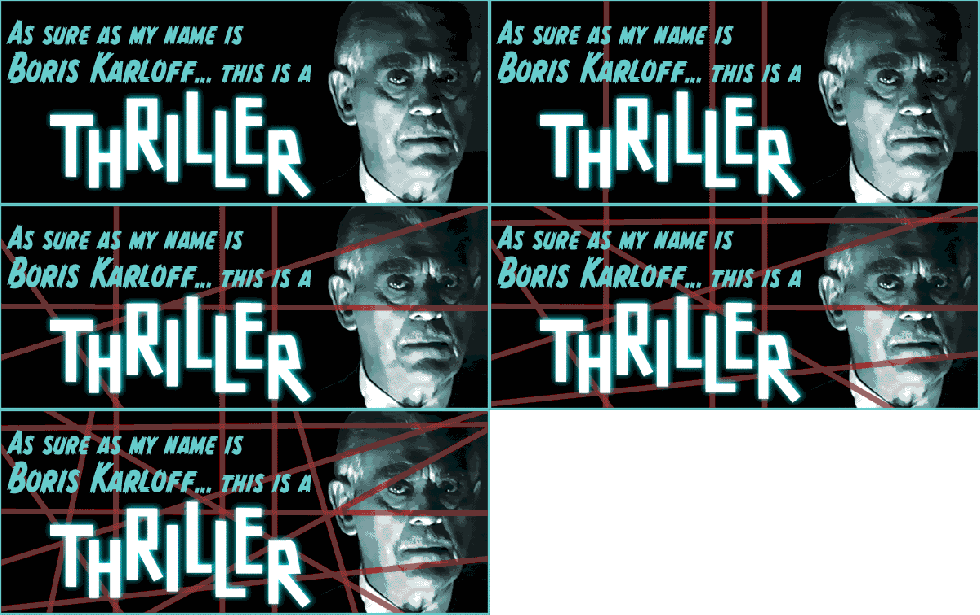
Boris Karloff’s Thrilling: Another Visit with Boris Karloff’s Cinematic Television Masterpiece

When I first started blogging on The Last Drive In, I chose one of my most beloved memories, a thing of nostalgia for me, and what I consider to be one of the greatest television programs that contained not only the classic crime mystery drama, but Gothic horrors based on some of the most prolific writers of these genres back then, such as Cornell Woolrich , Robert Bloch and August Derleth.

I recently covered episodes like The Hungry Glass, The Hollow Watcher, The Grim Reaper, The Cheaters, The Incredible Doktor Markesan and Pigeons From Hell.


This time I will be blogging about a few more interesting tales such as The Ordeal of Dr Cordell starring Robert Vaughn. The Remarkable Mrs. Hawk starring Jo Van Fleet and John Carradine, The Premature Burial starring Sidney Blackmer (the piercing Roman Casstavette in Rosemary’s Baby) and Boris himself as Dr. Thorne. And finally Rose’s Last Summer starring Mary Astor since I’m on a Mary Astor kick what with working on my Aldrich series and Hush…Hush Sweet Charlotte post that’s giving me an infarction, it’s so detailed, yet I don’t know how to write any other way.

I’ll be periodically choosing other great episodes from the series,but these were the ones I thought would be really interesting to cover right now.

I am talking about Boris Karloff’s television series that ran from 1960-1962: Thriller: The Complete Series.

Also the contributions by directors like John Brahm, Ida Lupino , Herschel Daugherty, Arthur Hiller and Paul Henreid who had a unique visual perspective that created creepy landscapes and lighting that would fit the noir canon very well.Also very notable for me as a musician are the musical scores by Mort Stevens, Pete Rugolo and Jerry Goldsmith that were nothing short of stunning, evocative melodies that tore at your soul and fit the mood of each episode,adding another vivid dimension to the atmospherics.

I have written earlier about some of my favorite episodes from Boris Karloff’s anthology series Thriller, which was an unusual collection of mixed genres. The series seems to be a very popular one here at The Drive In, so I’ve decided to write about a few more that have stayed with me over time, not that I didn’t absolutely love every single episode, all 67 of them. I only wish there had been more, or that someone would discover lost episodes that were never released. I have virtually watched each episode hundreds of times, not only catching little details for the first time with each reviewing, but never do I grow tired of them. That is the sign of something timeless, and masterful. And the more time goes by, I realize even further how preeminent this body of work truly is.

I can only imagine how excited fans like me were when they finally released the box set.I cried, I am not even kidding you. I, like many other devotees, waited a very long time for them to release this masterpiece on DVD. I used to have to wait up until 3am back in the day so that I could set my VCR to record when the Sci-Fi Channel had the good sense to run the episodes. Although I’d always get hocked off that the commercials were ads with nude girls telling me to “pick up the phone” while they were sliding up and down a pole. I know that boys and men love sci-fi and horror, but news flash! girls and women actually can have an avid appreciation for all things scary, thrilling and wondrous like the marvels of science, just as much. We can have a visceral passion for action and frightmares just like anyone else. So having to endure the “babes” of late night Sci-Fi Channel commercial land was irksome. Now I can watch Boris with some undisturbed dignity and I don’t have to be told to “pick up the phone” by some bimbo jutting her tongue over her shiny lip gloss, as if that were sexy to me. I’d rather watch Marisa Mell or Barbara Steele sitting under a tree reading a book. But again I digress as by now you know I am apt to do. Forgive MonsterGirl her little occasional rants.

So anyway, not only was there unmistakable atmosphere to each of Thriller’s episodes, but the stories themselves were lensed in a unique way that was very ahead of it’s time. The actors brought a serious attitude to their characters and the plot development, and didn’t treat them as merely short pulp stories as fodder for the tv masses. This was an intelligent show, and the presence of Boris Karloff only added a charming sage fabulist narration that was like being tucked in by your remarkable grandfather who loved to tell a good spooky tale to you right before bedtime. I’ve said this plenty, I wish Boris Karloff had been my grandfather.

MonsterGirl

MonsterGirl’s Quote of the day: The Bellero Shield/ The Outer Limits 1964

The Outer Limits; The Bellero Shield airdate Feb 10th, 1964

This sweet visitor from space is one of my all-time favorite Outer Limits creatures. You can spot him in The Theatre Ephemera!

this episode is loosely inspired by Shakespeare’sThe Tragedy of Macbeth.

Control Voice: (opening narration) There is a passion in the human heart which is called aspiration. It flares with a noble flame and by its light man has traveled from the caves of darkness to the darkness of outer space. But, when this passion becomes lust when its flame is fanned by greed and private hunger, then aspiration becomes ambition by which sin the angels fell.

Judith Bellero: “Someone spoke of the trembling way: a bridge between earth and heaven. When I grew up, I found it in the mythology book. Scandinavians call it the “Bifrost.” I thought of this as our “Bifrost.” A trembling way to what for me would be heaven–power, far-flung holdings, undiminishable authority!”

Bifrost Alien: ” I cannot speak your language. I analyze your eyes. In all the universes, in all the unities beyond the universes, all who have eyes, have eyes that speak, and all speak the same language.”


Control Voice: (closing narration) When this passion called aspiration becomes lust, then aspiration degenerates becomes vulgar ambition by which sin the angels fell.

MonsterGirl’s Quote of The Day! The Blue Dahlia (1946)

THE BLUE DAHLIA (1946)

Johnny Morrison ( Alan Ladd ): “You oughta have more sense than to take chances with strangers like this.”
Joyce Harwood (Veronica Lake): “It’s funny, but practically all the people I know were strangers when I met them.”